
Why NDAs Need More Than Confidentiality Protections
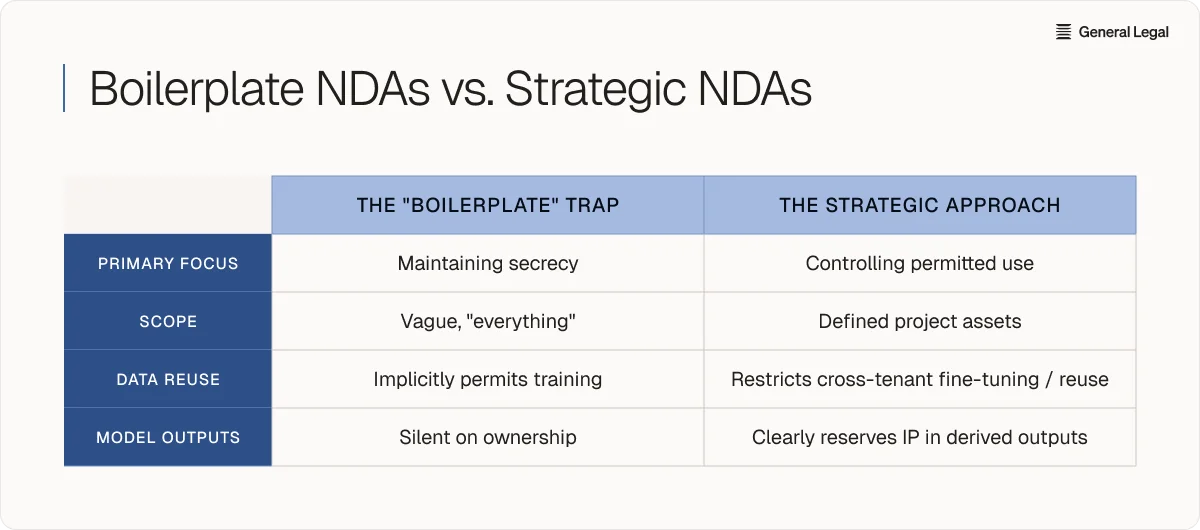
Most founders treat NDAs as a tax, a burdensome formality to sign before getting to the "real" conversation. The assumption is simple: NDAs keep information secret. But that is the wrong focus. The most critical question isn't whether your information remains private; it’s whether the agreement actually controls how your information can be used once it leaves your hands.
This distinction is the source of significant, often silent, business risk. Many NDAs focus exclusively on confidentiality, the promise not to talk about what was shared, while remaining silent on permitted use. If you are sharing proprietary data to evaluate an AI vendor or a partnership, this gap matters. In practice, the risk depends heavily on the vendor’s architecture and whether your NDA interacts with broader data processing terms.
However, without an explicit restriction, data shared during a pilot, such as a proprietary customer dataset used to train a workflow prototype, can, in some cases, be incorporated into model training pipelines, effectively turning your IP into the vendor's training set. The most effective NDAs do more than define confidential information; they establish clear boundaries around how disclosed data may be used.
How Should an NDA Address Permitted Use and No-Training Restrictions?
To stop "boilerplate drift," we advise our clients to anchor the purpose of disclosure in the preamble; e.g., 'solely for the purpose of evaluating a potential commercial partnership regarding [X]'; and ensure the 'Permitted Use' section restricts the recipient to that narrow scope. While the logic is straightforward, the nuances of 'No-Training' language often determine whether your data remains segregated from a vendor's training environment. The challenge is that no-training restrictions rarely operate in isolation. Their effectiveness often depends on how they interact with data processing agreements, product terms, ownership provisions, and model-improvement clauses elsewhere in the contract.
Many vendor agreements contain broadly drafted data-use provisions that may permit analytics, service improvement, or model training activities beyond what customers initially expect. Because these issues often depend on a vendor's technical architecture and contractual framework, effective drafting requires more than inserting a standard no-training clause. Even well-drafted no-training provisions can be undermined by analytics, service-improvement, derivative works, or model-enhancement language elsewhere in the agreement.
Why Vendor Data-Use Terms Matter
Ultimately, an NDA should be a bridge to a deal, not an unintended license to your intellectual property. If the text does not clearly define how your data is processed, the bridge is missing guardrails.
AtGeneral Legal, we help companies build commercial agreements that account for the realities of AI development, data governance, and model training. If you want to ensure your data rights are protected from day one, reach out for a review of your commercial agreements.
- Most NDAs focus only on confidentiality, the promise not to disclose, while staying silent on permitted use, which is the actual gap that creates risk.
- Without an explicit use restriction, data shared during a vendor evaluation or pilot could end up incorporated into that vendor's AI training pipeline.
- No-training restrictions don't work in isolation. Their real strength depends on how they interact with data processing agreements, product terms, ownership clauses, and other language elsewhere in the vendor contract.
- General Legal recommends anchoring the disclosure's purpose narrowly in the NDA's preamble and tying the permitted-use section directly to that stated purpose.
- Where personal data is involved, GDPR's purpose limitation principle can add another layer of relevant obligations.
| The pitfall | Founders assume NDAs are just about secrecy, but the real risk is whether the agreement actually restricts how disclosed data can be used. |
|---|---|
| The AI angle | Data shared with an AI vendor during a pilot can end up folded into that vendor's model training without an explicit no-training restriction. |
| Why no-training clauses aren't enough alone | Their effectiveness depends on how they interact with data processing agreements, product terms, ownership provisions, and analytics or model-improvement language elsewhere in the contract. |
| The fix | Anchor the NDA's stated purpose narrowly in the preamble and make sure the permitted-use section restricts the recipient to exactly that purpose. |
| GDPR relevance | Where personal data is shared, GDPR's purpose limitation principle can independently restrict how that data may be processed further. |
| What to review | Before sharing proprietary data with an AI vendor, review permitted-use language, no-training clauses, DPAs, ownership terms, and analytics provisions together, not in isolation. |
Does an NDA automatically stop a vendor from using my data to train their AI?
Not necessarily. Confidentiality and permitted use are different protections, and without an explicit no-training or permitted-use restriction, shared data could end up in a vendor's training pipeline.
What is a no-training restriction?
Contract language meant to prevent disclosed information from being used to train a vendor's AI models, whose strength depends on how it interacts with other contract terms.
Can other parts of a vendor agreement undercut a no-training clause?
Yes. Data processing agreements, product terms, ownership provisions, and analytics or model-improvement clauses elsewhere in the contract can all affect what the no-training language actually protects.
How should a company word an NDA to avoid this pitfall?
By anchoring the disclosure's purpose narrowly in the preamble, for example 'solely for evaluating a potential partnership regarding X', and tying the permitted-use section to that same scope.
Does GDPR add anything beyond the NDA itself?
Yes. Where personal data is involved, GDPR's purpose limitation principle independently requires that data be used only for the specified purpose it was collected for.
What should a company check before sharing proprietary data with an AI vendor?
Permitted-use provisions, no-training language, data processing agreements, ownership terms, and any analytics or service-improvement clauses, reviewed together rather than any single clause in isolation.
Does an NDA only protect confidentiality, or does it also control how data is used?
An NDA can establish confidentiality obligations, but it may also need to address how disclosed information can be used. Permitted-use provisions can restrict a vendor from using the information for purposes beyond those agreed, including certain forms of model training or product improvement.
Can a vendor's other contractual terms affect a no-training restriction?
Yes. No-training restrictions rarely operate in isolation. Data processing agreements, product terms, ownership provisions, analytics provisions, service-improvement provisions, and model-enhancement clauses may all affect the practical scope of the restriction.
Does GDPR matter when personal data is shared?
Where personal data is involved, GDPR requirements may be relevant. (Eur-Lex) Article 5 of the GDPR includes the purpose limitation principle, under which personal data is collected for specified, explicit and legitimate purposes and should not be further processed in a manner incompatible with those purposes.
What should a company review before sharing proprietary data with an AI vendor?
The company should consider the NDA's permitted-use provisions, no-training language, data processing agreements, product terms, ownership provisions, and other clauses addressing analytics, service improvement, derivative works, or model enhancement.
- The Risks of AI in Law: What They Are and How to Manage ThemDiscover the risks of AI in law and learn how to protect client data, avoid common pitfalls, and use AI responsibly in legal work.
- AI Contract Review: How it Works and What it Actually CatchesExplore how AI contract review works so you can identify risks, understand its limits, protect sensitive data, and know when to seek legal advice.
- Commercial Contract Litigation: When It Happens & How to AvoidExplore what you need to know about commercial contract litigation so you can understand common disputes, manage legal risks & protect your business.