
Every matter that comes through our door starts with one unglamorous step: triage. Before anyone drafts a clause or rejects the opposing counsel's redlines, someone has to look at the incoming request, figure out what it actually is, and route it to the right attorney.
It's the legal equivalent of an emergency room intake. Diagnose the matter, gauge its urgency, send it to the person best equipped to handle it.
What good triage actually weighs?
Done well, triage looks at two things at once.
- First, the nature of the request. What practice area does it touch? How complex is it? How quickly does the client need it?
- Second, the attorney on the other end. Who has the relevant expertise? Who has the bandwidth this week? Who's available right now? Matching those two columns is the whole game.
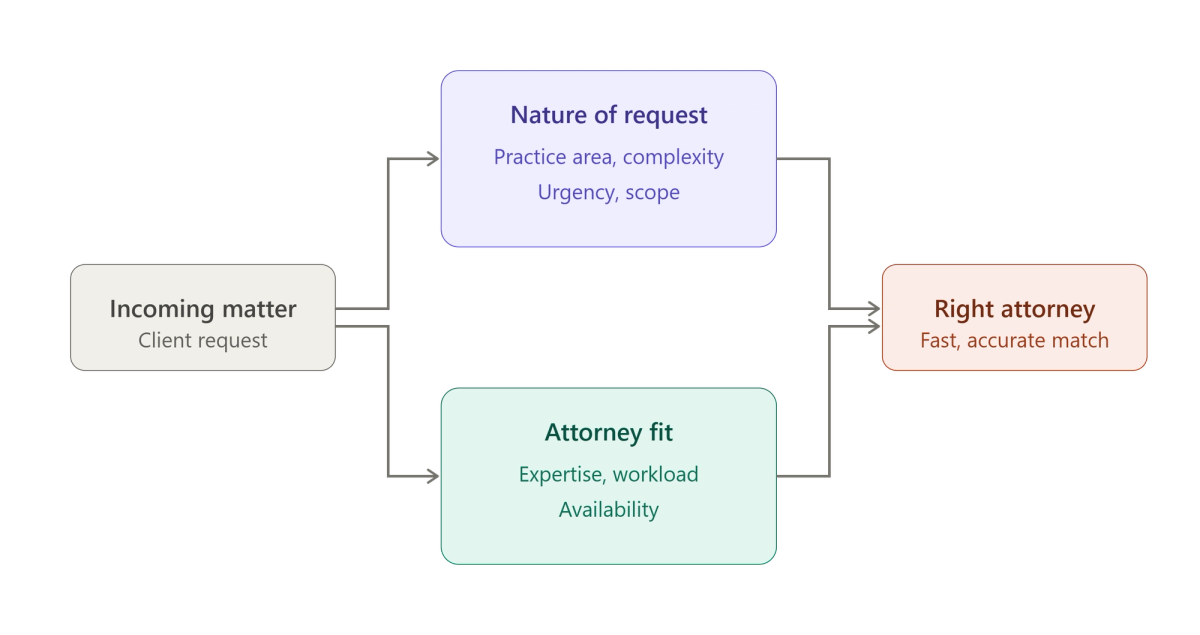
Triage weighs the request against attorney fit, then routes to the right desk.
Efficient triage is what makes everything else we promise possible. Our turnaround times and quality guarantees only hold if matters land on the right desk (or, to be more pricise, in the right Slack DMs) the first time.
A misrouted matter is slow, and worse, it has to be reassigned, reviewed again, and explained again. Triage that takes too long is its own failure, because the clock starts the moment the client hits send, not the moment we figure out who's handling it.
The second audience: the attorneys themselves
But there's a second audience for good triage that's easy to overlook. The attorneys themselves. A routing process that ignores how its lawyers actually work, that overloads the available and starves the specialists, quietly burns people out.
So we listen. We ask attorneys what kinds of matters energize them, where their real expertise lies, and what their week actually looks like. Triage that respects that feedback isn't just more accurate. It's part of what makes General Legal a place attorneys want to stay.
That's the balance we build for. The client gets the right attorney, fast. The attorney gets work that fits. And the firm gets a process that scales without breaking either promise.
The Benefits of Getting Triage Right
Good triage pays off on both sides of the match:
| For clients | For attorneys |
|---|---|
| Faster turnaround - the clock starts the moment a request lands, and routing it right the first time keeps it running | Work that fits their real expertise, not whatever happens to land on the pile |
| No reassignment delay - the matter doesn't get reviewed and re-explained by a second attorney | Balanced bandwidth - no one is overloaded while a specialist sits idle |
| The firm's turnaround and quality guarantees only hold because this first decision is right | A firm that listens to what energizes them, which is what keeps attorneys from burning out and leaving |
| One consistent point of contact from the start, instead of a mid-matter handoff | More predictable weeks, since routing accounts for actual bandwidth, not just availability on paper |
And for the firm as a whole: a process that scales - more matters, more attorneys - without breaking either promise.
- Every matter starts with triage: diagnosing what the request is, gauging its urgency, and routing it to the right attorney, like an emergency-room intake.
- Good triage weighs two things at once: the nature of the request (practice area, complexity, urgency) and the attorney fit (expertise, bandwidth, availability).
- Routing right the first time is what makes the firm's speed and quality guarantees hold, since a misrouted matter has to be reassigned, reviewed, and explained again while the clock runs.
- Triage also serves a second audience, the attorneys, matching people to work that fits so specialists are not starved, and the available are not burned out.
| Core process | Every incoming matter is triaged: diagnosed, prioritized by urgency, and routed to the right attorney, much like ER intake. |
|---|---|
| Two-sided weighing | Triage balances the nature of the request (area, complexity, urgency) against attorney fit (expertise, bandwidth, availability). |
| Why speed matters | The client's clock starts the moment they send the request, so slow or wrong routing directly erodes the firm's turnaround promises. |
| Cost of misrouting | A wrongly routed matter must be reassigned, reviewed again, and re-explained, compounding delay. |
| Attorney-side benefit | Triage also protects attorneys from burnout by matching them to work that fits their expertise and current bandwidth. |
| Ongoing feedback | The firm asks attorneys directly what matters energize them and what their week looks like, feeding that into routing decisions. |
| Business impact | Effective triage is described as what makes the firm's speed and quality guarantees possible at scale. |
What is legal matter triage at General Legal?
The first step in handling any request: diagnosing what it is, gauging urgency, and routing it to the attorney best equipped to handle it, similar to ER intake.
What two factors does General Legal weigh when routing a matter?
The nature of the request (practice area, complexity, urgency) and the attorney's fit (relevant expertise, current bandwidth, and availability).
Why does triage speed matter so much to clients?
Because the clock starts when the client sends the request, not when the firm finishes figuring out who's handling it. Slow routing directly eats into the turnaround the firm promises.
How does triage affect the attorneys, not just clients?
A routing process that overloads available attorneys and starves specialists quietly burns people out, so the firm asks attorneys what energizes them and matches work accordingly.
What happens when a matter is misrouted?
It has to be reassigned, reviewed again, and re-explained, adding delay to a clock that's already running for the client.