
TL:DR: General Legal chose to build a law firm instead of another legal technology vendor because when the company behind the underlying AI model also builds tools for lawyers, a vendor's roadmap can get overrun overnight. That risk became concrete when Anthropic released Claude for Word in beta on April 11, 2026, aimed squarely at lawyers, and fixed its most significant early flaw within about 72 hours. A law firm has nothing to lose from a better Claude. General Legal builds around client outcomes rather than defensible software, using whatever tools work best, to chase the 92% of civil legal problems that low-income Americans don't currently get adequate legal help for, according to the Legal Services Corporation's 2022 Justice Gap study.
Why We Chose to Build a Law Firm, Not a Legal Tech Vendor
I've been asked by numerous friends and investors over the last couple months why we chose to build a law firm and not another legal technology vendor. It's a fair question—we come from Casetext which built legal AI products for lawyers for a decade before selling to Thomson Reuters—and all three of our founders are engineers.
I think the answer becomes self evident, though, if you look at Anthropic's latest release.
Aligning with the bottom of the stack
Last Friday evening, Anthropic dropped a Microsoft Word plugin geared toward lawyers. I took a look, and as with most things Claude, the UX is awesome. Specifically, they seem to have embedded their web app’s React components into Office's webview container, so that the Word plugin feels exactly like the web app. They also built a few simple agentic tools that could be called from the chat: one that found minor errors with high precision and recall in my test called “check-doc”, and one that totally screwed up by misreading section numbers and paragraph spacing called “copy-edit”.
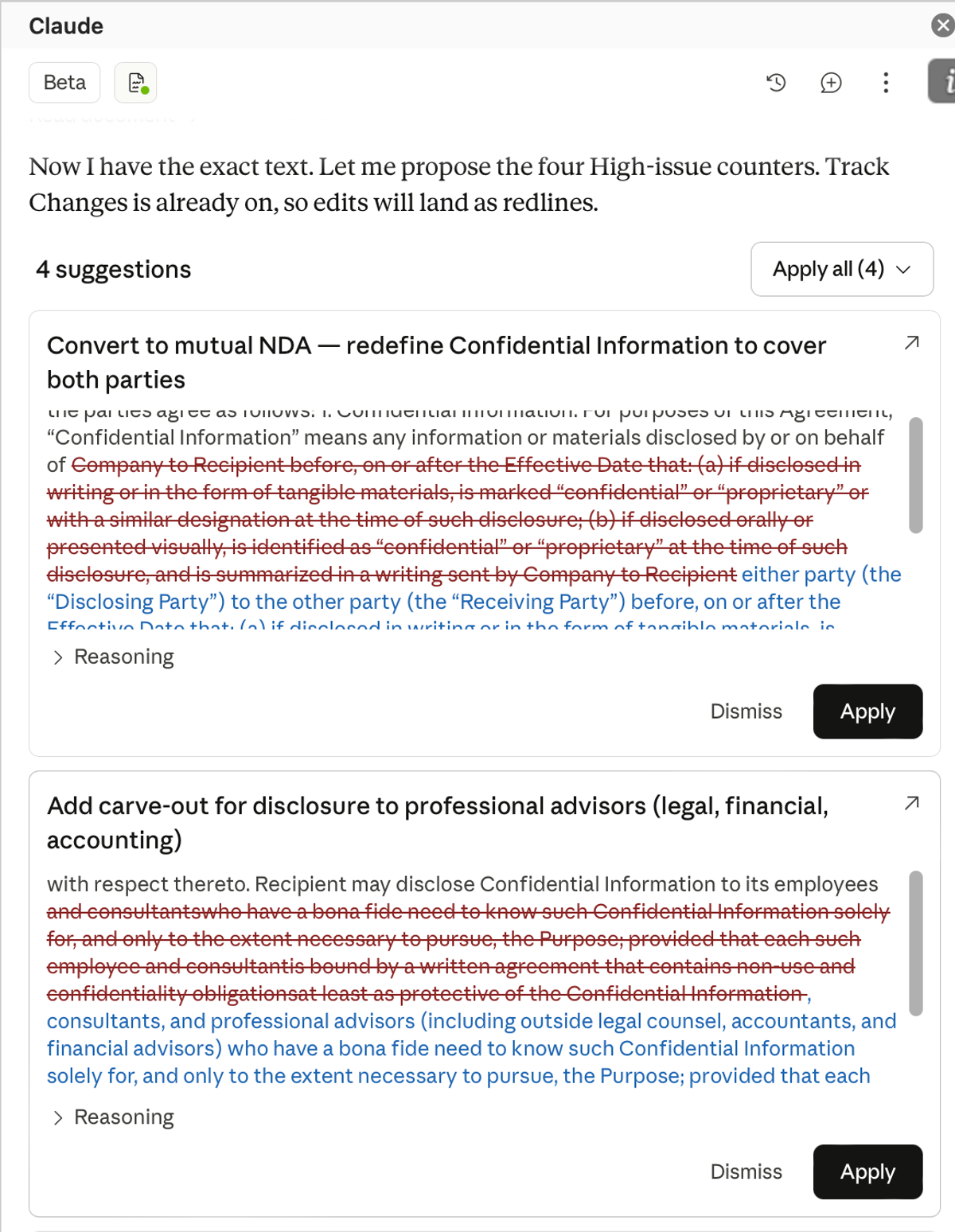
I reported back to my team that the plugin was as-of-yet unusable, though, because the redlines were made in blocks at the sentence level and not at the word and character level—a dealbreaker for lawyers redlining documents—and there was no playbook feature to provide structured client background to the AI.
What Held It Back on Day One
I reported back to my team that the plugin was as-of-yet unusable for two reasons:
- Redline granularity. The redlines were made in blocks at the sentence level rather than the word and character level, a dealbreaker for lawyers redlining documents, where a single changed word or number matters.
- No visible playbook feature. There was no obvious way to feed the AI structured client background, the kind of standing instructions a firm's own playbook (a set of predefined positions, fallback language, and client-specific preferences that guides how a tool drafts and flags issues) would normally provide.
Fixed in 72 Hours
But then, remarkably, the next day, just 72 hours after the plugin was released on Friday night, the redline issue had been entirely fixed by Anthropic (I also discovered that the plugin’s “skill creation” feature had always allowed users to build custom playbook skills).
It went from unusable to the best Word plugin I have seen on the market in one day, and our firm may well integrate it into our workflow soon.
Building for the Outcome, Not the Tool
Which brings me back to why we decided to build a law firm, and not a legal technology company for lawyers. If we did the latter, Anthropic diving headfirst into making lawyers more efficient would undermine our business. We would be carefully designing our roadmap to entrench tools that Anthropic can’t or doesn’t want to build, while scouring for information on what’s coming next.
How lame.
Instead, tools like this just make our services better, faster and cheaper, because clients, not lawyers, are our obsession. This will ultimately drive our price point down into the 92% of unmet legal demand in the US, bringing us more clients and creating immense value for people and businesses.
That is our mission and we are entirely agnostic about which tools we use to achieve it.
- General Legal's three founders came from Casetext, a legal AI company sold to Thomson Reuters for $650 million in 2023, and chose to build a law firm rather than another legal tech vendor.
- Anthropic's April 2026 release of Claude for Word, aimed at lawyers doing contract review, illustrates the risk legal tech vendors face when AI labs build tools that compete with them directly.
- Claude for Word initially had unusable sentence-level redlining and no visible playbook feature, but Anthropic fixed the redlining issue within about 72 hours.
- Because General Legal is a law firm rather than a software vendor, improvements to underlying AI tools like Claude make its service better instead of threatening its business.
- General Legal deliberately stays tool- and model-agnostic, prioritizing client outcomes over defending any particular piece of software.
- The firm's stated goal is to lower prices enough to reach the 92% of civil legal problems that, per the Legal Services Corporation's 2022 Justice Gap study, low-income Americans currently can't get adequate help with.
| Why a law firm, not a vendor | Building a legal tech product means competing with AI labs like Anthropic when they build tools for lawyers; building a law firm means any such tool just makes the firm's service better. |
|---|---|
| Founders' background | All three General Legal founders came from Casetext, a legal AI company Thomson Reuters acquired for $650 million in 2023. |
| The triggering event | Anthropic released Claude for Word in public beta on April 11, 2026, with legal contract review as its headline use case. |
| Early flaws | The plugin's redlines landed at the sentence level instead of word or character level, and there was no visible way to feed it a client playbook. |
| Fast fix | Anthropic fixed the redlining granularity issue within about 72 hours of launch, and the plugin already supported custom playbook skills via its skill-creation feature. |
| General Legal's approach | The firm is model- and tool-agnostic, focused on client outcomes rather than defending any specific software. |
| The mission | Lower prices driven by better AI tools are aimed at the 92% of civil legal problems low-income Americans don't currently get adequate help with, per the LSC's 2022 Justice Gap study. |
Why did General Legal decide to build a law firm instead of a legal tech company?
Because a legal tech vendor built for lawyers competes directly with whatever AI labs like Anthropic build next, while a law firm simply benefits when the underlying AI gets better.
What is Claude for Word?
Anthropic's Microsoft Word plugin for lawyers, released in public beta on April 11, 2026, with contract review as its headline use case.
What was wrong with Claude for Word at launch?
Its redlines were made in blocks at the sentence level rather than the word and character level, which doesn't work for how lawyers actually redline, and there was no obvious way to feed it structured client background.
How quickly did Anthropic fix the redlining problem?
About 72 hours, going from the Friday night release to a fix that the firm's own testing found the very next day.
Where do General Legal's founders come from?
All three previously worked at Casetext, a legal AI company acquired by Thomson Reuters for $650 million in 2023.
What does General Legal mean by the 92% figure?
It refers to the Legal Services Corporation's 2022 Justice Gap study finding that 92% of civil legal problems facing low-income Americans don't get adequate legal help, which the firm frames as the market it's trying to reach with lower prices.
Why did General Legal build a law firm instead of a legal technology company?
Because a legal tech vendor competes directly with whatever the underlying AI labs, like Anthropic, decide to build for lawyers next. A law firm has no such conflict: any improvement to the underlying AI just makes the firm's own service better, faster, and cheaper.
What is Claude for Word, and why does it matter to this argument?
Claude for Word is Anthropic's Microsoft Word plugin, released in public beta on April 11, 2026, with legal contract review as its headline use case. Its rapid launch and near-daily improvement is the concrete example General Legal points to for why building tools for lawyers is a risky bet when the model maker itself might build the same tool.
What was wrong with Claude for Word when it first launched?
Its redlines landed in blocks at the sentence level rather than the word and character level, which doesn't work for how lawyers actually redline documents, and there was no obvious way to feed it structured client background through a playbook.
How fast did Anthropic fix the redlining issue?
About 72 hours, going from Friday night's release to a fix the very next day, according to the firm's own testing.
Where does General Legal's founding team come from?
All three founders previously worked at Casetext, a legal AI company that built products for lawyers for a decade before Thomson Reuters acquired it for $650 million in 2023.
What does General Legal mean by the "92% of unmet legal demand"?
It's a reference to the Legal Services Corporation's 2022 Justice Gap study, which found that 92% of the civil legal problems substantially affecting low-income Americans did not receive any or enough legal help. General Legal frames lower prices, driven by better AI tools, as a way to reach more of that unmet demand.
- But would a lawyer actually send that?General Legal’s new benchmark evaluates the gap between model performance in completing discrete legal tasks and in drafting client-ready deliverables.
- What Is a Forward-Deployed Attorney?for·ward-de·ployed at·tor·ney \ ˈfor-wərd di-ˈploid ə-ˈtər-nē \ noun 1: a lawyer embedded in a company's day-to-day operations, including its communication channels, product roadmap, and deal desk, rather than retained from outside for discrete matters 2: counsel who identifies issues in the client's own records before anyone raises them, and who delivers systems the business can operate rather than one-off answers