

8 best AI law firms for modern legal support
AI law firms are legal service providers that use artificial intelligence (AI) as a core part of their legal and operational workflows.
This approach is gaining traction because clients increasingly expect faster execution, better responsiveness, and more predictable costs than traditional delivery models were designed to provide.
With nearly 95% of legal professionals believing AI will become central to their organization’s workflow within the next five years, the market has largely reached a consensus on AI adoption. However, it’s yet to agree on how to classify the firms driving it.
The term “AI law firm” is currently being applied to several distinct layers of the legal market.
At the top are major law firms using AI to improve the delivery of complex, high-stakes matters. In the middle are AI-native firms that have integrated AI directly into their operating model. At the base are AI enabled Alternative Legal Service Providers (ALSPs), which focus on high-volume, process-driven legal workflows.
To help you identify the right provider for your needs, this guide breaks down the nine best AI law firms across all three categories.
Key takeaways
- The best AI law firms focus on execution, not AI branding
The firms that stand out are using AI to improve efficiency, reduce turnaround times, and deliver better legal outcomes. - AI law firms fall into three categories
Traditional firms, AI-native firms, and ALSPs each serve different legal needs and operating models. - AI-native firms are changing legal service delivery
By building around AI from day one, these firms often offer faster turnaround times and more predictable pricing. - Large firms still lead in complex legal work
Traditional corporate firms remain the strongest choice for high-stakes litigation, regulation, and major transactions. - General Legal is a strong option for startups
General Legal combines experienced attorneys, AI-driven workflows, and transparent pricing to help startups move faster without sacrificing legal quality.
How we chose the 9 best AI law firms
Choosing the best AI law firms comes down to operational leverage. The relevant distinction isn’t whether a firm markets itself as AI-powered, but whether this technology is improving its execution, efficiency, and service delivery in measurable ways.
Also, differentiating between AI law firm categories is becoming increasingly difficult because firms are beginning to converge in how they use AI. For example, one Harvard Law study found that 50% of large firms would consider taking on lower-margin legal work if AI made it operationally efficient enough.
However, in the current market environment, the following factors were the primary drivers of our rankings:
- Operational efficiency and workflow leverage (30%): We prioritized firms that are using AI to compress turnaround times, reduce operational friction, and improve execution quality.
- AI-native infrastructure (25%): Firms that have embedded AI into the core architecture of their business received higher scores than those using the technology primarily as an internal efficiency tool.
- Market sophistication (15%): Firms handling sophisticated commercial work, complex transactions, institutional clients, or high-stakes operational matters scored more favorably than those focused on generic document automation.
- Pricing model innovation (10%): AI changes the economics of legal services. Firms still charging purely for time spent rather than value delivered performed less well against this criterion. Fixed-fee, subscription, per-document, and managed-service models scored higher.
- Speed and responsiveness (10%): Modern legal support is becoming an operational problem. Founders and operators care about velocity, so we favored firms known for fast execution and practical responsiveness under pressure.
- Technical realism (5%): The strongest firms understand where human judgment still matters. We penalized firms that overstated AI capabilities or presented the technology as a substitute for legal expertise.
- Reputation and market traction (5%): We looked at real adoption signals: enterprise clients, venture backing, regulatory approvals, founder reputation, and broader market influence.
The 9 best AI law firms at a glance
Category
AI law firm
Legal focus
Best for
AI-enabled corporate firms
1. Latham & Watkins
Corporate law, AI disputes, and regulatory defense
High-stakes corporate transactions and AI-related litigation
2. Freshfields
International regulation, privacy, and enterprise governance
Cross-border AI governance and enterprise regulatory work
3. Allen & Overy Shearman
Finance, legal infrastructure, and AI workflow systems
AI-powered enterprise transactions and legal operations
AI-native firms
1. General Legal
Commercial contracts, startup counsel, and legal ops
AI-powered commercial contracting and startup legal operations
2. Avantia Law
Private markets compliance and managed legal services
Scalable in-house legal support and managed commercial workflows
3. Covenant
Fund investments, LP agreements, and side letter review
AI-assisted private equity and fund-related legal work
AI-enabled ALSPs
1. UnitedLex
Legal operations, compliance, and enterprise transformation
Enterprise legal transformation and managed compliance delivery
2. Crosby
Revenue contracts, procurement, and contract review - incorporated as a law firm
High-volume contract redlining and procurement workflows
3. Consilio
eDiscovery, investigations, and forensic data analysis
Large-scale investigations and technology-driven discovery support
3 best AI-enabled corporate firms
Even the largest corporate law firms are now rapidly integrating AI into their workflows to meet growing client demands. Doing so allows them to reduce operational friction and deliver more value from every billable hour.
The three corporate firms below stand out for the depth and sophistication of their AI adoption.
1. Latham & Watkins: Best for high-stakes corporate transactions and AI-related litigation

Latham & Watkins is one of the most influential corporate law firms in the world and has invested heavily in AI-related legal capabilities.
It’s a strong fit for large technology companies, enterprise operators, and high-growth businesses navigating complex AI-related legal exposure.
Latham is particularly strong in matters where major commercial stakes intersect with emerging regulation: copyright disputes, AI governance, cross-border compliance, strategic infrastructure deals, and litigation with significant financial consequences.
Core strengths
Latham stands out because it treats AI as a shift in both legal execution and operational delivery.
This translates to:
- Deploying Harvey AI across more than 3,600 attorneys and business professionals
- Advising major AI companies on copyright, licensing, privacy, and regulatory matters
- Supporting the full AI ecosystem, including chips, cloud infrastructure, data centers, and LLM deployment
- Investing heavily in AI-enabled research, drafting, document analysis, and workflow acceleration
Pricing
Latham & Watkins predominantly operates on a traditional billable-hour model, although alternative fee arrangements may be available for certain large-scale matters or ongoing enterprise engagements.
2. Freshfields: Best for cross-border AI governance and enterprise regulatory work

Freshfields is a global corporate law firm with a strong footprint in international regulation, data governance, complex transactions, and high-level advisory work tied to emerging technologies.
It’s especially effective for multinational companies operating across heavily regulated markets where AI creates overlapping legal, operational, and compliance risk.
Businesses deploying AI products internationally, managing sensitive data infrastructure, or navigating fragmented regulatory regimes across the US, UK, Europe, and Asia will benefit from the firm’s integrated approach to governance, privacy, cybersecurity, and enterprise risk management.
Core strengths
What separates Freshfields from many traditional firms is that it’s actively building AI-native workflows rather than relying on third-party tools.
Its core strengths include:
- Deploying Claude across 33 global offices through the firm’s proprietary AI platform
- Collaborating directly with Anthropic to co-develop legal AI applications and agentic workflows
- Integrating AI into legal research, drafting, contract review, and due diligence processes
- Advising multinational companies on AI governance, data privacy, and cross-border regulatory strategy
- Combining technology, regulatory, investigations, and transactional teams into a unified AI practice
Pricing
Freshfields predominantly uses traditional hourly billing structures, though enterprise clients may negotiate alternative fee arrangements for large cross-border matters and ongoing advisory work.
3. Allen & Overy Shearman: Best for AI-powered enterprise transactions and legal operations

Allen & Overy Shearman is a global corporate law firm focused on complex finance, cross-border transactions, regulatory matters, and large-scale enterprise legal work.
The firm was an early adopter of generative AI, rolling out Harvey enterprise-wide before most competitors had governance policies in place. It also built proprietary systems designed to accelerate complex legal workflows across global teams.
A&O Shearman is a strong fit for large enterprises dealing with massive transaction volume, complicated financing work, and multi-office legal coordination where workflow inefficiency can drive up costs at scale.
Core strengths
A&O Shearman distinguishes itself by treating AI as infrastructure rather than just another productivity tool.
The operational leverage becomes clearer when you look at the specifics:
- Deploying Harvey enterprise-wide across nearly 4,000 staff members in 43 jurisdictions
- Building proprietary AI systems like ContractMatrix for drafting, negotiation, and review workflows
- Launching agentic AI tools for antitrust analysis, cybersecurity, fund formation, and loan review
- Embedding lawyers, engineers, and technologists into multidisciplinary AI development teams
- Combining AI deployment experience with advisory work on governance, regulation, privacy, and AI risk management
Pricing
A&O Shearman largely uses traditional hourly billing, although some AI-enabled products and workflow tools are licensed through subscription or usage-based pricing models.
3 best AI-native firms
Unlike traditional firms retrofitting AI onto legacy workflows, AI-native firms were structured around AI from the beginning. This approach changes the economics, staffing models, turnaround times, and operations of the entire business.
The three firms below are among the most notable examples of AI-native legal providers today.
1. General Legal: Best for AI-powered commercial contracting and startup legal operations

General Legal is an AI-native law firm built for startups and growth-stage companies that need high-quality commercial legal work delivered at the speed of modern startups.
Founded by former Casetext operators and backed by investors including Y Combinator, SV Angel, and BoxGroup, the firm combines experienced US attorneys with AI-driven workflows designed to compress contract turnaround times from days into hours.
The firm is best suited for companies that operate at high velocity and need legal support that can keep pace.
Startups closing customers, negotiating vendor agreements, reviewing procurement paperwork, or scaling internal legal processes will benefit from General Legal’s deliberate focus on rapid execution, responsiveness, and workflow efficiency.
Core strengths
General Legal’s advantage comes from designing the entire firm around workflow efficiency, operational clarity, and AI-assisted execution.
Its core strengths include:
- Delivering commercial contract reviews in hours rather than days or weeks
- Embedding AI agents directly into contract triage, summarization, issue spotting, and risk detection
- Supporting startups across commercial contracts, employment, fundraising, privacy, and early-stage corporate matters
- Operating directly inside client Slack channels to match how modern startups actually work
- Combining AI-accelerated workflows with experienced US-barred attorneys responsible for final legal judgment
- Scaling high-volume commercial contract review without relying on junior associate leverage models
- Expanding rapidly into adjacent practice areas, including privacy, IP, financing, and real estate work
Pricing
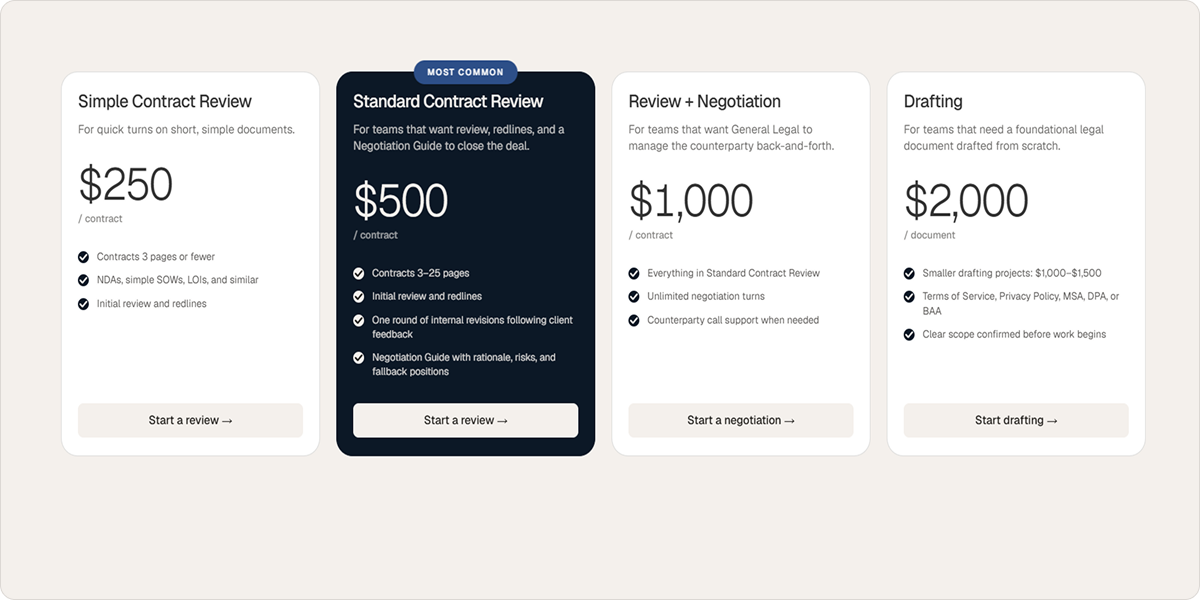
General Legal uses transparent flat-fee pricing across most services, with standard commercial contract reviews starting at $250, full negotiations at $1,000, and fixed pricing extending across employment, venture financing, drafting, and legal operations work.
2. Avantia Law: Best for scalable in-house legal support and managed commercial workflows

Avantia Law is an AI-native legal and compliance services firm focused on private equity, investment funds, and large-scale managed legal operations.
The firm combines fund-specialist attorneys with its proprietary AI platform, Ava, to handle high-volume legal and compliance workflows without relying on traditional hourly billing models.
Avantia is a good fit for private market firms and enterprise legal teams dealing with operationally heavy legal work where consistency, speed, and process management matter just as much as legal expertise.
Core strengths
Avantia has set itself apart by approaching legal operations as a scalable systems problem rather than a staffing issue.
That workflow-first philosophy translates into:
- Automating intake, triage, execution, and reporting across managed legal workflows
- Handling high-volume compliance, onboarding, and contract operations at scale
- Embedding AI into workflow management while keeping attorneys responsible for legal judgment
Pricing
Avantia uses fixed-fee, outcome-based pricing rather than traditional hourly billing. However, the firm doesn’t publicly disclose standardized pricing; it customizes fees based on workflow volume, complexity, and scope.
3. Covenant: Best for AI-assisted private equity and fund-related legal work
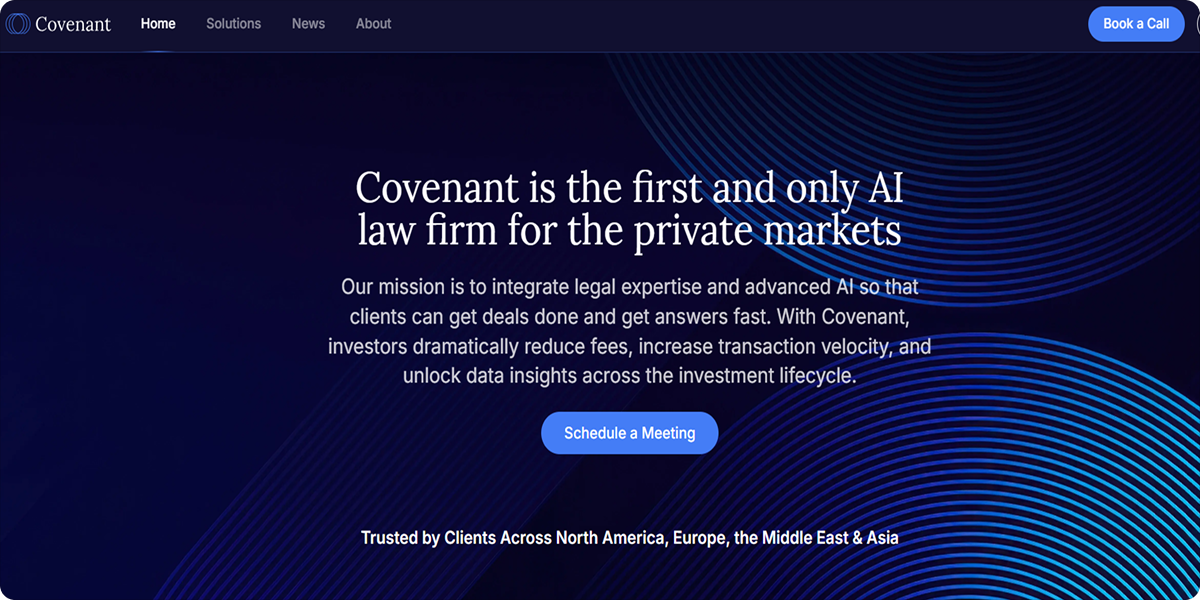
Covenant is an AI-native law firm built specifically for private market investors, venture funds, and institutional capital allocators.
It uses specialized AI systems and experienced investment counsel to accelerate fund reviews, LP agreement analysis, side letter negotiations, and broader investment workflow management.
Covenant works especially well for investors processing large volumes of repetitive but high-stakes fund documentation where traditional legal review becomes painfully slow and expensive.
Core strengths
Covenant differentiates itself by applying AI directly to some of the most operationally inefficient workflows in private markets.
This focus is reflected in the following capabilities:
- Accelerating LPA, side letter, and investment agreement review through specialized AI models
- Generating AI-assisted commentary, issue spotting, and negotiation analysis across fund documents
- Supporting private market investors across venture, hedge funds, co-investments, and alternative assets
- Delivering searchable investment data and portfolio-level document intelligence through a centralized platform
- Combining transaction-focused legal expertise with multi-model AI systems designed for high-accuracy review
Pricing
Covenant primarily uses transaction-based and fixed-fee pricing models, although the firm doesn’t publicly disclose standardized pricing.
3 best AI-Enabled ALSPs
AI first ALSPs generally handle less complex legal work than traditional firms or AI-native law firms, but they remain an important part of the modern legal ecosystem.
Most are highly specialized operators focused on narrow, process-heavy categories like document review, contract management, compliance workflows, due diligence, or litigation support.
The providers below are some of the strongest options in this category at the time.
1. UnitedLex: Best for enterprise legal transformation and managed compliance delivery

UnitedLex is a global ALSP that helps large enterprises and law firms manage high-volume legal operations across litigation, intellectual property, compliance, and investigations.
The company operates at a significant scale, with thousands of legal professionals, engineers, technologists, and data specialists supporting enterprise legal departments across multiple jurisdictions.
UnitedLex is best suited for corporations trying to modernize large, fragmented legal operations without rebuilding their entire in-house legal infrastructure.
Core strengths
UnitedLex approaches legal operations as a data and systems problem, a perspective that is evident in its core strengths:
- Automating high-volume legal review, privilege logging, and first-pass document analysis
- Integrating data science, legal expertise, and engineering teams into centralized delivery systems
- Delivering AI advisory, implementation, and legal operations support across global organizations
Pricing
UnitedLex uses customized enterprise pricing rather than standardized public rate cards, with fees typically scoped around project complexity, data volume, workflow requirements, and technology infrastructure.
2. Consilio: Best for large-scale investigations and technology-driven discovery support
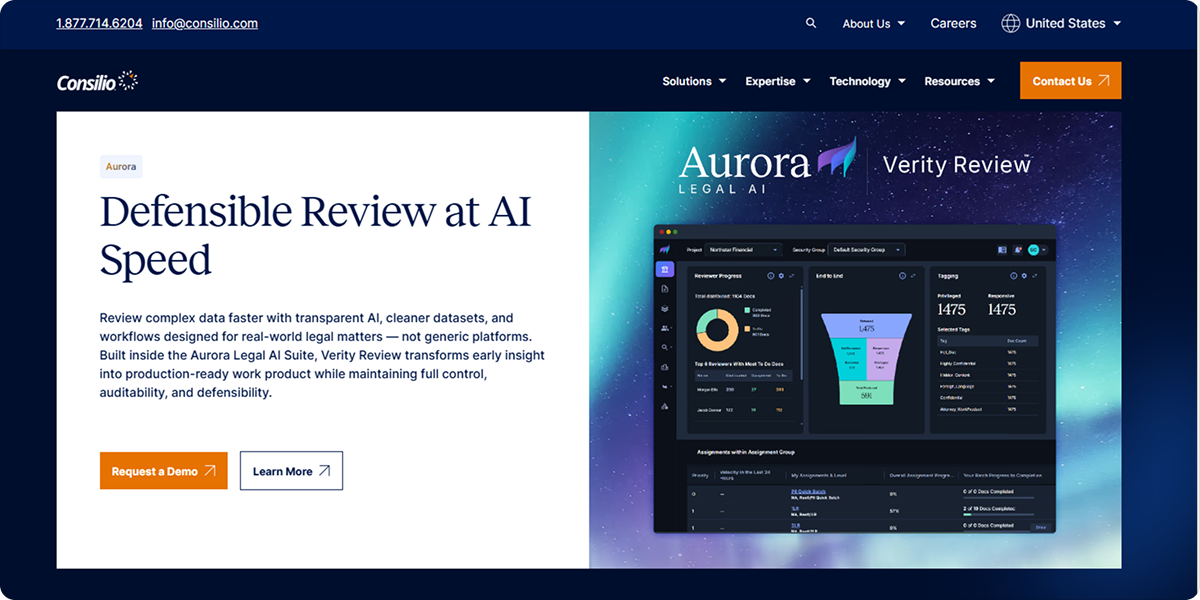
Consilio is a global ALSP focused on eDiscovery, investigations, compliance, cyber incident response, and large-scale legal data management.
The company operates large-scale review and forensic infrastructure across dozens of jurisdictions, using AI-powered analytics and workflow automation to help enterprises manage document-heavy legal matters at scale.
Consilio is particularly useful for corporations, law firms, and regulatory teams handling investigations where data volume can quickly become overwhelming.
Core strengths
Consilio’s main advantage comes from pairing enterprise-scale review infrastructure with heavily technology-driven legal workflows.
That approach translates into capabilities like:
- Deploying AI-powered review, summarization, and investigation tools across discovery workflows
- Managing multilingual document review and forensic analysis across global jurisdictions
- Automating privilege review, data classification, and evidence analysis processes
- Integrating forensic experts, review professionals, and AI systems into centralized investigation operations
Pricing
For the most part, Consilio uses custom enterprise pricing based on investigation scope, document volume, data complexity, staffing requirements, and technology usage.
What is the best AI law firm?
The best AI law firm for your business depends on the type of legal work you need done.
For bet-the-company litigation and cross-border regulatory matters, the largest corporate firms still dominate. However, specialized ALSPs tend to perform better in high-volume compliance operations and discovery workloads. Startups and growth-stage companies operate in a different category altogether, making General Legal the strongest choice.
This firm has carved out a distinctive position by combining three attributes that are rarely found together in legal services: BigLaw-quality execution, AI-native operational speed, and publicly transparent pricing.
That alone separates it from most traditional firms, where pricing remains vague, tied to billable hours, and disconnected from actual workflow efficiency.
It also occupies a very different position from most ALSPs.
Providers like Crosby, Consilio, and UnitedLex are highly specialized operational businesses optimized for narrow workflow categories at scale. General Legal, by contrast, operates as a true law firm with experienced attorneys directly responsible for legal judgment while using AI to accelerate execution behind the scenes.
Getting started with General Legal
Companies looking for faster contract turnaround times and predictable legal costs can get started directly through General Legal’s website.
If you have any questions beforehand, contact our team by email.
FAQ
Is AI used in law firms?
Yes. AI is now widely used across law firms for legal research, contract review, drafting, document analysis, compliance workflows, and litigation support.
How many law firms use AI?
Around 28% of law firms currently use AI in some capacity, although adoption is expected to rise rapidly over the next several years.