
TL:DR: General Legal's contract review runs on three layers: Sentinel, an internal AI that gives every contract a first pass in about ten seconds, attorneys who spend 15 to 30 minutes finishing the review instead of the several hours it used to take, and a hiring model built to attract the kind of high-leverage attorneys and engineers this workflow depends on. Independent research backs the scale of the speedup. Bloomberg Law's 2024 Contract Workflow Analysis found AI-assisted review cut standard contract review time from 92 minutes to 22 minutes, a 76% reduction, and a GC AI survey of active users reported saving an average of 14 hours per week. The model isn't AI replacing lawyers. It's AI doing the parts it's good at, issue spotting and drafting, so attorneys can spend their time on the parts it isn't: interpreting client needs, judging what's market, and setting deal strategy.
The Technology: Sentinel and a Slack-Native Workflow
Most of our clients work directly with us over Slack. Each client's private Slack channel is monitored by bots that detect new client requests, trigger our contract AI workflows, and schedule attorney time for review.
How Sentinel Is Built
Our contract AI (which we call Sentinel) is built on a few simple ideas:
- State of the art LLMs are good at issue detection, redlining, and annotation
- The best LLM agents are bad at interpreting client needs, leverage, and defining strategy for deals
- LLM world models do not know what's market and LLMs are both overconfident in their market knowledge and over-aggressive in their mark-ups
- The best human attorneys are really good at 2 and 3 and often not particularly great at 1.
That gap between what AI does well and what attorneys do well isn't just General Legal's internal read. A LexCheck 2024 benchmark testing clause identification across 12 standard categories, including indemnification, limitation of liability, and IP ownership, found AI tools reached 94-97% accuracy, while experienced lawyers reviewing the same contracts averaged around 80%, with accuracy dropping further under time pressure. That's exactly idea 1 and idea 4 above, measured independently.
The Internal Review Workflow
We turned these ideas into General Legal's core internal contract review workflow:
- Sentinel AI always takes the first pass over a contract, guided optionally by an attorney defined strategy
- Sentinel creates redlines, annotations, and issues lists. These lists are overly inclusive, sometimes misinterpret market, and don't fully align to the client strategy
- After Sentinel finishes its review (in about ten seconds), our attorneys take over reviewing the full contract as well as the AI's markup.
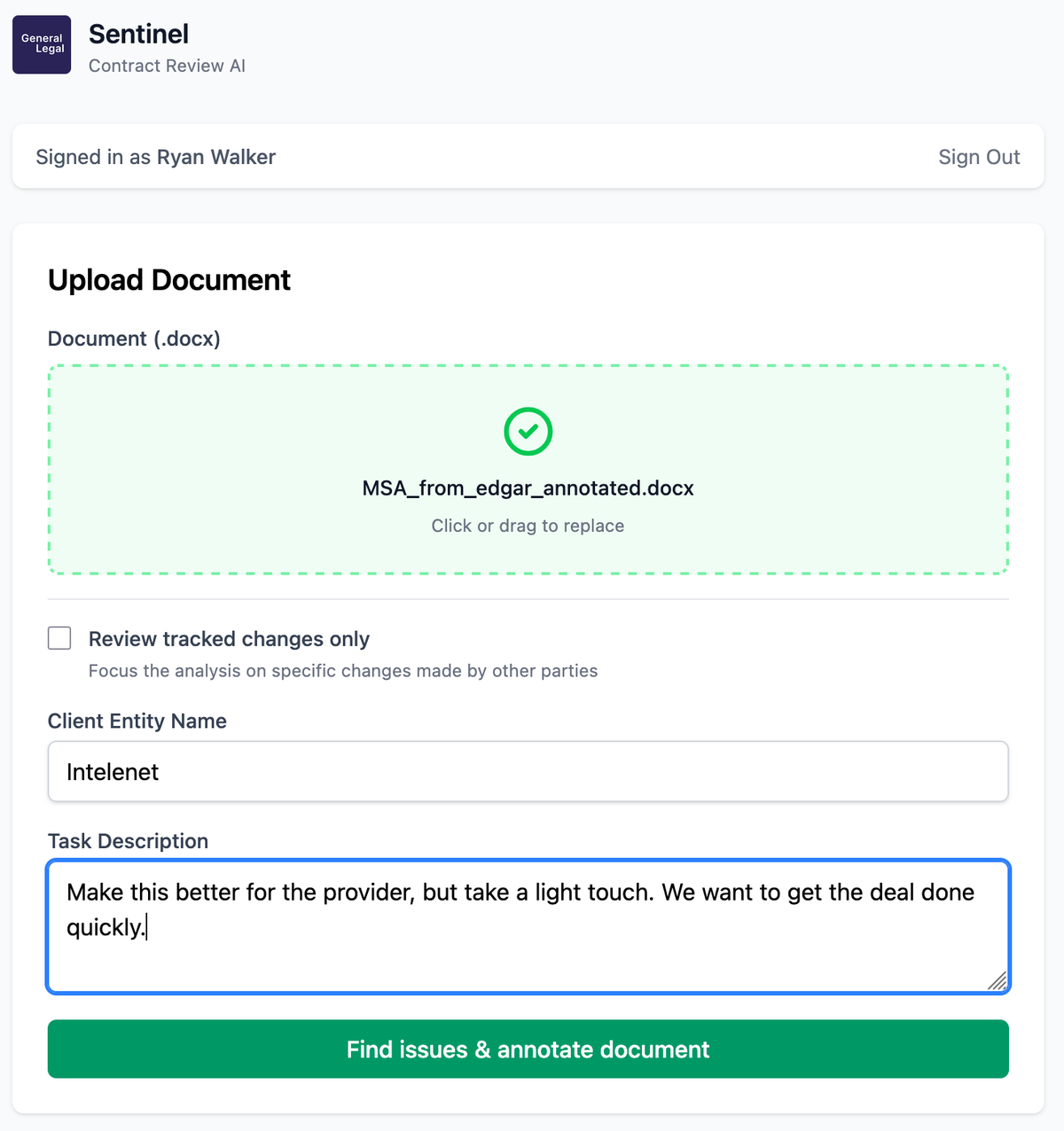
Sentinel AI reviews the contract guided by an attorney defined strategy
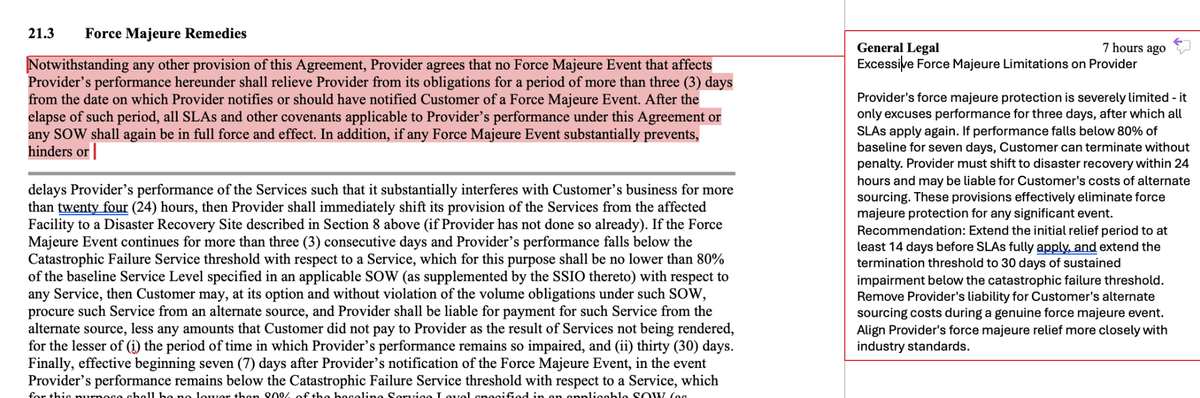
Sentinel generates redlines, annotations, and issues lists in about 10 seconds
The Humans: Where Attorneys Add the Value AI Can't
Experienced attorneys can typically do a post-Sentinel review in about 15-30 minutes, a compression of several hours of formerly billable work. The AI related human acceleration comes from three sources:
- having all issues clearly marked in the document with concise explanations
- having many redlines and comments pre-built that the attorney can edit
- having full client context (including prior contracts) in AI memory and easily accessible to the attorney through our tooling
Human acceleration also comes from several non-AI factors built into our workflow:
- Contract review happens in only one place, Microsoft Word. This keeps the attorney fully focused on the actual contract document that gets turned back to the client. We built a specialized Word add-in to add additional AI capabilities to the review without pulling the attorney into another tool
- Great UX is the standard for any tool an attorney uses
- Automation around every handoff point. Bots and agents manage our scheduling, and notification, eliminating hours of lost productivity in the email driven workflows of traditional law firm contract review
For context on how much time is actually at stake, broader industry data points the same direction: a 2026 Forrester Consulting Total Economic Impact study of Thomson Reuters CoCounsel found customers achieved up to a 33% reduction in time spent on document review, research, and drafting.
The Talent: Hiring for a High-Leverage Model
The best traditional law firms are phenomenal managers of talent. Talent is core to the identity of law firms, built into their apprenticeship models, and a point of fierce competition. We think the best AI-native law firms will be the ones that can also hire the best attorneys and AI engineers. Good engineers and good attorneys already deliver 10x+ leverage multiples over bad ones. In the AI-native model, the leverage of these already high-leverage people can be massively compounded. Well-run AI-native companies should trend toward at least 100x employee leverage.
Two Lessons from Traditional Law Firms
How does a new AI-native law firm win the kind of talent that can deliver those multiples? We're drawing a couple lessons from traditional law firms:
- Hire people to work on something that matters. Law matters and good lawyers became lawyers to work on important things.
- Giving real ownership stakes to top talent yields exceptional outcomes.
- General Legal's contract review process has three layers: Sentinel AI's first pass, an attorney's finishing review, and a hiring model built around high-leverage attorneys and engineers.
- Sentinel reviews a contract in about ten seconds, producing redlines, annotations, and an issues list that is intentionally broad rather than perfectly tuned.
- Attorneys then spend roughly 15 to 30 minutes finishing a review that used to take several hours, because the AI has already surfaced the issues.
- Independent studies back up the scale of the speedup: Bloomberg Law found AI-assisted review cut contract review time from 92 to 22 minutes, and a LexCheck benchmark found AI reached 94-97% accuracy on clause identification versus about 80% for experienced lawyers.
- The firm treats AI and attorneys as complementary rather than substitutes: AI is good at issue-spotting, while attorneys are needed for client context, market judgment, and deal strategy.
- General Legal's hiring philosophy borrows two lessons from traditional law firms: give talented people work that matters, and give top performers real ownership stakes.
| Three-layer model | Contract review runs through Sentinel AI's first pass, an attorney's finishing review, and a hiring approach built to attract high-leverage talent. |
|---|---|
| Sentinel's speed | Sentinel completes an initial review of a contract in about ten seconds, generating redlines, annotations, and an issues list. |
| Attorney review time | Attorneys typically spend 15 to 30 minutes finishing a contract that used to require several hours of manual review. |
| Independent validation | Bloomberg Law's 2024 analysis found AI-assisted review cut standard review time from 92 to 22 minutes, a 76% reduction. |
| AI accuracy vs. humans | A LexCheck 2024 benchmark found AI tools hit 94-97% accuracy on clause identification, compared to about 80% for experienced lawyers. |
| Division of labor | AI handles issue detection and redlining; attorneys handle interpreting client needs, judging what's market, and setting deal strategy. |
| Workflow design | Review happens entirely in Microsoft Word through a custom add-in, with bots handling scheduling and notifications around it. |
| Talent strategy | The firm aims to compound already high-leverage attorneys and engineers with AI tooling, following the traditional law-firm lessons of meaningful work and real ownership stakes. |
What exactly does Sentinel do during its ten-second first pass?
Sentinel produces redlines, annotations, and an issues list for a contract, guided optionally by an attorney-defined strategy. Its output is deliberately broad and imperfect, since a human attorney reviews and finalizes everything afterward.
Does using AI make General Legal's review less thorough than a traditional law firm's?
No. Every contract still gets a full attorney review of both the document and the AI's markup. The AI's role is limited to the parts of review it demonstrably does well, like issue spotting, not to replacing legal judgment.
How much faster is this than a traditional review process?
Attorneys typically finish in 15 to 30 minutes what used to take several hours of billable work, a compression roughly consistent with independent findings like Bloomberg Law's 76% time reduction for AI-assisted review.
Why doesn't General Legal let the AI handle more of the process, like negotiation strategy?
The firm's own experience and outside research (like the LexCheck benchmark) both suggest LLMs are overconfident about what's market and tend to over-mark-up contracts, while attorneys are comparatively strong at exactly that judgment. So strategy and market calls stay with humans.
What role does Microsoft Word play in the workflow?
Contract review happens entirely inside Word, using a specialized add-in built in-house, so attorneys stay focused on the actual document that goes back to the client rather than switching between tools.
How does General Legal think about hiring given this AI-heavy workflow?
The firm tries to hire attorneys and engineers who already deliver outsized individual leverage, then compound that leverage with AI tooling, following two lessons borrowed from traditional law firms: give people work that matters, and give top performers real ownership stakes.
What is Sentinel?
Sentinel is General Legal's internal contract review AI. It takes the first pass on every contract, producing redlines, annotations, and an issues list in about ten seconds, guided optionally by an attorney-defined strategy.
What is an "AI-native law firm"?
An AI-native law firm is one built from the ground up around an AI-first workflow, rather than a traditional firm that has added AI tools on top of its existing process. At General Legal, that means AI always takes the first pass on a contract, with attorneys reviewing and finalizing the result.
How fast is General Legal's contract review process?
Sentinel completes its first pass in about ten seconds. An attorney then typically spends 15 to 30 minutes reviewing the full contract and the AI's markup before it goes back to the client, compressing what used to be several hours of billable work.
Does Sentinel replace the attorney's review?
No. Sentinel's output is intentionally overly inclusive and sometimes misreads market or client strategy. Every contract still gets a full attorney review on top of the AI's first pass.
Is General Legal's reported speedup consistent with the rest of the legal industry?
Yes. Bloomberg Law's 2024 Contract Workflow Analysis found AI-assisted review cut standard contract review time from 92 to 22 minutes, a 76% reduction, and GC AI's December 2025 survey of active users found lawyers saving an average of 14 hours per week with AI contract review.
How does General Legal think about hiring and retaining talent in this model?
General Legal focuses on hiring attorneys and engineers who already deliver outsized leverage individually, then compounds that leverage with AI tooling. The firm follows two lessons from traditional law firms: give people meaningful work, and give top performers real ownership stakes.
- The Neofirm: Why I Bet a Summer on AI-native Legal ServicesA glimpse of the future of AI-native law
- 7 Best Contract Review AI Tools for Legal Teams [Comparison]Explore the best contract review AI tools and find the right solution to review agreements faster, and reduce legal risks.
- Contract Review Automation: Top Benefits & Use CasesA deep dive into how General Legal automates contract review