

6 best law firms for growing companies
Startup law firms are legal partners with deep experience advising high-growth companies.
And no, these firms aren’t only useful when things go sideways.
Only 2% of startups fail directly because of legal issues.
But when it comes to the remaining reasons why up to 90% of startups collapse, strong legal infrastructure affects a surprising number of them.
That’s because law firms also help founders raise capital faster, survive investor diligence, protect ownership, avoid cap table disasters, and keep momentum from getting killed by operational friction.
Founders who treat legal only as a cleanup problem usually learn this lesson the hard way.
To help you stay at the top of the Startup Survival 101 class instead of becoming just another cautionary tale, we’ve curated a list of the seven best startup law firms for growing companies.
Key takeaways
- The best startup law firm depends on your growth stage
Early-stage startups, IPO-bound companies, and heavily regulated businesses all need very different legal support. A firm that works great at pre-seed can quickly become an operational bottleneck later.
- Venture ecosystem credibility matters more than flashy branding
Firms like Wilson Sonsini consistently show up in major VC financings because investors trust them, founders recommend them, and they understand how venture-backed companies actually scale.
- Legal speed directly affects startup momentum
Slow contract review does not just create frustration. It can delay revenue, hiring, procurement, fundraising, and partnerships. Founders consistently value responsiveness and execution speed over polished law firm aesthetics.
- Specialized startups need specialized legal counsel
Biotech, fintech, AI, crypto, and deep-tech companies face regulatory and IP complexity much earlier than most founders expect.
- General Legal is one of the strongest options for startups that move fast
Unlike traditional firms built around billable hours and slower workflows, General Legal is optimized for high-velocity startup operations with AI-native contract review, flat-fee pricing, and turnaround times measured in hours instead of days.
How we chose the 6 best startup law firms
Choosing the best startup law firms is less about raw prestige and more about the firm’s understanding of how startups operate under pressure.
These factors carried the most weight when narrowing the list of 463,600 law firms operating in the United States down to just seven:
- Venture ecosystem reputation (30%): We prioritized firms that consistently appear in major VC financings, get recommended by founders and investors, and have deep roots across ecosystems like YC and top-tier venture markets.
- Independent legal rankings (20%): We cross-referenced Chambers, Legal 500, and Vault rankings focused specifically on venture capital, emerging companies, and technology transactions.
- Founder reviews and reputation signals (20%): Founders care a lot more about responsiveness, practicality, and speed than polished law firm branding. We reviewed recurring patterns across founder communities, startup discussions, and operator feedback rather than isolated reviews.
- Startup lifecycle coverage (15%): Some firms are great at incorporation and seed rounds but become operational bottlenecks later. We favored firms that can support companies from formation through growth financings, M&A, IPOs, and international expansion.
- Sector specialization (10%): We gave additional weight to firms with strong expertise in AI, fintech, biotech, climate tech, infrastructure, and other high-growth technical markets.
- Pricing and founder accessibility (5%): We gave bonus points to firms offering deferred fees, startup-friendly pricing, and practical flexibility for earlier-stage companies.
The 6 best startup law firms at a glance
Law firm
Startup ecosystem credibility
Best for
1. General Legal
Y Combinator-backed AI-native startup law firm serving 250+ growth-stage companies
Startups handling high-velocity commercial contract work
2. Wilson Sonsini Goodrich & Rosati
Historic Silicon Valley startup law firm behind Apple’s IPO
Startups with heavy intellectual property needs
3. Latham & Watkins
Tier 1 global capital markets law firm advising 1,000+ public companies
Startups eyeing traditional IPO paths
4. DLA Piper
Globally distributed startup law firm with offices across Europe, Asia, and the Americas
Startups with immediate global expansion plans
5. Goodwin Procter
Top-ranked venture capital and life sciences law firm with strong growth equity presence
Life sciences startups that face complex regulatory frameworks
6. Orrick Herrington & Sutcliffe
Law360-recognized fintech law firm with a leading emerging companies practice
Fintech startups looking for forward-thinking legal counsel
1. General Legal: Best for startups handling high-velocity commercial contract work

General Legal is an AI-native law firm built for startups and growth-stage companies that move fast and don’t want to wait three business days for outside counsel to redline a customer agreement.
Backed by Y Combinator, SV Angel, BoxGroup, and other major startup investors, this law firm stands out on this list for building AI directly into legal workflows instead of treating it like an add-on to traditional processes.
Since it operates less like a traditional law firm and more like a high-performance operational layer for growing companies, General Legal is a strong fit for startups handling large volumes of commercial agreements that don’t want any legal bottlenecks killing deal momentum.
Core strengths
What makes General Legal particularly interesting is that the firm is built around operational execution, not just legal output.
The workflows, communication model, and service structure are all optimized for how startups actually move.
Its core strengths include:
- AI-assisted commercial contract review and redlining
- Contract drafting for MSAs, DPAs, BAAs, NDAs, SAFEs, side letters, and employment agreements
- Fast-turnaround negotiation support for customer and vendor agreements
- Founder-focused employment and ECVC support
- Structured contract management through Slack and client portal workflows
- Attorney-led legal review backed by AI-assisted risk surfacing and document analysis
- Legal ops support, including negotiation playbooks and workflow standardization
- Expanding coverage across privacy, IP, financings, real estate, and other adjacent practice areas
Benefits
The biggest advantage General Legal offers startups is that it removes a lot of the operational friction founders have learned to expect from traditional outside counsel.
In practice, this translates to:
- Faster contract turnaround: Commercial agreements are typically reviewed in hours instead of days or weeks, which matters a lot when legal is sitting directly in the path of revenue, hiring, or fundraising.
- More predictable legal costs: Fixed-fee pricing eliminates the billable-hour roulette that makes traditional law firms painful for startups managing tight budgets and fast-moving priorities.
- BigLaw-level legal quality: The firm combines AI-assisted workflows with experienced US attorneys, allowing lawyers to focus on judgment and negotiation instead of repetitive administrative work.
- Less operational overhead: Slack-native communication removes a huge amount of the email ping-pong, follow-ups, and coordination friction that slows down traditional legal workflows.
- Better support for high-volume legal work: Startups processing large numbers of customer agreements, vendor contracts, employment documents, or procurement workflows can move significantly faster without overwhelming internal teams.
Pricing
General Legal uses a flat-fee pricing model built around the kind of repeatable legal work startups deal with constantly, rather than the open-ended hourly billing structure traditional firms still rely on.
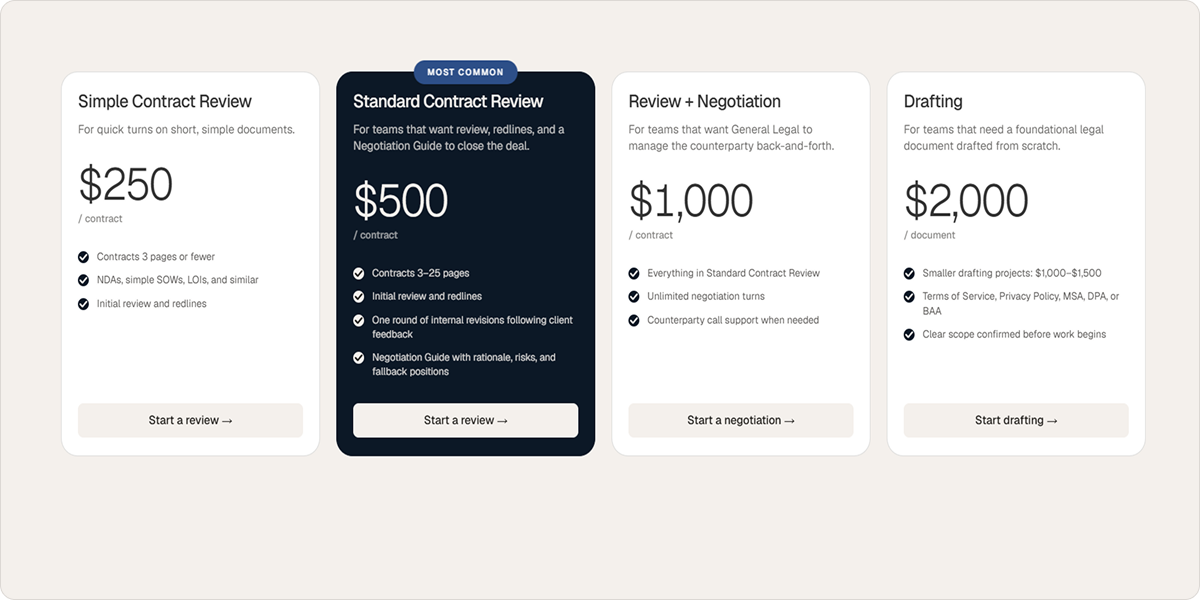
🚀 Founder takeaway:
The model works particularly well for startups because founders know exactly what work costs before legal gets involved, which makes it much easier to move quickly without worrying that every redline or follow-up call is quietly increasing the bill in the background.
2. Wilson Sonsini Goodrich & Rosati: Best for startups with heavy intellectual property needs

Wilson Sonsini is one of the original Silicon Valley startup law firms and has been deeply embedded in the venture and technology ecosystem for decades, including major work across financings, IPOs, governance, and IP-heavy transactions.
It’s a good choice for deep-tech, hardware, and biotech startups because these companies often rely heavily on patents, proprietary technology, licensing structures, and defensible IP positioning long before revenue fully materializes.
Core strengths
What makes Wilson Sonsini particularly valuable for technical startups is its ability to combine startup execution with serious IP and regulatory depth, including:
- Patent, trademark, copyright, and trade secret strategy
- Technology transactions and IP-heavy commercial agreements
- Venture financings and institutional governance support
- IP litigation and PTAB dispute representation
- IPO, acquisition, and cross-border transaction experience
Pricing
Wilson Sonsini primarily follows a traditional enterprise-style hourly billing model common among top-tier Silicon Valley firms.
Role
Typical hourly rate
Paralegals / Clerks
$120–$480/hour
Associates
$510–$1,090/hour
Senior counsel
$925–$2,720+/hour
🚀 Founder takeaway:
WSGR has a near-unmatched reputation for technical sophistication and investor credibility, but founders also know they’re dealing with a very premium Silicon Valley law firm, both operationally and financially.
3. Latham & Watkins: Best for startups eyeing traditional IPO paths

Latham & Watkins is one of the world’s largest corporate law firms, with a massive global platform spanning capital markets, M&A, securities regulation, governance, finance, and public company representation.
It’s especially valuable for later-stage startups preparing for aggressive expansion, large growth financings, or eventual public market entry because few firms have comparable experience navigating IPOs, cross-border regulatory complexity, and high-stakes institutional transactions at scale.
Core strengths
Latham tends to become significantly more valuable as startups mature into larger, more operationally complex businesses, offering capabilities such as:
- IPO, direct listing, and SPAC transaction support
- Cross-border expansion and international regulatory guidance
- High-value acquisitions, exits, and secondary offerings
- Public company governance and SEC compliance counsel
- Large-scale capital markets and debt financing expertise
Pricing
Latham & Watkins primarily operates on a premium BigLaw hourly billing structure, particularly for capital markets, securities, and complex corporate work.
Role
Typical hourly rate
Paralegals / Clerks
$355–$570/hour
Associates
$760–$1,850/hour
Senior counsel
$1,470–$3,050+/hour
🚀 Founder takeaway:
Founders tend to view Latham as a powerhouse once companies reach serious scale, but they also understand they’re entering true top-tier BigLaw pricing territory, with partner rates expected to exceed $3,000 an hour in 2026.
4. DLA Piper: Best for startups with immediate global expansion plans

DLA Piper is a massive international law firm with offices across the Americas, Europe, the Middle East, Africa, and Asia Pacific, giving startups access to legal support across dozens of jurisdictions under a single firm.
Companies expanding internationally early will benefit from its coordinated cross-border counsel, which makes managing employment rules, corporate structures, commercial agreements, and regulatory obligations across multiple countries less operationally messy.
Core strengths
DLA Piper’s biggest advantage for startups is the breadth of its international infrastructure, with support areas including:
- Cross-border expansion and international corporate structuring
- Venture financings and growth-stage transactions
- Employment and workforce scaling across jurisdictions
- Global commercial agreements and operational support
- Startup education and scaling resources through DLA Piper Accelerate
Pricing
DLA Piper generally follows a standard BigLaw hourly billing model, with rates varying by office, geography, and transaction complexity.
Role
Typical hourly rate
Paralegals / Clerks
$340–$500/hour
Associates
$730–$1,215/hour
Senior counsel
$1,215–$1,800+/hour
🚀 Founder takeaway:
DLA Piper gets strong marks from startups operating internationally, especially outside traditional Silicon Valley circles, though founder experiences tend to be less consistent across regions and practice groups.
5. Goodwin Procter: Best for life sciences startups that face complex regulatory frameworks

Goodwin Procter is a major US law firm with a particularly strong presence across venture capital, growth equity, healthcare, fintech, and life sciences transactions.
It’s particularly well-suited for biotech, medtech, and healthtech startups because companies operating in heavily regulated industries usually need legal teams that can simultaneously handle financing, FDA exposure, IP strategy, licensing, compliance, and commercialization without treating them as separate problems.
Core strengths
Goodwin tends to stand out most when startups begin operating in technically demanding or regulation-heavy markets, with strengths like:
- FDA regulatory guidance and compliance support
- Patent strategy, IP litigation, and licensing work
- Venture capital and growth equity financings
- Life sciences partnerships and commercialization agreements
- IPO, M&A, and crossover financing execution
Pricing
Goodwin primarily relies on premium hourly billing for high-complexity legal work, although the firm increasingly uses fixed-fee and hybrid pricing arrangements for certain matters.
Role
Typical hourly rate
Paralegals / Clerks
$295–$660/hour
Associates
$770–$1,270/hour
Senior counsel
$1,260–$2,000+/hour
🚀 Founder takeaway:
Goodwin is widely respected for navigating complicated regulatory and financing environments, though the firm’s culture tends to skew more finance-oriented than founder-native.
6. Orrick Herrington & Sutcliffe: Best for fintech startups looking for forward-thinking legal counsel

Orrick is a major global law firm with a particularly strong reputation across venture capital, emerging companies, fintech, climate tech, and technology-driven corporate work.
It’s a strong partner for fintech and crypto infrastructure startups because these companies often need legal counsel that understands both fast-moving technical markets and the regulatory friction that comes with operating inside financial systems.
Core strengths
What makes Orrick stand out is how aggressively the firm has leaned into startup-focused operational models and technology-enabled legal delivery, offering:
- Fintech regulatory and compliance guidance
- Venture financings and startup scaling support
- Cross-border expansion and international structuring
- AI-enabled compliance tooling through Winnow
- Flexible startup programs and founder education resources
Pricing
Orrick primarily uses hourly billing for most matters, although the firm is known for being significantly more flexible than many traditional BigLaw competitors on startup pricing structures.
Role
Typical hourly rate
Paralegals / Clerks
$400–$800/hour
Senior counsel
$1,400–$1,850+/hour
Specialized premium matters
$1,750+/hour
🚀 Founder takeaway:
Founders often describe Orrick as one of the more commercially pragmatic BigLaw firms, particularly for startups that want sophisticated counsel without every interaction feeling overly institutional.
What is the best startup law firm?
There’s no single “best” startup law firm because the right choice depends on what stage you’re at, how fast you’re scaling, how complex your legal exposure is, and how much operational friction you’re willing to tolerate from outside counsel.
If you’re raising aggressively from top-tier VCs and already thinking several financings ahead, Wilson Sonsini is hard to ignore simply because of how deeply embedded they are in the venture ecosystem.
If your company lives in highly regulated markets like biotech, fintech, or financial infrastructure, firms like Goodwin and Orrick start making a lot more sense because legal complexity compounds fast in those sectors, and generic startup counsel stops being enough surprisingly quickly.
For startups prioritizing speed, execution, and operational efficiency in day-to-day commercial legal work, General Legal stands out as the most modern option on this list.
Its AI-native workflows, flat-fee structure, and startup-first operating model make it particularly attractive for companies that want legal support to move at something closer to startup speed instead of traditional law firm speed.
Getting started with General Legal
If fast-moving commercial legal support is what your company needs at this stage of growth, register online with General Legal and start sending contracts over immediately through Slack, email, or the client portal.
If, however, you still have questions about pricing, turnaround times, scope, or the operational fit, contact the team directly, and they’ll walk you through how the model works before you commit to anything.
FAQ
What are the magic 5 law firms?
The Magic Circle refers to five elite UK-based law firms: Allen & Overy (now A&O Shearman), Clifford Chance, Freshfields, Linklaters, and Slaughter and May.
What is the #1 law firm in the world?
Chicago-based Kirkland & Ellis is the #1 law firm in the world when measured by annual revenue.