
Commercial law is the legal framework that allows businesses to operate. It governs how companies enter agreements, manage risk, protect assets, raise capital, and resolve disputes.
While not all of the roughly 463,600 law firms in the United States focus on commercial law, the industry has seen a growing shift toward commercial and transactional workin recent years as firms adapt to rising deal complexity, tighter timelines, and AI-driven operational changes.
The problem is that every firm insists it’s a “trusted business partner” offering “innovative legal solutions,” and most businesses have no clear framework for evaluating whether any of that is true. Meanwhile, founders are paying premium rates for legal work that still takes days to return a redline.
To help you assess prospective firms more rigorously, this guide breaks down what commercial law firms actually do, which core services they offer, what they typically cost, and which factors matter most when selecting legal counsel for commercial law matters.
What are commercial law firms?
Commercial law firms are legal practices that help businesses with the regulatory, operational, and strategic realities of running a company.
Every contract signed, employee hired, partnership formed, or product launched carries legal and commercial consequences, which aren’t necessarily lawsuits. More often, they take the form of lost deals, governance disputes, regulatory scrutiny, or unnecessary costs incurred resolving issues that should’ve been addressed much earlier.
Effective commercial law firms understand that legal decisions can have operational consequences, and vice versa. For that reason, their work covers everything from transactions that drive growth and expansion to ongoing legal guidance and dispute resolution.
5 key services offered by commercial law firms
Most commercial law firms organize internally around broader practice areas like corporate, finance, or intellectual property law.
However, a company founder is unlikely to be looking for “cross-functional commercial advisory.” They need a specific solution to a specific problem, whether that’s closing a deal, reviewing a contract, hiring employees, protecting IP, or resolving a dispute with as little inconvenience as possible.
That is why commercial law firms typically package their work into practical service categories.
1. Contract drafting and review
Most businesses are held together by contracts. Customers, vendors, employees, investors, contractors, and partners all create legal and commercial obligations the moment something gets signed.
The problem is that poorly drafted contracts rarely reveal their weaknesses immediately. The issues show up later when a deal breaks down, payment gets delayed, a customer churns, or a vendor relationship turns hostile.
To prevent that, commercial law firms help businesses draft, negotiate, review, and enforce agreements that are operationally clear, legally sound, and commercially realistic.
Common examples include:
- Supplier and vendor agreements
- Partnership and shareholder agreements
- Master Services Agreements (MSAs)
- NDAs, non-competes, and non-solicitation agreements
- Licensing and intellectual property agreements
- Terms and conditions for digital products and platforms
- Privacy policies and data usage agreements
- Proprietary Information and Inventions Agreements (PIIAs) or IP Assignment Agreements
Traditional commercial law firms are notoriously slow at contract turnaround. Even basic agreement reviews can take days while deals, procurement, and revenue sit waiting in someone’s inbox.
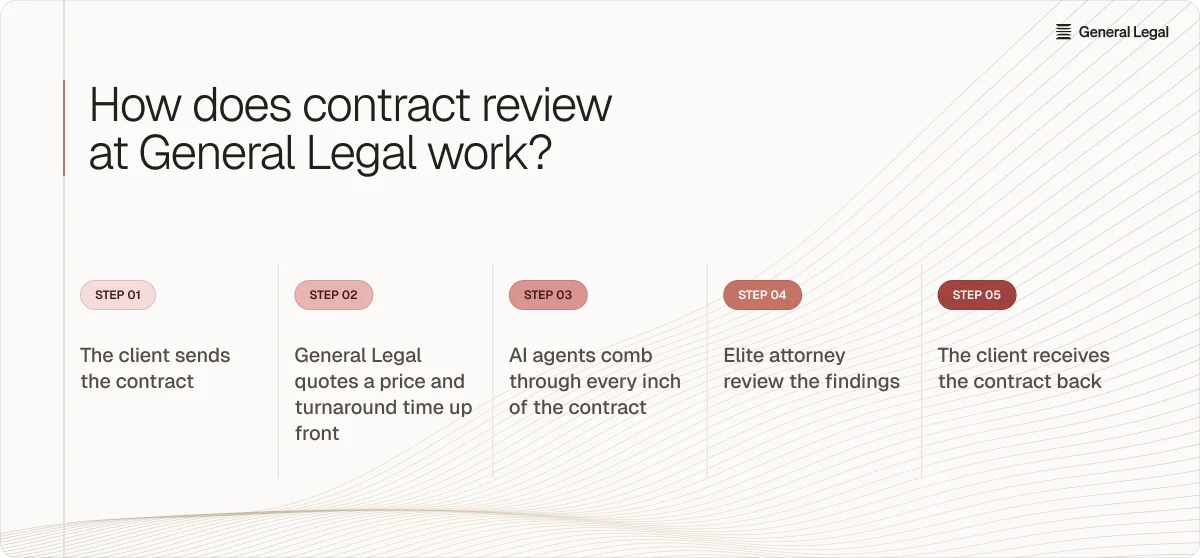
That’s why many startups and growth-stage companies are turning to AI-native firms like General Legal.
Instead of relying on bloated workflows and junior-associate review chains, AI-native firms combine experienced commercial lawyers with optimized AI-assisted workflows to deliver contract reviews in hours, not days, without sacrificing quality.
2. Business formation and structuring
Early decisions around ownership, governance, liability, and fundraising can later create either leverage that accelerates growth or structural problems that are costly to correct.
For example, a rushed incorporation decision can complicate future fundraising, weak shareholder agreements can create founder disputes, and poor governance structures often introduce operational friction as the company scales.
That’s why good commercial law firms help founders choose structures that match how the business actually plans to operate, grow, raise capital, and make decisions over time.
Services in this area typically cover:
- Incorporating and forming business entities
- Choosing between LLC, corporation, partnership, or other legal structures
- Drafting Articles of Incorporation and corporate bylaws
- Structuring vesting schedules and equity allocation
- Establishing board structure and voting rights
- Creating governance and decision-making frameworks
- Supporting mergers, acquisitions, and restructurings
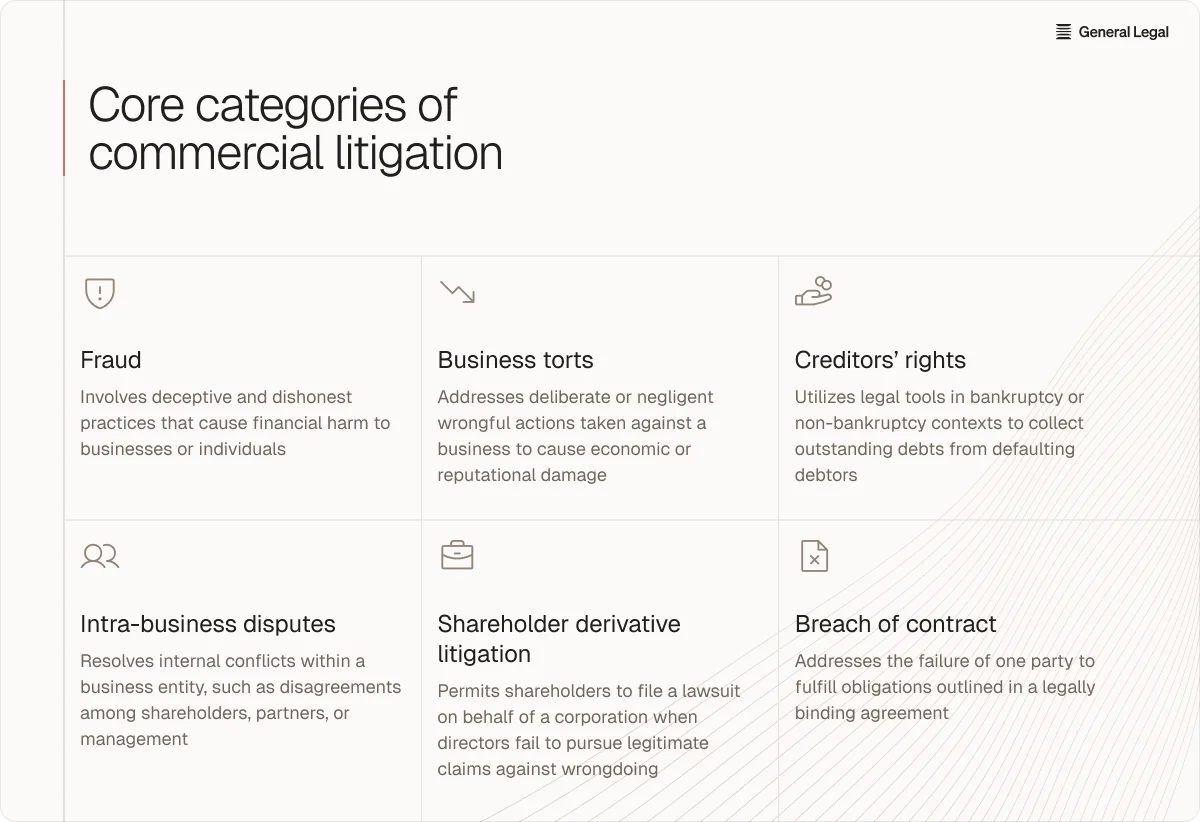
3. Commercial litigation and dispute resolution
In the US, litigation demand grew by 2.5% in 2025, after already increasing by 3.3% in 2024, highlighting how common legal claims have become in modern business operations.
The reason is simple: Business relationships break down all the time, whether it’s over a breached contract, an unpaid invoice, or unfair commercial practices. Once meaningful financial, ownership, or operational pressure comes into play, disputes become inevitable for many growing companies.
Commercial law firms help businesses resolve these conflicts through:
- Negotiation
- Mediation
- Arbitration
- Settlement agreements
- Court representation
4. Employment and HR legal support
Employment issues often evolve into legal problems. Hiring, compensation, termination, workplace policies, contractor classification, and employee disputes all create regulatory and financial exposure if handled poorly.
Commercial law firms support businesses in building employment frameworks that are legally compliant, practical, and structured to reduce future disputes.
For growing companies, in particular, employment law is rarely just an HR problem. A poorly handled termination, weak contractor agreement, or outdated policy can quickly turn into litigation, regulatory scrutiny, or reputational damage.
5. Compliance and risk management
Many companies don’t think about compliance until regulators, lawsuits, customers, or investors force them to. By that point, the problem is usually much more expensive to fix.
Commercial law firms help businesses avoid these costly mistakes by identifying legal and operational risks early and staying compliant with evolving regulations.
To do so, these law firms typically assist with:
- Data protection and privacy law compliance
- Consumer protection compliance
- Risk assessments and internal audits
- Intellectual property protection and enforcement
- Trademark, copyright, and licensing support
- Regulatory investigations and responses
- Trade risk and liability management
This type of service is invaluable in heavily regulated industries like finance, healthcare, technology, energy, and e-commerce, where compliance obligations change constantly, as even minor regulatory missteps can result in major legal, financial, or reputational consequences.
The challenge is finding a commercial law firm that delivers all these services equally well.
So, how do you identify the firms that are actually equipped to handle those responsibilities successfully?
How to choose the right commercial law firm: A step-by-step guide
Here are 10 practical steps that can help businesses find a commercial law firm that fits their industry, operational needs, budget, and growth stage.
1. Start with the problem, not the law firm
Many businesses begin by searching for the “best commercial law firm” before they have clearly defined what they actually need help with. This is not the best approach.
Commercial law covers a broad spectrum of transactional, advisory, and contentious matters. A company negotiating SaaS contracts and managing data privacy obligations requires very different expertise than a manufacturer dealing with supply chain disputes or a startup preparing for a Series A financing.
Before speaking to a firm, identify the legal work you expect to need over the next 12 to 24 months. The clearer your requirements, the easier it becomes to evaluate whether a firm is genuinely equipped to help you.
2. Match the firm’s size to the complexity of the work
A bigger firm isn’t necessarily a better firm.
Large international firms make sense for cross-border transactions, major acquisitions, public company work, or high-stakes litigation, as they have extensive resources and highly specialized teams.
For many startups and growth-stage companies, however, boutique and mid-sized firms can offer more direct access to senior lawyers and faster response times because they operate with leaner teams, fewer layers of internal reviews, and less process overhead.
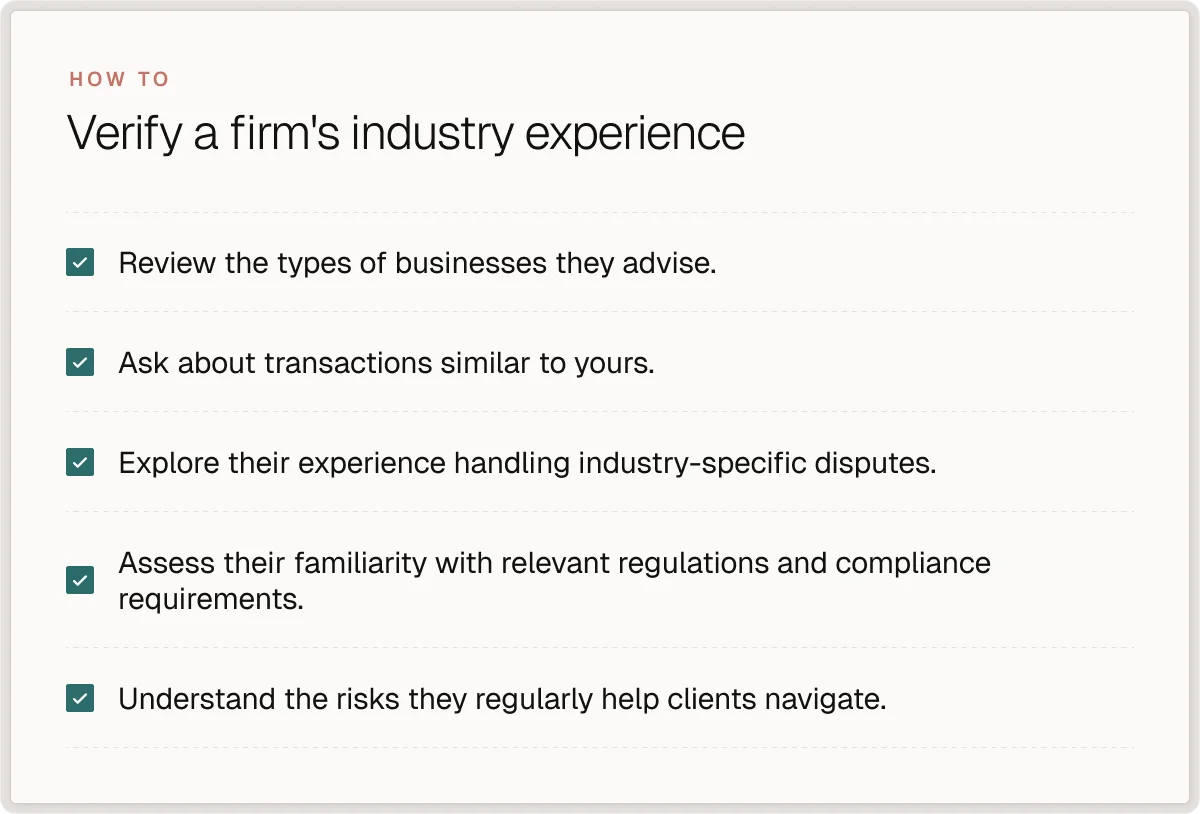
3. Look for firms that understand your industry
Legal risk is industry-specific. A healthcare company navigating patient data regulations faces a completely different risk profile than an e-commerce brand managing consumer protection obligations.
Ideally, you should choose a law firm that has advised similar businesses and understands the legal and regulatory risks associated with your industry.
4. Research reputation beyond online reviews
Online reviews can be useful, but they should never be the primary basis for your decision.
Many business owners have learned this lesson the hard way after hiring highly rated lawyers who failed to provide meaningful commercial guidance. Research confirms this reality, with one large-scale study finding that law firm prestige didn’t consistently correlate with litigation success.
Referrals from founders, accountants, investors, operators, and other business professionals are often far more valuable. Equally important are client references, case studies, and evidence of long-term client relationships.
5. Evaluate how they think during the first conversation
The initial consultation shouldn’t feel one-sided. While you’re evaluating the firm, its lawyers should be asking you questions to understand:
- How your business operates
- Which risks you face
- Who your customers are
- Where revenue comes from
- What you’re ultimately trying to accomplish
Commercial legal advice is only useful when it’s tailored to the business receiving it.
The initial consultation with a law firm can also reveal whether its lawyers have strong commercial judgment, because the goal isn’t always to eliminate every possible risk. Sometimes, it’s to move quickly, preserve a relationship, close a deal, or accept a manageable risk in exchange for a larger commercial opportunity.
That kind of judgment is often more valuable than technical expertise alone.
6. Make sure they can support more than today’s issues
Businesses rarely need help in neat, isolated categories. The best commercial law firms either maintain capabilities across adjacent practice areas or have trusted specialist networks they can bring in when needed.
Take General Legal as an example.
Recognizing how frequently employment issues arise for startups and growth-stage businesses, the firm recently expanded beyond commercial contracts into dedicated employment support.
General Legal now handles everything from offer letters and employee handbooks to equity plans, executive agreements, separations, and restructuring support, using the same AI-native, fast-turnaround model it built around commercial contract work.
7. Find out who will actually do the work
There is nothing wrong with delegation, but clients shouldn’t believe they’re hiring one level of expertise only to receive another.
To avoid this scenario, ask direct questions:
- Who reviews contracts?
- Who negotiates agreements?
- Who communicates with your team?
- Who is ultimately accountable for the work product?
The answers to these questions should be specific. If the firm is vague about who will handle the work or avoids discussing staffing altogether, there’s likely a disconnect between what’s being promised and what will actually be delivered.
8. Test responsiveness before you become a client
Commercial work is often time-sensitive, which is why it’s important to pay close attention to how the firm communicates during the sales process. Slow replies, vague timelines, and disorganized intake processes usually get worse after the engagement letter is signed.
9. Consider the long-term relationship
Unlike a divorce lawyer or personal injury attorney, a commercial lawyer is typically not someone you hire once and never speak to again. For many businesses, this relationship becomes an ongoing part of day-to-day operations.
So, before hiring a law firm, ask yourself a simple question: Would you actually want its lawyers in your corner when a difficult decision needs to be made?
10. Make sure the pricing works for your business
Even the best legal partner may not be the right fit if their pricing model doesn’t align with your budget and operating reality. However, this doesn’t mean you should choose the cheapest option.
Instead, focus on transparency, predictability, and incentives. Ask the following questions:
- Are fees clearly explained upfront?
- Do you know what is and what isn’t included in the fee?
- Are you paying for outcomes, defined scopes of work, or simply time spent on the matter?
After answering these, one question remains: Can your business realistically afford the level of support it requires?
What do commercial law firms charge?
Commercial law firms can charge from a few hundred dollars for basic contract work to several thousand dollars per hour for elite litigation or highly specialized advisory work.
Pricing varies depending on factors like:
- Type, volume, and complexity of ongoing legal work
- Firm size and market positioning
- Lawyer seniority and specialization
- Geographic location
- Urgency and turnaround expectations
On average, US business lawyers bill $350–$500 per hour, and these rates only continue to trend upward.
Commercial law firm billing rates increased by an average of 6.5% in 2024, marking the fastest growth since the 2008 financial crisis. As a result, pricing at the very top end of the market has reached unprecedented levels.
While $1,500 per hour was considered exceptionally high a decade ago, elite litigators and specialized partners now charge double that for high-stakes disputes and corporate advisory work.
What you ultimately pay also depends on the pricing model the firm uses:
| Pricing model | How it works | When it’s used |
|---|---|---|
| Hourly billing | Billing based on time spent on the matter | Litigation, unpredictable work, complex negotiations |
| Fixed fee | Pre-agreed flat price for a defined scope | Incorporations, trademarks |
| Retainer agreement | Ongoing monthly legal support | Outside general counsel relationships |
| Contingency or success fee | Payment tied to a successful outcome | Certain disputes or litigation matters |
| Stage-based pricing | Work billed in phases or milestones | Transactions, fundraising, M&A |
The traditional billable-hour model is facing increasing scrutiny.
Businesses are questioning why routine contract reviews, employment documents, or compliance work should generate unpredictable invoices based on how many hours a law firm decides to spend.
That pressure is only accelerating with AI. Nearly half of legal professionals now expect generative AI to reduce reliance on billable-hour pricing over the next five years as firms shift toward outcome-based models.
This shift is exactly why AI-native firms like General Legal are gaining traction with startups and growth-stage companies.
Why growth-stage companies are choosing General Legal

General Legal is an AI-native law firm built for companies that need commercial legal support without the delays, unpredictability, and operational friction that still define much of the legal industry.
What makes this possible is a combination of sophisticated contract AI, purpose-built workflows, and exceptionally talented attorneys.
For founders and operators, this combination translates into:
- Contracts turned in hours instead of days
- Practical legal advice delivered in real time
- Fewer deals stuck waiting for legal review
- Direct access to legal support through Slack
Behind the scenes, our technology handles the repetitive work and administrative coordination that traditionally consumes attorney time. This allows our experienced US-barred attorneys to focus on legal judgment, negotiation strategy, and risk analysis.
The result is BigLaw-quality commercial legal support delivered at a fraction of traditional BigLaw costs, with upfront flat-fee pricing replacing the unpredictability of hourly billing.
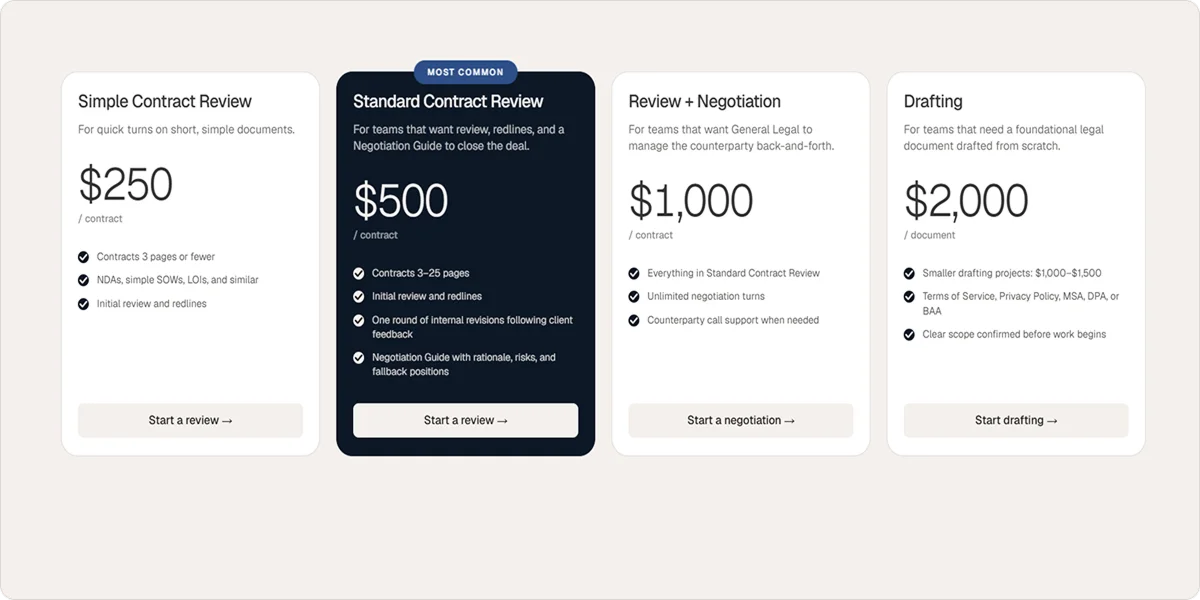
Whether you need a quick NDA review, a customer MSA negotiated, an employee handbook drafted, or support on fundraising and employment matters, General Legal can help.
Sign up online to get started immediately, or reach out if you’d like to discuss your needs first.
- Commercial law firms handle the legal work businesses need to operate, spanning contracts, business formation, disputes, employment, and compliance.
- Poorly drafted contracts and weak governance often surface as costly problems later rather than causing immediate visible harm.
- The best commercial lawyers already understand the risks specific to a client's industry, which reduces the learning curve on new matters.
- Choosing a firm should start with defining your own legal needs first, then matching firm size, industry experience, staffing transparency, and responsiveness, rather than chasing brand name alone.
- Commercial legal fees vary enormously, from a few hundred dollars for basic contract work to several thousand dollars an hour for elite litigation, with billing models ranging from hourly to fixed-fee to retainer.
- AI-native firms like General Legal pair experienced attorneys with AI-assisted workflows to review contracts faster, using flat-fee pricing instead of unpredictable hourly billing.
| What commercial law covers | The legal framework businesses rely on to enter agreements, manage risk, protect assets, raise capital, and resolve disputes. |
|---|---|
| Five core services | Contract drafting and review, business formation and structuring, commercial litigation and dispute resolution, employment and HR support, and compliance and risk management. |
| Start with the problem, not the firm | Define the legal work you'll actually need over the next 12-24 months before evaluating firms, rather than searching for a generically 'best' firm. |
| Size isn't everything | Large firms suit cross-border deals and major litigation; boutique and mid-sized firms often give startups faster access to senior lawyers. |
| Test before you commit | Ask who actually does the work, check responsiveness during the sales process, and confirm pricing is transparent before signing an engagement letter. |
| What it costs | Fees range from a few hundred dollars for basic contract work to several thousand dollars per hour for elite litigation, with average US business-lawyer rates around $350-500/hour and rising. |
| The AI-native alternative | General Legal combines experienced attorneys with AI-assisted workflows to deliver contract reviews in hours instead of days, using flat-fee pricing instead of hourly billing. |
How do I know if I need a commercial lawyer versus a corporate lawyer?
You generally need a corporate lawyer for raising capital, restructuring ownership, or pursuing an acquisition; many firms handle both since major business decisions often touch both areas.
What should I look for beyond a firm's reputation or online reviews?
Referrals from other founders, evidence of long-term client relationships, whether the firm understands your industry's specific risks, and how they think and ask questions during the first consultation.
Why is pricing transparency important when choosing a commercial law firm?
Because costs can range enormously and firms differ in whether they bill hourly, by fixed fee, retainer, or milestone, so knowing what's included upfront avoids unpredictable invoices.
Do I need a big firm for commercial legal work?
Not necessarily. Large firms make sense for cross-border transactions or major litigation, but boutique and AI-native firms can offer faster turnaround and more direct access to senior lawyers for most day-to-day commercial needs.
How is General Legal different from a traditional commercial law firm?
It combines experienced attorneys with AI-assisted workflows to review contracts in hours rather than days, and uses upfront flat-fee pricing instead of unpredictable hourly billing.
What type of lawyer is the highest paid?
Corporate lawyers and elite M&A attorneys are consistently among the highest-paid lawyers in the US, especially at large firms handling billion-dollar transactions and disputes.
What is the highest salary for a commercial lawyer?
Some elite BigLaw partners reportedly earn $20 million per year, while top specialists now bill upward of $6,000 per hour.
When do you need a corporate lawyer instead of a commercial lawyer?
You generally need a corporate lawyer if you’re raising capital, restructuring ownership, managing shareholder rights, or pursuing an acquisition. Many law firms advise on both commercial and corporate issues because significant business decisions often involve both sets of considerations.
- The Ultimate Commercial Contract Checklist for 2026: What to Review Before SigningDiscover the ultimate commercial contract checklist so you can review key terms, spot risks, and protect your business.
- Commercial Law vs. Business Law: 5 Main DifferencesCompare commercial law vs business law so you can understand their differences, identify your legal needs & choose the right fit.
- 8 Commercial Legal Issues & How to Solve Them [Explained]Discover commercial legal issues so you can identify common risks, protect your business, resolve disputes, and stay ahead of legal problems.