
Generative AI is a type of artificial intelligence that can create new content based on large volumes of training data and natural language prompts.
So far, the legal industry has been particularly receptive to this technology.
According to a 2025 report by the American Bar Association (ABA), 31% of legal professionals are already using generative AI at work, and 95% of legal teams expect this technology to become a central part of their organization’s workflow within the next five years.
The explanation lies in the nature of legal work itself; much of it revolves around language, structure, research, and information processing, which are areas where generative AI performs remarkably well.
But where does AI actually create value for law firms, and how big is the upside?
This guide on generative AI for law firms provides a detailed breakdown.
The current state of the industry
From rapid AI adoption rates to growing ethical concerns, here’s what the current state of the legal industry looks like.
Legal professionals are enthusiastic about generative AI
According to Thomson Reuters’s 2025 Generative AI in Professional Services Report, 55% of professionals describe themselves as excited or hopeful about generative AI.
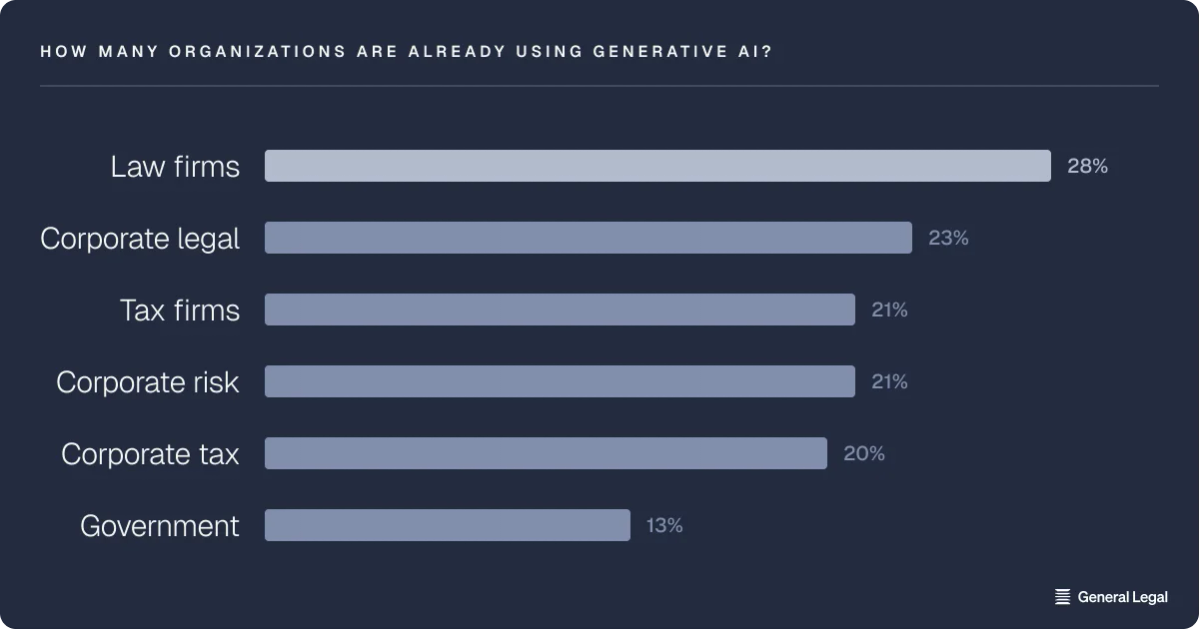
The legal industry is already demonstrating the strongest generative AI adoption rates among all surveyed professional sectors, with 28% of law firms using this technology and 14% of them planning to do so.
Legal professionals who adopt AI tend to use it consistently
As many as 72% of current generative AI users engage with it at least weekly, while more than 40% use it once or multiple times per day. This kind of adoption curve usually only happens when a tool starts delivering meaningful operational leverage very quickly.
Generative AI is exceptionally well-suited for legal work
Large language models (LLMs) can read, analyze, summarize, and generate human-like text while recognizing patterns across massive amounts of information. This makes them effective in legal environments, where nearly every workflow depends on processing documents and context accurately and within a limited time frame.
Traditional legal software can also support these workflows to a degree, but it typically relies on predefined rules, templates, and keyword-based searches. In contrast, generative AI can adapt dynamically to context, tone, and subject matter, allowing it to handle far more nuanced legal tasks.
AI still requires human judgment
Despite the excitement around generative AI, most legal professionals don’t see it as a replacement for lawyers.
Legal work requires judgment, accountability, and client-specific advice that AI can’t provide independently, especially given the technology’s tendency to hallucinate fake case law, potential to compromise strict client confidentiality, and high likelihood of amplifying systemic bias hidden within training data.
For these reasons, the AI output is often described as a basic starting point that still requires meaningful human input and review.
Failing to apply that review can have serious professional consequences. In one case, lawyers submitted fictitious case law generated by ChatGPT and were fined $5,000 after the judge discovered that the citations didn’t exist.
So, while AI might be good at accelerating legal work, it still requires a sign-off from people qualified to exercise legal judgment.
That’s precisely the model behind General Legal, an AI-native law firm built around the idea that great lawyers equipped with AI can deliver legal services with greater speed and efficiency than traditional firms and without sacrificing quality.
The regulatory framework for AI is still evolving
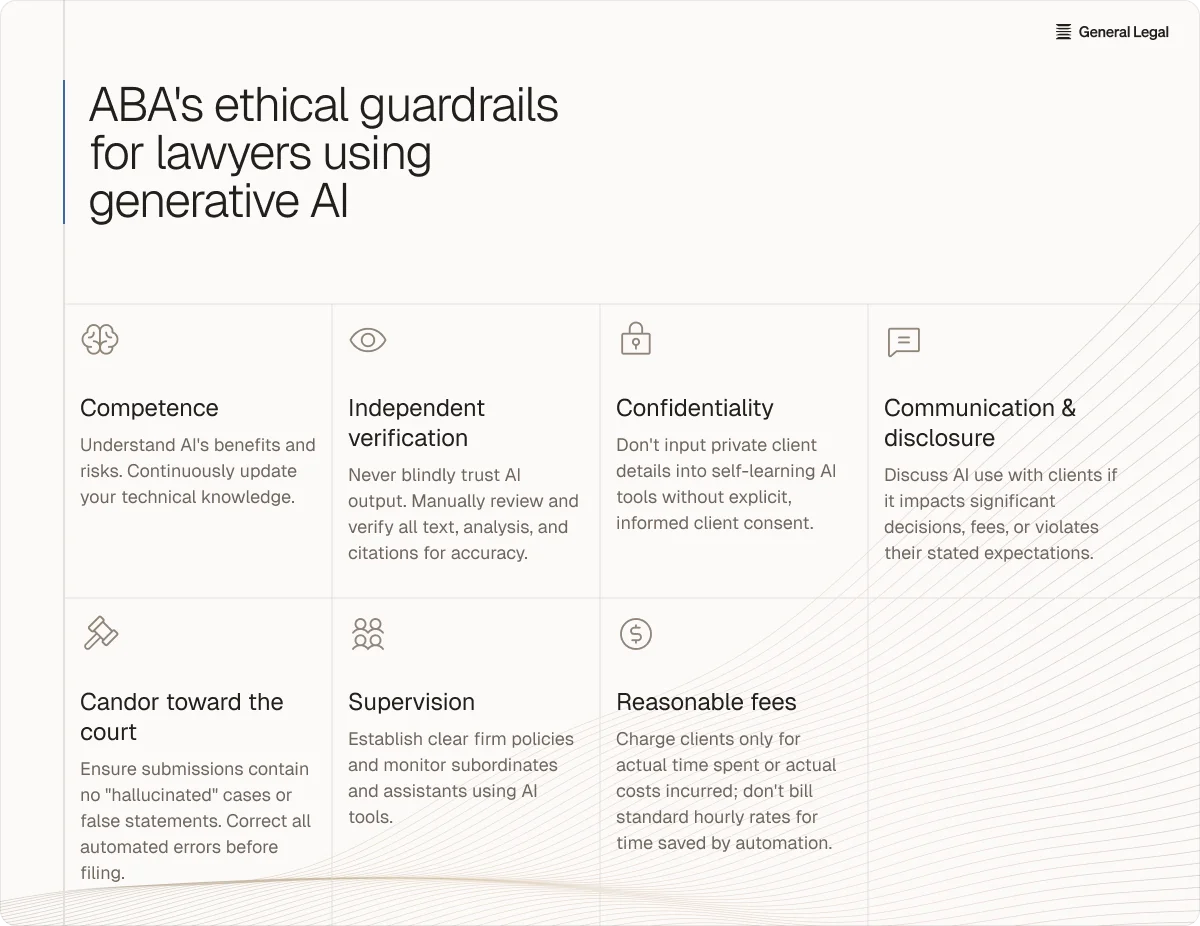
AI adoption is outpacing regulation, which is why 52% of organizations still don’t have any formal usage policies. However, the legal industry as a whole is establishing guardrails for the responsible use of generative AI.
For example, in Formal Opinion 512, the ABA emphasized that lawyers remain fully responsible for competence, confidentiality, client communication, and oversight when using generative AI tools.
Clients are starting to expect AI from their law firms
As many as 57% of clients expect the firms they work with to use generative AI.
This expectation is understandable, given that clients want faster turnaround times, lower friction, more predictable execution, and better economics—and AI has the potential to improve all four.
At the same time, clients are still cautious about confidentiality, accuracy, and verification, which is why the firms emerging as leaders are the ones integrating AI thoughtfully into legal workflows rather than automating everything.
But what does that integration look like in practice?
Generative AI for law firms: 10 practical use cases
Here are 10 real-world ways generative AI is already reshaping how modern law firms operate.
1. Automating contract review
Contract review is one of the most practical and widely adopted use cases for generative AI in law firms. The workload alone explains why. Large organizations manage an average of 19,000 contracts per year, a volume labeled as challenging by as many as 99% of them.
Traditionally, contract review required lawyers to manually examine large volumes of legal language, looking for risks, inconsistencies, obligations, and missing clauses. This is time-intensive, repetitive work that requires significant attorney involvement.
Generative AI accelerates this process significantly, thanks to modern systems that can review contracts in seconds, compare agreements, flag unusual language, and identify potential risks across large datasets.
Take General Legal as an example.
You can send over a contract through Slack, email, or the client portal.
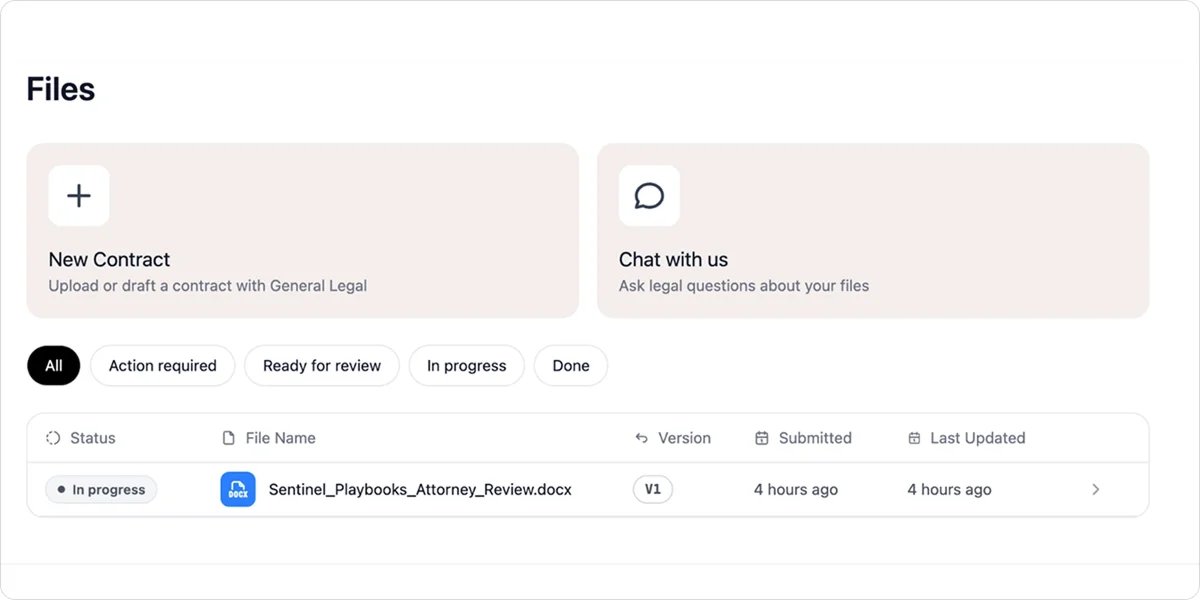
AI agents handle the initial review (triaging, summarizing, and surfacing risk) while lawyers focus on the actual legal judgment.
This operational model allows contracts to move in hours instead of days, which is invaluable during due diligence and other high-volume workflows where legal teams operate under intense time pressure.
2. Conducting legal research
Traditionally, legal research involved associates spending hours reviewing case law, filings, regulations, and secondary sources, trying to find the right authorities and arguments. The process is slow, expensive, and susceptible to human error.
Generative AI changes that equation by enabling legal teams to:
- Analyze thousands of documents in seconds
- Surface relevant case law
- Summarize arguments
- Extract key facts
- Identify weaknesses in opposing positions
- Generate research summaries backed by citations
Because AI systems can analyze information in context rather than relying solely on keyword matching, they’re able to surface more relevant results across large datasets. This is particularly useful in litigation and e-discovery, where teams often need to process substantial amounts of information within tight deadlines.
3. Summarizing legal documents
Law firms deal with vast amounts of text every day, and not every document needs a full manual review.
Generative AI can read and summarize lengthy contracts, filings, discovery materials, and internal documents in seconds, allowing legal teams to identify the most relevant information more efficiently.
4. Drafting briefs and legal memos
Beyond reviewing and summarizing documents, generative AI can assist with drafting them.
Well-developed AI systems can generate first drafts of briefs, legal memos, internal assessments, and other analysis-driven legal documents by pulling together relevant language and identifying useful authorities.
Instead of working from a blank page, lawyers can start from a structured draft and focus on the parts that require legal judgment.
5. Drafting contracts
Contract quality directly impacts risk allocation, negotiation leverage, enforceability, and the likelihood of future disputes.
With this in mind, the ABA identifies five core characteristics of excellent contract drafting:
| Characteristic | Explanation |
|---|---|
| 1. Accuracy | The contract fully reflects the actual agreement and allocates risk correctly. |
| 2. Clarity | The language is easy to interpret and difficult to misunderstand. |
| 3. Efficiency | Every clause serves a purpose without unnecessary repetition or bloated language. |
| 4. Simplicity | Complex ideas are expressed as plainly as possible. |
| 5. Resonance | The tone and structure fit the audience and business context. |
Generative AI systems can support each of these drafting principles at scale.
They can identify missing provisions, flag inconsistent definitions, surface unusual language, suggest clearer phrasing, and compare drafts against large volumes of precedent agreements almost instantly.
As for accuracy, legal-specific AI tools address it by drawing on trusted legal sources and citing supporting authority. This allows lawyers to verify whether clauses align with current standards and prior agreements.
6. Producing legal correspondence
With the help of generative AI, emails, client communications, demand letters, and other day-to-day legal correspondence become much easier to draft, and 54% of lawyers are already using AI for that purpose.
AI tools can also suggest legally tested language, improve clarity, and help maintain consistent tone and formatting across these communications, which reduces the amount of routine drafting tasks lawyers need to perform manually.
7. Extracting contract data
Operationally important information, such as payment obligations, renewal dates, indemnity clauses, termination rights, and compliance requirements, is often embedded throughout contracts.
Generative AI can make this information instantly searchable, allowing legal teams to extract key data across thousands of agreements without manually reviewing every page.
8. Preparing deposition questions
Depositions require lawyers to review extensive case materials and identify potential inconsistencies in testimony under significant time constraints.
Generative AI can supportthis processby:
- Organizing case materials
- Surfacing inconsistencies
- Summarizing witness information
- Generating structured deposition questions based on the underlying record
9. Translating legal documents
Many legal environments operate across multiple languages, jurisdictions, and regulatory systems, which makes translation a significant operational requirement. Generative AI allows firms to translate contracts, filings, and other legal documents more efficiently while preserving much of the underlying legal structure and context.
10. Managing legal spend
Legal work is expensive, and most companies still have limited visibility into how those costs are incurred.
Generative AI can optimize legal spend management by:
- Analyzing invoices
- Tracking spending patterns
- Benchmarking outside counsel costs
- Identifying non-compliant billing entries
- Surfacing opportunities to reduce unnecessary spend
These capabilities are highly beneficial for legal departments managing large volumes of work. As the number of matters, invoices, and outside counsel relationships grows, AI can analyze spending data at a scale that would be significantly more difficult to manage manually.
However, the ability to operate more efficiently is just one of the many benefits generative AI can offer law firms.
Key benefits of generative AI for law firms
The most immediate and measurable benefit of generative AI is the amount of time it can return to legal teams. Within the next five years, this could be up to 12 hours per week.
Where do these savings come from?
They are largely driven by the types of tasks lawyers perform every day, many of which are high-volume, repetitive, and well-suited to automation. Consequently, generative AI can reduce the time required for these tasks by:
- Reviewing and summarizing documents in seconds
- Surfacing clauses, risks, and inconsistencies instantly
- Speeding up legal research and precedent analysis
- Automating mechanical drafting and formatting work
- Organizing large datasets and discovery materials
- Tracking obligations, deadlines, and contract terms automatically
However, the impact of these time savings extends beyond efficiency gains.
With less time spent on formulaic operational work, lawyers can invest more time in strategy, negotiation, client relationships, and judgment-heavy work that actually creates value. Faster workflows also translate directly into better client responsiveness, which is a major advantage in an industry where speed often matters almost as much as quality.
Other notable benefits of generative AI for law firms include:
| Benefit | How generative AI contributes |
|---|---|
| Improved accuracy | Flagging inconsistencies, surfacing missing information, and reducing human error |
| Greater scalability | Allowing firms to handle larger workloads without proportional headcount growth |
| Better resource allocation | Redirecting attorney time away from low-value administrative work |
| Stronger profitability | Increasing operational efficiency and expanding lawyer capacity |
| Growth and innovation opportunities | Creating space for new service models and AI-native legal operations |
| Improved employee retention | Reducing administrative burden and allowing lawyers to focus on more engaging work |
| More competitive pricing | Reducing operational costs and making alternative fee structures more viable |
One of the biggest long-term implications of generative AI is what it means for the traditional billable hour model.
Today, roughly 80% of legal fee arrangements are still based on billable hours. However, the more AI compresses the time required for different legal workflows, the harder it becomes to justify billing based solely on hours worked.
AI-native firms like General Legal are already adapting to the new normal.
Instead of billing unpredictable associate hours, the firm uses upfront flat-fee pricing built around faster AI-assisted workflows. This is a major shift for an industry that has historically monetized time instead of efficiency.
Why are AI-native firms winning?
Generative AI clearly has considerable potential to improve legal operations. That said, its adoption also raises legitimate concerns.
Hallucinated citations, inaccurate outputs, confidentiality risks, and overreliance on AI systems remain key barriers to adoption for many law firms. However, in many cases, these risks stem less from the technology itself and more from its deployment and from a lack of appropriate oversight and governance.
That is where AI-native firms like General Legal are starting to separate themselves from traditional firms that are still testing AI tools at the margins.

General Legal was built around AI-assisted legal workflows from day one. This means that clients can benefit from AI-driven efficiency without the risks associated with relying on AI tools alone or layering generic technology onto legacy law firm workflows.
Through General Legal, companies can access AI-accelerated legal services for:
- Contract review and redlining, including commercial agreements, vendor contracts, NDAs, and employment documents
- Full contract negotiation support, including counterparty negotiations and unlimited redline turns
- Drafting legal documents from scratch, including MSAs, DPAs, BAAs, Terms of Service, Privacy Policies, and SAFEs
- High-volume agreement review and contract workflow support for teams handling large contract volumes
- Legal research and sourced analysis for specific legal questions and operational decisions
- Legal operations support, including contract playbooks and workflow optimization
- Ongoing collaboration with legal counsel directly through Slack or the client portal
Curious what an AI-native approach to legal services looks like in practice?
Sign up online to join the hundreds of growth-stage companies already using General Legal for faster contract review, drafting, negotiation, and legal operations support. If you have additional questions about workflows, pricing, or supported legal matters, contact the General Legal team directly.
- Generative AI adoption in the legal industry is accelerating fast, with 31% of legal professionals already using it and 95% of legal teams expecting it to become central to their workflow within five years.
- AI delivers the most value in high-volume, document-heavy tasks like contract review, legal research, drafting, and summarization, potentially saving lawyers up to 12 hours a week.
- AI still can't replace human judgment or accountability, and unreviewed AI output has already led to real consequences, including a $5,000 sanction for lawyers who submitted fabricated case citations generated by ChatGPT.
- The technology's rise is putting pressure on the traditional billable-hour model, since it becomes harder to justify billing by the hour as AI compresses the time legal tasks require.
- Clients increasingly expect their law firms to use AI, with 57% expecting it, but they remain cautious about confidentiality and accuracy, rewarding firms that integrate AI thoughtfully rather than automate everything.
- AI-native firms like General Legal build workflows around AI-assisted review from the start, pairing AI efficiency with attorney oversight across services like contract review, drafting, and negotiation.
| Adoption pace | 31% of legal professionals already use generative AI at work, and legal is the fastest-adopting professional sector, with 72% of current users engaging weekly. |
|---|---|
| Why legal work fits AI | Legal work is heavily language-, document-, and research-based, which plays to generative AI's strengths, unlike rule-based traditional legal software. |
| Where it's used | The ten practical use cases include contract review, legal research, document summarization, brief and contract drafting, correspondence, data extraction, deposition prep, translation, and legal spend management. |
| Human judgment still required | AI can hallucinate citations, risk confidentiality, and reflect training-data bias, so lawyers remain accountable for reviewing and signing off on AI output. |
| Real cost of skipping review | Lawyers who submitted ChatGPT-generated fake case citations were fined $5,000 after a judge found the citations didn't exist. |
| Billable hour under pressure | About 80% of legal fees are still billed hourly, but as AI compresses task time, that model is becoming harder to sustain, pushing firms toward flat fees. |
| Client expectations | 57% of clients now expect their law firm to use generative AI, driven by demand for faster turnaround and more predictable pricing. |
| General Legal's model | AI handles contract triage and initial review while attorneys apply legal judgment, supporting flat-fee pricing instead of the traditional billable hour. |
How is generative AI actually used in law firms today?
For contract review, legal research, document summarization, drafting briefs and contracts, correspondence, data extraction, deposition prep, translation, and legal spend management.
Can generative AI replace lawyers?
No. It can accelerate document-heavy work, but legal judgment, accountability, and client-specific advice still require a lawyer, especially since AI can hallucinate case law and reflect biased training data.
What happens if a lawyer submits AI-generated content without checking it?
It can carry real professional consequences; in one case, lawyers were fined $5,000 after submitting fabricated case citations generated by ChatGPT.
Will AI kill the billable hour?
It's putting real pressure on it. Roughly 80% of legal fees are still billed hourly, but as AI shortens the time tasks take, flat-fee and alternative pricing models are becoming more common.
Do clients actually want their law firm to use AI?
Yes, 57% of clients expect it, though they remain cautious about confidentiality and accuracy, so firms that integrate AI carefully tend to win more trust than those that automate everything.
Is Claude or ChatGPT better for lawyers?
It depends on the workflow. Many legal professionals prefer Claude for long-document analysis and drafting, and ChatGPT for broader research and brainstorming, but neither should be used without legal oversight.
How is Gen AI used in law firms?
Law firms use generative AI for contract review, legal research, document summarization, drafting, negotiation analysis, legal correspondence, and legal operations workflows.
Do BigLaw firms use AI?
Yes. Most large law firms are actively testing or deploying AI tools to improve productivity, accelerate workflows, and reduce repetitive manual work.