
The US is a relentless business-building machine, with hundreds of thousands of new companies entering the pipeline every month.
According to the US Census Bureau’s Business Formation Statistics, there were 578,926 business applications in July 2026, which is on par with the roughly-500,000-applicants-per-month pace the country has kept since the start of 2026.
At some point or another, nearly all of these businesses will sign a contract, hire employees, raise money, or end up in a dispute with a vendor—and need a commercial law firm to handle it. That’s because commercial law isn’t a niche specialty you call in an emergency; it’s the operating system running underneath every deal, hire, and dollar the business touches.
To understand when your business might need legal support—and what kind of support to look for—this guide breaks down what commercial law firms do across three core service areas: advisory, transactional, and contentious work.
Key takeaways
- Legal support matters throughout the business lifecycle Companies may need counsel for formation, employment, IP, fundraising, financing, M&A, compliance, and more as they grow.
- Getting legal terms right early can prevent costly disputes Strong contracts, clear ownership arrangements, and well-structured employment and equity documents can reduce legal risk before problems escalate.
- Startups face particular legal complexity as they grow Fundraising, equity, IP ownership, employment, tax, privacy, and technology transactions all require legal decisions that can affect future growth.
- An AI-native firm can make commercial legal support more accessible General Legal combines experienced lawyers with AI-native workflows, flat-fee pricing, and fast turnaround for businesses that need commercial counsel without traditional law firm friction.
Advisory work: Keeping the business on solid legal ground
Advisory work is the legal support a business relies on to make decisions, manage risk, and stay on the right side of the rules as it operates and grows. It can be ongoing or brought in when a specific legal question comes up. Either way, the goal is the same: Deal with commercial legal issues before they become expensive problems.
Company formation and corporate structuring
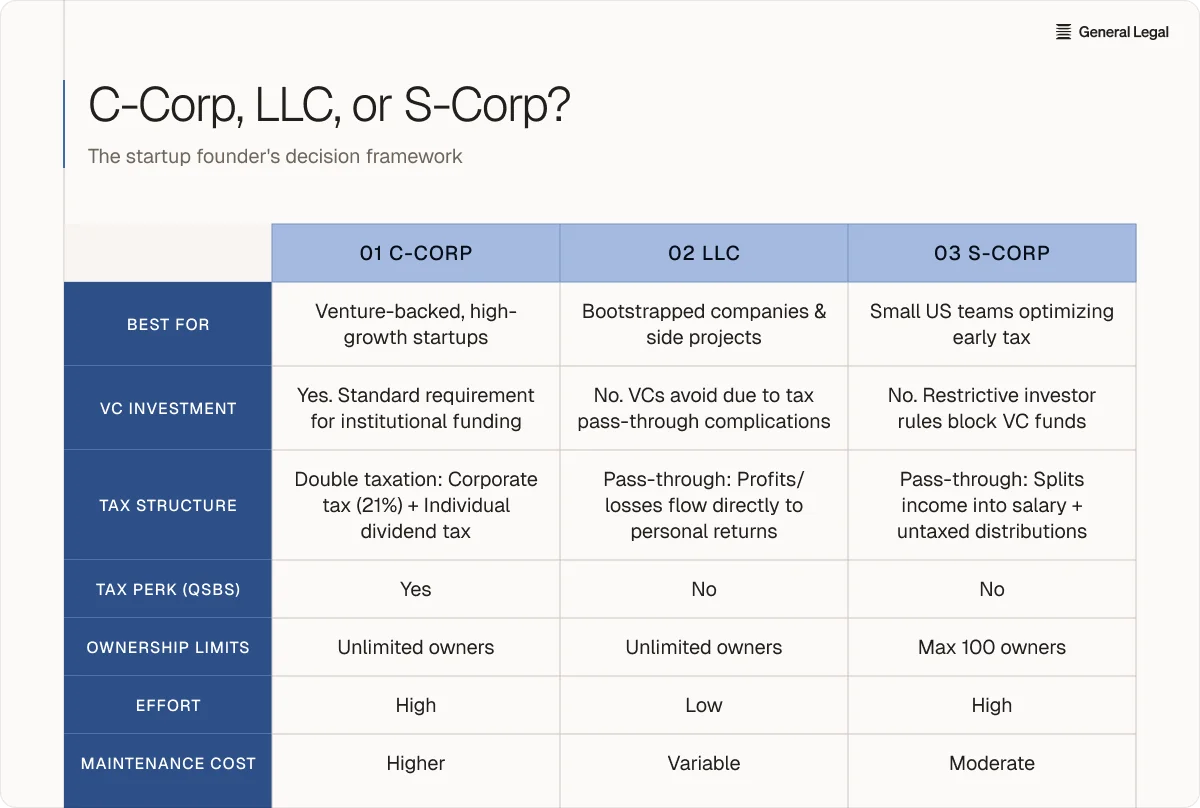
Company formation and corporate structuring covers the legal work required to set up a business and establish who owns it, how decisions get made, and how the company is governed.
At this point, commercial lawyers advise on entity and jurisdiction selection, handle incorporation, and prepare documents like:
- Articles of incorporation
- Bylaws
- Operating agreements
- Shareholder agreements
For startups, the structure set up during this stage should also account for future fundraising, equity arrangements, and changes in ownership.
Corporate governance and ongoing legal counsel
Corporate governance is a core part of commercial law because businesses need legal guidance long after they’re incorporated.
Boards and management may need advice on fiduciary duties, shareholder relations, voting, corporate records, compliance, and internal policies, while changes to the company can require reorganizations or other entity-management work.
This support may be issue-by-issue or ongoing through outside General Counsel (OGC), giving growing businesses a legal resource without adding a full-time hire.
Employment and equity advice
The employment relationship creates legal exposure from the moment a business makes its first hire.
Commercial law firms help businesses manage that exposure through:
- Employment and contractor agreements
- Offer letters and hiring terms
- Workplace policies and handbooks
- Employee classification
- Compensation and benefits
- Separation and release documents
While all of these activities matter, exits deserve particular attention, as discharge or constructive discharge was the most commonly raised issue in the FY 2025 Agency Performance Report by the US Equal Employment Opportunity Commission, with 64 cases in total.
For startups, the same legal work extends to equity, including stock options, founder vesting, and equity grants that need to keep pace with the company’s growth.
Intellectual property and technology advice
For companies whose value depends on ideas, software, brands, or other intellectual property (IP), protecting those assets is a core legal concern.
The sheer volume of trademark filings shows how much businesses have at stake. By mid-August 2026, the US Patent and Trademark Office recorded 672,691 trademark applications, up 11.5% from the same period last year.
Beyond helping businesses protect their brands, commercial lawyers also assist with:
- Patent and copyright protection
- IP portfolio reviews
- Trade-secret protection
- Confidentiality frameworks
- IP ownership and assignments
- Technology-related legal advice
For startups, the issue is often who legally owns the IP being created. Founders, employees, and contractors may all contribute to the product, code, designs, or other valuable assets, so the company needs appropriate assignment and confidentiality agreements to establish ownership and protect sensitive information from the outset.
This becomes especially important when bringing in investors, hiring employees, or selling the business, since unclear IP ownership can create a serious legal problem during due diligence.
Tax planning and structuring
Commercial law firms can help businesses understand the tax consequences of important decisions before they make them.
For founders and investors, these decisions include:
- Qualified small business stock (QSBS) planning
- Equity compensation
- Stock options
- 83(b) elections
As the company grows, commercial counsel can also advise on the tax implications of financings, reorganizations, M&A, and exits.
Data privacy and AI governance
With 24 US states now enforcing comprehensive consumer privacy laws, businesses face a growing patchwork of rules governing how they collect, use, and share personal data.
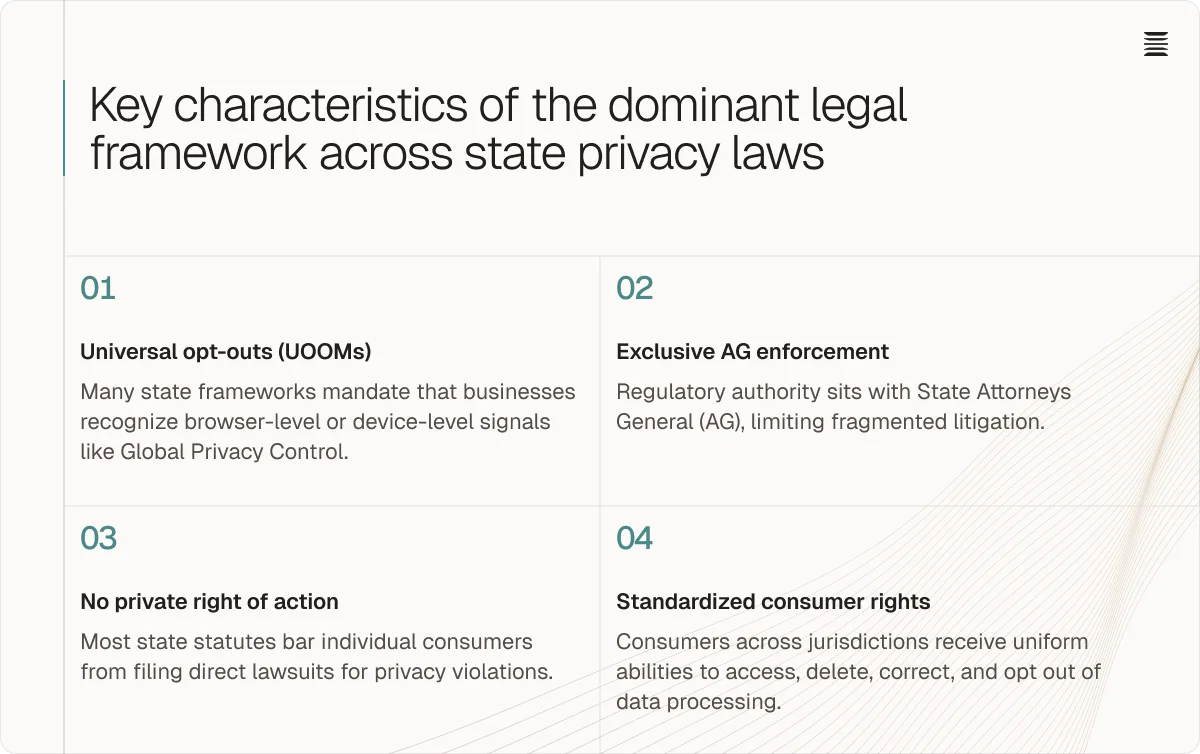
This patchwork makes data privacy an increasingly important part of commercial legal support, which might include drafting the following:
- Privacy policies
- Impact assessments
- Cookie notices
- Vendor terms
- Data processing agreements
For companies building or using AI, the legal work in this area can also cover acceptable-use policies, training data, model governance, and safeguards for new AI features.
Regulatory, compliance, and risk advice
As businesses expand into new markets and industries, they face rules that can carry serious financial and operational consequences if ignored.
Regulatory, compliance, and risk advice allows companies to understand these obligations and build processes to manage them. The obligations in question include:
- Industry-specific requirements
- Licensing
- Anti-money laundering and anti-corruption rules
- Sanctions
- Trade controls
- Import and export requirements
- Environmental regulations
If your business is operating internationally, commercial lawyers may also assess third-party and cross-border risks and advise on compliance programs designed to catch problems before they trigger investigations, penalties, or disruptions.
Transactional work: Making deals happen
Transactional work covers the legal work behind major business deals and financial decisions. It comes into play when a company is buying or selling a business, raising capital, issuing shares, securing financing, or restructuring. The number one goal of commercial lawyers here is to ensure that the resulting agreement reflects the deal the parties actually intend to make.
Commercial contracts and agreements
Commercial contracts are the legal backbone of most business relationships. However, they’re also a major source of commercial disputes.
In 2025, the American Arbitration Association handled almost 12,000 B2B cases involving over $21.37 billion in claims, underscoring why getting the terms right before signing matters.
That’s precisely what commercial lawyers aim to achieve. They draft, review, and negotiate the agreements to define obligations, allocate risk, and give businesses workable terms before they sign. The agreements in question can include:
- Master Services Agreements (MSAs)
- Statements of work
- Vendor and supplier agreements
- One-way and mutual Non-Disclosure Agreements (NDAs)
- SaaS and subscription agreements
- Customer terms
Startup fundraising and venture financings
More than $400 billion flowed into US startups in the first half of 2026 alone, already exceeding the full-year total for 2025. For companies raising that capital, the legal work starts well before the money lands.
In this area, commercial lawyers:
- Review term sheets
- Structure SAFEs and convertible notes
- Coordinate due diligence
- Prepare investment and equity documents
As rounds become more complex, they also handle investor rights, cap tables, founder equity, and closing requirements.
The ultimate goal is to get the company investment-ready, negotiate terms that work for its interests, and close the round without leaving legal loose ends.
Mergers and acquisitions
The US M&A market is moving into bigger, more concentrated deals: $1.2 trillion in deal value was recorded in the first five months of 2026, nearly twice the amount from the same period in 2025.
For companies buying, selling, or merging with another business, this scale of activity translates into complex legal matters that have to be carefully managed from beginning to end.
Commercial law firms can help with:
- Choosing the deal structure
- Reviewing the target through legal due diligence
- Negotiating the purchase agreement and risk allocation
- Securing required approvals
- Handling the closing
Debt and corporate finance
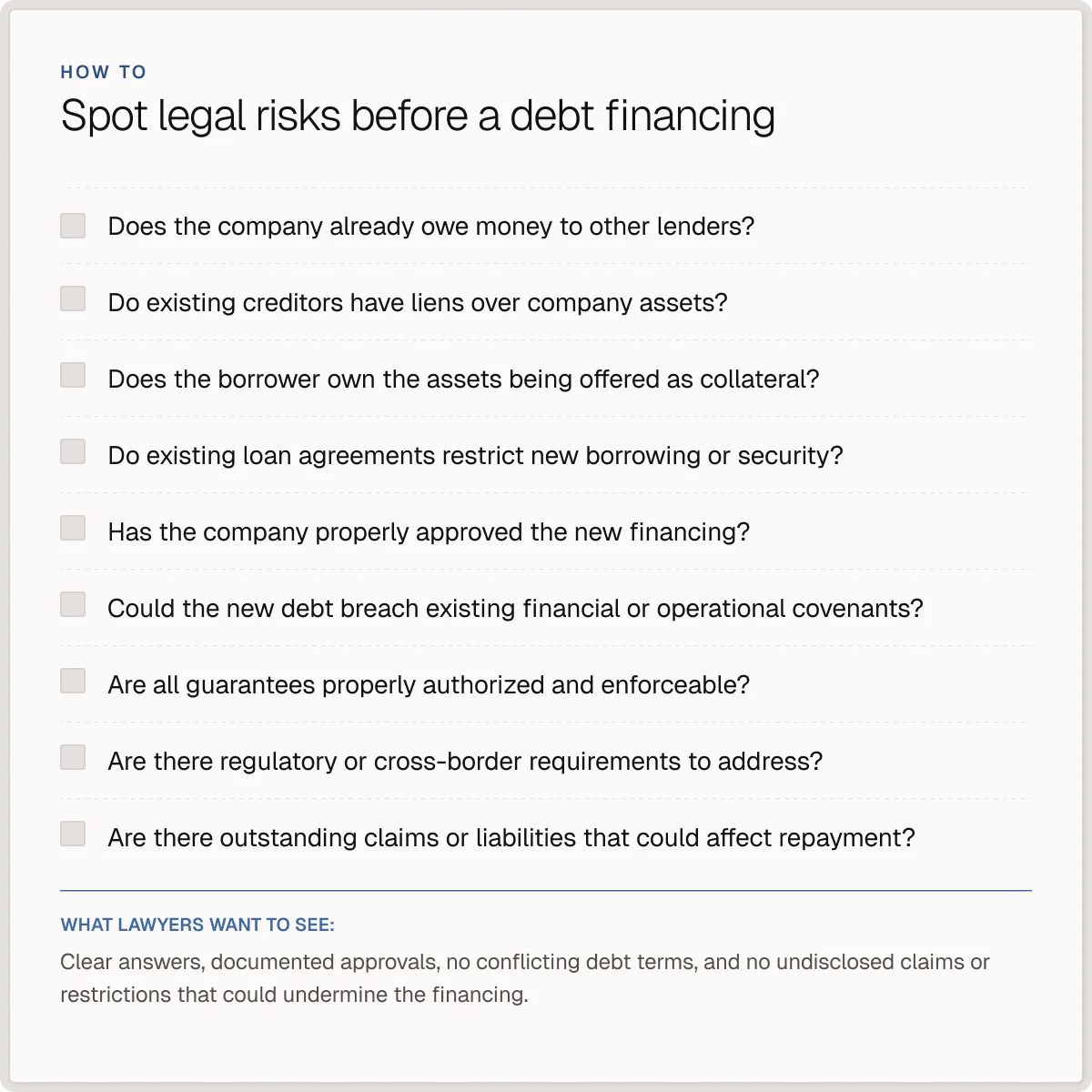
When a business needs to borrow rather than sell equity, debt and corporate finance lawyers help structure the financing and document the terms.
Their work can cover corporate loans, credit facilities, venture debt, asset-based lending, and project finance, along with promissory notes, security agreements, and guarantees.
They also negotiate key terms like repayment schedules, covenants, and default provisions, while reviewing existing obligations and assets for legal issues that could affect the deal.
Private equity and growth investments
Private equity firms had roughly $1.1 trillion in dry powder in the US in 2025, which means that enormous amounts of committed capital were available for new investments.
Deploying that capital requires lawyers to manage the legal complexity of acquiring, financing, and eventually exiting investments.
Their work can include leveraged buyouts, platform and bolt-on acquisitions, minority investments, and joint ventures, alongside legal due diligence and negotiation of purchase and financing documents. Commercial lawyers may also:
- Structure management incentive plans and rollover equity
- Handle regulatory approvals
- Advise portfolio companies through subsequent acquisitions, restructurings, and exits
Technology, licensing, and IP transactions
Putting technology on the market creates a new set of legal questions, including:
- Who can use the software?
- Who owns the underlying IP?
- What happens if the product fails, data is mishandled, or a partner walks away?
Technology and IP transactions answer those questions through SaaS agreements, software licenses, IP licenses, procurement terms, joint-development agreements, and reseller or integration contracts.
Real estate transactions
A business’s property can be one of its largest assets or expenses, so mistakes in a purchase, lease, or development deal can tie up capital, create unexpected liabilities, or limit how the property can be used.
Commercial lawyers help avoid these mistakes by handling the agreements and due diligence behind the transactions, including:
- Purchase contracts
- Deeds
- Commercial leases
- Title reviews
- Zoning issues
They may also coordinate commercial financing, structure the deal for tax purposes, and manage the legal steps required to close and transfer the property.
Equity capital markets and IPOs
Going public is one of the biggest legal transitions a company can make.
Commercial lawyers assist companies in preparing for that transition by:
- Restructuring governance
- Conducting legal due diligence
- Drafting prospectuses and registration statements
- Negotiating underwriting agreements
They can also handle exchange and securities-law requirements for IPOs, secondary offerings, rights issues, direct listings, and other equity capital markets transactions.
Contentious work: Resolving business disputes
Contentious work comes into play when a disagreement has moved beyond ordinary legal advice, and the business needs to protect its position against another party. The objective here is to resolve the matter while limiting financial, operational, and reputational damage.
Depending on the circumstances, lawyers may negotiate directly, pursue mediation or arbitration, or take the dispute to court.
The right approach primarily depends on the type of dispute.
Common business disputes
Common business disputes arise from the company’s everyday commercial relationships and normally involve customers, vendors, competitors, creditors, insurers, or other third parties.
The table below breaks down the most common types and what they typically involve:
| Dispute type | Examples |
|---|---|
| Contract disputes | Breach of contract, contract interpretation, customer or vendor disagreements |
| Debt disputes | Unpaid invoices, debt recovery, creditor claims |
| Fraud and misrepresentation | Fraudulent statements, deceptive business practices |
| Business torts | Tortious interference, unfair competition, restraint of trade, injurious falsehood |
| Professional negligence | Claims against accountants, advisers, or other professional service providers |
| Insurance disputes | Coverage disagreements and claims over policy obligations |
| Property disputes | Commercial lease, purchase, development, and other real estate conflicts |
| Technology disputes | SaaS agreements, software, technology services, and platform disagreements |
Internal business disputes
Internal disputes arise when the conflict is inside the company or between the people who own, manage, or work for it.
For startups and closely held businesses, these can be particularly disruptive because a disagreement between founders or shareholders can affect control, equity, decision-making, and the company’s ability to operate.
Here are the most common types of internal business disputes:
| Dispute type | Examples |
|---|---|
| Shareholder disputes | Voting, control, profit-sharing, or derivative claims |
| Founder disputes | Co-founder breakups, ownership disagreements, founder obligations |
| Partnership disputes | Management, profit-sharing, or business-direction conflicts |
| Governance disputes | Board decisions, fiduciary duties, corporate authority |
| Equity disputes | Stock options, equity grants, vesting, ownership claims |
| Employment disputes | Wrongful termination, discrimination, executive conflicts |
| IP ownership disputes | Claims over technology, inventions, or other company IP |
Specialist and regulatory disputes
These matters involve specialized legal regimes, regulators, or unusually complex commercial issues, often raising higher stakes or requiring industry-specific expertise. A dispute like this may involve significant financial exposure, government enforcement, restrictions on the business, or complex questions of law.
Common examples of these disputes include:
| Dispute type | Examples |
|---|---|
| IP disputes | Patent, trademark, copyright, and trade-secret claims |
| Competition disputes | Antitrust claims, merger challenges, competition-law disputes |
| Financial services disputes | Securities claims, investor disputes, regulated-finance matters |
| Regulatory disputes | Enforcement actions, regulatory challenges, government investigations |
| M&A disputes | Claims arising from acquisitions, representations, or transaction terms |
| Insolvency and creditor disputes | Bankruptcy claims, debt recovery, creditor rights |
| Business crime and investigations | Corporate fraud and other alleged business crimes |
Many of these commercial disputes can be prevented or contained with the right legal support from the outset.
Properly drafted contracts can reduce ambiguity, employment agreements can establish clear expectations and rights, and IP assignments and equity documents can prevent disputes over ownership and compensation.
These are also among the legal services offered by General Legal, an AI-native law firm built around the needs of growing businesses.
General Legal: Commercial law built for the growth stage

General Legal is an AI-native commercial law firm built around a simple premise: businesses shouldn’t have to choose between top-tier legal work and the speed their operations demand.
The firm uses AI-native workflows to automate the repetitive parts of legal work, while experienced lawyers handle the judgment, strategy, and final advice. This model allows General Legal to turn work around in hours rather than days or weeks and offer upfront flat-fee pricing, while clients can work directly with their legal team through Slack.
General Legal’s core commercial practices include:
- Commercial contracts: The firm drafts, reviews, and negotiates the agreements businesses rely on every day.
- Employment: Growing teams can turn to General Legal for employment agreements, equity arrangements, and other workplace matters.
- Data privacy: Privacy, data protection, and AI governance requirements are addressed as part of the firm’s data privacy practice.
- Financial regulatory: The practice covers commercial legal work involving payments, lending, financial products, and related regulatory requirements.
- Emerging companies and venture capital: Startups receive legal support from incorporation through fundraising and later stages of growth.
- Tax: Tax counsel covers structuring and planning at different points in the company lifecycle.
- Technology transactions: Software, SaaS, licensing, and other technology relationships form the core of this practice.
- Blockchain and cryptocurrency: General Legal provides legal support for digital-asset businesses and products.
General Legal’s practice areas are also constantly expanding.
For example, we’re currently exploring areas like real estate, with the longer-term ambition of bringing our AI-native model to legal work across industries.
If your business needs commercial legal support, General Legal gives you a straightforward way to get it.
Need a contract reviewed today? Create your account and send us your first contract right away. Have a specific legal question or need advice on a more complex matter? Book a quick call with our team to discuss what your business needs.
FAQ
What is the definition of commercial law?
Commercial law is the body of law governing business activities, commercial transactions, and relationships between businesses and other parties.
What is another name for commercial law?
Commercial law is also commonly called business law, although the two terms can have slightly different meanings depending on the context.
What do commercial law firms do?
Commercial law firms advise and represent businesses on legal matters including contracts, corporate affairs, employment, financing, transactions, regulatory compliance, and commercial disputes.
- Commercial law firms provide three core service types: advisory work to manage risk and compliance, transactional work to structure deals and financings, and contentious work to resolve business disputes.
- Early-stage legal decisions around company formation, IP ownership, employment agreements, and equity structures can prevent expensive disputes as companies grow.
- Over 578,000 business applications were filed in July 2026 alone, with nearly all eventually requiring commercial legal support for contracts, hiring, fundraising, or disputes.
- AI-native law firms like General Legal combine experienced attorneys with automated workflows to deliver flat-fee pricing and faster turnaround times than traditional commercial firms.
- Startups face concentrated legal complexity across fundraising, equity compensation, IP assignment, employment classification, tax elections, and privacy compliance as they scale.
- Common business disputes involving contracts, debt, fraud, employment, shareholder conflicts, and regulatory enforcement can often be prevented through properly drafted agreements and governance documents.
| Advisory services | Commercial lawyers provide ongoing guidance on formation, governance, employment, IP protection, tax planning, privacy compliance, and regulatory risk before problems arise. |
|---|---|
| Transactional work | Law firms structure and document major business deals including contracts, fundraising rounds, M&A transactions, debt financing, technology licenses, real estate purchases, and IPOs. |
| Contentious matters | When disputes occur, commercial lawyers handle resolution through negotiation, mediation, arbitration, or litigation for contract breaches, shareholder conflicts, employment claims, IP disputes, and regulatory enforcement. |
| Startup-specific needs | Growing companies require legal support for equity structures, founder vesting, stock options, 83(b) elections, IP assignments, and venture financing that affects future fundraising and exits. |
| Business volume drivers | With roughly 500,000 new US business applications monthly and over $400 billion in startup funding in early 2026, demand for commercial legal services continues at high levels. |
| Dispute prevention | Strong contracts, clear ownership arrangements, and well-structured employment and equity documents established early reduce legal exposure and prevent costly conflicts later. |
| AI-native delivery model | Firms like General Legal use AI workflows to automate repetitive tasks while lawyers handle strategy and judgment, enabling flat-fee pricing and turnaround measured in hours instead of weeks. |
| Practice area scope | Commercial law encompasses contracts, corporate governance, employment, IP, tax, privacy, regulatory compliance, financing, M&A, technology transactions, real estate, and dispute resolution. |
When does a startup actually need a commercial lawyer?
Startups typically need legal support at incorporation to establish ownership and governance structures, when making first hires to handle employment agreements and equity grants, during fundraising to review term sheets and structure investment documents, and when IP ownership needs to be clearly assigned from founders and contractors.
What's the difference between advisory and transactional commercial legal work?
Advisory work involves ongoing legal counsel to manage risk, ensure compliance, and make informed decisions on matters like employment, governance, IP protection, and regulatory obligations. Transactional work focuses on specific deals or financial events such as fundraising, M&A, debt financing, or major contracts, requiring structured documentation and negotiation to close the transaction.
How can early legal decisions prevent disputes later?
Properly drafted contracts reduce ambiguity that leads to breaches, clear IP assignment agreements prevent ownership disputes during fundraising or exit, well-structured employment and equity documents establish expectations and rights upfront, and appropriate governance frameworks reduce shareholder and founder conflicts as the company grows.
What does flat-fee pricing mean for commercial legal services?
Flat-fee pricing provides upfront cost certainty for defined legal work instead of hourly billing that can escalate unpredictably. AI-native firms like General Legal can offer this model by automating repetitive tasks, allowing lawyers to focus on judgment and strategy while delivering faster turnaround and transparent pricing.
Why is IP ownership particularly important for startups?
Unclear IP ownership creates serious problems during investor due diligence, hiring, or business sales because founders, employees, and contractors may all contribute to valuable code, designs, or other assets. Companies need proper assignment and confidentiality agreements from the outset to establish ownership and protect these assets as the business grows.
What commercial disputes are most common for businesses?
The most frequent disputes involve contract breaches with customers or vendors, unpaid invoices and debt recovery, shareholder and founder disagreements over control or equity, employment matters including wrongful termination claims, and IP ownership conflicts. The American Arbitration Association handled nearly 12,000 B2B cases in 2025 involving over $21 billion in claims.
- What is an AI-native Law Firm? [The Complete Guide]Learn what an AI-native law firm is so you can understand how AI transforms legal services and improves efficiency.
- Commercial Contract Litigation: When It Happens & How to AvoidExplore what you need to know about commercial contract litigation so you can understand common disputes, manage legal risks & protect your business.
- Commercial Terms vs. Legal Terms: 5 Key DifferencesCompare commercial terms vs legal terms so you can understand key differences, spot risks, and protect your interests before signing a contract.