
Every business relationship you enter raises the same open questions: who gets paid, who owns what, who takes the risk, and what happens when things don’t go according to plan.
A commercial contract answers these questions.
Some founders believe that these contracts only matter once you’re closing seven-figure deals. However, given that 12 million annual contract lawsuits are filed against small businesses in the US alone, it’s clear that size doesn’t buy you an exemption from getting sued.
To help you understand what’s at stake regardless of your size, growth stage, or industry, this guide breaks down 11 reasons why you need commercial contracts.
What are commercial contracts?
Commercial contracts are legally binding agreements that formalize the terms of a business arrangement, ensuring everyone involved is operating from the same playbook.
These contracts are typically signed when:
- Selling products or services to customers
- Purchasing goods or services from vendors and suppliers
- Hiring employees, freelancers, or independent contractors
- Sharing confidential information with third parties
- Licensing intellectual property, software, or proprietary technology
- Entering into a partnership or joint venture
- Bringing on advisors, consultants, or fractional executives
- Raising capital from investors
- Outsourcing operational functions like IT, customer support, or manufacturing
- Acquiring, merging with, or selling a business
Depending on the situation, you’ll likely need one or more of these commercial contract types:
| Contract type | What it does |
|---|---|
| Master Services Agreement (MSA) | Establishes the framework for an ongoing services relationship |
| Customer Agreement | Sets the terms under which you provide products or services to customers |
| Vendor Agreement | Governs the purchase of goods or services from suppliers and vendors |
| Non-Disclosure Agreement (NDA) | Protects confidential information shared between parties |
| Employment Agreement | Defines compensation, responsibilities, and employment-related obligations |
| Shareholders’ Agreement | Sets out the rights and responsibilities of founders and investors |
| Advisor Agreement | Formalizes an advisor’s role, compensation, and obligations |
| Partnership or Joint Venture Agreement | Governs how two businesses will collaborate and share responsibilities |
| SaaS Terms and Conditions | Establishes the rules governing access to and use of a software platform |
While the contract itself may change depending on the business scenario, the value it creates for your business remains consistent.
Why you need commercial contracts: 11 reasons
From day-to-day operations to long-term growth, these 11 reasons illustrate why commercial contracts are a fundamental part of running a successful business.
1. They establish clear rules for the business relationship
A commercial contract gives every stakeholder the same understanding of how the business relationship is supposed to work. It outlines each party’s obligations, key deliverables, timelines, and performance standards, creating a shared framework from day one.
Without that framework, businesses are often forced to rely on assumptions, verbal conversations, and conflicting recollections of what was agreed upon.
2. They create guardrails around business risk
No matter how strong a business relationship is, problems can still arise. A supplier may miss a critical deadline, a customer may refuse to pay, a contractor may deliver substandard work, or a service outage may disrupt operations. When that happens, the fallout can affect cash flow, operations, and customer relationships.
Commercial contracts keep those consequences under control.
They assign responsibility for delays, defects, payment failures, data breaches, and other common risks before they become problematic. They also limit financial exposure, establish remedies, and outline how unforeseen events, such as supply chain disruptions or regulatory changes, should be handled.
Thanks to these provisions, commercial contracts create predictability when circumstances are at their most uncertain. Rather than negotiating solutions in the middle of a crisis, the parties can follow a framework they agreed to before problems emerged.
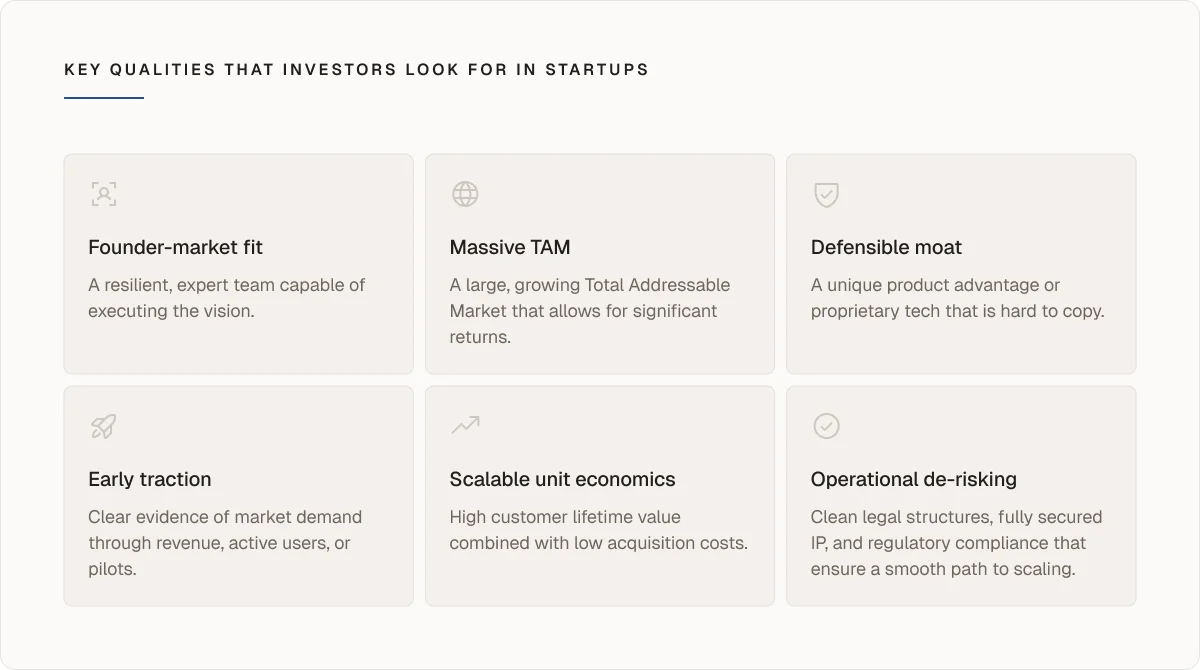
For startups looking to raise capital, there’s another benefit to proactively managing risk. Investors want confidence that the business can scale without preventable legal and operational issues, and robust commercial contracts provide that assurance.
3. They make business commitments enforceable
Businesses evolve quickly, and agreements often outlast the people who negotiated them. Team members leave, priorities change, and memories fade. A commercial contract preserves the terms of the deal in a form that doesn’t depend on anyone’s recollection of a meeting or Slack conversation.
This is particularly important for growing companies, where relationships with customers, vendors, partners, and contractors can span months or even years.
4. They reduce payment-related friction
Late payments are a persistent challenge for businesses. More than half of small businesses report being owed money on unpaid invoices, with the average business carrying $17,500 in outstanding payments at any given time.
In many cases, the problem isn’t an unwillingness to pay; it’s disagreement over what was owed, when it was due, or how it should be invoiced.
Commercial contracts help eliminate that uncertainty by establishing:
- Pricing breakdown
- Payment schedules
- Accepted payment methods
- Invoicing requirements
- Refund terms
- Consequences for late payment
By documenting these details upfront, contracts make it easier for businesses to get paid accurately and on time.
5. They protect sensitive business information
Businesses regularly share confidential information with employees, contractors, vendors, partners, and prospective customers. While that information may be necessary to progress a deal, it can also create significant risk if it’s disclosed, misused, or shared with competitors.
Businesses typically protect sensitive information through confidentiality clauses in commercial contracts or standalone NDAs. Common examples of the type of information protected by these contracts include:
- Customer and prospect lists
- Pricing and commercial terms
- Financial data and forecasts
- Product roadmaps and business strategies
- Proprietary processes and trade secrets
- Technical documentation and source code
6. They establish ownership of intellectual property
For many businesses, intellectual property is among their most valuable assets. Software companies rely on source code, manufacturers depend on proprietary formulas and product designs, agencies create original creative assets, and consumer brands build value through trademarks and brand recognition.
Without ownership of these assets, much of the value created by the business can be placed at risk.
That’s why commercial contracts are necessary when engaging third parties who may create, access, license, or use intellectual property as part of the relationship. These parties include:
- Software developers
- Consultants
- Designers
- Manufacturers
- Distributors
By defining ownership rights, licensing permissions, and usage restrictions up front, contracts enable businesses to retain control over the assets that drive their competitive advantage.
7. They create accountability when agreements are breached
Disputes involving broken contractual obligations are one of the most common sources of commercial litigation, with breach-of-contract cases increasing by 15% in 2023 alone. Many originate from familiar situations: missed payments, service failures, delayed deliveries, or non-compliance with agreed terms.
Besides proving that something went wrong, businesses often struggle to determine what happens next because they have no prior agreement on how to handle the breach.
With a commercial contract in place, the breaching party may be required to:
- Fix the issue within a specified period
- Compensate the other party for resulting losses
- Pay predetermined damages
- Face termination of the agreement
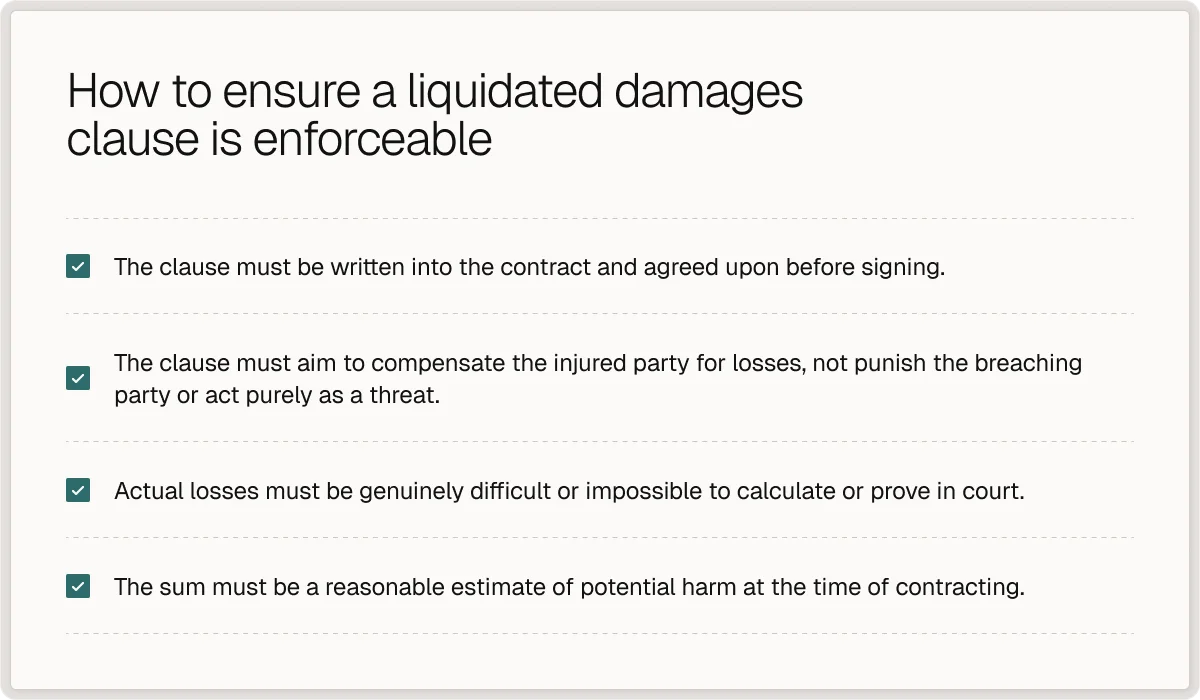
For specific types of agreements, such as Service Level Agreements (SLAs), commercial contracts can include a liquidated damages clause, which establishes predetermined financial consequences for certain breaches or performance failures.
8. They provide a structured exit strategy
Not every business relationship is built to last. Priorities change, partnerships lose momentum, and sometimes, the relationship just stops delivering value.
Commercial contracts allow businesses to exit these arrangements in an orderly manner through termination provisions. These can specify:
- When an agreement can be ended
- How much notice must be given
- Which obligations survive termination
- What happens to ongoing work, payments, or confidential information
Rather than navigating a difficult separation without guidance, both parties can follow a predefined process that minimizes disruption and helps protect their interests.
9. They establish credibility with partners and customers
In many industries, a formal contract is the standard way of doing business. Customers, suppliers, investors, and strategic partners expect important commercial relationships to be documented.
For this reason, a well-drafted contract often signals that your business operates professionally and takes its commitments seriously. When both parties understand their responsibilities and commitments from the outset, there is less friction, fewer misunderstandings, and a more solid basis for long-term collaboration.
10. They support business growth and scalability
Informal agreements may be manageable when a business is small, but they become increasingly difficult to maintain as the company grows.
Standardized agreements make it easier to onboard new parties, negotiate terms more efficiently, and ensure key protections are applied across the business. Instead of reinventing the process for every new deal, companies can rely on a repeatable framework that supports growth at scale.
11. They embed compliance into business relationships
Many businesses operate in environments shaped by legal, regulatory, and industry-specific requirements. Depending on the industry, these obligations may relate to data protection, employment practices, cybersecurity, financial regulations, and product safety.
Through commercial contracts, businesses can translate these requirements into enforceable obligations. They can require customers, vendors, contractors, and other third parties to do the following:
- Follow applicable laws
- Meet industry standards
- Maintain specific safeguards
- Comply with internal policies
By embedding compliance requirements directly into commercial relationships, businesses can reduce regulatory risk and demonstrate that appropriate controls are in place.
Given the role commercial contracts play in supporting compliance and other essential business functions, they should be drafted by—or at least reviewed by—experienced commercial attorneys.
Get commercial contracts right from the start
The strongest contracts are written in clear language, allocate risk appropriately, anticipate common points of friction, and protect the interests that matter most to the parties involved. Getting those details right at the outset is often far less expensive than trying to fix problems after a dispute arises.
While you can create a commercial contract yourself using online templates or precedent documents, hiring a lawyer gives you access to something these two can’t provide: legal judgment.
Experienced commercial attorneys can identify unusual risks, spot terms that fall outside market standards, clarify ambiguous language, and ensure the agreement aligns with both your legal and commercial objectives.
Even when a contract appears straightforward, a second set of trained eyes can uncover issues that would otherwise go unnoticed.
The problem is that many growing businesses are forced to choose between doing everything themselves and hiring a traditional law firm. One option can leave critical issues unaddressed; the other often means high hourly rates, slow turnaround times, and lengthy email chains that delay the deal.
That’s where General Legal comes in.
General Legal is an AI-native law firm built for growth-stage companies. It combines experienced US-barred attorneys with proprietary AI-powered workflows to deliver high-quality commercial legal services more efficiently and predictably than traditional firms.
The AI handles much of the repetitive review and analysis work, while attorneys provide the legal judgment, strategy, and advice that businesses rely on when making important decisions.
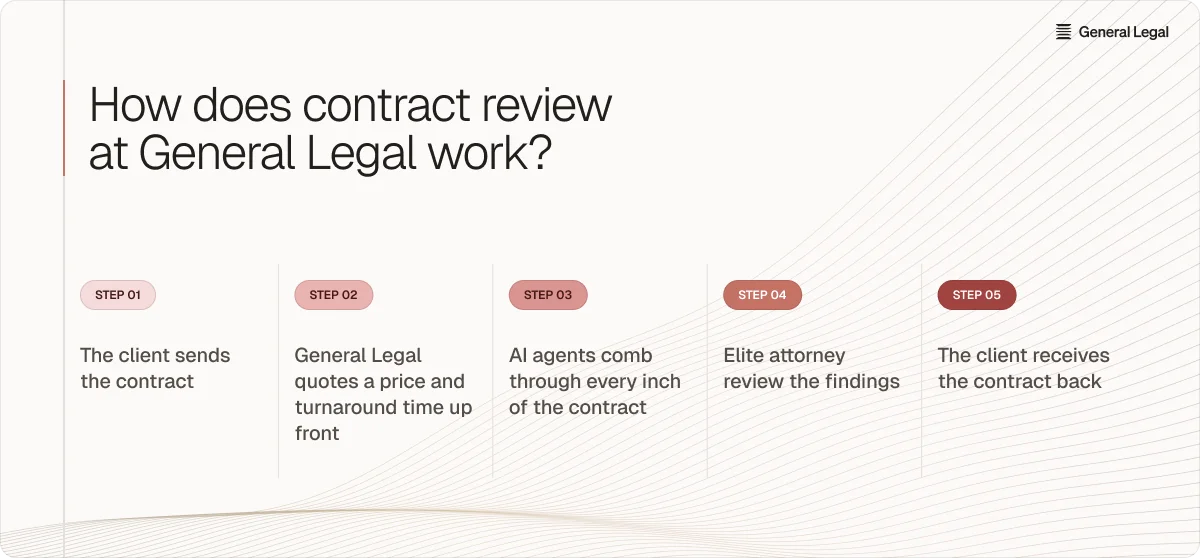
The process is straightforward:
- You send over a contract or legal request through Slack, email, or the client portal.
- General Legal provides an upfront flat-fee quote.
- AI systems perform the initial review and issue spotting.
- An attorney delivers the final work product, often within hours rather than days.
Whether you need a commercial contract reviewed, negotiated, or drafted from the ground up, General Legal provides the speed of modern software with the accountability of a real law firm.
If you have a contract that needs attention, you can start sending legal requests immediately or reach out to our team first to discuss your matter.
- Commercial contracts matter regardless of company size: roughly 12 million contract-related lawsuits are filed against small businesses in the US each year.
- The article lists 11 functions contracts serve, including setting clear rules, allocating risk, making commitments enforceable, reducing payment friction, protecting confidential information, establishing IP ownership, creating breach accountability, providing exit terms, signaling credibility, supporting scalable growth, and embedding regulatory compliance.
- More than half of small businesses report unpaid invoices, with the average business carrying about $17,500 in outstanding payments at any time, a problem contracts address through clear pricing, payment schedules, and late-payment consequences.
- Breach-of-contract cases increased 15% in 2023, and contracts establish upfront what happens when an agreement is broken, including cure periods, damages, or termination.
- General Legal positions itself as an alternative to both DIY templates and traditional hourly-billing firms, using a flat-fee quote plus AI-assisted first-pass review followed by attorney sign-off, often delivered within hours.
| Why size doesn't exempt you | About 12 million contract-related lawsuits are filed against US small businesses annually, showing informal handshake deals carry real legal risk at any size. |
|---|---|
| The 11 functions of contracts | They set clear rules, allocate risk, make commitments enforceable, reduce payment friction, protect confidential information, secure IP ownership, create breach accountability, define exit terms, signal credibility, support scalable growth, and embed compliance obligations. |
| Payment friction specifically | More than half of small businesses report unpaid invoices, with the average business owed about $17,500 at any given time; contracts fix this by spelling out pricing, schedules, and late-payment consequences upfront. |
| Breach and enforcement | Breach-of-contract cases rose 15% in 2023; contracts pre-define what happens next through cure periods, damages, liquidated-damages clauses, or termination rights. |
| Common contract types | MSAs, customer and vendor agreements, NDAs, employment agreements, shareholder agreements, advisor agreements, partnership/JV agreements, and SaaS terms each serve a different relationship. |
| IP and confidentiality | Contracts are how businesses lock down ownership of code, designs, and trade secrets when working with developers, consultants, designers, manufacturers, or distributors. |
| DIY vs. professional review | Templates can work as a starting point, but they rarely account for a specific business's risks, which is where legal judgment from an attorney adds value. |
| General Legal's process | Clients send a contract via Slack, email, or portal, get an upfront flat-fee quote, AI performs first-pass review, and an attorney delivers the final work product, often within hours. |
Do small businesses really need to worry about contract disputes?
Yes. Roughly 12 million contract-related lawsuits are filed against US small businesses every year, so size alone doesn't provide protection.
What's the biggest practical problem contracts solve around payment?
Late and disputed payments. More than half of small businesses report unpaid invoices, averaging about $17,500 outstanding at a time, which clear pricing, schedules, and late-payment terms help prevent.
Can I just use an online contract template instead of hiring a lawyer?
You can, but templates rarely account for your specific business risks; a lawyer adds legal judgment that can catch unusual risks or off-market terms a template would miss.
What happens legally when someone breaches a contract?
Depending on the contract's terms, the breaching party may need to fix the issue within a set period, compensate for losses, pay predetermined damages, or face termination of the agreement.
How does General Legal handle contract review differently from a traditional firm?
Clients get an upfront flat-fee quote, AI performs the initial review and issue-spotting, and an attorney delivers the final work product, often within hours rather than days.
What are the most common types of commercial contracts a business needs?
MSAs, customer and vendor agreements, NDAs, employment agreements, shareholder agreements, partnership/joint venture agreements, and SaaS terms and conditions.
Why is it important to have a contract?
A contract is important because it establishes expectations, allocates risk, protects business interests, and creates legally enforceable obligations between the parties.
Can I create my own contract?
Yes, you can create your own contract using templates or precedent agreements. However, hiring a lawyer ensures the contract reflects your specific business needs and adequately protects your interests.
What are some examples of commercial contracts?
Examples of commercial contracts include NDAs, MSAs, vendor agreements, employment agreements, software licensing agreements, and independent contractor agreements.
What are the commercial terms of a contract?
Commercial terms are the business provisions of a contract, such as pricing, payment terms, deliverables, timelines, service levels, and termination rights.
When do businesses need commercial law services?
Businesses typically need commercial law services when drafting, reviewing, negotiating, or managing contracts, as well as when entering new business relationships, resolving disputes, or navigating regulatory requirements.
- Commercial Contract Litigation: When It Happens & How to AvoidExplore what you need to know about commercial contract litigation so you can understand common disputes, manage legal risks & protect your business.
- 9 Must-Have Startup Contracts [Early-Stage Founder’s Guide]Discover the must-have contracts for startups so you can protect your business, clarify responsibilities, manage risk, and grow.
- What Should Be Included in a Commercial Contract: 15 ClausesLearn what should be included in a commercial contract so you can define key terms, manage risks, and protect your interests.