
TL:DR: Claude Work for Legal caught nine legitimate, real risk issues in a Master Services Agreement in about ten minutes, and it explained the reasoning behind each one. That's genuinely impressive. But it did not tell the reviewer which of those nine issues actually mattered for this specific deal, how hard to push on each one, what "market" really means for this industry and deal size, or how to sequence the negotiation without burning goodwill. A 2026 industry survey found that 58% of in-house lawyers have used AI to review contracts in the past year, but only 31% use AI tools to redline them, the step that requires the most judgment. General Legal's answer to this gap is a hybrid workflow: AI handles the first pass, a lawyer supplies the context, prioritization, and strategy.
What the AI Found
The AI flagged several categories of issues that are genuinely important for a service provider to consider:
Risk allocation provisions like the "time is of the essence" clause, a short cure period for breaches, and a broad indemnification provision covering "any intentional act or omission."
Business terms like a very short initial term (3 months) and restrictions on assigning the contract to affiliates or acquirers.
IP protections ensuring the service provider retains ownership of its pre-existing tools, methodologies, and general know-how.
Each of these is a real issue that could meaningfully impact the service provider's risk profile. The AI correctly identified them and (usually) proposed reasonable alternative language.
So what's missing?
The Context Problem
Contract negotiation isn't about identifying every possible issue—it's about understanding which issues matter in this specific deal. It means knowing which issues to push on and which to let go in the interest of getting the deal done. The classic mistake rookie lawyers make is to overzealous in their markup, massively slowing the deal by arguing over terms where the other side will never bend.
The Prioritization Problem
The AI produced nine suggested changes. Unless you hold a lot of leverage over the other party, you can't push hard on all nine. Counterparties have limited patience, and every ask spends relationship capital.
A skilled lawyer helps you answer: What do I actually care about here?
Maybe the IP carve-outs are genuinely critical because the service provider's core business depends on reusing its tools across clients. That's worth fighting for.
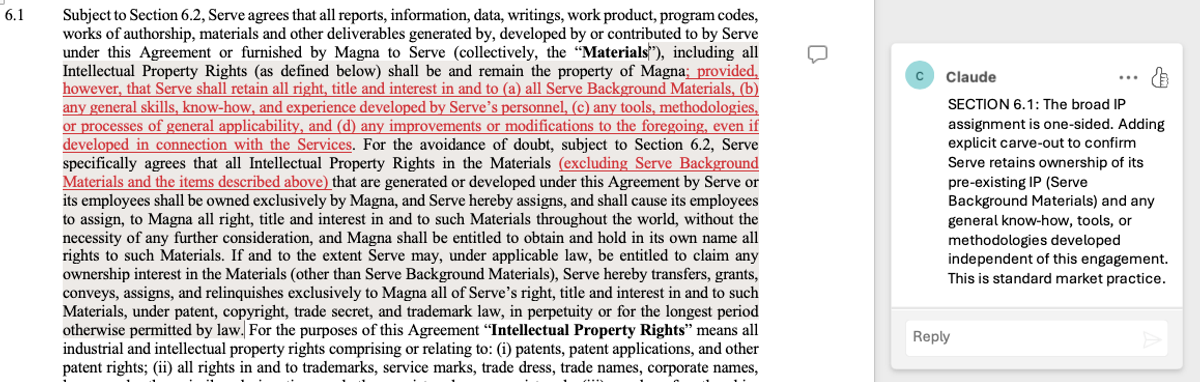
ip carveout
But the governing law change from Delaware to New York is, in most cases, an unnecessary complication that doesn't need to be argued over. Both states have sophisticated commercial courts, and the practical difference is minimal.

governing law
The "time is of the essence" provision here is unusual, Claude was right to flag it, but it's so unusual that this was likely an important part of the agreement between the parties. In practice, this was likely already agreed, something your lawyer would know, but the AI does not.
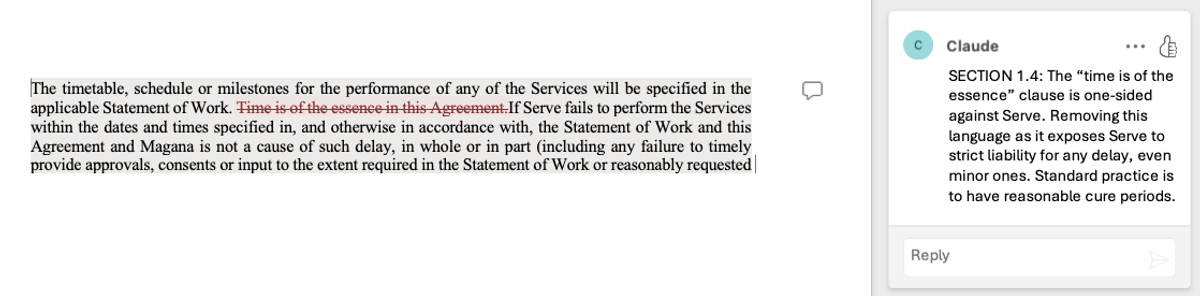
time of the essence
A lawyer who knows your business, your risk tolerance, and your relationship with this counterparty can help you pick your battles wisely.
The "Market" Problem
Every AI suggestion came with a rationale like "this is standard market practice" or "these are standard carve-outs." But, first of all, AI models don't actually have a good sense of what's market (because reliable information on what's market cannot be found on the open internet documents the AI is trained with), and, furthermore, what's "market" varies enormously by:
Industry: Software licensing deals have different norms than manufacturing contracts, which differ from professional services agreements.
Deal size: A $50,000 engagement doesn't get the same terms as a $5 million one.
Relative leverage: A startup contracting with a Fortune 500 company faces different negotiation dynamics than two equally-sized parties.
Relationship context: A first-time vendor gets scrutinized differently than a trusted long-term partner.
The AI doesn't know any of this. It applies general principles that may or may not reflect what's actually achievable—or advisable—in your specific situation.
A lawyer who works in your space knows what terms counterparties typically accept, where they usually push back, and what creative alternatives might work when a direct ask fails.
The AI doesn't know any of this. It applies general principles that may or may not reflect what's actually achievable, or advisable, in your specific situation.
This gap shows up in how lawyers themselves use these tools. A recent industry survey of in-house counsel found that 58% have used AI to review contracts in the past year, but only 31% use AI tools to redline them, the step that requires exactly the market judgment described above. Reviewing is where AI adds the most value fastest. Redlining is where lawyers still hold the line.
A lawyer who works in your space knows what terms counterparties typically accept, where they usually push back, and what creative alternatives might work when a direct ask fails.
The Strategic Problem
Contract negotiation is also about sequencing and signaling.
If you send back a redline with nine changes and extensive comments, what message does that send? Maybe it signals sophistication. Or maybe it signals that you're going to be difficult to work with.
A lawyer helps you think about:
- Should we raise these issues in the redline, or address them verbally first?
- Are there changes we should make silently vs. changes that warrant a comment explaining our position?
- How do we frame our asks in a way that feels collaborative rather than adversarial?
- What's our fallback if they reject our primary position?
These strategic questions require judgment that comes from experience—experience the AI doesn't have.
This is also why the legal profession's own ethics rules put the responsibility back on the lawyer, not the tool. ABA Model Rule 1.1's duty of technology competence, now adopted by 40 states plus DC and Puerto Rico, requires lawyers to understand the benefits and risks of the technology they use. That duty runs in both directions: a lawyer who ignores useful AI tools may fall short of it, and so does a lawyer who defers to an AI's output without applying independent judgment.
For context on the scale of the problem AI is chipping away at, one 2026 industry benchmark found that legal teams spend an average of three hours reviewing a single contract manually, which adds up to roughly 188 of 250 working days a year for teams handling 500 contracts annually. Ten minutes for a first-pass AI review against that baseline is a real efficiency gain. It's just not the same job as the negotiation that follows.
AI-Assisted Allows General Legal to Review Efficiently
Should you use Claude Work for Legal instead of a lawyer? Absolutely not. You're playing with fire.
But lawyers absolutely should use it to save them time, and they should be passing that saving on to you, the client. That's what General Legal is doing.
General Legal uses AI systems throughout the stack, making our lawyers several fold more efficient, which allows us to turn documents in hours rather than days or weeks, and do it for a low flat fee.
If you need help with a contract and want high-quality highly efficient legal advice, please contact us.
- Claude Work for Legal reviewed a Master Services Agreement in about ten minutes and surfaced nine real risk issues, including one-sided indemnification and a short cure period.
- Spotting issues isn't the same as knowing which ones actually matter for a specific deal; that prioritization judgment is where a lawyer's value shows up.
- AI can't reliably gauge what's 'market' because that depends on industry, deal size, leverage, and the relationship between the parties, not just what's published online.
- A cited 2026 survey found 58% of in-house lawyers use AI to review contracts, but only 31% use it to redline them, showing lawyers already draw a line between AI-assisted review and AI-driven negotiation.
- ABA Model Rule 1.1's duty of technology competence, now adopted by 40 states plus DC and Puerto Rico, requires lawyers both to use helpful AI tools and to apply independent judgment rather than deferring to AI output.
- General Legal builds AI into its own review workflow to work faster and pass the time savings on to clients, while keeping negotiation strategy in human hands.
| What was tested | Claude Work for Legal reviewed an MSA from the service provider's side and produced nine suggested redlines with rationale in about ten minutes. |
|---|---|
| What AI got right | It flagged real issues, including one-sided indemnification, a short cure period, a narrow 3-month initial term, and assignment restrictions. |
| The context problem | Finding issues isn't the same as knowing which ones matter enough to fight for in this specific deal. |
| The market problem | AI can't reliably judge 'market' terms because that varies by industry, deal size, leverage, and relationship context, information that isn't reliably captured in its training data. |
| The strategic problem | Negotiation is also about sequencing and signaling, deciding which issues to raise in writing versus by phone, and how many asks to make without souring the relationship. |
| Ethics rule | ABA Model Rule 1.1, adopted by 40 states plus DC and Puerto Rico, requires lawyers to understand AI's benefits and limits and not defer to it blindly. |
| General Legal's model | AI does the first pass; a lawyer supplies context, prioritization, and negotiation strategy, letting the firm turn documents around fast at a flat fee. |
Can AI tools like Claude Work for Legal replace a lawyer for contract review?
No. It can flag real issues fast, but it can't tell you which ones matter for your deal, how hard to push, or how to sequence a negotiation without damaging the relationship.
What did the AI actually catch in this test?
Nine legitimate issues in a Master Services Agreement, including a one-sided indemnification clause, a short cure period, a narrow initial term, and assignment restrictions, each with proposed alternative language.
Why can't AI reliably tell you what's 'market'?
Because market practice depends on industry, deal size, negotiating leverage, and the relationship between the parties, and that context isn't reliably captured in the documents the AI was trained on.
Do lawyers actually use AI to redline contracts?
Less than they use it to review them. A cited 2026 survey found 58% of in-house lawyers use AI to review contracts, but only 31% use it to redline, the step requiring the most judgment.
How does using AI affect a lawyer's ethical obligations?
ABA Model Rule 1.1, now adopted by 40 states plus DC and Puerto Rico, requires lawyers to understand what AI can and can't do, and it cuts both ways: ignoring useful AI and blindly deferring to it can both fall short of the duty.
How does General Legal use AI in its own contract review process?
AI performs the first-pass review to save time, and General Legal passes those savings to clients, while an attorney still supplies prioritization and negotiation strategy.
What did the AI actually get right in this review?
It correctly identified nine legitimate risk issues in a Master Services Agreement, including a one-sided indemnification clause, a short cure period, a narrow initial term, and assignment restrictions, and it proposed reasonable alternative language for most of them.
What is "market practice," and can AI reliably tell you what's market?
Market practice is the range of terms a reasonable, informed party would typically accept in a given industry, deal size, and negotiating position. AI struggles here because that information isn't reliably available in the documents it's trained on, and market terms vary by industry, deal size, leverage, and relationship context.
Do lawyers actually trust AI to redline contracts?
Not as much as they trust it to review them. A 2026 industry survey found that 58% of in-house lawyers have used AI to review contracts in the past year, but only 31% use AI tools to redline them, the step where market judgment and negotiation strategy matter most.
Does using AI change a lawyer's ethical obligations?
Yes. ABA Model Rule 1.1's duty of technology competence, adopted by 40 states plus DC and Puerto Rico as of 2026, requires lawyers to understand the benefits and risks of relevant technology, including AI. That means both using AI where it helps and applying independent judgment rather than deferring to its output.
What is General Legal's approach to AI in contract review?
General Legal uses AI throughout its workflow to speed up first-pass review, which lets lawyers turn documents around in hours instead of days, at a low flat fee. The AI handles the first pass; a lawyer still supplies the context, prioritization, and negotiation strategy. --- Disclaimer: This blog post is for informational purposes only and does not constitute legal advice. This blog post does not create an attorney-client relationship with General Legal. Every contract and business situation is unique, and you should consult with qualified legal counsel for advice on your specific circumstances.