
Waiting a week for a redline, getting billed in six-minute increments, and communicating exclusively through email was common in 2005. Fast forward to 2026, and startups are shipping products, closing deals, and raising rounds faster than many law firms can turn a contract.
In response, a new category of legal provider has emerged: AI-native law firms.
Unlike traditional firms that bolt AI onto legacy workflows, AI-native firms integrate AI into the core of their service delivery model, changing everything from staffing structures and turnaround times to pricing and client experience.
However, this category of law firms is still in its infancy.
As of late June 2026, the AI Firm Index tracks just over 50 AI-native law firms globally, 31 of them based in the United States. Compared with the country's 162,155 traditional law firms, 50 sounds like a rounding error. But for a founder trying to pick one, it’s still a real decision—and a hard one, since this category has no Chambers ranking, no Vault score, and no decade of Am Law data to lean on.
To help founders navigate this emerging category, we shortened the list to the five AI-native law firms best positioned to support startups.
5 best AI-native law firms for startups at a glance
| AI-native firm | Primary focus | Funding / Status | Best for |
|---|---|---|---|
| 1. General Legal | Startups | $11.5 million; Y Combinator’s W26 batch | Startups and growth-stage companies overall |
| 2. Moritz | Contracts | $9 million; Y Combinator’s W26 batch | Cross-border startups and complex commercial transactions |
| 3. Avantia Law | Private equity | Acquired by Carta | Venture-backed companies with complex legal operations |
| 4. LegalOS | Immigration | $10 million; Y Combinator’s W26 batch | International founders and globally distributed teams |
| 5. Covenant | Funds | $4 million | Founder-led venture funds and emerging managers |
How we chose the 5 best AI-native law firms for startups
AI adoption is becoming the norm in legal services. Bloomberg Law found that 83% of lawyers now use AI in some capacity, while SurePoint’s 2025 State of the Legal Industry Report showed that 63% of mid-sized law firms have formally adopted generative AI.
That creates a challenge for founders: When nearly everyone claims to be AI-powered, it’s increasingly difficult to tell which firms have actually changed their way of delivering legal services.
To identify the strongest options, we reviewed more than 30 AI-forward legal providers and evaluated them using the following criteria:
- AI-Native Delivery Model (30%): We examined whether AI meaningfully changes how legal work is delivered, not just how lawyers work behind the scenes. We looked for evidence that technology enables faster turnaround times, reduces manual work, and ultimately improves client experience without sacrificing legal quality.
- Startup Fit and Legal Coverage (25%): We prioritized firms that solve the common problems founders face, including fundraising, commercial contracts, employment matters, intellectual property, compliance, and day-to-day outside counsel needs.
- Attorney Oversight and Regulatory Credibility (20%): We favored firms with well-defined lawyer review processes, licensed legal teams, and, where applicable, transparent regulatory standing.
- Pricing and Founder Experience (15%): We assessed how easy each firm is to work with, based on factors like pricing transparency, responsiveness, onboarding, communication, and the overall client experience.
- Independent Market Validation (10%): We considered signals beyond a firm’s own marketing, including customer adoption, industry recognition, media coverage, venture backing, and reputation within the startup ecosystem.
1. General Legal: Best overall for startups and growth-stage companies

General Legal is an AI-native law firm built for startups and growth-stage companies. Combining experienced US-barred attorneys with AI-powered workflows, it delivers commercial legal work more efficiently and predictably than traditional firms.
The company was founded by former leaders from legal AI pioneer Casetext and is backed by Y Combinator, SV Angel, BoxGroup, Susa Ventures, and Audacious Ventures, giving it unusually strong roots in both the legal and startup ecosystems.
General Legal is the most startup-focused firm on this list. Unlike firms built around a single specialty, it supports the day-to-day legal work founders actively encounter, from commercial agreements and employment matters to data privacy and financial compliance.
Core strengths
General Legal is a strong fit for companies from seed stage through scale-up, thanks to the following capabilities:
- Rapid turnaround times: Get contracts reviewed, redlined, and returned in hours rather than days, helping your team close deals faster.
- Low-bureaucracy service model: Avoid the layers of intake forms, administrative handoffs, and internal approvals that often slow communication with traditional law firms.
- Slack-native communication: Submit requests, share documents, and get legal guidance directly inside the tools your team already uses.
- Matter-to-attorney matching: Get every legal request routed to the attorney best suited to handle it based on subject-matter expertise, urgency, and availability.
- Contract drafting and negotiation: Create and negotiate everything from MSAs and SaaS agreements to employment documents and fundraising paperwork.
- Scalable legal support: Extend your legal capacity as your company grows without immediately hiring an in-house legal team.
Pricing
Unlike most traditional law firms that bill by the hour—and many AI-native providers that rely on custom quotes—General Legal publishes flat-fee pricing directly on its website.
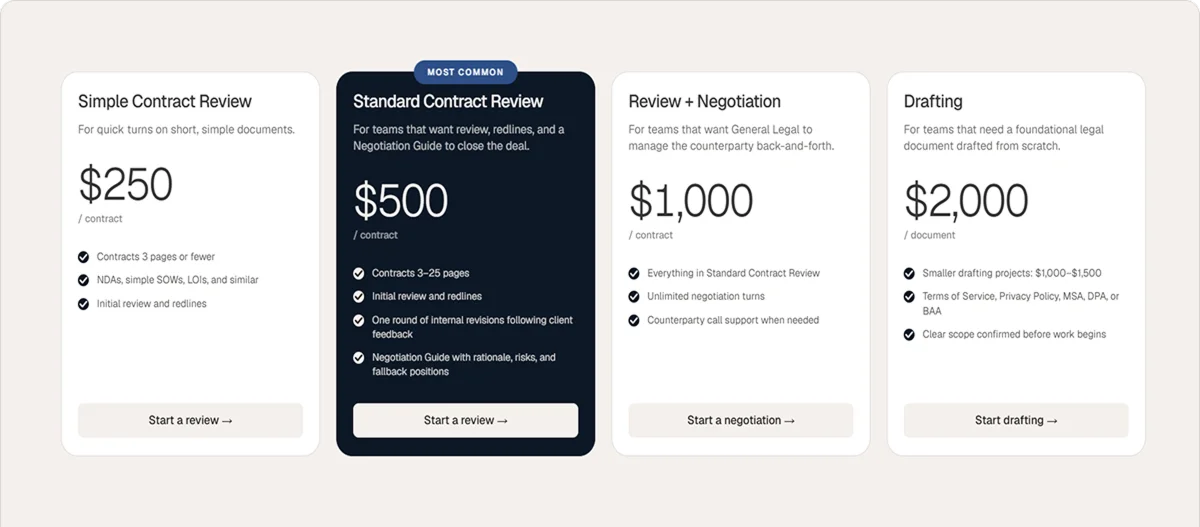
This allows founders to see what common legal matters cost before contacting the firm, making legal spend easier to forecast and compare across providers. Combined with fast delivery, this transparency creates a more predictable legal experience than most alternatives can provide.
2. Moritz: Best for cross-border startups and complex commercial transactions

Moritz is a YC-backed AI-native law firm focused on commercial, corporate, and employment matters. The firm pairs proprietary legal AI with experienced attorneys, using automation to handle much of the production work while lawyers provide strategic review, negotiation support, and final legal advice.
Founders selling internationally, raising capital, or negotiating high-value commercial agreements will value Moritz’s combination of cross-border expertise, same-day turnaround times, and support for corporate and fundraising matters.
Core strengths
Moritz focuses on helping fast-growing companies execute legal work in multiple markets through:
- Cross-border legal coverage: Navigate commercial and corporate matters spanning the US, Europe, and other jurisdictions, reducing friction as your company expands internationally.
- AI-first delivery model: Accelerate drafting and review workflows through automation, helping move transactions forward faster.
- Complex transaction support: Manage fundraising, equity, employment, and commercial agreements through a single legal provider, simplifying legal operations as you scale.
Pricing
Moritz uses a fixed-fee pricing model and publishes pricing on its website.
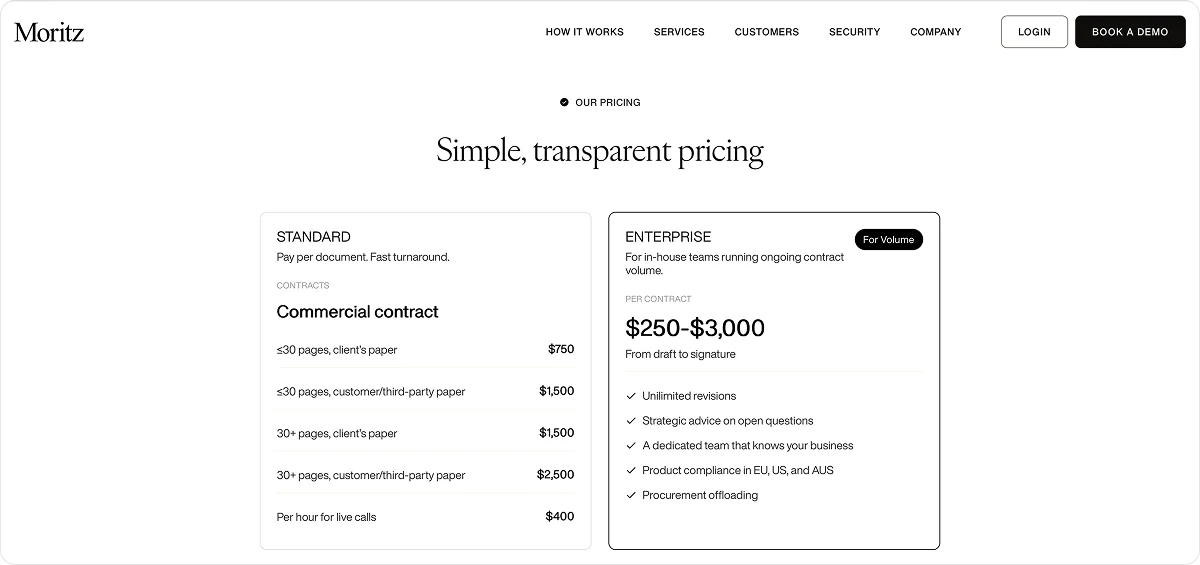
The final price will vary based on the type, complexity, and volume of legal work requested.
3. Avantia Law: Best for venture-backed companies with complex legal operations

Avantia Law is an AI-native law firm dedicated to investment funds, compliance, and managed legal operations.
Later-stage and venture-backed startups are likely to benefit most from Avantia’s approach. Rather than focusing primarily on company formation, fundraising, or day-to-day outside counsel work, the firm specializes in managing repeatable legal processes at scale.
This makes it well-suited for companies whose legal complexity comes from growing workflow volume and operational demands.
Core strengths
What distinguishes Avantia is its focus on turning repeatable legal work into structured, scalable operations, with capabilities like:
- Managed legal workflows: Centralize recurring legal processes, creating greater consistency across high-volume work.
- Contract operations support: Streamline contract administration and execution, helping reduce operational bottlenecks.
- Compliance management: Coordinate ongoing compliance activities through standardized processes, improving oversight and accountability.
Pricing
Avantia primarily works on a fixed-fee, pay-per-use basis, tailored to the scope, volume, and complexity of the engagement. However, pricing ranges aren’t publicly disclosed.
4. LegalOS: Best for international founders and globally distributed teams
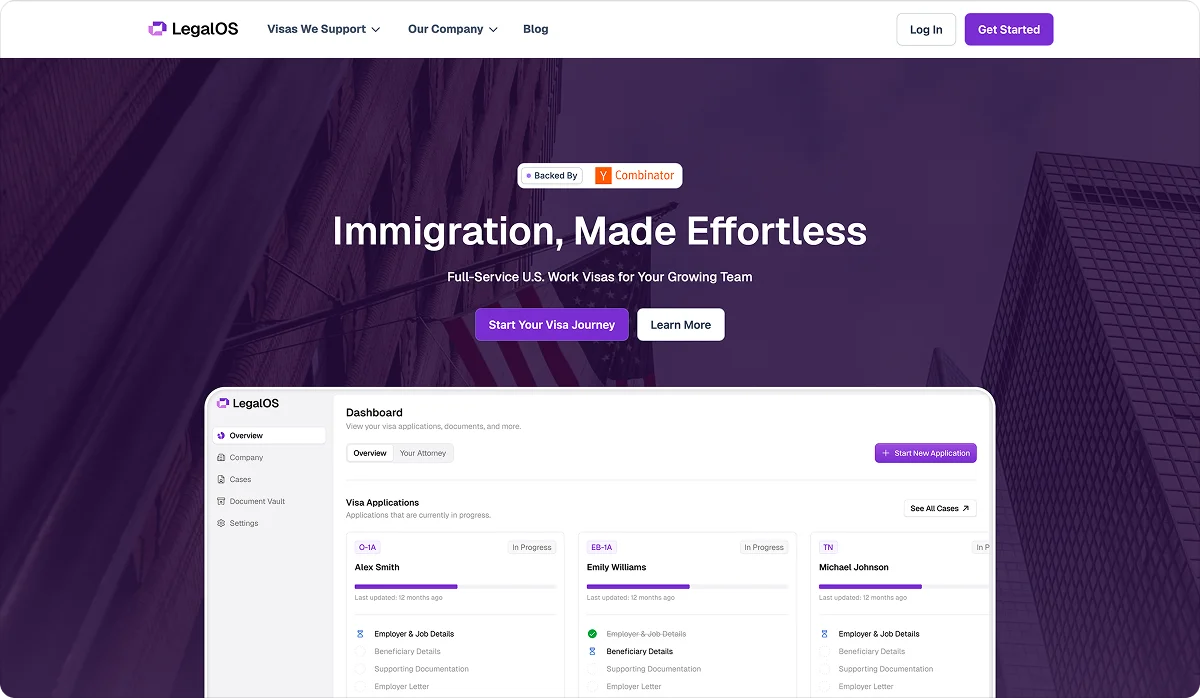
LegalOS is a YC-backed AI-native immigration law firm that connects licensed immigration attorneys with AI systems trained on more than 12,000 successful visa petitions. The firm focuses exclusively on employment-based visas and green cards, including O-1, H-1B, L-1, and EB-1 applications.
LegalOS is a solid fit for startups hiring globally, relocating key employees, or helping founders secure work authorization. By streamlining evidence collection, petition drafting, and case preparation, the firm aims to shorten a process that traditionally takes weeks while maintaining attorney oversight throughout the filing process.
Core strengths
For startups navigating immigration requirements at scale, LegalOS offers a focused approach, with strengths that include:
- Visa category breadth: Access support for multiple employment-based visa and green card pathways, reducing the need to work with separate specialists.
- AI-assisted petition preparation: Compile supporting evidence and draft application materials faster, reducing administrative work throughout the filing process.
- Structured immigration workflows: Follow a defined process from eligibility assessment to filing, creating greater visibility into case progress.
- Post-filing assistance: Manage requests for evidence, status updates, and follow-up questions through the same provider, ensuring continuity throughout the case lifecycle.
Pricing
The firm doesn’t publicly disclose standard pricing and typically provides custom proposals based on client needs.
5. Covenant: Best for founder-led venture funds and emerging managers
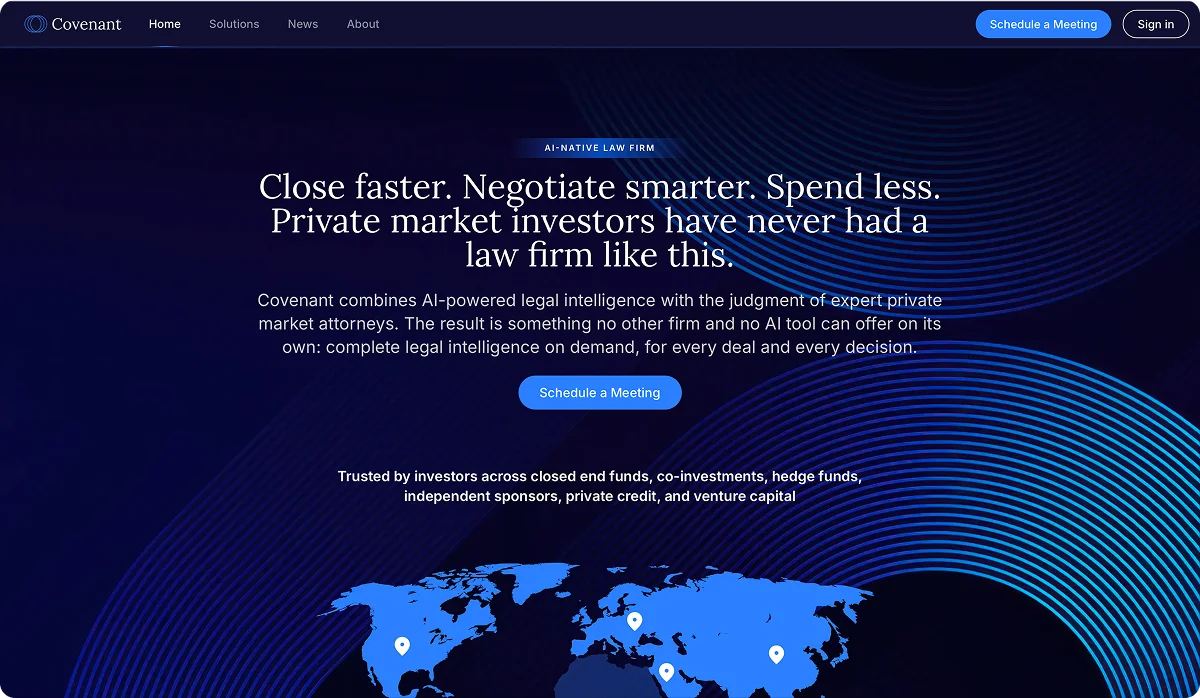
Covenant is an AI-native law firm designed for private markets, providing legal support for fund formation, fund investments, LP agreements, side letters, and related investment transactions through a combination of legal services, software, and proprietary AI tools.
Founder-investors and emerging fund managers are likely to get the most value from Covenant’s specialized focus. That’s because the law firm is built around the legal work that comes with deploying capital, making it a great choice for launching venture funds, managing syndicates, or overseeing investment vehicles.
Core strengths
Covenant provides technology-enabled support for investment workflows, including:
- Fund formation services: Structure new investment vehicles and related fund documentation, helping bring new funds to market more efficiently.
- Investment document review: Analyze LP agreements, side letters, and other investment documents, enabling faster evaluation of investment opportunities.
- Portfolio data visibility: Access searchable investment information from past and current transactions, making it easier to track terms and obligations over time.
Pricing
Covenant primarily relies on fixed-fee and transaction-based pricing, although standardized pricing isn’t publicly available.
What is the best AI-native law firm?
The best AI-native law firm for your startup will depend on your stage, legal needs, and the type of support you need most often.
For example, let’s say you’ve just raised a seed round and found the perfect founding engineer—except they’re based overseas and need a visa before they can join the company. In that situation, your biggest legal challenge isn’t commercial contracts or fundraising paperwork; it’s immigration. That’s where an immigration specialist like LegalOS would be a better fit than a general startup law firm.
Most startups, however, don’t have a single specialized legal problem. They need ongoing support for a wide range of matters, and that’s where General Legal stands out.
General Legal is designed for startups that have moved beyond occasional legal questions but aren’t ready to hire an in-house legal team. It provides broad startup legal coverage, predictable flat-fee pricing, rapid turnaround times, and direct communication channels that help founders avoid bottlenecks as legal needs multiply. For most seed-to-Series B companies, that combination makes it the most well-rounded AI-native law firm on this list.
Getting started with General Legal
If General Legal sounds like the right fit for your startup, you can create an account online and begin working with us right away. If you’d like to learn more about our services, pricing, or approach, feel free to reach out by email.
- As of late June 2026, the AI Firm Index tracked just over 50 AI-native law firms globally (31 in the US), a tiny fraction of the roughly 162,155 traditional US law firms.
- Firms were scored primarily on whether AI actually changes service delivery (30%) and startup fit/legal coverage (25%), not on whether they merely use AI internally.
- General Legal is named the best overall pick for startups broadly, due to its breadth of practice areas, flat-fee pricing, and founder-oriented workflow.
- Moritz, Avantia Law, LegalOS, and Covenant round out the list, specializing respectively in cross-border commercial work, private-equity/fund operations, immigration, and venture fund formation.
- LegalOS specifically trains its AI on more than 12,000 successful visa petitions and focuses exclusively on employment-based visas and green cards.
- Broad industry adoption figures cited include 83% of lawyers using AI in some capacity and 63% of mid-sized firms formally adopting generative AI, making it harder to distinguish genuinely AI-native firms from those merely using AI tools.
| How small this category still is | As of late June 2026, roughly 50 AI-native law firms exist globally (31 in the US), compared to over 162,000 traditional US law firms. |
|---|---|
| What makes a firm AI-native | AI must meaningfully change how legal work is delivered, turnaround time, pricing, client experience, not just support lawyers behind the scenes. |
| Best overall for startups | General Legal is ranked best overall for covering the broad range of day-to-day legal needs founders encounter, with flat-fee pricing and Slack-based communication. |
| Specialist alternatives | Moritz (cross-border commercial work), Avantia Law (private equity operations), LegalOS (immigration), and Covenant (fund formation) each target a narrower need. |
| LegalOS specifically | Trains its system on more than 12,000 successful visa petitions and focuses only on employment-based visas like O-1, H-1B, L-1, and EB-1. |
| Industry-wide AI adoption | 83% of lawyers already use AI in some capacity, and 63% of mid-sized firms have formally adopted generative AI, making it harder to distinguish real AI-native firms from marketing claims. |
| How to choose | The right firm depends on whether one specialized need (like immigration) dominates, versus needing broad, ongoing support across many areas. |
How many AI-native law firms actually exist right now?
Just over 50 globally as of late June 2026, with 31 based in the US, compared with more than 162,000 traditional US law firms.
What actually separates an AI-native firm from a traditional firm that uses AI tools?
Whether AI has reshaped the firm's core delivery model, turnaround times, staffing, and pricing, rather than just serving as an internal productivity aid.
Which AI-native firm is best for a startup with a single specialized need, like immigration?
LegalOS, which focuses exclusively on employment-based visas and green cards and trains its system on over 12,000 successful petitions.
Which firm is best for a startup that needs broad, ongoing legal support?
General Legal, ranked best overall for covering commercial contracts, employment, fundraising, privacy, and other recurring needs in one place.
Are AI-native law firms less safe or less regulated than traditional firms?
No. They remain subject to the same professional and ethical obligations around confidentiality and licensed legal practice as traditional firms.
How was this list of five firms selected?
Firms were evaluated on AI-native delivery model (30%), startup fit and legal coverage (25%), attorney oversight (20%), pricing and founder experience (15%), and independent market validation (10%).
What is an AI-native law firm?
An AI-native law firm is a legal practice that builds AI into its core service delivery model, using technology to streamline legal work while attorneys provide legal advice and oversight.
Why use an AI-native law firm?
Companies use AI-native law firms to receive legal support more efficiently, often benefiting from faster turnaround times, more predictable pricing, and a smoother client experience than traditional law firms typically provide.
Are AI-native law firms safe to use?
Yes. Like traditional firms, AI-native law firms are subject to professional and ethical obligations regarding client confidentiality and legal practice.
Are AI-native law firms less expensive than traditional law firms?
Usually, yes. They use AI to reduce manual work, which can help lower costs and support more predictable pricing models.
Can AI-native law firms handle complex legal matters?
Yes. AI helps improve efficiency, but experienced attorneys still provide the legal judgment required for complex matters like fundraising and compliance.
What is the best legal plan for startups that need ongoing legal advice?
For startups that need ongoing legal advice, the best legal plan can be working with an AI-native law firm. Compared to traditional legal models, AI-native firms can provide more predictable pricing, faster response times, and greater operational efficiency.
- Best Fractional General Counsel for Startups: 6 Top OptionsDiscover the best fractional general counsel for startups so you can find expert legal support and manage costs.
- Outside General Counsel for Startups: What to expect?Discover outside general counsel for startups so you can access ongoing legal guidance, reduce costs, and support your company.
- 7 Best Ontra Alternatives for Contract Automation [Compared]Discover the best Ontra alternatives so you can compare contract solutions, find the right fit, and streamline legal workflows.