
Nobody goes into law expecting it to be easy. The hours run long, clients expect miracles, and deadlines don’t care about your weekend. Add a managing partner’s expectations and a billable hour target you didn’t set, and the job gets harder to sustain long-term.
That’s why many lawyers start considering a solo practice.
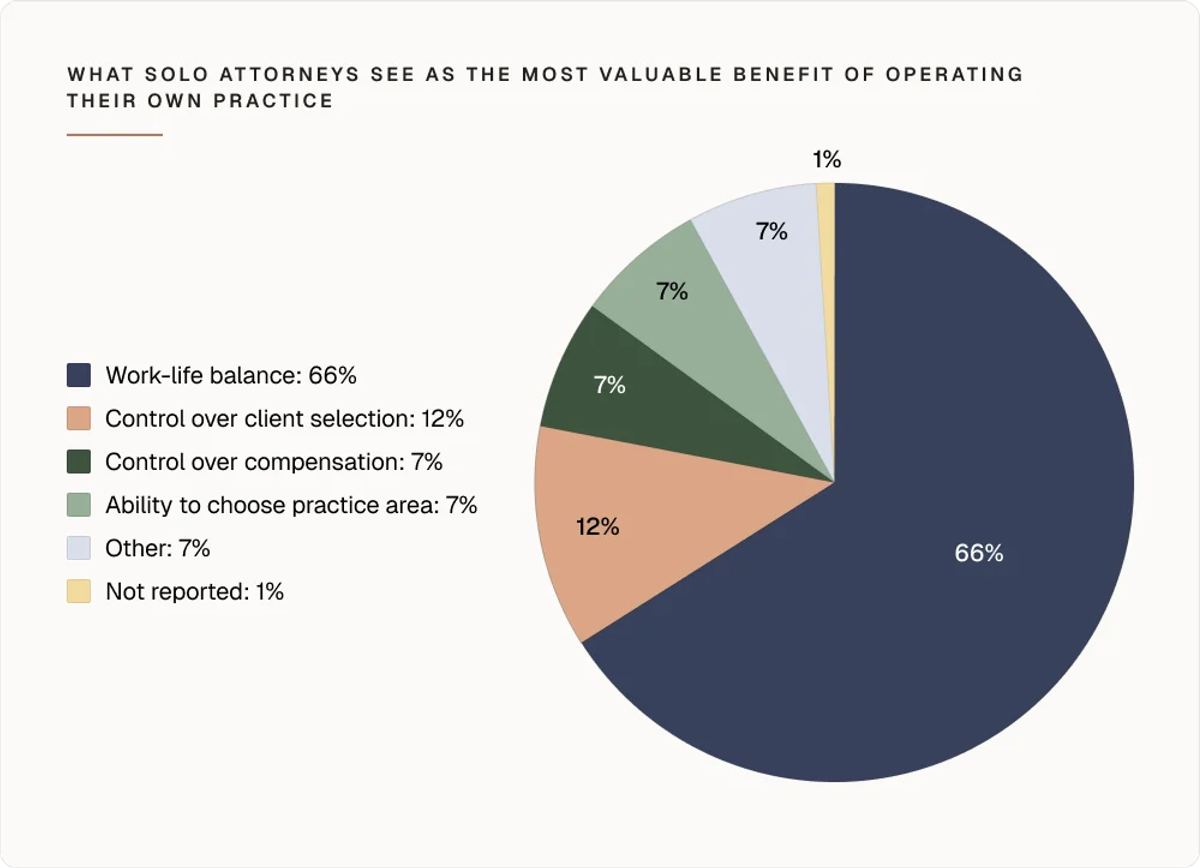
ALPS Insurance’s 2025 Solo Attorney Well-Being Trends Report found that 66% of solo practitioners rank work-life balance as the top payoff of running their own shop. Factor in setting your own schedule, picking clients, and building a docket around the matters you want to practice, and the value proposition behind going solo becomes crystal clear.
But what does it actually take to go solo?
Attorneys routinely underestimate the costs of launching a law firm, budgeting for the obvious expenses while missing the smaller costs that stack up in the background. To help you calculate the real investment required, this guide breaks down the law firm startup costs you’ll encounter if you choose this path.
12 law firm startup costs to plan for before you launch
According to the National Association for Law Placement, just 0.8% of the Class of 2024 went directly into solo practice—a record low. This means that by the time attorneys decide to go solo, they’ve usually spent years inside other firms and already understand how a practice operates.
Still, there’s a difference between practicing law and starting (and running) a law firm.
To help you cover all the bases, here are 12 law firm startup costs to plan for before you launch, whether you’re going solo or starting a firm with partners.
1. Forming your law firm entity
One of the first expenses you’ll encounter—and one of the rare law firm startup costs you can’t skip—is creating the legal entity that will operate your firm. The structure you choose affects everything from taxation and liability protection to ownership rules and future growth.
The table below breaks down the most common entity types and their associated startup costs:
| Entity type | Key advantages | Key drawbacks | Formation cost | Best for |
|---|---|---|---|---|
| Limited Liability Company (LLC) | Simple setup, flexible management, pass-through taxation | Not available for law firms in most states | $40–$500 | Solo attorneys in states that permit law firms to operate as LLCs |
| Professional Limited Liability Company (PLLC) | Pass-through taxation, strong liability protection, fewer corporate formalities | Not available in every state; some states impose publication or additional compliance requirements | $40–$500 | Most solo and small law firms |
| Professional Corporation (PC) | Strong liability protection, potential S-Corp tax advantages, easier partner onboarding | More governance requirements, bylaws, meetings, stock issuance, and ongoing formalities | $100–$300 | Firms operating in states that require corporate structures or firms planning for growth |
The biggest driver of formation costs is geography.
Besides the wide range of state filing fees, a handful of jurisdictions layer on additional requirements. New York, for example, requires PLLCs to publish formation notices in local newspapers, which can cost anywhere from a few hundred dollars to more than $1,500 depending on where the firm is located.
Complexity matters, too.
A solo attorney can start with a straightforward operating agreement or set of bylaws. A multi-partner firm, however, needs custom provisions covering voting rights, compensation, partner departures, malpractice allocation, and buyout mechanics, which can increase legal drafting costs to as much as $3,500.
Pro tip:
If a $3,500 drafting bill sounds too steep, consider working with an AI-native law firm like General Legal.
Thanks to AI-assisted legal workflows, the firm can prepare standard incorporation documents at a much lower cost than traditional providers. Pricing is fixed and transparent from the outset, so you know exactly what you’re paying before the work begins.
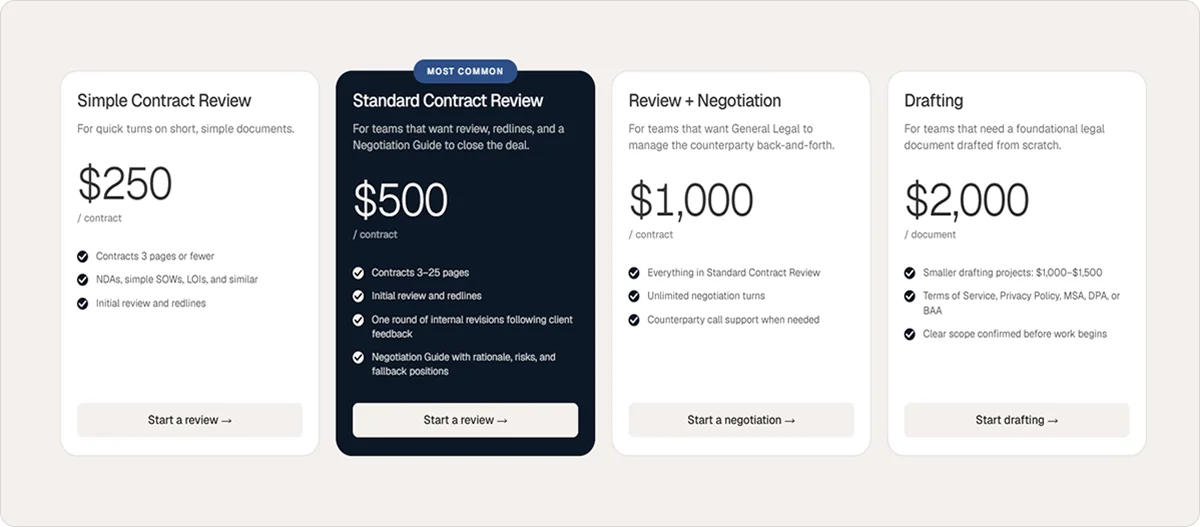
Beyond the savings, outsourcing helps ensure your entity is structured correctly, prevents the conflicts that can arise when founders draft their own governing documents, and frees up valuable time to focus on building the practice.
2. Registering your firm with the state bar
Depending on your state, you might also need to register your law firm with the state bar, supreme court, or another regulatory body before you can begin practicing.
The exact requirements vary by jurisdiction, but startup costs commonly include application fees, entity registration fees, and initial compliance filings. Expect to pay between $50 and $500 for these initial registrations.
Before submitting anything, verify the required filing sequence in your state; some jurisdictions require bar approval before entity formation, while others need entity formation first.
3. Securing insurance coverage
For many solo attorneys, insurance is the single largest upfront operating expense.
How much you’ll pay for insurance depends on your practice area, coverage limits, location, and type of practice. Here are some typical ranges to help you budget:
| Insurance type | What it covers | Who should carry it | What it typically costs |
|---|---|---|---|
| Malpractice (professional liability) | Claims arising from missed deadlines, drafting errors, conflicts, negligence allegations, and other professional mistakes | Virtually every law firm* | $1,000–$4,000 per attorney |
| General liability / Business Owner’s Policy (BOP) | Third-party bodily injury, property damage, office equipment, and other everyday business risks | Firms with a physical office, client visits, leased space, or business property to protect | $500–$1,200 |
| Cyber liability | Data breaches, ransomware attacks, business email compromise, breach notifications, forensic investigations, and related legal costs | Any firm that stores client data electronically | $750–$2,500 |
| Workers’ compensation | Employee medical expenses, lost wages, and workplace injury claims | Firms with employees | $500–$1,000 |
*While only a handful of states require malpractice insurance, many clients expect it and some jurisdictions require disclosure if you practice without coverage.
The biggest variable is malpractice insurance.
Criminal defense, immigration, and appellate practices generally sit on the lower end of the spectrum, while plaintiff-side personal injury, real estate, trust and estate litigation, and securities work can push premiums several times higher.
Coverage limits also matter, as many sophisticated clients now expect outside counsel to carry at least $1 million in coverage, regardless of firm size.
However, despite the potentially steep premiums, skipping malpractice insurance is a dangerous place to cut costs.
According to the Bar Association of San Francisco, a minimum of five to six out of every 100 private-practice lawyers will face a malpractice claim in any given year, meaning the financial risk of going uninsured is far from theoretical.
4. Papering your business relationships
If your goal is to build something larger than a one-lawyer shop, you’ll likely need documents to hire employees, work with contractors, bring on partners, or formalize relationships with vendors and clients.
Here are some of the most common legal documents new firms end up drafting:
- Shareholder agreement
- Employment agreements
- Independent contractor agreements
- Non-disclosure agreements (NDAs)
- Intellectual property assignment agreements
- Vendor agreements
- Client engagement letters
- Terms of service
- Privacy policy
- Employee handbook
- Equity incentive plan (if applicable)
The cost of drafting these documents varies widely depending on complexity.
A standalone NDA or employment agreement may cost a few hundred dollars, while founder agreements, equity plans, employee handbooks, and comprehensive document packages can push total legal spend into the $7,500+ range.
5. Opening your banking accounts
If you plan to hold client retainers, settlement proceeds, or other client funds, you’ll need more than a standard business checking account. Most law firms establish the following accounts:
- An operating account for revenue and day-to-day expenses
- An Interest on Lawyers’ Trust Account (IOLTA) for client funds
- A business savings account for tax reserves and emergency cash
Opening these accounts is usually inexpensive. The real cost comes from maintaining them correctly, as trust account mismanagement is one of the most common reasons attorneys face disciplinary action.
6. Setting up your office
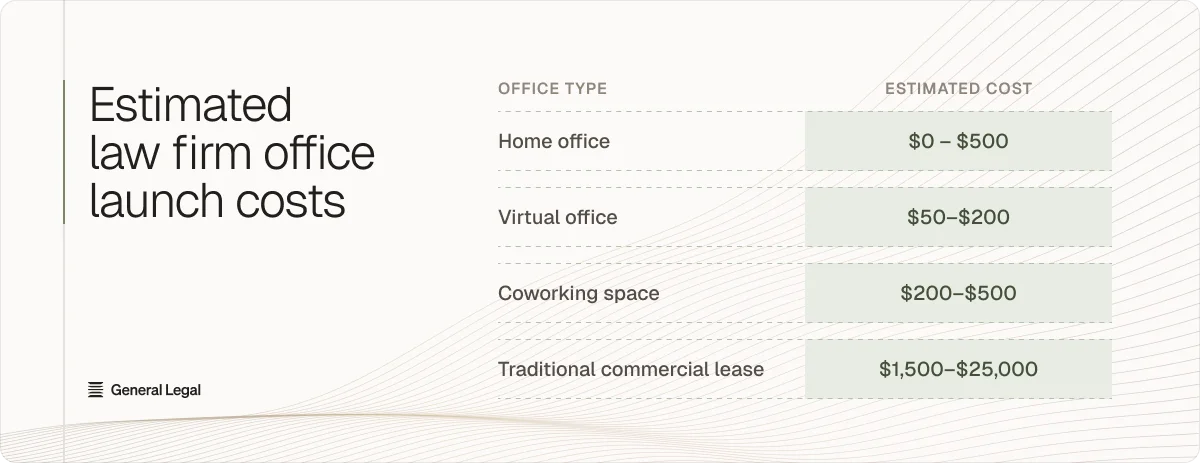
Your choice of office has an outsized impact on law firm startup costs, as the difference between working from home and signing a commercial lease can easily amount to thousands of dollars.
Launching from a home office often means spending little to nothing if you already have a dedicated workspace. At most, you may need to make minor upgrades to your setup, making this the most affordable option.
If you need a dedicated location for client meetings or prefer a traditional office environment, a private office lease can require $1,500–$7,000, depending on your city and required square footage. This range can increase to $5,000–$25,000 if you also need to pay for:
- Security deposit
- Commercial furniture
- Enterprise internet installation
- Signage
Coworking spaces sit somewhere in the middle. For roughly $200–$500 per month, they provide a professional workspace, meeting rooms, and networking opportunities without the commitment of a long-term commercial lease.
The right choice primarily depends on your practice area.
Attorneys who rarely meet clients in person can often operate successfully from home, while estate planning, family law, and similar practices may benefit from a professional meeting space.
Pro tip:
If a home office feels too informal but a dedicated office is too expensive, consider a virtual office. For $50–$200 per month, you can get a professional business address, mail handling, and access to conference rooms when needed.
7. Equipping your office
If you already own a reliable laptop and have a dedicated workspace, you may be ready to start without additional expenses. If, however, you want to invest in a more comprehensive setup, here’s what you can expect to pay:
- Business-grade laptop: $1,000–$2,500
- External monitor(s): $200–$600
- Dedicated document scanner: $400–$1,000
- Laser printer: $300–$800
- Webcam and microphone: $150–$300
- Office supplies and filing materials: $150–$300
Pro tip:
Clients care far more about responsiveness, communication, and results than they do about your desk setup. Invest in the systems that help you run the firm first; you can always upgrade the office later.
8. Creating a dedicated business phone line
Clients need a reliable way to reach your firm, and you need a way to separate business calls from personal communications. Most new firms set up a dedicated business line through services like OpenPhone, Google Voice, Phone.com, or Zoom Phone.
Expect to spend roughly $150–$400 per year for a business number with features like texting, voicemail transcription, and call routing.
If you need someone to answer calls on your behalf, AI-powered receptionist services cost roughly $50–$300 per month, while live human receptionist services typically start around $250–$800 per month depending on call volume.
9. Building your software stack
According to Clio’s 2025 Legal Trends for Solo and Small Law Firms Report, solo firms that use tools like e-signatures, online intake forms, and scheduling software report 53% higher revenue than those that don’t. Many practitioners are also beginning to experiment with generative AI for law firms, using AI-powered tools to assist with drafting, legal research, client intake, and administrative work.
While you don’t need an enterprise-grade tech stack to launch, you’ll need a few core tools:
| Software category | Why you need it | What it usually costs |
|---|---|---|
| Practice management software (e.g., Clio, MyCase, PracticePanther) | Matter management, calendaring, billing, time tracking, and client communication | $50–$100 / user / month |
| Accounting software (e.g., QuickBooks, Xero) | Bookkeeping, expense tracking, and financial reporting | $25–$85 / month total |
| Document management & e-signatures | Secure file storage, document sharing, and electronic signatures | $15–$45 / user / month (or per-use) |
When choosing software, look for tools that integrate well with each other to avoid unnecessary administrative work.
However, in some cases, software alone isn’t enough. Many law firms also hire a bookkeeper or an accountant to handle reconciliations, tax filing, and trust accounting compliance. Expect to pay roughly $600–$800 per month for these services, depending on the complexity of your practice.
10. Securing access to legal research databases
Nearly every law firm needs access to case law, statutes, regulations, and secondary sources. The most widely used ways to access these are through dedicated legal research databases, such as:
- Fastcase and similar research platforms: $65–$95 per user per month
- Westlaw or LexisNexis (standard plans): $110–$400 per user per month
- Advanced research platforms with AI tools: $250–$700+ per user per month
Most lawyers leave law school believing that a Westlaw or Lexis subscription is a non-negotiable cost of practicing law. In reality, many new firms delay those subscriptions until their caseload justifies the expense. Until then, you can get by with free research tools, courthouse law libraries, or bar-association-sponsored access.
11. Establishing your digital presence
Even firms that rely heavily on referrals need a professional online presence, as many clients visit a law firm’s website before reaching out. At a minimum, you should secure a domain name, set up a professional email address, and create a basic website.
Fortunately, the barrier to entry is relatively low. Domain registration and hosting typically cost $150–$350 per year, while Google Workspace or Microsoft 365 generally adds another $85–$170 per user per year for professional email and productivity tools.
When it comes to the website itself, attorneys have two primary options:
- Using DIY website builders like Wix, Squarespace, and WordPress: $200–$500 (depending on the tools and templates you use)
- Hiring a professional designer or agency: $2,000–$5,000+
Pro tip:
Don’t let a website become a launch blocker. Many successful firms start with a simple site that includes their practice areas, attorney bio, and contact information, then invest in more sophisticated features as the business grows.
12. Marketing your law firm
A website makes your firm discoverable, but it doesn’t automatically generate clients. That’s why most law firms need to invest at least some resources into business development and marketing.
Common marketing expenses include:
- Logo and brand design: $500–$2,000
- Professional headshots and firm photography: $300–$2,000
- Business cards and marketing materials: $100–$500
- Google Business Profile and local SEO setup: $0–$3,000+
- Google Ads and other paid advertising: $500–$5,000+ per month
Pro tip:
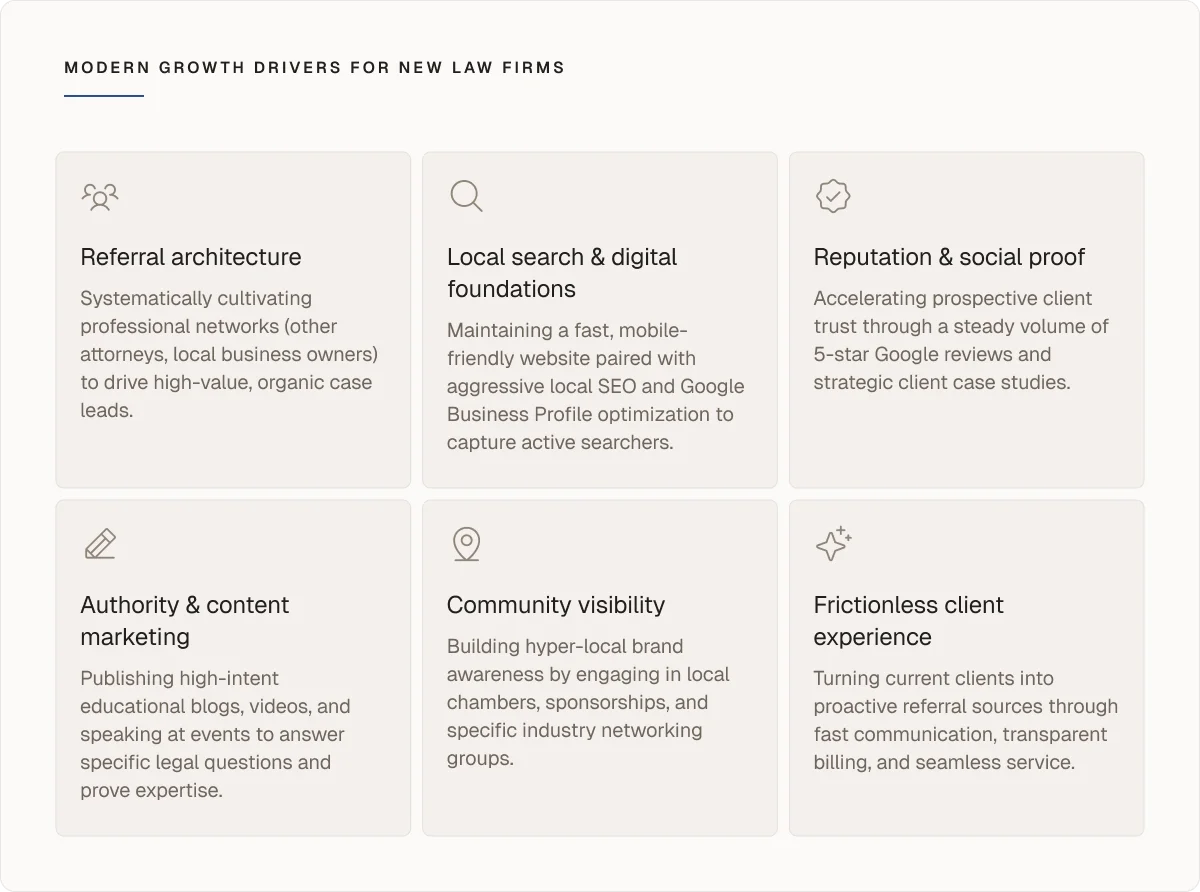
For many new firms, a well-optimized Google Business Profile, a strong referral system, and consistent networking generate a better return than paid ads. Start with the channels most likely to reach your ideal clients, then scale what works.
How much does it cost to start a law firm?
The exact cost of starting a law firm depends on your practice area, location, growth plans, and appetite for upfront investment. Based on the law firm startup costs covered above, here’s what your initial budget might look like:
| Budget level | Estimated startup cost | What it typically includes |
|---|---|---|
| Lean launch | $2,500–$7,500 | Home office, basic equipment, DIY website, business phone line, essential software, bar-sponsored legal research, minimal marketing |
| Mid-range launch | $10,000–$25,000 | Professional entity setup, malpractice insurance, dedicated office or coworking space, professional website, paid software stack, modest marketing budget |
| Full-service launch | $30,000–$75,000+ | Premium office space, extensive legal drafting, Westlaw or Lexis subscriptions, professional branding, paid advertising, advanced software, support services, and larger insurance policies |
While the first few years of solo practice can be challenging, ALPS reports that 74% of solo practitioners are satisfied or very satisfied with their professional lives after going solo.
As your firm grows, you’ll also discover that not every task needs to be handled internally. That’s where General Legal can help.
How General Legal helps law firms scale
Beyond serving as a company formation partner, General Legal can act as an extension of your team by handling:
- Commercial contract drafting and review
- Legal research and memorandum preparation
- High-volume contract review projects
- Other routine legal work that doesn’t justify hiring additional headcount
By combining elite attorneys with AI-native workflows, General Legal delivers high-quality legal work more efficiently and predictably than traditional firms.
Whether you’re opening your doors today or planning for future growth, you can create a free account with no commitment or upfront fees and connect with an attorney immediately. Or, if you’re exploring options, book a 10-minute introductory session to see how General Legal can help your firm handle more work without making another hire.
- A solo law firm can launch for as little as $2,500-$7,500 (a "lean launch") by working from home with essential software, while a full-service launch with a physical office and premium tools can run $30,000-$75,000+.
- The guide walks through 12 categories of startup cost: entity formation, bar registration, insurance, contracts for business relationships, banking, office setup, equipment, phone systems, software, legal research access, digital presence, and marketing.
- Malpractice insurance is typically the largest recurring expense ($1,000-$4,000 per attorney), and skipping it is risky since 5-6 out of every 100 private-practice lawyers face a malpractice claim in a given year.
- Entity formation costs vary by structure and state, ranging roughly $40-$500, with added costs in states like New York that require publishing PLLC formation notices, potentially $1,500 or more.
- Technology often matters more than office space: solo firms using e-signatures, online intake, and scheduling tools reported 53% higher revenue than those that don't, per a Clio survey.
- Just 0.8% of the 2024 law school graduating class went directly into solo practice, a record low, meaning most solo attorneys have years of prior firm experience before striking out on their own.
| Range of total cost | Launching ranges from a $2,500-$7,500 lean home-office setup to $30,000-$75,000+ for a full-service launch with premium office space and Westlaw/Lexis subscriptions. |
|---|---|
| Entity formation | Costs $40-$500 depending on structure (LLC, PLLC, PC) and state, with added requirements like New York's PLLC publication rule potentially adding $1,500 or more. |
| Insurance | Malpractice insurance ($1,000-$4,000 per attorney) is usually the largest recurring cost and shouldn't be skipped; 5-6 out of every 100 private-practice lawyers face a claim in a given year. |
| Office setup | Ranges from near-zero for a home office to $1,500-$25,000+ for a leased commercial space, with coworking space as a $200-$500/month middle option. |
| Software stack | Practice management, accounting, and e-signature tools run roughly $90-$230/month combined; solo firms using these tools report 53% higher revenue per a Clio survey. |
| Legal research access | Ranges from $65-$95/user/month for Fastcase-tier tools up to $250-$700+/month for AI-enabled research platforms, though many new firms delay this until caseload justifies it. |
| Marketing and digital presence | A basic website and Google Business Profile can generate clients cheaply; paid ads can run $500-$5,000+/month, but referrals and local SEO often outperform paid ads for new firms. |
| Outsourcing option | Rather than hiring full-time staff, new firms can route contract drafting, legal research, and high-volume review to partners like General Legal to add capacity without adding headcount. |
What's the minimum realistic budget to start a solo law firm?
A lean launch working from home with essential software can cost $2,500-$7,500, according to the guide's breakdown.
What's typically the single largest startup cost?
Malpractice insurance, usually running $1,000-$4,000 per attorney, and the guide advises against skipping it given how often solo practitioners face claims.
Do I need a Westlaw or Lexis subscription to start?
Not necessarily. The guide notes many new firms delay premium legal research subscriptions until their caseload justifies the expense, relying instead on free tools or bar-sponsored access.
Is a physical office worth the cost for a new solo firm?
It depends on practice area. Attorneys who rarely meet clients in person can often work from home, while practices like estate planning or family law may benefit from a dedicated meeting space.
How much does entity formation typically cost?
Roughly $40-$500 depending on entity type and state, though some states like New York add extra requirements, such as publication notices, that can push costs over $1,500.
What can new firms do instead of hiring full-time staff for overflow legal work?
Route routine work like contract drafting, legal research, and high-volume contract review to outsourcing partners like General Legal instead of adding headcount.
Is it worth opening your own law firm?
For many attorneys, yes. While building a practice takes time, most solo practitioners report high levels of professional satisfaction after opening their own law firm and would choose the path again.
How profitable is owning a law firm?
Owning a law firm can be highly profitable, but profitability rarely happens overnight. Many solo attorneys don’t match their previous salary until two to three years after launching their practice.
What are 5 common startup costs?
Five common law firm startup costs are entity formation, malpractice insurance, office setup, software subscriptions, and marketing.
How to calculate startup costs?
To calculate startup costs, add together your one-time launch expenses and the operating costs you’ll need to cover before the firm becomes profitable.
What is the best startup law firm?
The best startup law firm depends on your needs, but many founders and attorneys look for AI-native firms that combine specialized expertise, transparent pricing, and fast turnaround times.
- Fractional General Counsel Cost: What to Expect in 2026Learn how you can assess fractional general counsel costs, compare legal options, and choose pricing that fits your startup's needs.
- 6 Best Law Firms for Growing Startups To Choose in 2026 [Comparison]An overview of the top law firms for growing companies.
- Best Fractional General Counsel for Startups: 6 Top OptionsDiscover the best fractional general counsel for startups so you can find expert legal support and manage costs.