
Running a business means dealing with legal complexity, whether you like it or not.
In the worst-case scenario, that complexity might end in a lawsuit, which can cost anywhere from $15,000 to settle a straightforward contract dispute to over $5 million for complex patent litigation. For many small businesses and startups, either end of that range can have a serious impact on the balance sheet.
To combat a potentially devastating lawsuit—or prevent one from happening in the first place—companies need counsel that specializes in the legal issues they commonly face. But that’s where things get confusing: Should they turn to a business or commercial law firm?
The terms are often used interchangeably, even by lawyers, making it hard to tell whether there’s a meaningful distinction.
To clear up the confusion, this commercial law vs. business law guide breaks down each concept and examines the five key differences between them.
Key takeaways
- Commercial law focuses on business transactions It covers contracts, sales, supply, distribution, licensing, financing, and related disputes.
- Business law covers the company more broadly It can include formation, governance, ownership, employment, compliance, financing, and dissolution.
- The two areas overlap in practice The distinction is mainly about where legal work is concentrated, not rigid boundaries between specialties.
- Your legal needs determine which counsel fits Commercial counsel is typically useful for transactions and commercial relationships, while business counsel handles company structure and operations. Growing companies often need both.
- One firm can cover both sides General Legal combines commercial contracts, technology transactions, employment, fundraising, governance, and other business needs under one roof.
What is commercial law?
Commercial law is the body of law governing commercial transactions and the legal relationships that arise from them. It’s sometimes called trade or mercantile law, and it provides the legal framework for activities like buying and selling goods, financing transactions, and distributing products and services.
Commercial law firms generally handle three types of work:
- Advisory work: Commercial lawyers guide companies on legal issues that arise in commercial activity.
- Transactional work: The focus here is on preparing, reviewing, and negotiating agreements and other documents.
- Contentious work: When commercial relationships break down and legal action becomes necessary, lawyers handle the resulting disputes.
What is business law?
Business law is the broad body of law governing the formation, operation, regulation, and dissolution of businesses.
In legal education, business law is generally treated as an umbrella term encompassing three related areas:
- Corporate law
- Securities law
- Commercial law
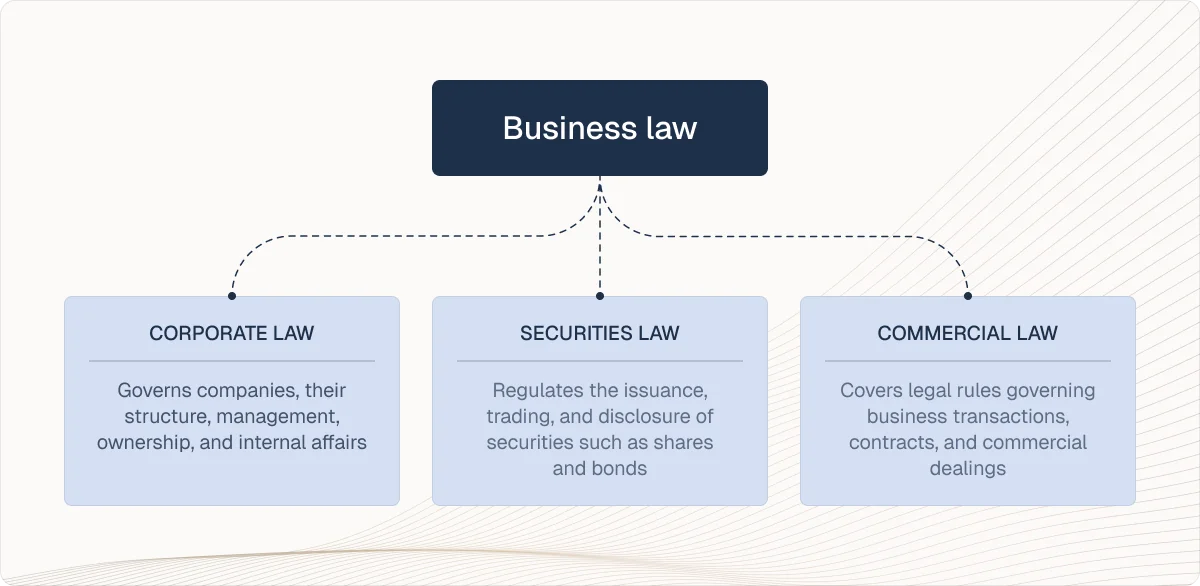
This breakdown explains why commercial law and business law overlap so much.
Both deal with the legal side of running a company, and many lawyers work across both areas without drawing a hard line between them. In practice, the distinction can depend as much on the firm’s practice areas and terminology as it does on the underlying legal issue.
Still, understanding the distinction can help clients set realistic expectations about the type of legal work they’re asking for.
Commercial law vs. business law: 5 main differences
These five areas provide the most useful points of comparison between commercial and business law.
1. What the law primarily focuses on
The commercial law vs. business law distinction starts with the subject of the legal work.
Business law is generally centered on the company itself, covering matters tied to its formation, structure, governance, and ongoing operation. Commercial law, by contrast, focuses more on the company’s relationships with counterparties, whether individuals involved in a commercial transaction or other businesses.
This difference also affects when each area of law tends to come into play during a company’s lifecycle.
Business law can be relevant from the moment a founder starts setting up the company through growth, restructuring, and eventual dissolution. Commercial law usually enters the picture whenever the business is actively engaging in a transaction or commercial relationship, such as negotiating an agreement, completing a deal, or resolving a dispute.
Still, the distinction isn’t absolute.
A growing company may need both types of legal support at the same time, particularly when a major transaction also affects its structure or ownership.
2. What each area of law typically covers
The practical scope of commercial and business law becomes easier to see when you look at the types of legal work that typically fall within each one.
Business law can encompass:
- Company formation: Choose an entity structure and handle the legal steps required to establish a business.
- Corporate governance: Get advice on decision-making, directors’ duties, shareholder rights, and internal company rules.
- Ownership and financing: Address equity arrangements, share issuances, investments, and other ownership matters.
- Employment: Receive guidance on employment agreements, workplace rules, and other legal issues arising from the company’s workforce.
- Regulatory compliance: Address licensing, tax, industry-specific requirements, and other rules governing the company’s operations.
- Business restructuring and dissolution: Manage the legal issues involved in reorganizing, winding down, or closing a company.
Commercial law is more concentrated on legal work arising from commercial transactions and relationships, including:
- Commercial contracts: Draft, review, and negotiate agreements that govern business dealings.
- Sales and supply: Formalize agreements for the purchase, sale, and supply of goods or services.
- Distribution and licensing: Establish the legal terms for distributing products or granting rights to use intellectual property.
- Procurement and agency: Structure arrangements with vendors, agents, and other commercial intermediaries.
- Trade and financing: Address legal issues surrounding trade credit, secured transactions, and financing tied to commercial activity.
- Commercial disputes: Handle disagreements arising from contracts, transactions, or other commercial relationships.
This division doesn’t mean a business lawyer won’t work on a commercial contract, or that a commercial attorney can’t advise on business formation. The difference is more about where each practice typically concentrates its legal work.
3. Who the legal work primarily deals with
The parties at the center of the legal matter can also differ between commercial and business law, following the broader focus of each field.
Commercial law typically deals with:
- Buyers and sellers
- Suppliers and distributors
- Companies entering into commercial arrangements, collaborations, or other business-to-business relationships
- Banks, lenders, and other institutions involved in commercial financing or payment arrangements
As for business law, it more often concerns:
- Founders and owners
- Shareholders and investors
- Individuals responsible for overseeing or running the company and exercising corporate powers
- People whose relationship with the company is governed by employment and workplace rules
- Government bodies that impose or enforce legal requirements affecting the company’s operations
4. What types of contracts are involved
On par with the general focus of each practice, commercial law tends to revolve around agreements that facilitate a transaction or ongoing commercial relationship, while business law usually involves documents that establish or govern the company itself.
The table below gives an overview of the types of agreements commercial law commonly involves:
| Type of agreement | What it does |
|---|---|
| Sales and purchase agreements | Set out the terms for buying or selling goods or services |
| Supply agreements | Cover the supply of products, materials, or other inputs |
| Master Services Agreements (MSAs) and Statements of Work (SOWs) | Establish the terms for providing ongoing or project-based services |
| SaaS and technology agreements | Govern access to software, technology services, or related support |
| Distribution and reseller agreements | Arrange how products or services reach the market through third parties |
| Licensing agreements | Grant another party rights to use intellectual property, software, or other assets |
Contract law is a major part of commercial law, as these agreements provide the legal framework for most business relationships.
When it comes to business law, the following documents normally establish, structure, or govern the company and its internal affairs:
| Type of agreement | What it does |
|---|---|
| Operating agreements and bylaws | Govern how an LLC or corporation is structured and managed, including decision-making, ownership rights, and internal governance |
| Shareholders’ agreements | Set out shareholders’ rights and obligations and, where relevant, rules for voting, transfers, and corporate decision-making |
| Employment and contractor agreements | Establish the terms of relationships between the company and its workforce |
| Non-disclosure agreements (NDAs) | Protect confidential information shared with employees, contractors, investors, or other parties |
| Investment and equity agreements | Document investments, share issuances, and other arrangements affecting ownership of the company |
| Founder and partnership agreements | Define ownership, responsibilities, decision-making, and other terms between people building or owning a business together |
5. Which legal frameworks govern the work
The legal framework behind each practice reflects what it’s designed to regulate.
For commercial law, the Uniform Commercial Code (UCC) is a major source of rules in the US.
The UCC is a set of model laws enacted by the states, with provisions covering areas like sales, leases of personal property, negotiable instruments, and secured transactions. Its purpose is to create greater consistency in commercial dealings across state lines, although individual states can modify the rules they enact.
Business law draws on a much broader regulatory framework, which can include:
- State corporate statutes
- Federal and state employment laws
- Tax rules
- Securities regulations
- Partnership statutes
- Industry-specific requirements
Corporate entities, for example, are primarily governed by state law, while employment and tax obligations can arise under both federal and state law.
In addition, some of the legal frameworks governing business law, such as employment and tax laws, can also apply to commercial matters. With so much overlap, how can you tell which type of legal counsel is the better fit for your business?
Commercial law vs. business law: Which type of legal counsel is right for your business?
The right type of legal counsel for your business primarily depends on the nature of the legal issue at hand, the stage of the company’s growth, and the type of legal work it needs.
Commercial counsel is typically the better fit when you need to:
- Draft, review, or negotiate commercial contracts
- Structure sales, supply, distribution, licensing, or SaaS arrangements
- Navigate legal issues tied to a particular transaction or commercial relationship
- Address disputes involving contracts, payments, delivery, or other commercial obligations
In contrast, you might need business counsel to:
- Form a company or choose an appropriate legal structure
- Set up corporate governance, ownership, or shareholder arrangements
- Handle fundraising, equity, or other matters affecting ownership of the company
- Address employment, regulatory, tax, or other legal requirements tied to operating the business
- Restructure, merge, or wind down the company
In practice, many companies need support across both areas. This applies to startups and high-growth companies, in particular, as they face a growing mix of corporate and commercial legal needs as they scale.
For example, a company might need business counsel to structure a new funding round while relying on commercial counsel to negotiate its customer and vendor agreements.
That’s why the best course of action is to hire a firm that can handle both areas under one roof, such as General Legal.
General Legal: One firm for both business and commercial law
General Legal is an AI-native law firm that combines highly qualified US-barred attorneys with AI-powered workflows to deliver legal work more efficiently and predictably than traditional firms. The firm primarily serves startups and growth-stage companies, delivering services through Slack, email, or its client portal, with quotes provided upfront.
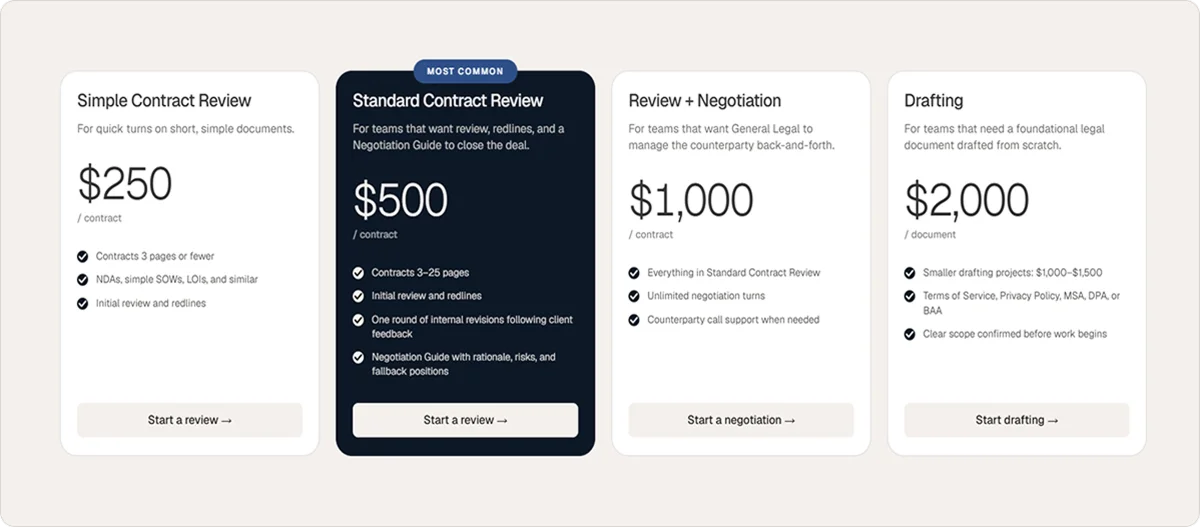
Instead of forcing founders to split routine legal work between multiple firms, General Legal brings several of the most sought-after practices under one roof, including:
- Commercial contracts: Draft, review, and negotiate the commercial agreements that govern your company’s day-to-day dealings, with standard commercial contract reviews typically turned around in hours.
- Employment: Build your team with support on offer letters, contractor agreements, equity grants, policies, terminations, and executive employment matters.
- Data privacy: Meet your obligations with advice on privacy policies, DPAs, cookie notices, and AI-data governance for US and global requirements.
- Financial regulatory: Navigate regulatory requirements with commercial agreements and regulatory-aware contracts for payments, lending, and financial products.
- Technology transactions: Negotiate the agreements that underpin your technology business, including MSAs, SaaS agreements, licensing arrangements, SOWs, and AI-data terms.
- Emerging companies and venture capital: Establish your company, set up corporate governance and cap table management, and navigate financing rounds from SAFEs through later-stage venture financings.
- Tax: Address tax matters throughout the company lifecycle, from formation and QSBS planning through financings, equity compensation, and exits.
A huge advantage of working with General Legal across these business and commercial matters is that you don’t have to maintain a traditional counsel relationship when your legal needs don’t justify one.
Instead, you can use General Legal on a matter-by-matter basis with upfront, flat-fee pricing, or opt for ongoing support through its GC-as-a-service offering if your legal needs are more recurring.
If you want to learn more about both options, you can book a quick consultation with our team. Alternatively, sign up directly online and start sending contracts to our attorneys.
FAQ
What is another name for commercial law?
Another name for commercial law is trade law or mercantile law.
What is another name for business law?
Another name for business law is corporate and commercial law, although business law is generally used as the broader term.
What happens in business law?
Business law governs the legal aspects of forming, operating, managing, and dissolving a business, including matters involving governance, employment, financing, compliance, and ownership.
What are the main types of commercial law?
The main types of commercial law include contract law, sales of goods, transportation and logistics, consumer protection, agency and distribution, and international trade.
- Commercial law focuses on transactions and relationships between businesses, covering contracts, sales, supply, distribution, and related disputes, while business law addresses the company's internal structure, formation, governance, employment, and compliance.
- The two areas overlap significantly in practice, with many lawyers working across both fields, and the distinction often depends more on where legal work is concentrated than on rigid boundaries.
- Commercial counsel is typically best for transactional work like negotiating vendor agreements or resolving contract disputes, while business counsel handles corporate formation, fundraising, governance, and regulatory compliance.
- Growing companies often need both types of legal support simultaneously, particularly during major transactions that affect ownership or corporate structure.
- Lawsuits can cost businesses anywhere from $15,000 for simple contract disputes to over $5 million for complex litigation, making specialized legal counsel essential for prevention and resolution.
| Core focus | Commercial law centers on transactions and external business relationships; business law addresses the company's internal structure, formation, and operations. |
|---|---|
| Typical scope | Commercial law covers contracts, sales, supply, distribution, licensing, and trade financing; business law includes formation, governance, employment, compliance, and dissolution. |
| Primary parties | Commercial law deals with buyers, sellers, suppliers, and commercial partners; business law involves founders, shareholders, investors, employees, and regulators. |
| Contract types | Commercial law involves sales agreements, MSAs, SaaS contracts, and licensing deals; business law covers operating agreements, shareholder agreements, employment contracts, and equity documents. |
| Legal frameworks | Commercial law is largely governed by the Uniform Commercial Code; business law draws on state corporate statutes, employment laws, tax rules, and securities regulations. |
| Practical overlap | Many firms and lawyers work across both areas, and the distinction is more about concentration of work than strict separation of specialties. |
| Choosing counsel | Select commercial counsel for transactional needs and commercial disputes; choose business counsel for corporate structure, governance, fundraising, and regulatory matters. |
| Integrated approach | Firms like General Legal combine both practice areas under one roof, offering flat-fee pricing and AI-powered workflows for startups and growth-stage companies. |
Is commercial law the same as business law?
No, though they overlap significantly. Commercial law focuses on transactions and commercial relationships like contracts and sales, while business law is broader and covers the company's formation, governance, ownership, employment, and compliance. Many lawyers work across both areas without drawing a hard line.
When should I hire commercial counsel versus business counsel?
Hire commercial counsel when you need to draft or negotiate contracts, structure sales or licensing deals, or resolve commercial disputes. Choose business counsel for company formation, governance setup, fundraising, employment matters, or regulatory compliance. Growing companies often need both simultaneously.
What legal framework governs commercial law in the United States?
The Uniform Commercial Code (UCC) is the primary framework for commercial law in the US. It's a set of model laws enacted by individual states to create consistency in commercial dealings, covering areas like sales, leases, negotiable instruments, and secured transactions.
Can one law firm handle both commercial and business law needs?
Yes, many firms provide both services under one roof. General Legal, for example, combines commercial contracts, technology transactions, employment law, corporate governance, fundraising support, and tax advice, allowing startups and growth companies to avoid splitting legal work between multiple providers.
How much can business lawsuits cost?
According to the article, lawsuits can range from $15,000 to settle a straightforward contract dispute to over $5 million for complex patent litigation. Either end of that range can significantly impact small businesses and startups, making preventive legal counsel important.
What types of contracts fall under commercial law?
Commercial law typically involves sales and purchase agreements, supply agreements, Master Services Agreements (MSAs), SaaS and technology agreements, distribution and reseller agreements, and licensing agreements—essentially contracts that facilitate transactions or ongoing commercial relationships.
- Contract Law vs. Commercial Law: 5 Key DifferencesCompare contract vs commercial law so you can understand their differences, identify the right legal framework & protect your business in every deal.
- 12 Types of Commercial Law You Should Know in 2026Explore the types of commercial law so you can understand your legal needs, manage business risks, and choose the right legal support.
- Paralegal vs. Lawyer: Who Should You Hire? [5 Differences]Compare if you should hire paralegal vs lawyer so you can understand their roles, legal responsibilities, costs, and the right choice for your needs.