
An outside general counsel (OGC) is an attorney or law firm that provides ongoing legal guidance without the cost of a full-time in-house legal team.
Demand for this model is growing, with 48% of chief legal officers now relying on external support. After years of pushing legal work in-house to cut costs, rising litigation, increasing regulatory scrutiny, and understaffed legal teams have reversed that trend.
But where does that leave startups?
Many founders still view ongoing legal support as something reserved for larger companies with bigger budgets. As startups navigate tighter funding environments, leaner teams, and increasing legal obligations, that assumption might be worth revisiting.
To help you evaluate whether this model makes sense for your company, this guide covers everything you need to know about outside general counsel for startups.
What is outside general counsel?
Outside general counsel is a legal arrangement in which an attorney or law firm functions as your company’s general counsel without joining the payroll.
For startups, this arrangement typically follows three stages:
- Understanding the company’s business model, operations, risk profile, and growth plans
- Establishing the legal foundations the company needs
- Remaining involved as the business evolves
Unlike traditional outside counsel, which is often hired for a specific transaction or dispute, OGC serves as a consistent legal point of contact across the organization, working directly with founders and leadership teams.
When does a startup need outside general counsel?
A startup may look for outside general counsel when its legal needs become too frequent, complex, or business-critical to handle on an ad hoc basis.
This counsel becomes especially valuable when your startup is:
- Raising capital regularly: Multiple funding rounds require consistent corporate governance, investor documentation, and securities compliance.
- Signing more contracts: As the number of customer, vendor, and partnership agreements increases, founders often need faster and more consistent legal review.
- Growing headcount: Hiring employees, issuing equity, and implementing workplace policies create new legal obligations.
- Expanding into new markets: Operating across multiple states or countries introduces additional regulatory and compliance requirements.
- Building in a regulated industry: FinTech, AI, healthcare, life sciences, crypto, and other regulated sectors face legal questions that arise long before startups can justify a full legal department.
- Preparing for an acquisition or exit: Clean corporate records, contracts, and compliance processes can make diligence significantly smoother.
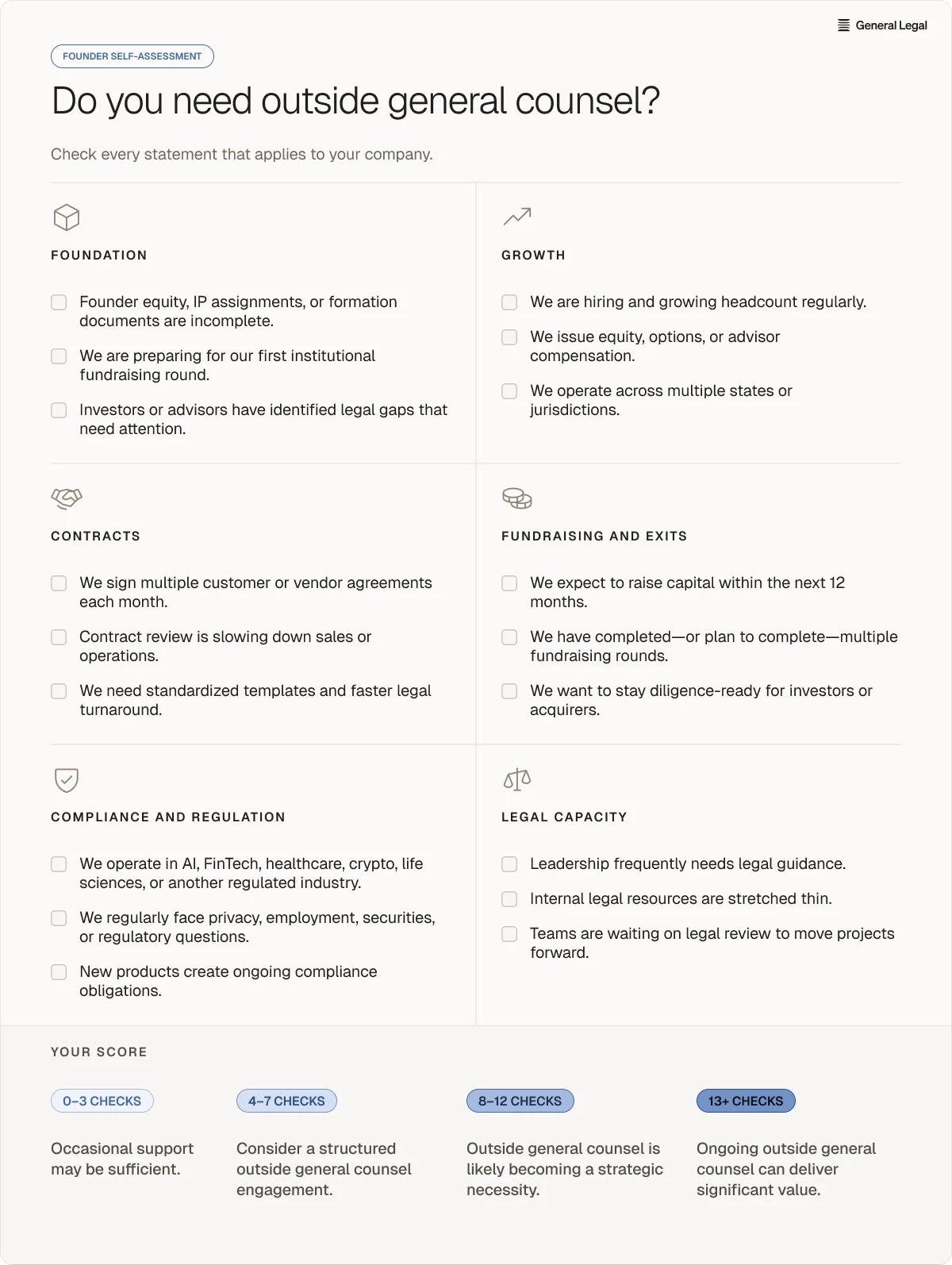
A useful rule of thumb: If legal issues are becoming a recurring part of running the business rather than a one-off event, it may be time to consider outside general counsel.
How does outside general counsel compare to in-house counsel?
The biggest difference is that in-house counsel is an employee of the company, while outside general counsel is an external attorney or law firm that provides ongoing legal support. Both perform many of the same functions, but outside general counsel offers additional capacity without requiring a full-time hire.
However, the two models aren’t mutually exclusive.
Many growing companies use outside general counsel alongside an in-house legal team. This is often a matter of necessity, as companies with less than $1 billion in revenue have a median legal team size of just two lawyers and three total legal staff members.
While in-house counsel focuses on the company’s daily legal needs, outside general counsel can provide specialized expertise, support major transactions, and help manage periods of increased workload. This allows internal teams to stay focused on the business while still having access to additional legal resources when needed.
For startups, however, the comparison is often more straightforward.
Most early-stage companies don’t have enough legal work to justify hiring a full-time general counsel. Outside general counsel fills that gap by providing consistent legal support until the business reaches the scale where building an internal legal team makes sense.
But what does that legal support actually entail?
What startups can expect from outside general counsel: 7 core service areas
A startup can expect outside general counsel to provide strategic legal leadership that supports the business as it grows. While the scope varies by company, most engagements center around the following seven core areas of support.
1. Fundraising and equity management
With investors pouring $300 billion into startups globally in the first quarter of 2026 alone, founders are navigating an increasingly active fundraising environment. That’s exactly why startups benefit from having experienced legal guidance throughout the fundraising lifecycle.
An outside general counsel can help:
- Structure and review SAFEs, convertible notes, and priced financing rounds
- Negotiate and analyze term sheets before founders commit to key terms
- Manage cap table issues, equity grants, and dilution considerations
- Ensure compliance with applicable securities laws and filing requirements
- Coordinate corporate approvals and documentation required for fundraising
- Prepare the company for investor due diligence and future financing rounds
Just as importantly, they help founders understand how today’s fundraising decisions can affect ownership, control, and future financing options.
2. Entity formation and governance
Founders spend a lot of time building products and raising capital, often overlooking the legal foundation supporting both. This is a mistake, as many of the issues that slow down fundraising, diligence, and acquisitions can be traced back to foundational legal decisions made years earlier.
An outside general counsel can ensure the company is built on a solid legal footing by:
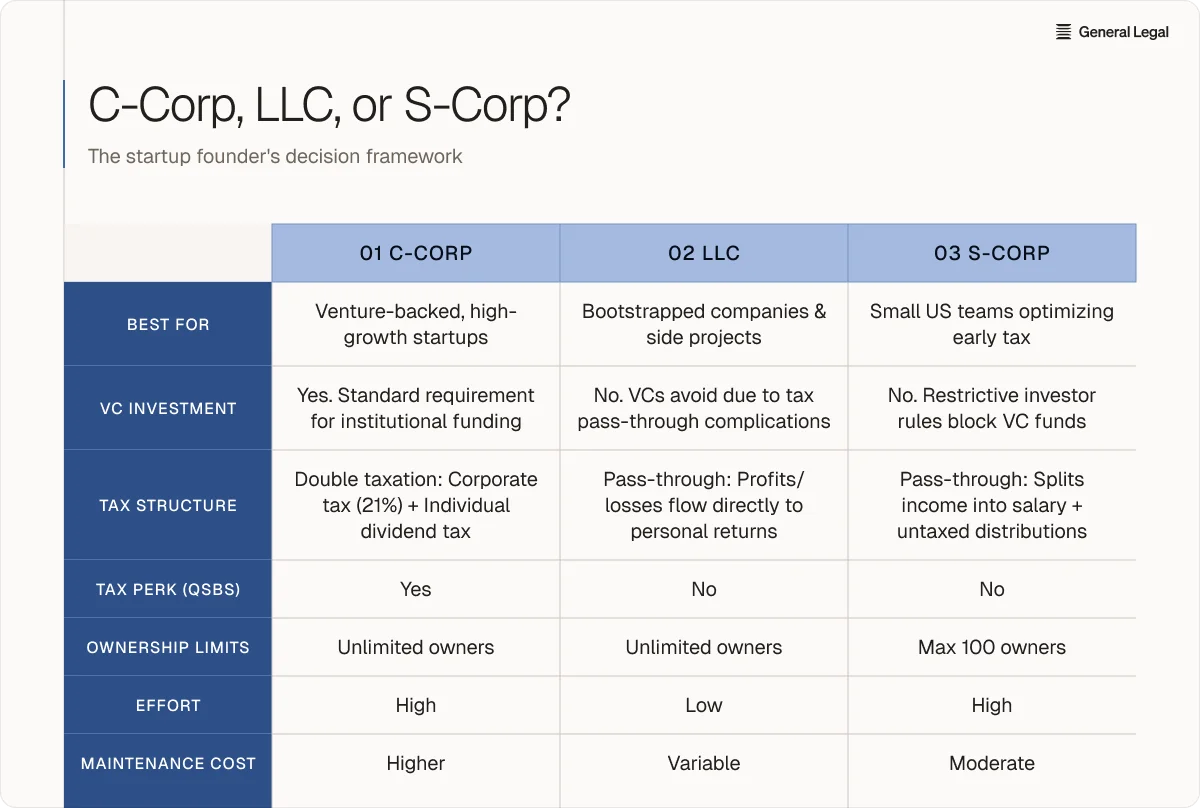
- Advising on the most appropriate entity structure for the business
- Drafting and maintaining bylaws, operating agreements, and other governing documents
- Documenting founder ownership, equity allocations, and vesting arrangements
- Preparing board resolutions, written consents, and meeting minutes
- Maintaining corporate records and governance frameworks that support fundraising, due diligence, and future exits
3. Contract review and negotiation
Startups run on contracts. From customer agreements and vendor relationships to partnerships and software licensing, nearly every stage of growth involves negotiating legal terms that can affect revenue, liability, and operational flexibility.
An outside general counsel can ensure these agreements protect the business while keeping deals moving by:
- Drafting, reviewing, and negotiating NDAs
- Managing customer agreements, MSAs, statements of work, and SaaS contracts
- Reviewing vendor, supplier, and procurement agreements
- Negotiating partnership, reseller, referral, and integration agreements
Beyond individual agreements, outside general counsel can also develop standardized contract templates, approval workflows, and negotiation playbooks that reduce legal bottlenecks and support faster growth.
4. Employment and HR compliance
Hiring sounds straightforward until startups start adding employees, contractors, advisors, and remote workers across multiple states.
Misclassification, poorly drafted employment agreements, and missing IP assignment provisions can create legal, tax, and ownership issues that often surface during fundraising, due diligence, or disputes with current and former workers.
An outside general counsel can ensure your workforce is structured and documented correctly by:
- Drafting offer letters, employment agreements, and onboarding documentation
- Preparing consultant, independent contractor, and advisor agreements
- Advising on employee versus contractor classification
- Drafting confidentiality, invention assignment, and IP ownership agreements
- Developing employee handbooks, workplace policies, and compliance procedures
- Managing equity grants, incentive plans, separation agreements, and other employment-related documentation
5. Intellectual property protection
For many startups, intellectual property (IP) is the business. Yet ownership and licensing issues often remain hidden until an investor, acquirer, or opposing party starts asking difficult questions.
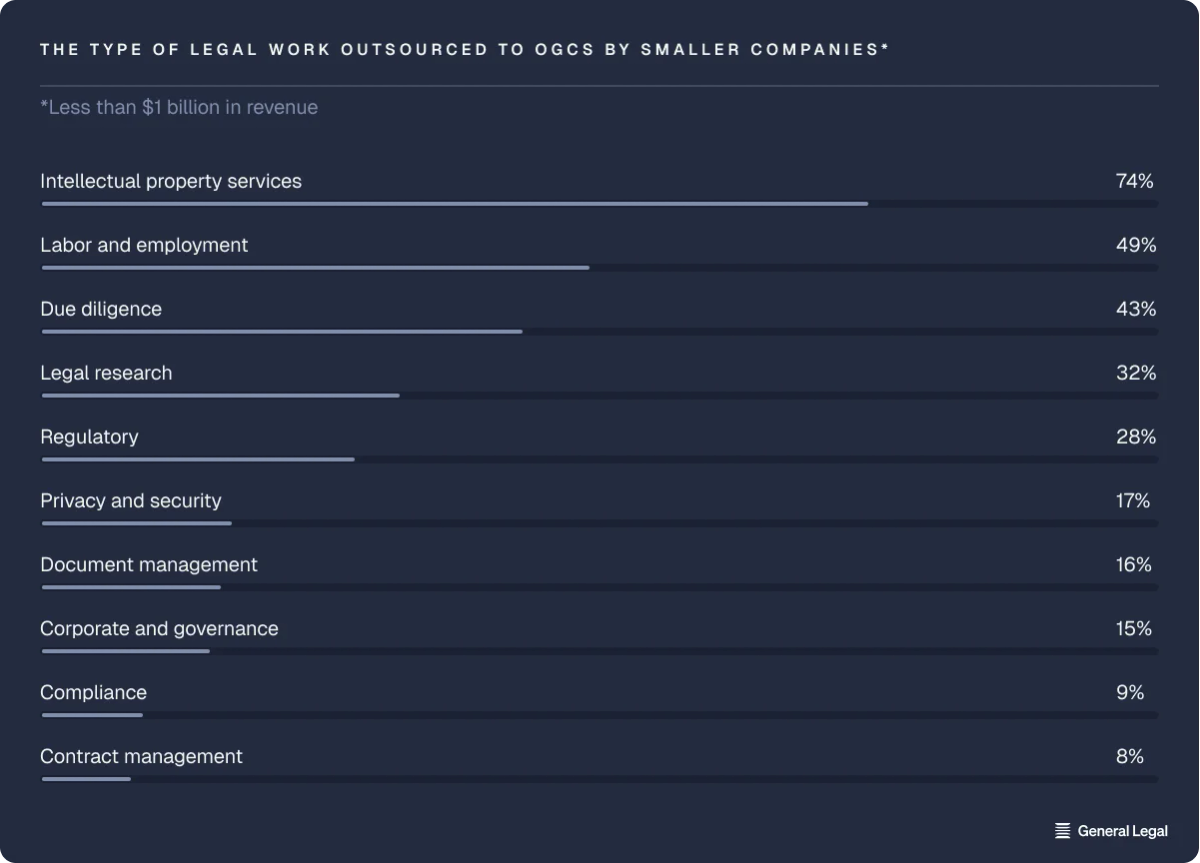
That complexity is one reason IP is among the most frequently outsourced legal functions in smaller companies: 74% of legal departments use outside counsel for intellectual property matters to some degree.
An outside general counsel can protect and strengthen your IP position by:
- Ensuring founders, employees, and contractors properly assign IP to the company
- Reviewing invention assignment, confidentiality, and NDA agreements
- Identifying potential ownership, licensing, and third-party IP risks early
- Coordinating trademark, copyright, and patent filings with specialized IP counsel
- Monitoring open-source software usage and related compliance obligations
- Aligning the company’s IP strategy with its fundraising, growth, and exit objectives
6. Data privacy and regulatory compliance
Most startups collect, store, or process customer data long before they have dedicated compliance resources. As privacy regulations continue to expand, staying compliant requires more than publishing a singular privacy policy and moving on.
An outside general counsel can manage privacy and compliance obligations by:
- Drafting privacy policies, cookie notices, and data processing agreements
- Advising on GDPR, CCPA/CPRA, and other applicable privacy requirements
- Developing internal data governance and data handling policies
- Supporting AI governance, vendor management, and incident response planning
- Coordinating HIPAA-related documentation and other industry-specific compliance requirements
7. Strategic legal guidance and risk management
Without proactive legal guidance, startups often end up operating in a reactive mode: addressing issues only after they become urgent, expensive, or investor-facing.
An outside general counsel can help avoid this scenario by:
- Assessing legal risks before new initiatives, partnerships, or expansions
- Advising on growth strategies, governance decisions, and operational changes
- Monitoring regulatory and compliance developments that may affect the business
- Coordinating specialized outside counsel when niche expertise is required
- Managing disputes, demand letters, and emerging legal issues
- Aligning legal decisions with the company’s long-term fundraising and exit objectives
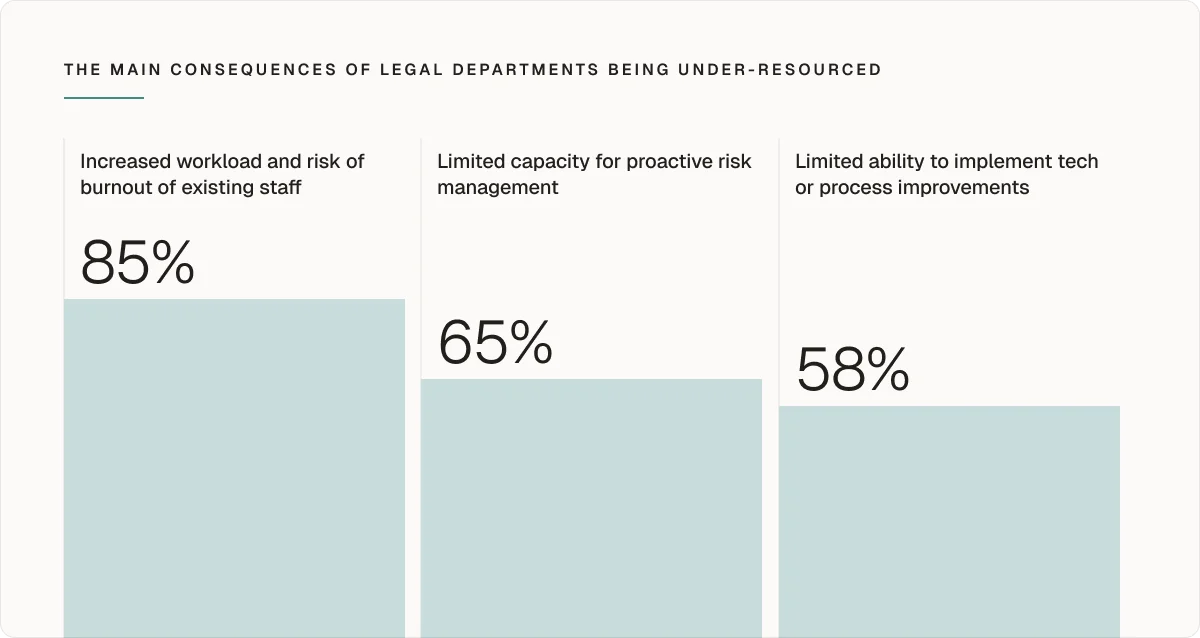
Given that proactive risk management is limited in 65% of legal teams due to resource constraints, outside general counsel can be a cost-effective way for startups to access the strategic legal oversight needed to stay ahead of emerging risks.
Cost-effective access to experienced legal counsel is one of the main reasons startups choose the outside general counsel model. But it’s far from the only advantage.
Why hire outside general counsel for your startup: 5 key benefits
Hiring outside general counsel gives startups several advantages, including these five key ones:
- Reduced founder workload: Startup founders already wear enough hats. OGC takes ownership of day-to-day legal matters, allowing you to focus on product, customers, and growth rather than contracts, compliance questions, and legal administration.
- Specialized expertise on demand: Few startups need a full legal department, but most eventually need advice on fundraising, employment, contracts, intellectual property, privacy, and compliance. OGC provides access to that expertise as it becomes relevant, without the cost of building a team of specialists.
- Embedded legal partnership: Re-explaining your business to a new lawyer every time an issue arises is inefficient. OGC develops institutional knowledge of the company over time, enabling faster guidance and advice that reflects your business model, investors, and long-term goals.
- A more holistic approach to growth: Legal challenges rarely exist in isolation. Modern legal leaders routinely oversee compliance, privacy, ethics, and risk management alongside traditional legal work. OGC brings that broader perspective to startups, helping legal strategy evolve alongside the business.
- Cost efficiency: Building an internal legal function is expensive, particularly for companies still searching for product-market fit or scaling headcount. OGC provides access to senior legal expertise without the salary, benefits, equity, and overhead of a full-time hire, making legal support easier to scale as the company grows.
Avoiding the cost of a full-time legal hire can sound appealing to startups. But what kind of investment does the OGC model require?
How much does outside general counsel cost?
The cost of outside general counsel varies based on the startup’s stage, legal complexity, and preferred engagement model. Most startups encounter one of the following arrangements:
| Engagement model | How it works | How much it usually costs |
|---|---|---|
| Hourly billing | The law firm bills for the time spent on each matter, with rates varying based on attorney seniority, experience, and firm size. | - $300-$500/hour for associates - $600-$1,000+/hour for partners and senior counsel (elite firms may exceed $2,000-$4,000/hour) |
| Monthly retainer | The startup pays a fixed monthly fee in exchange for ongoing legal support, strategic guidance, and access to counsel for day-to-day legal matters. | $1,500-$15,000+ per month |
| Quarterly retainer | The company engages counsel on a quarterly basis for periodic legal reviews, strategic planning, and a defined scope of ongoing support. | Varies by scope; typically lower than a full monthly retainer |
| Project-based pricing | Legal services are provided for a specific transaction, initiative, or deliverable, with pricing agreed upon before the work begins. | $1,500-$5,000+ per project, with larger transactions costing substantially more |
| Hybrid model | The company pays a recurring retainer for routine legal support while separately paying fixed fees for major transactions or specialized projects. | Retainer fees plus project-based pricing as needed |
The legal industry still overwhelmingly runs on billable hours, with 90% of legal spending flowing through this model. However, AI-native law firms are beginning to challenge the status quo by offering fixed-fee pricing that provides startups with greater predictability and cost control.
That’s just one of the reasons these firms are becoming a popular choice for outside general counsel.
Why AI-native law firms excel as outside general counsel for startups
AI-native law firms pair experienced attorneys with technology-enabled workflows that eliminate much of the friction found in traditional legal services. Founders still receive the strategic support they expect from outside general counsel, but with faster turnaround times, more predictable pricing, and greater operational efficiency.
General Legal is a good example of this model in practice.

Rather than selling legal software, it operates as a full-service law firm relying on AI-assisted attorney workflows. Every matter is still handled by US-barred attorneys, but routine tasks like issue spotting, contract analysis, and document review are accelerated through proprietary technology. The result is more efficient legal service delivery without sacrificing legal judgment or accountability.
This approach reinforces many of the benefits of outside general counsel for startups:
- Faster execution: Contracts, employment documents, fundraising materials, and other legal work can be reviewed and turned significantly faster than through traditional law firm workflows.
- More predictable pricing: General Legal offers flat-fee pricing across a wide range of legal services, allowing founders to budget for legal support without worrying about escalating billable hours or unexpected invoices.
- Broader legal coverage: General Legal’s expanding practice areas include employment, venture financing, data privacy, intellectual property, commercial contracts, and legal operations—the same areas where startups most commonly rely on outside general counsel.
- Higher leverage for founders: By combining technology with experienced legal counsel, General Legal removes administrative friction, accelerates routine legal work, and allows founders to spend less time managing legal processes and more time building the business.
General Legal also adopts a startup-native operating model.
Rather than relying on long email chains and traditional law firm communication, it works directly inside client Slack channels, allowing founders and operators to access legal support within the tools they already use every day. For fast-moving startups, this can make legal guidance feel less like an external service and more like an extension of the team.
That approach is part of the reason more than 250 growth-stage companies have chosen General Legal as their legal partner. If you’re exploring outside general counsel for your startup, you can sign up for free or contact our team to learn more.
- Outside general counsel (OGC) provides ongoing legal guidance without a full-time hire, and demand is rising: 48% of chief legal officers now rely on external support after years of trying to keep legal work in-house.
- Common triggers for needing OGC include frequent fundraising, a growing volume of contracts, rising headcount, expansion into new markets, operating in a regulated industry, or preparing for an acquisition.
- OGC typically covers seven core areas: fundraising and equity, entity formation and governance, contract review, employment/HR compliance, IP protection, data privacy compliance, and general risk management.
- Companies with under $1 billion in revenue have a median legal team of just two lawyers and three total legal staff, which is why many combine a small in-house team with outside general counsel rather than choosing one or the other.
- Engagement models range from hourly billing ($300-$500/hour for associates, $600-$1,000+ for partners) to monthly retainers ($1,500-$15,000+), project-based pricing, and hybrid arrangements.
- AI-native firms like General Legal are positioned as a newer alternative, offering flat-fee pricing and faster turnaround than the traditional hourly model that still accounts for about 90% of legal industry billing.
| What OGC is | An attorney or firm that functions as a company's general counsel on an ongoing basis without joining payroll, distinct from outside counsel hired for a single matter. |
|---|---|
| Why demand is rising | 48% of chief legal officers now rely on external legal support, reversing an earlier trend of pushing legal work in-house to cut costs. |
| When startups typically need it | Common triggers include frequent fundraising rounds, a growing volume of contracts, rising headcount, expansion into new markets, and operating in a regulated industry. |
| Seven core service areas | Fundraising and equity, entity formation and governance, contract review and negotiation, employment/HR compliance, IP protection, data privacy compliance, and general risk management. |
| In-house vs. outside counsel in practice | Companies under $1 billion in revenue have a median legal team of just two lawyers, so many combine a small internal team with OGC rather than picking one model exclusively. |
| Typical pricing models | Hourly ($300-$500/hr associates, $600-$1,000+/hr partners), monthly retainers ($1,500-$15,000+), project-based fees ($1,500-$5,000+), or hybrid arrangements. |
| Where the industry still sits | About 90% of legal spending still runs through billable hours, even as AI-native firms begin offering flat-fee alternatives. |
| General Legal's pitch | Positions itself as an AI-native OGC option offering faster turnaround and flat-fee pricing via Slack-based communication, working with more than 250 growth-stage companies. |
How is outside general counsel different from hiring a law firm for a single deal?
OGC serves as a consistent legal point of contact across the whole company on an ongoing basis, rather than being engaged only for one transaction or dispute.
At what point does a startup typically need outside general counsel?
When legal issues become a recurring part of running the business rather than a one-off event, commonly triggered by frequent fundraising, growing contract volume, headcount growth, or operating in a regulated industry.
Can a startup use outside general counsel alongside an in-house lawyer?
Yes, the two aren't mutually exclusive, and it's common given that companies under $1 billion in revenue have a median in-house legal team of just two lawyers.
What are the typical pricing models for outside general counsel?
Hourly billing, monthly or quarterly retainers, project-based pricing, or a hybrid of a retainer plus fixed fees for larger matters, with monthly retainers commonly running $1,500-$15,000+.
What's the difference between AI-native OGC providers and traditional firms?
AI-native firms like General Legal offer flat-fee pricing and faster turnaround by combining attorney oversight with AI-assisted workflows, versus the roughly 90% of the industry still billing hourly.
What are the core services a startup should expect from OGC?
Fundraising support, entity formation and governance, contract review, employment/HR compliance, IP protection, data privacy compliance, and general strategic risk management.
What does an outside general counsel do?
An outside general counsel provides ongoing legal guidance to a business without joining the company’s payroll.
How much does outside counsel cost?
Outside counsel costs vary by engagement model, but startups typically pay anywhere from a few hundred dollars per hour to over $15,000 per month.
Why should you hire outside counsel?
Hiring outside counsel gives you access to experienced legal expertise without the cost of building a full in-house legal team.
- Best Fractional General Counsel for Startups: 6 Top OptionsDiscover the best fractional general counsel for startups so you can find expert legal support and manage costs.
- 6 Best Law Firms for Growing Startups [Comparison]An overview of the top law firms for growing companies.
- 5 Best AI-native Law Firms for Startups [Comparison]Discover the best AI native law firms and find the right legal partner to streamline legal work, reduce costs, and support your bu