
Contract review is the process of analyzing a contract before signing to identify risks, validate terms, and ensure the agreement actually protects your business.
Startups might not handle over 50,000 contracts per year like the busiest enterprise legal teams do, but they still routinely negotiate contracts such as Master Service Agreements (MSAs) and SaaS terms. Getting those contracts wrong can create significant financial, legal, and operational risk.
However, manual contract review creates a costly bottleneck, withdelays, unfavorable contract terms, and operational friction eroding up to 9% of annual revenue.
That’s why legal teams are increasingly adopting artificial intelligence (AI) to accelerate review cycles, identify risky clauses, and reduce negotiation bottlenecks.
If contract review is starting to delay deals for your business, the seven contract review AI tools below are worth evaluating.
How we chose the 7 best contract review AI tools
There’s no single “best” contract review AI tool for every organization, as different teams operate under different constraints. Some need enterprise-grade review infrastructure; others require fast self-service reviews, outsourced legal support, or tools that integrate into their existing workflows.
So, rather than ranking tools based on marketing claims or feature volume, we selected platforms that solve different operational problems across startups, in-house legal teams, and enterprise organizations.
The following factors played the largest role in our selection process:
- Quality of contract review (25%): We prioritized tools that improve review accuracy, identify meaningful risks, surface problematic clauses, and help legal teams review contracts faster without sacrificing legal judgment.
- Fit for different company sizes (20%): Some tools are built for lean startup teams handling a handful of agreements a week. Others are designed for enterprise legal departments reviewing thousands of contracts per year. We included both.
- Level of legal involvement required (15%): We included both AI copilots designed for legal professionals and solutions geared toward founders, operators, procurement teams, and businesses seeking more hands-on legal support.
- Workflow integration (15%): Contract review happens inside operational workflows, not in isolation. We looked closely at integrations with Microsoft Word, Slack, CLM systems, e-signature platforms, approval workflows, and existing legal processes.
- Practical usability and adoption (15%): A powerful platform nobody adopts is useless. We favored tools that reduce friction, accelerate negotiations, and fit naturally into existing workflows.
- AI realism instead of hype (10%): Many legal AI tools promise full automation, but very few deliver it. We prioritized platforms that understand where AI is genuinely useful and where human legal judgment remains essential.
The 7 best contract review AI tools at a glance
| Tool | Review style | Best for |
|---|---|---|
| 1. Harvey AI | Enterprise legal intelligence | Enterprise legal teams and large law firms |
| 2. Spellbook | Word-native AI copilot | Legal teams working primarily in Microsoft Word |
| 3. Juro | Collaborative AI workflow | Lean legal teams managing growing contract volumes |
| 4. goHeather | Non-lawyer AI review | SMBs reviewing routine contracts |
| 5. Legly | Self-service AI review | Freelancers and small businesses reviewing straightforward agreements |
| 6. Docusign IAM | Integrated AI agreement management | Companies already using the Docusign ecosystem |
| 7. LegalFly | Playbook-driven AI review | Small legal teams handling high-volume contract review |
1. Harvey AI: Best for enterprise legal teams and large law firms

Harvey AI is an enterprise-grade legal AI platform that supports contract analysis, legal research, drafting, due diligence, regulatory work, and large-scale document review inside a centralized AI workspace.
This platform is geared toward large legal departments and Am Law firms handling substantial volumes of unstructured legal data while maintaining strict security, governance, and compliance standards.
Organizations managing highly specialized matters spanning multiple practice areas will find more value in Harvey than those looking for a point solution focused solely on routine contract review.
Key features
Harvey supports large-scale legal analysis and workflow automation through features like:
- Vault document analysis: Extract and compare key contract terms from thousands of agreements to identify renewals, compliance risks, and operational inconsistencies at scale.
- Review workflow builder: Build multi-step legal review processes that automate repetitive analysis, document assessment, and information extraction.
- Knowledge and playbook management: Apply internal precedents, templates, and negotiation standards consistently across legal teams and matters.
Pricing
Harvey operates on a custom enterprise pricing model with costs varying based on seat count, integrations, and workflow complexity.
The platform is designed for large firms and enterprise legal departments rather than smaller legal teams or startups, and its pricing reflects that positioning.
2. Spellbook: Best for legal teams working primarily in Microsoft Word
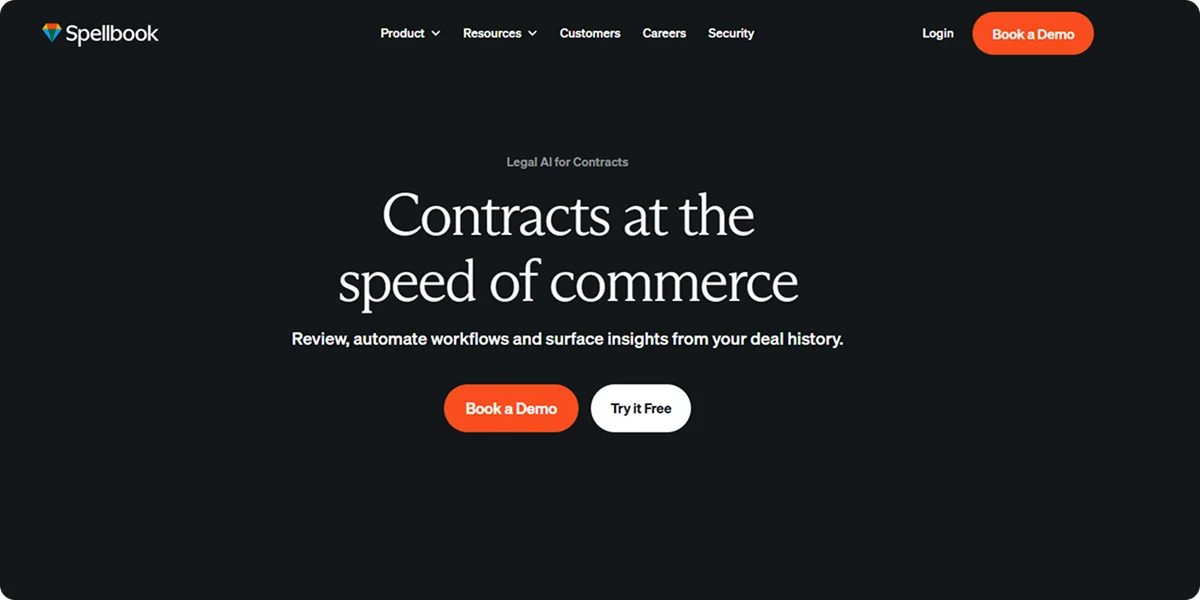
Spellbook is an AI contract review copilot built directly into Microsoft Word. It helps legal teams review, redline, and negotiate agreements without leaving the document itself.
This makes it a strong fit for transactional lawyers, small firms, and operators who spend most of their timereviewing contracts inside Word rather than managing complex enterprise CLM systems.
Key features
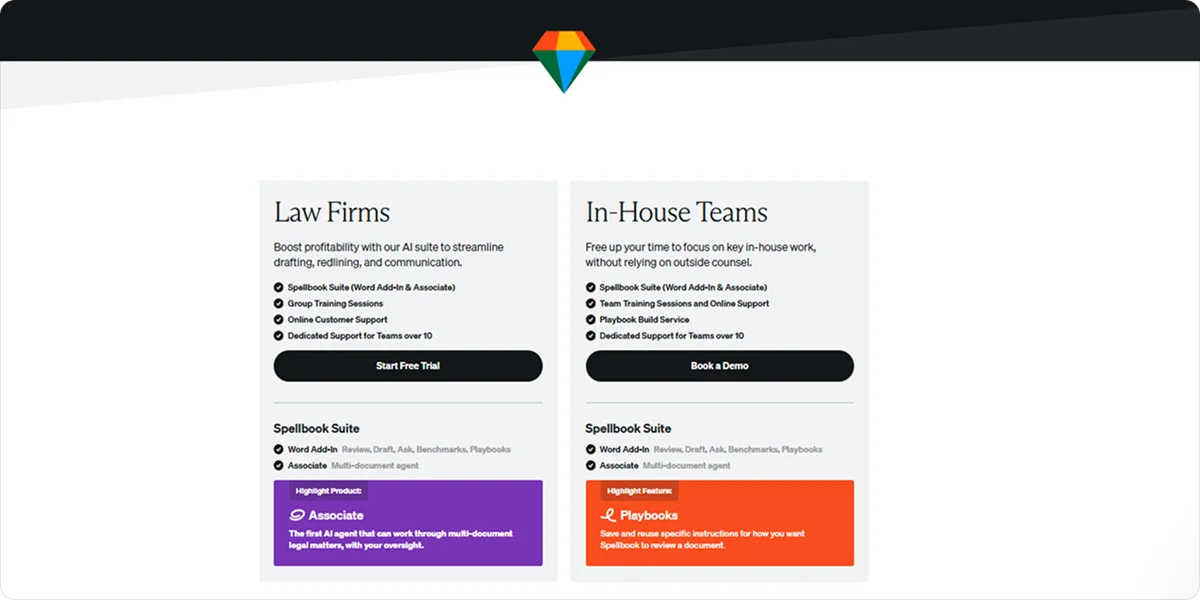
Spellbook streamlines in-document review and negotiation support through tools like:
- AI-powered redlining: Generate contract edits and negotiation markups directly inside Word to accelerate review cycles.
- Custom playbooks: Apply pre-approved legal guidance and fallback language automatically across agreements.
- Risk and drafting detection: Surface risky clauses, drafting inconsistencies, and missing terms before agreements move forward.
Pricing
Spellbook uses a custom pricing model based primarily on team size and organizational requirements.
3. Juro: Best for lean legal teams managing growing contract volumes
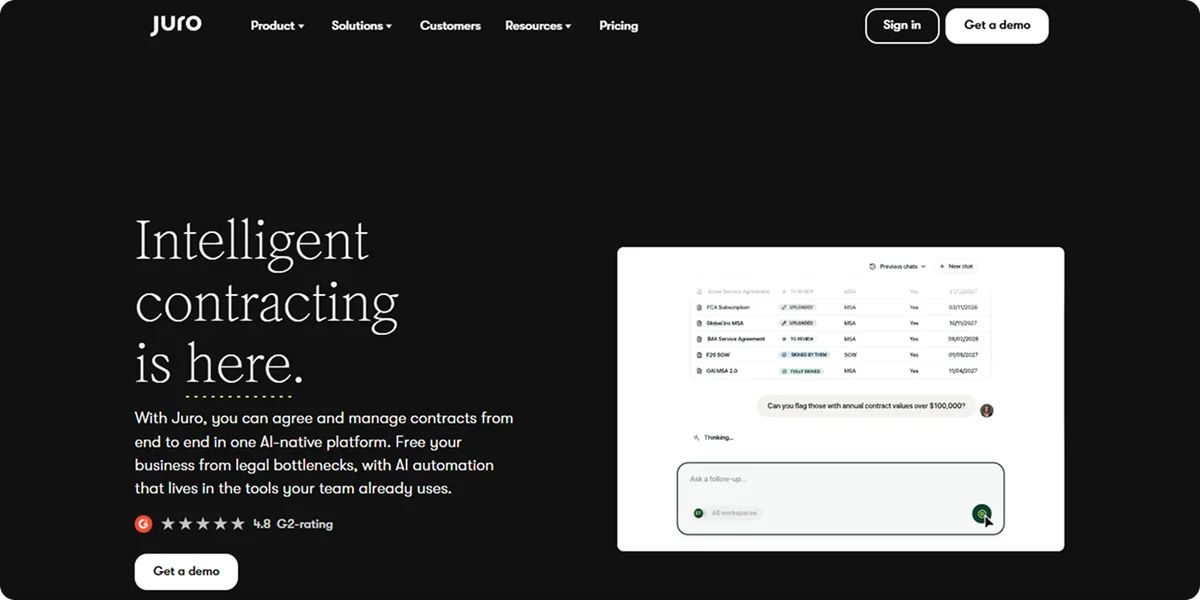
Juro is an AI-native contract automation platform that combines contract review, redlining, approvals, signing, and storage inside a collaborative browser-based workspace.
It’s particularly useful for companies handling increasing contract volume, as it enables commercial and business teams to self-serve routine agreements while legal retains oversight and control.
Key features
Juro keeps contract review fast, collaborative, and embedded inside existing business systems, thanks to tools like:
- AI review agent: Analyze third-party contracts against internal playbooks to identify deviations from approved terms and generate fallback redlines automatically.
- Smart data extraction: Pull key contract terms into structured fields that trigger approvals, workflows, summaries, and reporting.
- Cross-platform integrations: Review and manage contracts directly inside Slack, Microsoft Teams, Salesforce, HubSpot, Microsoft Word, and other existing business systems.
Pricing
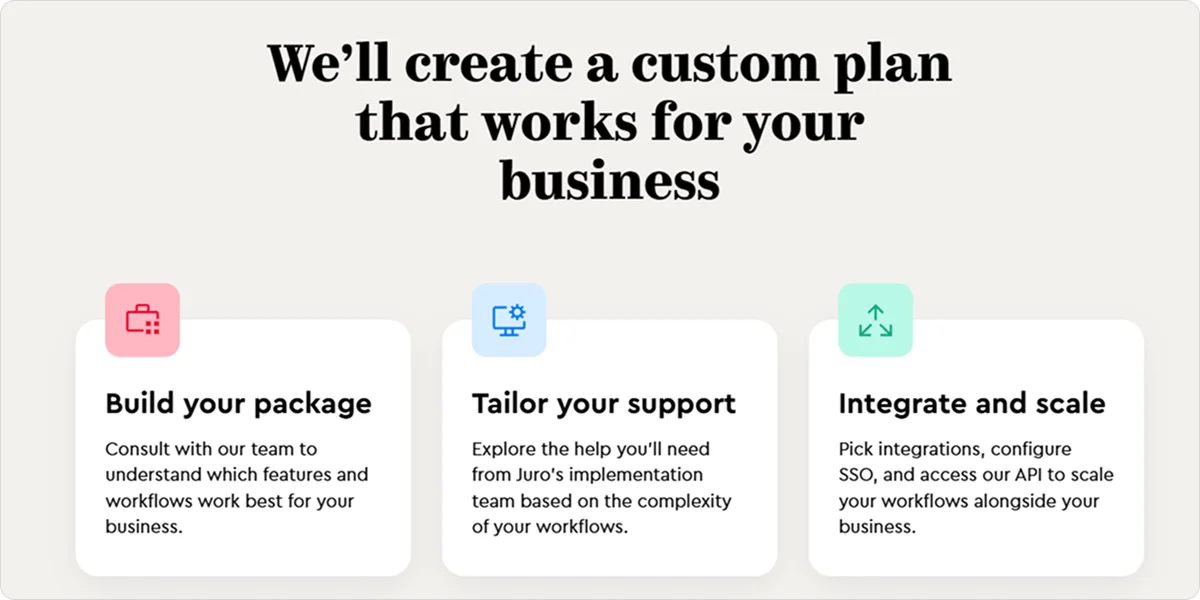
Juro’s pricing is customized based on contract volume, workflow requirements, AI functionality, and integration needs.
4. goHeather: Best for SMBs reviewing routine contracts
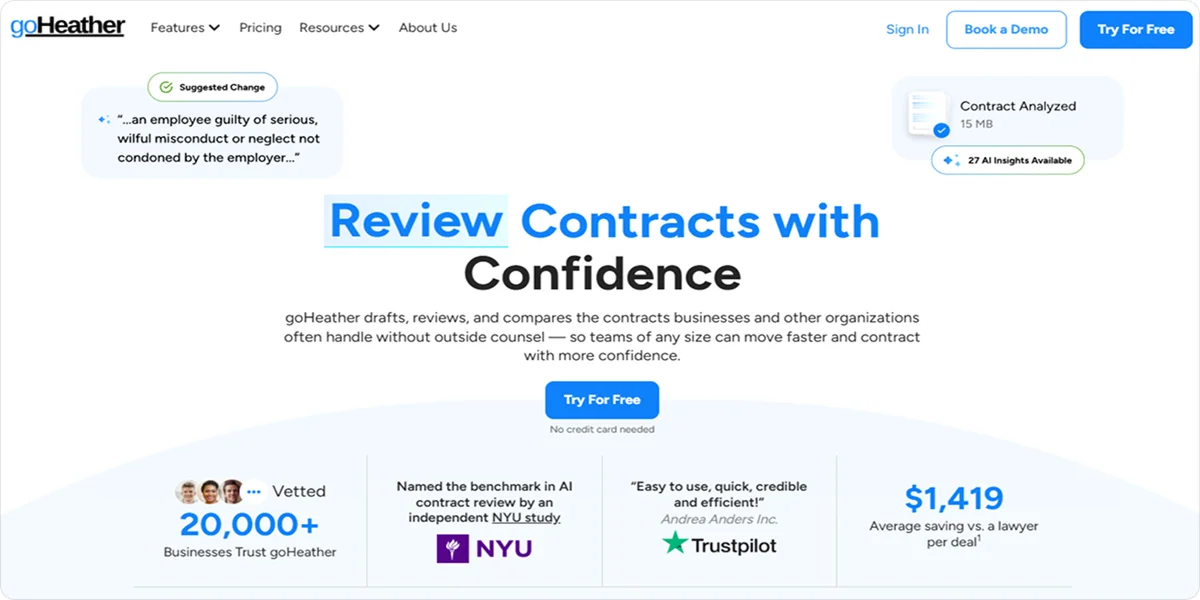
goHeather is a lawyer-trained AI contract review platform that helps users review, edit, and redline agreements through plain-English issue spotting, risk analysis, and guided negotiation suggestions.
It’s designed for contracts that require review but don’t necessarily justify involving outside counsel. That’s why small businesses, procurement teams, and fractional GCs reviewing employment agreements or routine commercial contracts are likely to find the most value in it.
Key features
goHeather makes deep contract review more accessible to non-lawyers through features like:
- Traffic-light risk scoring: Flag problematic clauses with a red, yellow, and green system, making it easier to prioritize legal risk.
- Plain-English clause explanations: Translate dense legal language into practical business implications and explain how specific terms could affect negotiations, IP ownership, or liability exposure.
- Custom AI playbooks: Apply internal standards and fallback positions automatically to uploaded Word documents and PDFs.
Pricing
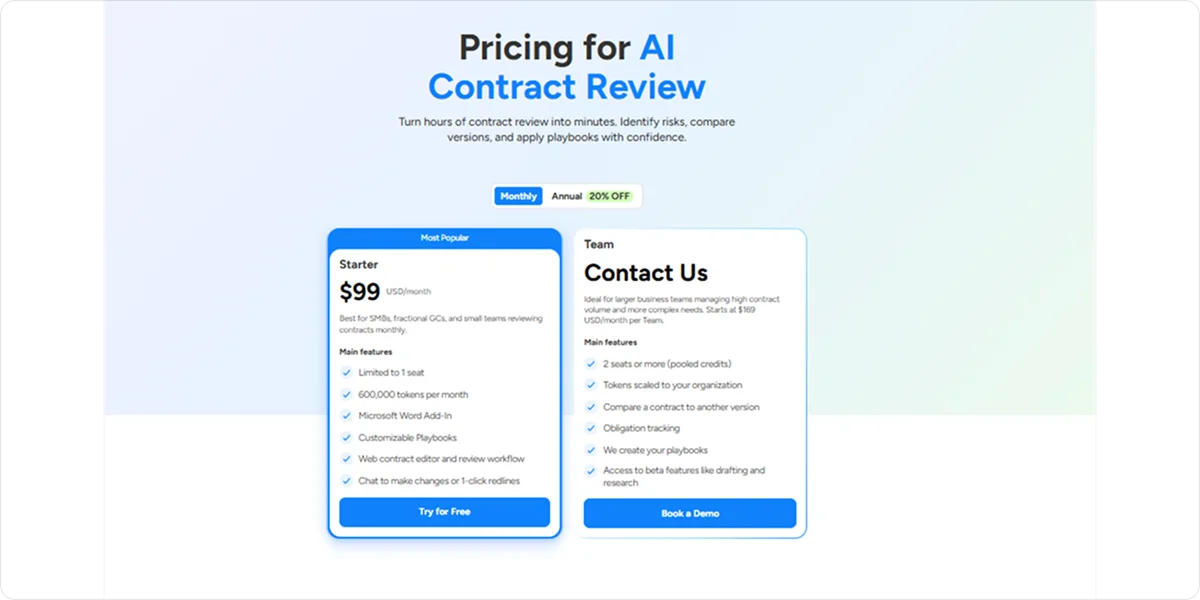
goHeather offers tiered pricing for individuals, small teams, and larger organizations with higher contract volume. The higher-tier plan adds collaborative review tools, obligation tracking, drafting support, and expanded AI capabilities.
5. Legly: Best for freelancers and small businesses reviewing straightforward agreements
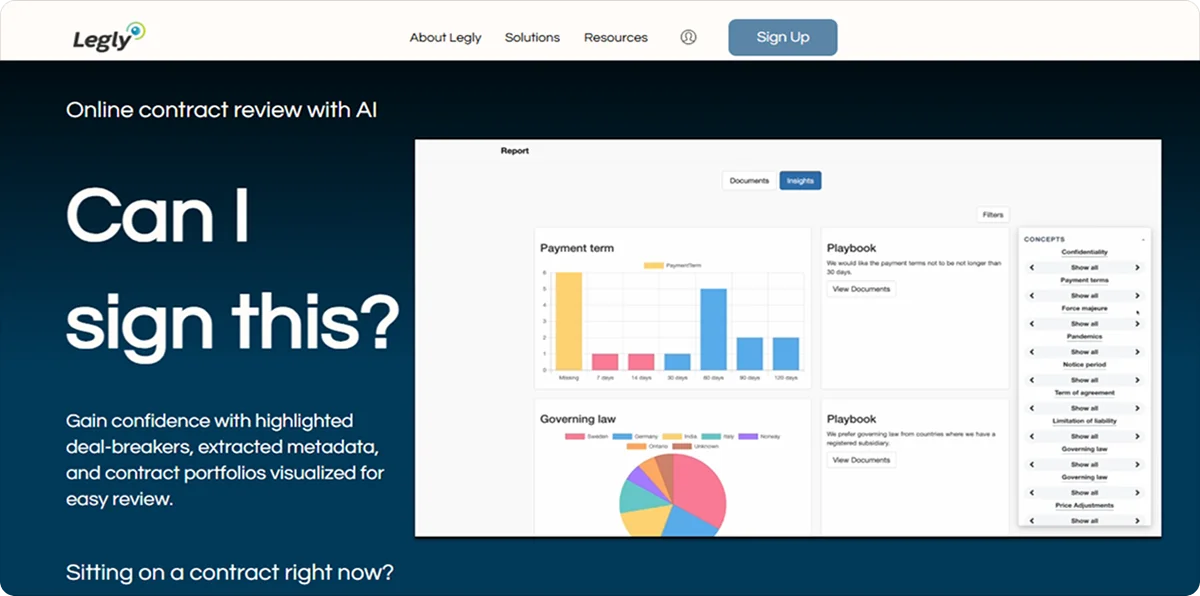
Legly is a web-based AI contract review platform that supports users in analyzing contracts, identifying deal-breakers, and organizing agreements without requiring any software installation.
Freelancers, independent contractors, and smaller businesses reviewing straightforward commercial agreements will benefit from its lightweight setup and highly accessible interface.
Key features
Legly prioritizes fast, low-friction contract analysis for business users, offering features like:
- Deal-breaker detection: Highlight missing clauses, restrictive terms, and non-standard contract language before agreements get signed.
- Metadata extraction: Pull deadlines, payment terms, renewal conditions, and termination notices into structured data for easier tracking and follow-up.
- Contract dashboard: Organize agreements visually, and search across contract portfolios to monitor obligations and key terms more efficiently.
Pricing
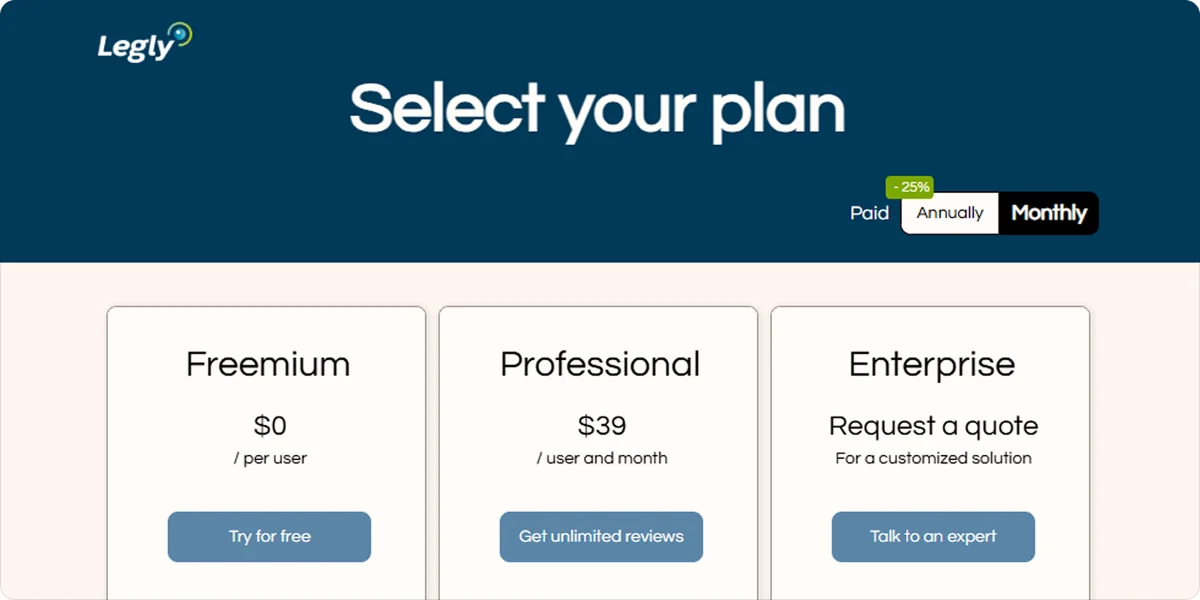
Legly offers a freemium model for basic contract reviews, alongside paid plans for businesses with higher review volume and more advanced analysis requirements. The enterprise plan adds portfolio management, customized review guidelines, integrations, and dedicated support.
6. Docusign IAM: Best for companies already using the Docusign ecosystem
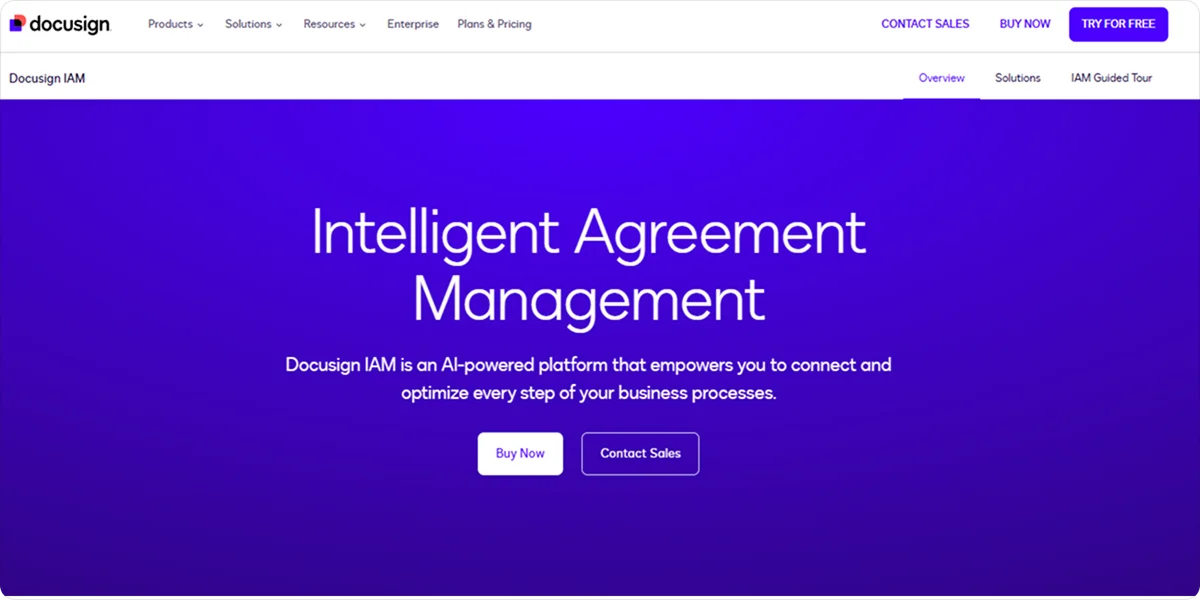
Docusign IAM is an AI-powered agreement management platform that combines contract analysis, review automation, storage, workflow management, and e-signatures inside a single agreement ecosystem.
It makes the most sense for businesses that already rely on Docusign for signing workflows and want to layer AI-powered contract review into systems their teams are already familiar with.
Key features
Docusign IAM centralizes agreement operations and accelerates contract handling at scale, through capabilities like:
- AI-assisted review: Compare agreements against internal playbooks to identify high-risk provisions and generate suggested redlines automatically.
- Agreement intelligence: Extract key contract data, monitor renewals, and surface operational insights from stored agreements.
- Conversational contract editing: Generate fallback clauses, rewrite contract language, and answer agreement questions directly inside Microsoft Word.
Pricing
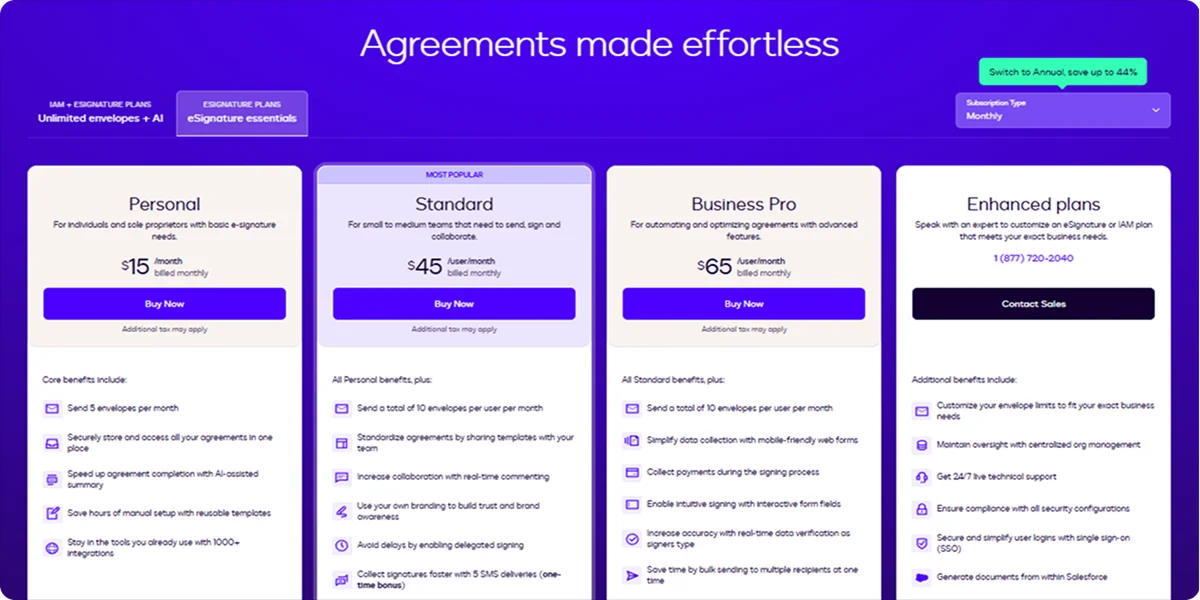
Docusign IAM offers multiple pricing tiers, ranging from individual e-signature plans to enterprise-scale agreement management deployments.
More advanced plans expand automation, integrations, compliance controls, AI review functionality, and organization-wide administration.
7. LegalFly: Best for small legal teams handling high-volume contract review
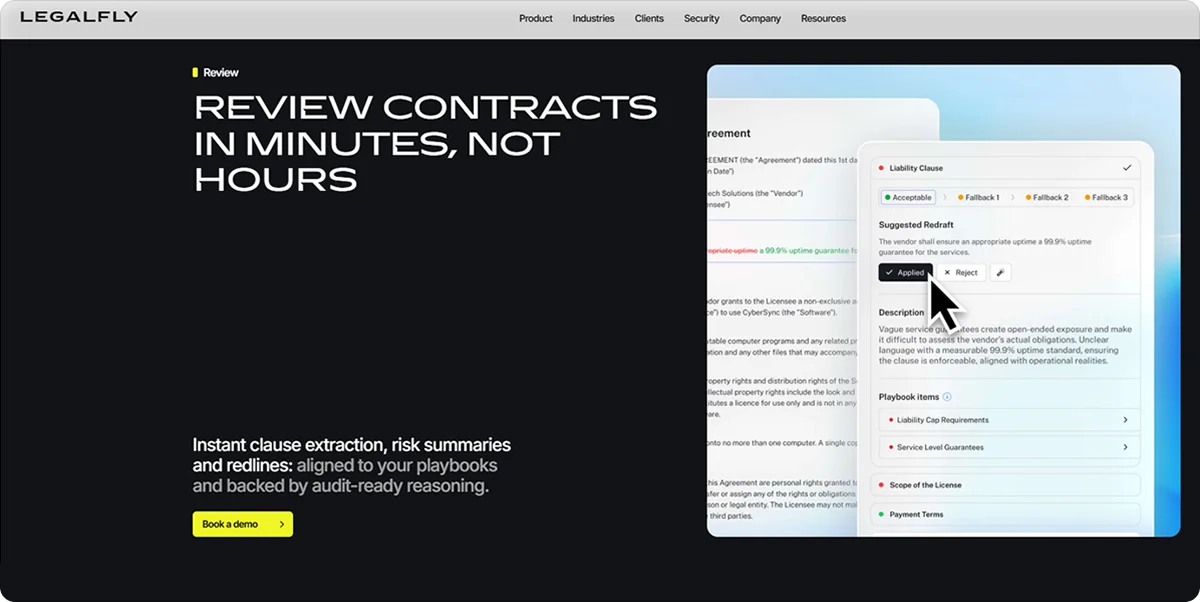
LegalFly is an AI contract review platform focused on fast clause analysis, playbook-based redlining, and audit-ready contract reviews inside Microsoft Word.
Small legal teams reviewing large numbers of agreements will benefit most from LegalFly’s ability to standardize contract decisions, maintain consistent negotiation positions, and reduce manual review time without losing visibility into why changes were made.
Key features
LegalFly offers scalable and defensible contract review through tools like:
- Automated playbook enforcement: Apply approved fallback clauses and negotiation standards automatically to incoming agreements.
- Audit-ready reasoning: Explain flagged risks, suggested edits, and clause deviations with supporting rationale and transparent review history.
- Negotiation-ready redlines: Generate fully formatted contract markups directly inside Microsoft Word for faster counterparty review and response.
Pricing
LegalFly operates on a custom quote-based pricing model tailored to contract volume, workflow complexity, and organizational requirements.
What is the best contract review AI tool?
The best contract review AI tool for your team depends on how your company handles contracts internally and where the review process tends to break down.
For large legal departments with complex approval chains, compliance requirements, and high contract volume, platforms like Harvey AI and Docusign IAM are often the most suitable choice. Smaller teams reviewing relatively straightforward agreements may find tools like goHeather, Legly, and Spellbook sufficient for issue spotting, redlining, and basic analysis.
The challenge often emerges in the middle.
Many startups and growth-stage companies have outgrown lightweight review tools but aren’t yet large enough to support a full in-house legal function.
In that situation, software alone only solves part of the problem. AI can identify clauses, suggest edits, and accelerate reviews, but someone still needs to make legal judgments, negotiate terms, and understand how employment, fundraising, commercial, privacy, and regulatory issues interact.
Hiring a single attorney can help, but their expertise may not cover every practice area the company encounters.
So, how do companies solve this problem without continuously adding headcount? The answer lies in AI-native law firms.
General Legal: An alternative to contract review AI tools
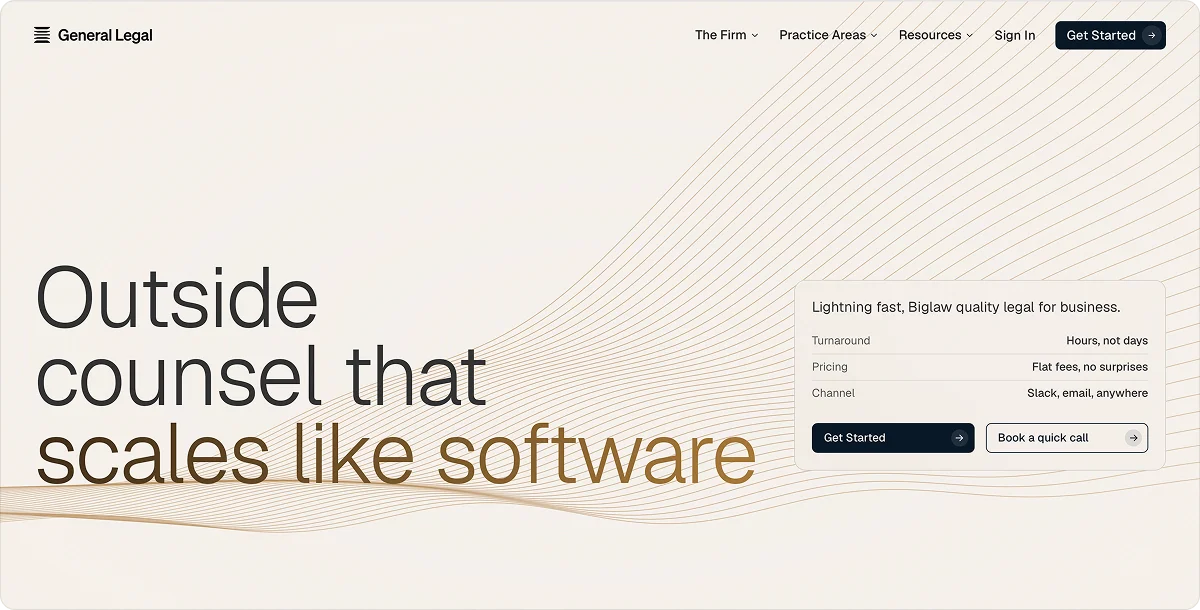
General Legal is an AI-native law firm that combines elite attorneys with AI-powered workflows to deliver contract review faster and more efficiently than traditional firms.
Unlike the companies on this list, General Legal doesn’t sell software. It delivers legal work through experienced lawyers who use AI internally to accelerate review cycles, reduce manual work, and turn contracts faster. This distinction creates a unique mix of legal expertise and operational speed that traditional firms and AI-only platforms can’t match.
Perhaps more importantly, it gives growing companies access to a broader range of legal expertise than they could reasonably maintain in-house.
Key features
General Legal removes much of the friction traditionally associated with legal services by offering:
- AI-assisted attorney review: Receive contract review from experienced US-barred attorneys supported by AI-enabled workflows.
- Slack-native workflow: Send contracts directly through Slack instead of managing legal requests over email.
- Support for core startup contracts: Review commercial agreements, employment documents, incorporation paperwork, Simple Agreements for Future Equity (SAFEs), and fundraising side letters.
- Client portal: Track matters, manage requests, and access documents from a centralized portal.
Benefits
General Legal’s biggest advantage is that it addresses three common frustrations with traditional legal services: slow turnaround times, unpredictable costs, and operational inefficiency.
This approach translates into the following benefits:
- Faster deal cycles: Receive contract reviews in hours instead of letting legal review queues delay negotiations and approvals.
- Higher-quality legal review: Get contract review grounded in legal judgment rather than relying exclusively on software-generated recommendations.
- Predictable pricing: Reduce uncertainty around legal spend with fixed-fee pricing and clearly defined scopes of work.
- Less operational drag: Keep legal review inside Slack and move contracts through the business faster without lengthy email chains and status updates.
- Scalable legal support: Process large volumes of standard agreements without overloading internal teams.
Pricing
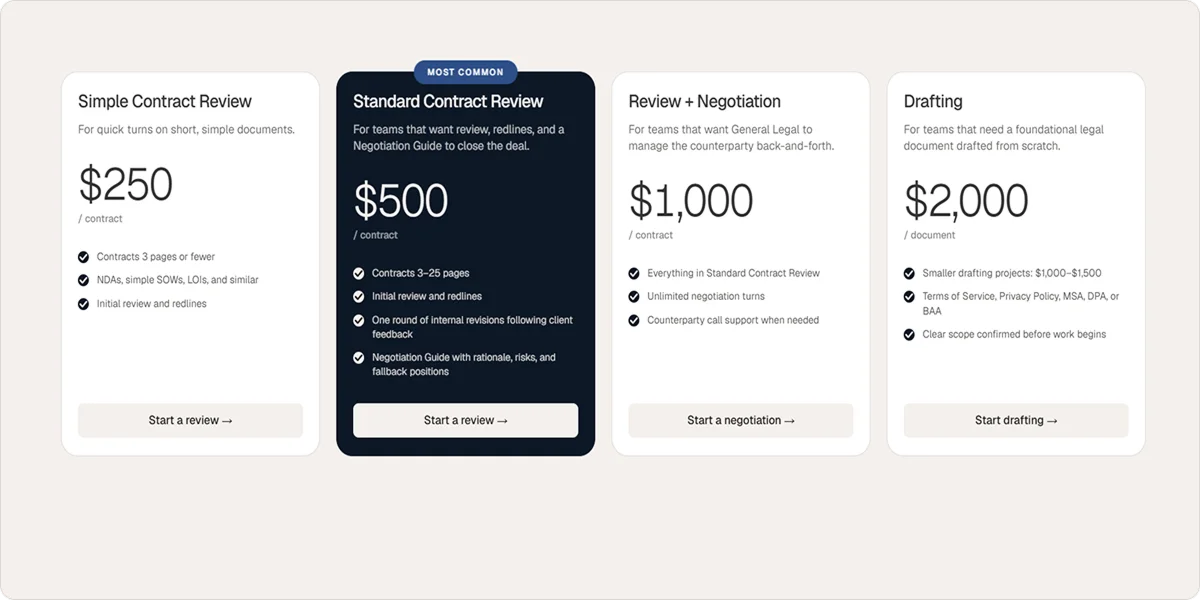
General Legal uses upfront flat-fee pricing instead of traditional hourly billing, making costs far easier to manage for startups and growth-stage companies.
Pricing varies based on the scope and complexity of the work, from lightweight contract reviews to full negotiations, drafting projects, and higher-volume agreement support.
Getting started with General Legal
If you think General Legal is the right fit for your company, getting started is straightforward.
Sign up directly through our website and start submitting contracts for review through Slack, email, or the client portal. For questions about pricing, supported matter types, or workflow compatibility, you can reach the team directly during operating hours: Monday through Friday, 5:00 a.m. to 6:00 p.m. PT.
- Manual contract review creates costly delays and unfavorable terms that can erode up to 9% of a company's annual revenue, driving legal teams toward AI-assisted review tools.
- The seven tools compared, Harvey AI, Spellbook, Juro, goHeather, Legly, Docusign IAM, and LegalFly, serve different needs, from enterprise-scale review to lightweight self-service tools for freelancers and small businesses.
- Harvey AI and Docusign IAM suit large legal departments with complex approval chains and high contract volume, while tools like goHeather, Legly, and Spellbook fit smaller teams handling more straightforward agreements.
- Growth-stage companies often fall in a gap where they've outgrown lightweight review software but can't yet justify a full in-house legal team spanning every practice area they need.
- General Legal positions itself as an alternative to buying software: it delivers contract review through attorneys who use AI internally, offering flat-fee pricing and Slack-based workflows instead of a licensed tool.
- AI can identify contract risks and suggest edits, but the article stresses that legal and business judgment still requires human review, regardless of which tool is used.
| Why this matters | Manual contract review delays deals and can erode up to 9% of annual revenue through unfavorable terms and operational friction. |
|---|---|
| Selection criteria | Tools were ranked on review quality (25%), fit for company size (20%), legal involvement required (15%), workflow integration (15%), usability (15%), and AI realism (10%). |
| Enterprise pick | Harvey AI is built for large legal departments and Am Law firms handling high volumes of unstructured legal data under custom enterprise pricing. |
| Word-native pick | Spellbook embeds AI review and redlining directly into Microsoft Word, suited to transactional lawyers who work mostly inside documents. |
| Collaborative workflow pick | Juro combines review, redlining, approvals, and e-signature in one workspace, letting business teams self-serve routine agreements while legal keeps oversight. |
| SMB and freelancer picks | goHeather offers traffic-light risk scoring for non-lawyers, while Legly provides a lightweight, no-install option for freelancers reviewing straightforward agreements. |
| Docusign and LegalFly | Docusign IAM layers AI review onto e-signature workflows already in use, while LegalFly focuses on playbook-driven, audit-ready review for small legal teams handling high volume. |
| The middle-market gap | Companies that have outgrown lightweight tools but aren't big enough for full in-house legal often turn to AI-native firms like General Legal instead of adding more software. |
Which AI contract review tool is best for a large legal department?
Harvey AI and Docusign IAM are generally the best fit for large legal departments with complex approval chains and high contract volume.
What if my company is too small for enterprise tools like Harvey but needs more than a basic review tool?
This is the gap the article identifies; companies at this stage often turn to AI-native law firms like General Legal, which pair AI-assisted review with attorney judgment rather than requiring a software purchase.
Can ChatGPT review a contract?
Yes, it can summarize clauses and suggest edits, but it can't provide legal advice and shouldn't replace professional review for high-stakes agreements.
What's the difference between a contract review tool and General Legal's service?
The tools on this list are software you manage yourself; General Legal doesn't sell software, it delivers completed contract review work through attorneys who use AI internally to speed up the process.
How much can manual contract review actually cost a business?
Delays, unfavorable terms, and operational friction from manual review can erode up to 9% of a company's annual revenue, according to the figures cited in the article.
Which AI tool is best for contract review?
The best AI tool for contract review depends on your company’s size, contract volume, and legal workflow requirements. Harvey AI is generally better suited to enterprise legal departments, while tools like Spellbook, Juro, goHeather, and Legly are often a stronger fit for smaller teams handling routine contract reviews. Companies that need legal support beyond software alone may also consider working with an AI-native law firm like General Legal.
- 7 Best Eudia AI Alternatives for Legal AI Workflows [Comparison]Explore the best Eudia AI alternatives so you can compare legal AI tools, find the right fit, and choose a solution for you.
- 7 Best Legora Alternatives for AI Legal Teams [Compared]Explore the best Legora alternatives so you can compare legal AI platforms, find the right fit & streamline your legal workflows.
- 7 Best Ontra Alternatives for Contract Automation [Compared]Discover the best Ontra alternatives so you can compare contract solutions, find the right fit, and streamline legal workflows.