
Running a business means dealing with the law—a lot more than most founders probably realize.
Even small businesses reported an average of four legal needs per owner in 2023, according to the 2024 California Justice Gap Study. The biggest needs were decidedly connected to a type of commercial law: 50% of businesses needed help drafting, reviewing, or negotiating contracts, while 40% required tax or financial legal advice.
But legal needs are only the starting point.
Where there’s legal activity, there’s room for something to go wrong, turning a routine legal need into a commercial problem.
To help you prepare for what may be ahead, this guide breaks down eight of the most common commercial legal issues businesses face and the steps they can take to resolve them.
8 commercial legal issues to watch for
These eight commercial legal issues cover a broad range of challenges businesses can face. The solutions vary just as widely, from using an established process to address it yourself to bringing in a commercial law firm when the stakes are higher.
For example, small businesses tend to start by looking online; 93% of owners did so when addressing their legal needs in 2023.
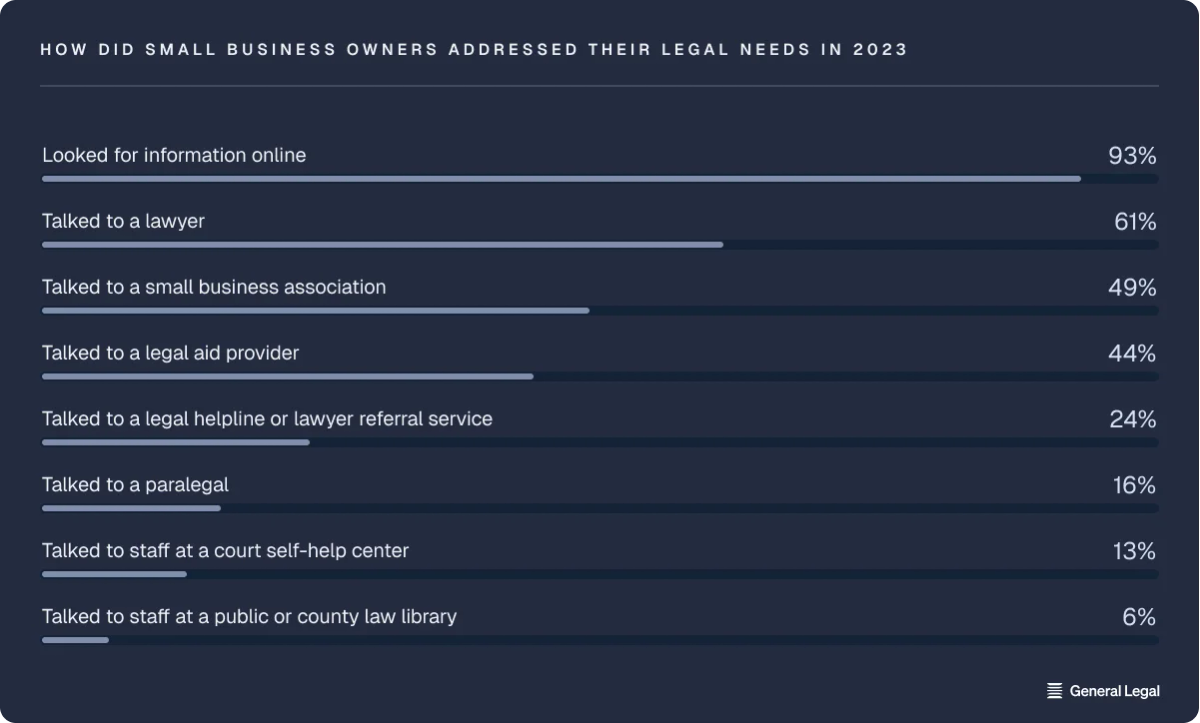
That’s why each commercial legal issue below is paired with practical ways to prevent, handle, or resolve it—with or without legal help.
1. Equity and governance disputes between co-founders
Co-founder disputes happen when founders no longer agree on ownership, voting power, strategic decisions, or a founder’s departure. The underlying commercial legal issue here isn’t the disagreement itself, but the lack of well-defined rules for resolving it.
Given that Harvard Business School research found that founder conflict plays a role in up to 65% of high-potential startup failures, resolving this legal issue should top your list of priorities. Otherwise, the dispute can:
- Freeze decision-making and leave critical issues unresolved
- Derail fundraising or a potential sale
- Strain relationships with employees, investors, customers, and other stakeholders
- Undermine investor or buyer confidence in the company
How to resolve co-founder equity and governance disputes:
- Document equity, roles, voting rights, and departure terms before problems arise.
- Implement vesting schedules to protect the company if a founder leaves early.
- Define buyback rights and procedures for founder departures.
- Establish deadlock mechanisms for situations where founders can’t agree.
- Review the governing documents whenever ownership, leadership, or strategy materially changes.
- Engage commercial counsel when a dispute threatens control, operations, or company value.
2. Intellectual property ownership and assignment gaps
Businesses run into intellectual property (IP) ownership gaps when they can’t establish that the company owns the software, designs, inventions, branding, or other IP it relies on. This often happens when founders build products before incorporation or when employees and contractors create IP without signing effective assignment agreements.
The problem is expanding at a pace that warrants attention well before a dispute arises. According to Norton Rose Fulbright’s 2025 Annual Litigation Trends Survey, IP dispute exposure had grown over the year before for 25% of respondents, while 26% expected it to increase even further.
If ownership remains unclear, it weakens the business’s ability to enforce or monetize its IP, potentially putting fundraising, acquisitions, and licensing deals at risk.
How to resolve intellectual property ownership gaps:
- Inventory the company’s key IP and identify who created each asset.
- Review founder, employee, and contractor agreements for effective assignment provisions.
- Execute assignments for IP that was never properly transferred to the company.
- Clear trademarks before investing heavily in a brand.
- Track ownership and creation records as new IP is developed.
- Audit open-source and third-party licenses used in company products.
- Bring in commercial counsel to resolve ownership gaps, structure IP protections, or address disputes.
3. Employee and independent contractor misclassification
Worker misclassification occurs when a business treats someone as an independent contractor while the law considers them an employee or incorrectly classifies an employee as exempt from overtime.
The distinction matters because employee status can trigger requirements around minimum wage, overtime, payroll taxes, benefits, and other protections.
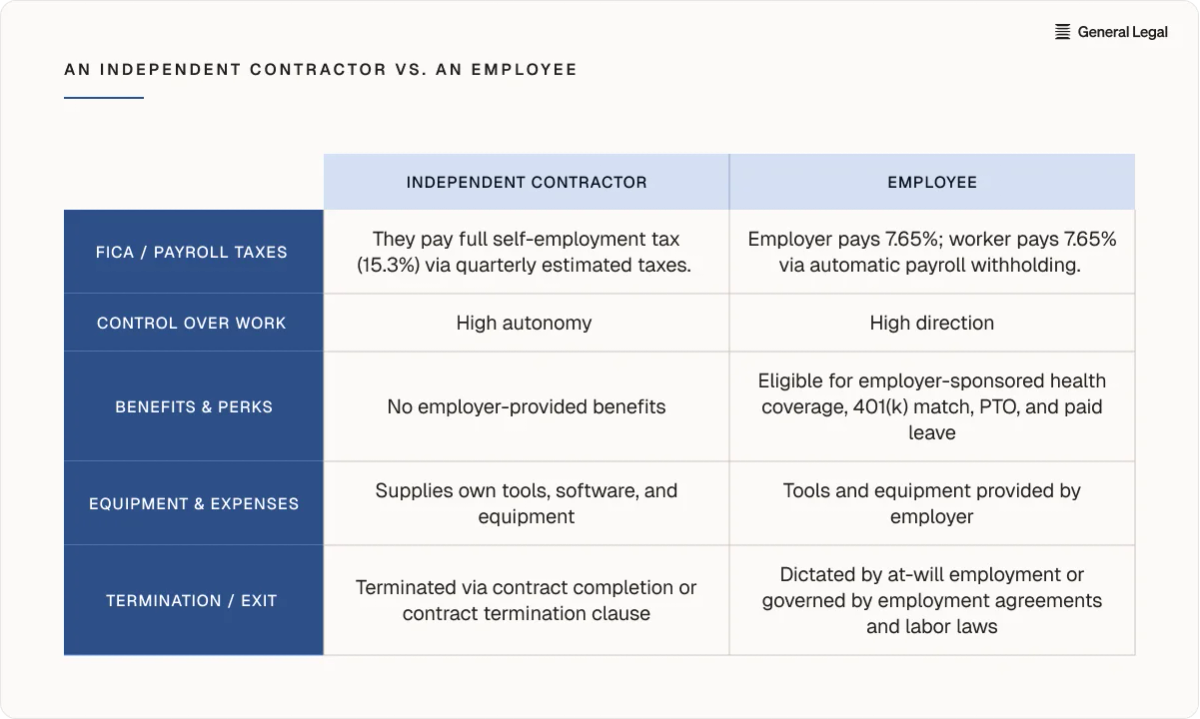
This commercial legal issue is common enough to attract significant enforcement. In FY2025, the Department of Labor’s Wage and Hour Division recovered more than $259 million in back wages for nearly 177,000 workers—its highest recovery since 2019.
Besides potentially owing back wages, overtime, and payroll taxes, businesses that get employee classification wrong can also face regulatory penalties, litigation, and significant costs to restructure their workforce.
How to resolve worker misclassification:
- Review each contractor relationship against the applicable federal and state classification tests.
- Reclassify workers who don’t meet the necessary contractor standards.
- Document the independence and business-to-business nature of legitimate contractor relationships.
- Audit wage, overtime, and exemption practices alongside worker classification.
- Obtain legal advice when classifications are unclear or an audit, claim, or reclassification could create significant exposure.
4. Data privacy and cybersecurity compliance gaps
Data privacy becomes a commercial legal issue when a business collects, uses, stores, or shares personal information without meeting applicable privacy and security requirements. The challenge is compounded by a growing patchwork of state laws and an expanding network of vendors, platforms, and AI tools handling business data.
This challenge is also often paired with cybersecurity because the same data-handling practices that create privacy obligations can also create security exposure.
According to Hiscox’s 2025 Cyber Readiness Report, 59% of surveyed US SMEs experienced a cyberattack in the prior 12 months. At the same time, Norton Rose Fulbright reported that cybersecurity and data privacy was the fastest-growing area of litigation exposure, with 36% of organizations facing disputes in this area in 2024.
If businesses get privacy or security wrong, they can:
- Trigger regulatory investigations and enforcement
- Face lawsuits and breach notification obligations
- Lose customer trust and commercial relationships
- Incur significant remediation and response costs
How to resolve data privacy and cybersecurity compliance gaps:
- Map what personal and sensitive data your business collects and where it goes.
- Review privacy policies and data practices for accuracy.
- Restrict access to sensitive information based on business needs.
- Establish an incident response plan before a breach occurs.
- Require appropriate security and data-processing terms from vendors.
- Update compliance practices as applicable state requirements change.
- Work with commercial lawyers to assess obligations, negotiate Data Processing Addendums (DPAs), and respond to breaches or regulatory issues.
5. AI compliance and commercial risk
Artificial intelligence (AI) creates commercial legal risk wherever businesses use it to process data, generate content, make decisions, or deliver products and services. This can implicate privacy, confidentiality, IP, employment, consumer protection, cybersecurity, and contract obligations—often at the same time.
The pace of adoption is making the problem harder to ignore, with Norton Rose Fulbright identifying AI as one of the areas where litigation exposure is growing.
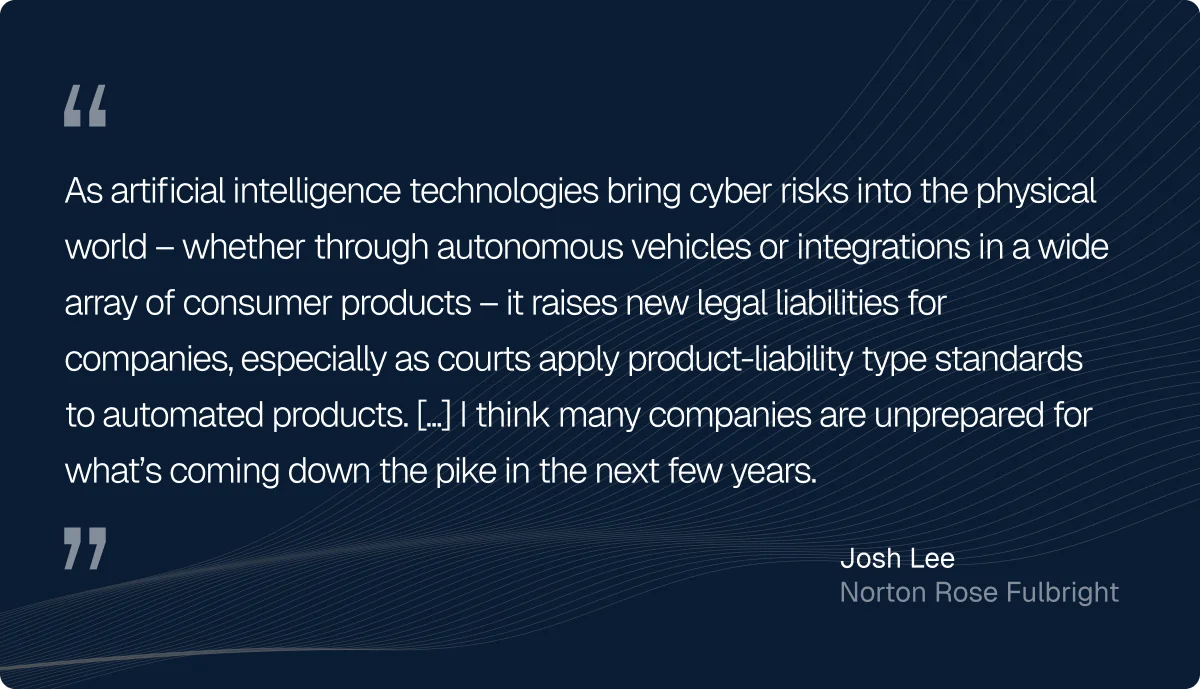
AI is also a major challenge to commercial law firms. This highlights how uncharted the territory remains when even those meant to guide businesses through it are still finding their way.
How to resolve AI compliance and commercial risk:
- Inventory how employees and business systems currently use AI.
- Restrict the information employees can submit to external AI tools.
- Require human review for high-risk AI outputs and decisions.
- Update customer contracts and disclosures where AI affects service delivery.
- Turn to commercial counsel to build AI governance rules, review vendor agreements, and assess emerging legal risks.
6. Securities law violations
Issuing stock, SAFEs, convertible notes, or other securities generally requires registration with the US Securities and Exchange Commission (SEC) or a valid exemption from registration, along with any applicable state Blue Sky requirements. This remains true whether the investor is a venture fund, an angel, a friend, or a family member.
Violations of these laws happen frequently, with the SEC receiving over 10,000 tips, complaints, and referrals each year and filing hundreds of formal enforcement actions annually (456 in FY2025).
In addition to experiencing SEC enforcement actions, businesses that fail to comply with the commission’s requirements—whether through oversight, poor documentation, or a misunderstanding of the rules—can face the following consequences:
- State securities-law enforcement
- Investor lawsuits or rescission claims
- Loss of an exemption from registration
- Delays to future fundraising or an acquisition
- Personal liability for founders in certain cases
How to resolve securities law violations:
- Identify the securities being offered and the exemption that applies.
- Verify investor eligibility and accreditation where required.
- Use standardized financing documents appropriate to the transaction.
- Complete Form D and applicable state filings on time.
- Maintain an accurate cap table and complete record of securities issuances.
- Correct documentation or filing gaps before the next financing.
- Consult commercial counsel when structuring a round or addressing potential violations.
7. Consumer protection, advertising, and subscription issues
Consumer protection issues arise when a business’s marketing, pricing, sales process, or billing practices give customers a misleading impression of what they’re buying or how much it costs. Common examples include unsupported claims, undisclosed fees, misleading testimonials, automatic renewals, difficult cancellations, and deceptive free trials.
The risk is particularly high for consumer-facing businesses, where growth teams are often rewarded for maximizing conversion while regulators care about whether customers can make an informed choice. The FTC’s enforcement activity shows that this concern isn’t theoretical: In May 2026, the agency secured a $35 million settlement with Shutterstock over alleged deceptive subscription and cancellation practices.
This commercial legal issue can affect the company’s finances in several additional ways, including through:
- Consumer lawsuits and refund claims
- Loss of customer trust and damage to the brand
- Overhaul of product flows and billing systems after launch
How to resolve consumer protection, advertising, and subscription issues:
- Review marketing claims for accuracy and adequate substantiation.
- Disclose material pricing, renewal, cancellation, and refund terms clearly.
- Test checkout and subscription flows to ensure customers understand what they’re agreeing to.
- Audit testimonials, reviews, guarantees, and comparative claims.
- Simplify cancellation processes so they don’t create unnecessary friction.
- Monitor applicable federal and state consumer protection requirements.
- Have commercial counsel review high-risk campaigns, subscription models, and customer-facing terms before launch.
8. Contract ambiguity and breach
A commercial contract becomes a legal problem when its terms fail to clearly allocate responsibilities, risk, payment obligations, or remedies between the parties. That can happen when businesses rely on generic templates, accept customer-provided contracts without reviewing or negotiating key risk provisions, or use AI-generated agreements without understanding what the document actually protects—or fails to protect.
Contract disputes are difficult to quantify because many are resolved privately, but they consistently rank among the most common commercial disputes businesses face.
When contracts leave too much open to interpretation, businesses can:
- Lose revenue through payment or performance disputes
- Assume liabilities they never intended to accept
- Struggle to terminate underperforming relationships
- Have limited options when a customer, vendor, or partner breaches
How to resolve contract ambiguity and breach:
- Identify the provisions that carry the most financial and operational risk.
- Replace generic templates with ones tailored to the business model.
- Use a commercial contract checklist to review key provisions before signing or accepting changes.
- Bring in a commercial lawyer when the contract involves material risk or an active breach.
For startups and growing businesses that can’t justify in-house counsel for commercial legal issues, partnering with a law firm like General Legal on an as-needed basis can be a practical way to balance legal coverage with cost and speed.
How General Legal helps businesses stay ahead of commercial legal issues
General Legal is an AI-native law firm that combines highly qualified US-barred attorneys with AI-powered workflows to deliver commercial legal work faster and at predictable, flat-fee pricing.
In this model, AI handles the repetitive work—issue spotting, document triage, redlines, and annotations—while attorneys handle the judgment, strategy, and final legal advice. The result is legal work returned in hours rather than days or weeks, without sacrificing quality.
And the model is built for the way startups actually work: Clients can send matters through Slack, email, or a client portal, get a quote upfront, and work directly with their attorney.
The table below outlines how General Legal can help businesses with specific commercial legal issues:
If you’re facing a commercial legal issue—or want to avoid one—book a consultation with General Legal to talk through your legal needs with our attorneys. Alternatively, sign up online and start sending legal work over right away.
- Small businesses averaged four legal needs per owner in 2023, with half requiring help on contracts and 40% needing tax or financial legal advice.
- Co-founder disputes contribute to up to 65% of high-potential startup failures, making documented equity and governance agreements essential.
- Worker misclassification led the Department of Labor to recover over $259 million in back wages for nearly 177,000 workers in FY2025.
- Data privacy and cybersecurity disputes are the fastest-growing litigation area, with 59% of US SMEs experiencing cyberattacks in the prior 12 months.
- Securities law violations can trigger SEC enforcement, investor lawsuits, and personal founder liability when registration requirements or exemptions aren't properly documented.
- AI-native law firms like General Legal combine US-barred attorneys with AI workflows to deliver commercial legal work in hours at flat-fee pricing.
| Co-founder disputes | Document equity, voting rights, vesting schedules, and departure terms before disagreements freeze operations or derail fundraising. |
|---|---|
| IP ownership gaps | Execute proper assignment agreements with founders, employees, and contractors to establish company ownership of software, designs, and inventions. |
| Worker misclassification | Review contractor relationships against federal and state tests to avoid back wages, payroll taxes, and regulatory penalties. |
| Data privacy compliance | Map personal data collection and storage practices, update privacy policies, and establish incident response plans before breaches occur. |
| AI commercial risk | Inventory AI use across your business, restrict sensitive information submissions, and require human review for high-risk outputs. |
| Securities violations | Verify exemptions, investor accreditation, and complete Form D filings to avoid SEC enforcement and investor rescission claims. |
| Consumer protection issues | Disclose pricing, renewal, and cancellation terms clearly and substantiate marketing claims to prevent FTC action and customer lawsuits. |
| Contract ambiguity | Replace generic templates with tailored agreements that clearly allocate payment, liability, termination, and performance obligations. |
What are commercial issues?
Commercial issues are legal or business problems that affect a company’s operations, transactions, relationships, or financial interests.
What is a commercial conflict?
A commercial conflict is a dispute between businesses or people involved in a business relationship, typically over contracts, payments, ownership, performance, control, or other commercial rights and obligations.
What are legal and ethical issues in business?
Legal issues involve conduct that may violate laws or regulations, while ethical issues concern conduct that may be unfair, misleading, or inconsistent with accepted business standards, even when it isn’t necessarily illegal.
- The Ultimate Commercial Contract Checklist for 2026: What to Review Before SigningDiscover the ultimate commercial contract checklist so you can review key terms, spot risks, and protect your business.
- The Risks of AI in Law: What They Are and How to Manage ThemDiscover the risks of AI in law and learn how to protect client data, avoid common pitfalls, and use AI responsibly in legal work.
- Why Do You Need a Commercial Contract? [11 Practical Reasons]Learn why you need a commercial contract so you can protect your business, manage risk, and clarify responsibilities.