
When a commercial contract is read for price and timeline only, the terms that create real exposure can slip past you.
As a result, your Master Services Agreement (MSA) might cap your total recovery at a single month’s fees, or your licensing agreement might give away IP rights you assumed would remain yours.
That’s because the clauses that matter most when things go wrong are often buried beneath layers of legal language. This complexity is why nearly 90% of business users say contracts are difficult or impossible to understand, according to World Commerce & Contracting.
This commercial contract checklist exists to help close that gap. Work through it in order, and turn your contract review into a repeatable part of your business’s operations.
Key takeaways
- Use a commercial contract checklist as your baseline Review the core terms systematically, then add checks specific to the type of agreement.
- Focus on the terms that create real exposure Pay particular attention to payment, IP, data, liability, termination, and dispute provisions.
- Build a repeatable review process Use playbooks, approval thresholds, the right stakeholders, and clear records for negotiated exceptions.
- Bring in legal support when the stakes are high For complex or consequential contracts, General Legal provides attorney-led review with AI-native workflows, flat-fee pricing, and fast turnaround.
Your go-to commercial contract checklist: 10 key areas to review
The 10 areas below cover the core commercial terms and legal contract requirements you will find across most commercial agreements.
Depending on the type of contract you’re reviewing, you may also need to look at additional provisions specific to that agreement, such as additional data-handling requirements covered by a Data Processing Addendum (DPA).
The best practice is to use this checklist as your baseline, then layer on any contract-specific considerations your deal requires.
1. Parties, purpose, and key contract details
Before getting into the substantive terms, verify that the contract identifies the right parties, reflects the deal you actually intend to make, and can be validly executed.
Confirm the following:
- Legal name and registered details of every contracting party
- Correct entity on each side of the transaction (especially where a parent company, subsidiary, or affiliate is involved)
- Each party’s role in the transaction and what the agreement is intended to accomplish
- Signatory’s authority to bind the relevant entity
- Effective date and contract start date
- Contract term and any mismatch between written dates and numerical dates
- Automatic renewal mechanics and notice deadlines
- Correct contact details for formal notices
- Complete and accurate signature blocks
2. Scope, deliverables, and performance obligations
This section defines what each side is actually agreeing to deliver and how performance will be measured.
Review the following:
- Exact products, services, deliverables, and quantities covered by the agreement
- Required specifications, quality standards, service levels, and performance metrics
- Delivery locations, implementation requirements, and other operational details
- Each party’s responsibilities, dependencies, and required inputs
- Milestones, deadlines, launch dates, and other performance dates
- Acceptance criteria, testing procedures, and the consequences of rejecting a deliverable
- Reporting obligations and the information required to demonstrate performance
- Service credits, fee reductions, re-performance, termination rights, or other remedies for missed service levels
- Process for approving changes to scope, price, deliverables, or timelines
- Consistency between the main agreement and any Statements of Work (SOWs), order forms, proposals, specifications, or other incorporated documents
3. Pricing, payment, and other financial terms
According to the 2025 Intuit QuickBooks Small Business Late Payments Report, 56% of US small businesses reported being owed money on unpaid invoices.
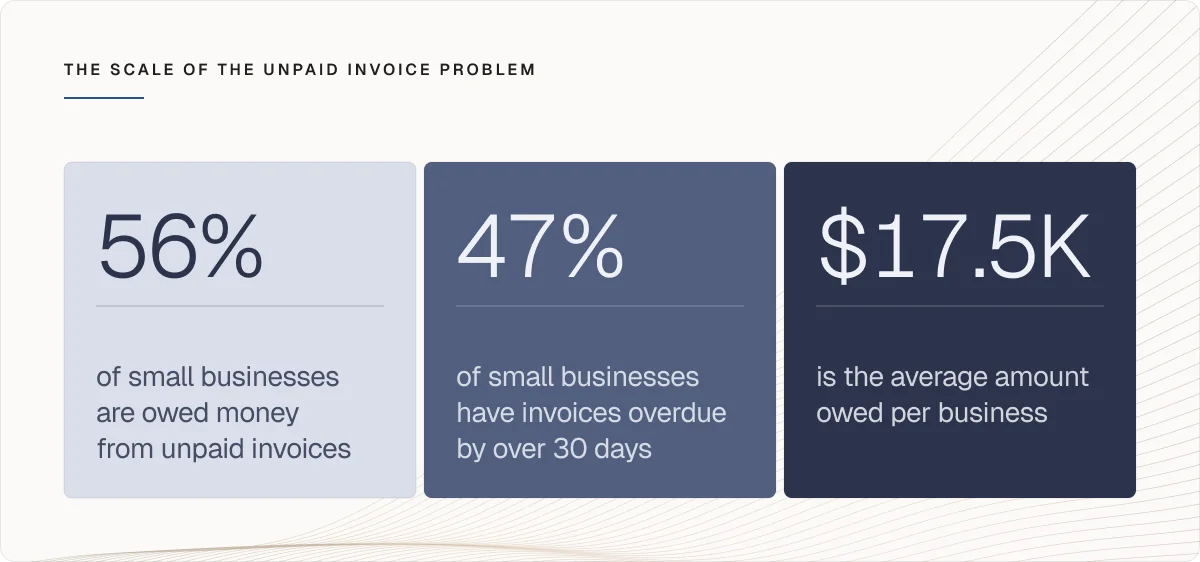
While closely reviewing financial terms in your contract can’t guarantee that a customer will pay on time, it can give you clearer payment triggers, stronger remedies, and fewer surprises when something goes wrong.
That’s why you should scrutinize the following:
- Pricing model and exactly what’s included in the quoted price
- Payment amount, timing, method, currency, and applicable taxes
- Invoicing requirements, approval conditions, and documentation needed before payment is due
- Discounts, credits, rebates, and any conditions attached to them
- Late-payment interest, penalties, and the rate at which they accrue
- Rights to dispute an invoice and the effect of a dispute on payment obligations
- Set-off rights and any ability to suspend performance for non-payment
- Price increase or escalation mechanisms, including timing, formulas, and caps
- Minimum spend, usage, volume, or purchase commitments
- Treatment of expenses and whether prior approval or spending limits apply
- Financial consequences of early termination, including outstanding commitments or fees
4. Intellectual property ownership and licensing
Intellectual property (IP) terms determine who owns the technology, content, inventions, and other work brought into or created through the relationship—and who can use them after the contract ends.
Get that allocation wrong, and the cost can go far beyond the value of the original deal. While the World Intellectual Property Organization (WIPO) notes that about 95% of patent cases settle before trial, each side can still spend several million dollars through discovery.
This makes the contract the place to clarify ownership and usage rights before a dispute forces you to sort them out later. To do so, go over the following:
- Ownership of each party’s pre-existing or “background” IP brought into the relationship
- Ownership of new IP, improvements, inventions, content, or other work created under the agreement
- Any assignment language that could unintentionally capture background IP or unrelated work
- Ownership and permitted use of jointly developed IP
- Scope, territory, duration, and exclusivity of every license granted
- Possibility of licensed IP being sublicensed, transferred, modified, or incorporated into other products
- Restrictions on how each party can use the other party’s IP
- Rights to continue using, accessing, or distributing IP after termination
- Treatment of AI-generated outputs, model inputs, or AI-assisted work product where relevant
- Work-made-for-hire and IP assignment provisions, including any required further-assurance obligations
- Moral rights waivers or consents where relevant to the work being created
5. Confidentiality, data protection, and security
These provisions control how sensitive information and personal data can be accessed, used, shared, and protected throughout the relationship.
Pay close attention to:
- Definition of confidential information and whether it covers the information your business actually needs to protect
- Exclusions for information that is public, already known, independently developed, or lawfully received elsewhere
- Permitted uses of confidential information and who can receive it
- Disclosure rights for employees, contractors, professional advisers, and other representatives
- Procedure for legally compelled disclosures, including any notice obligations
- Length of the confidentiality obligation and whether it continues after termination
- Requirements to return, delete, or destroy confidential information and related copies
- Ownership of business and customer data, including any rights the counterparty receives to use it
- Each party’s role and responsibilities when personal data is processed
- Required technical and organizational security measures
- Breach notification obligations, including who must be notified and how quickly
- Mechanisms for transferring personal data across borders where required
- Data return, deletion, and portability requirements when the relationship ends
6. Representations, warranties, and compliance obligations
Promises about performance are only useful if you know exactly what is being promised and what happens if those promises are wrong. The same goes for compliance: Vague or missing requirements can leave the business carrying obligations it can’t meet or risks it didn’t price into the deal.
To avoid these scenarios, assess the following:
- Express representations about each party’s authority, ownership, products, services, and ability to perform
- Warranties covering the quality, functionality, conformity, or performance of the products or services
- Any implied warranties that are preserved, excluded, or modified by the agreement
- Disclaimers that could limit protections you expected to receive
- Representations and warranties tied to applicable laws and regulatory requirements
- Industry-specific compliance obligations relevant to the transaction
- Export control, sanctions, and other trade compliance obligations where relevant
- AI-specific compliance commitments for AI-enabled products or services, including applicable governance requirements
- Audit rights, including what can be audited, how often, and who bears the cost
- Record-retention requirements and how long relevant documentation must be kept
- Contractual commitments to comply with internal procurement, security, or vendor-management policies
- Any compliance obligation that conflicts with applicable law or appears to require more than the business can realistically support
7. Indemnities, liability, insurance, and force majeure
When something goes wrong, these terms determine who pays, how much they can be made to pay, and whether the loss is covered at all.
Pressure-test the following:
- Scope of each indemnity and whether it covers third-party claims, direct losses, or both
- Direction of indemnification obligations, including whether they are mutual or one-sided
- Events that trigger an indemnity and any exclusions or limitations on it
- Who controls the defense of an indemnified claim and who must approve a settlement
- Overall liability cap and whether it applies per claim or across the agreement as a whole
- Categories of damages excluded from recovery, including consequential or indirect losses
- Liabilities carved out of the cap, including IP infringement, confidentiality breaches, data incidents, fraud, or other specified risks
- Breadth of liability carve-outs and whether they effectively swallow the liability cap
- Insurance types, coverage limits, policy requirements, and evidence of coverage
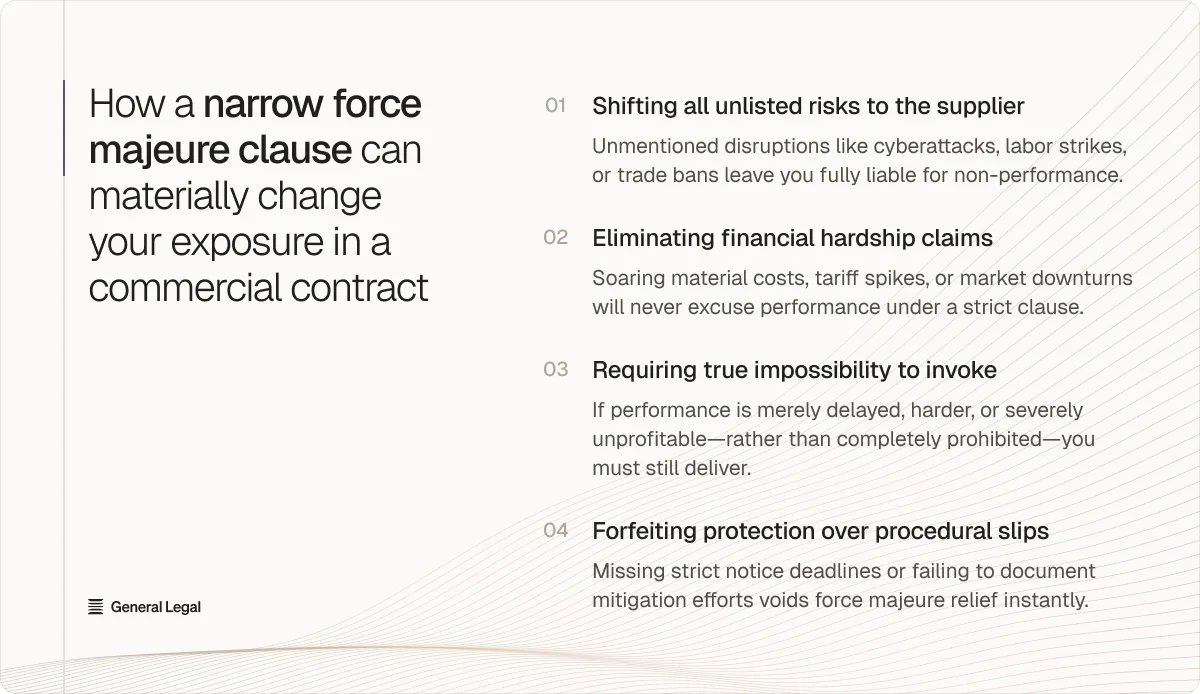
- Treatment of supply-chain disruptions, pandemics, government action, or AI system failures where relevant
- Force majeure events covered by the agreement and the consequences for affected obligations
8. Term, renewal, termination, and exit
Gartner estimates organizations overspend on SaaS by 25% on average, with missed contract and cancellation windows cited among the primary drivers. The lesson is broader than SaaS: Renewal mechanics and exit rights can turn an easily missed deadline into another year of unwanted obligations.
That’s why you should map out the following when reviewing your contract:
- Initial contract term and any extension or renewal options
- Automatic renewal mechanics and the deadline for opting out
- Notice periods, delivery methods, and other non-renewal requirements
- Termination rights for cause and the events that constitute material breach
- Cure periods and the steps required to remedy a breach before termination
- Termination-for-convenience rights and whether they’re mutual or one-sided
- Early termination fees, minimum-commitment penalties, and other exit costs
- Wind-down obligations and responsibilities during the transition period
- Transition assistance and cooperation required to move to a new provider or counterparty
- Outstanding payment obligations and treatment of unpaid or disputed amounts
- Survival provisions identifying which rights and obligations continue after termination
9. Dispute resolution, governing law, and enforcement
Hopefully, your contract never ends up in a dispute. If it does, these terms determine where the fight happens, which rules apply, and how much time and money you may have to spend enforcing your rights.
So, check the following before signing:
- Required negotiation or escalation steps before formal proceedings can begin
- Mediation requirements, including whether mediation is mandatory and when it must occur
- Choice between arbitration and litigation, including the practical advantages and trade-offs
- Arbitration rules, administering institution, and procedural requirements
- Allocation of arbitration, litigation, and other dispute-related costs
- Attorneys’ fees provisions and any fee-shifting rights
- Governing law and whether it is appropriate for the transaction
- Jurisdiction and the courts that can hear a dispute
- Venue and the physical or virtual location where proceedings will take place
- Consistency between the governing-law, jurisdiction, and dispute-resolution provisions
10. Boilerplate, incorporated terms, and document consistency
The last pages of a contract deserve the same scrutiny as the commercial terms.
Boilerplate terms can determine which document controls, how the parties can change the deal, where notices must go, and whether an online policy can change after you sign.
Small inconsistencies matter too: A broken cross-reference or missing schedule can change how the agreement works in practice.
That’s why you should run a final check on:
- Entire agreement or integration language and any prior discussions or documents it overrides
- Assignment rights and any restrictions on transferring the agreement
- Change-of-control provisions and the consequences of a sale, merger, or restructuring
- Amendment procedures and whether changes require mutual written consent
- Notice requirements, including permitted delivery methods and designated addresses
- Waiver provisions and whether a failure to enforce a right affects future enforcement
- Severability language and the treatment of an invalid provision
- Completeness of all schedules, annexes, exhibits, order forms, and other attachments
- Incorporated policies, Service Level Agreements (SLAs), specifications, and other external documents referenced by the agreement
- Hyperlinks and URLs that point to external terms, policies, or documentation
- Version dates and other identifiers for every incorporated document
- Unilateral rights to modify pricing, scope, policies, or other contractual terms after signing
- Internal cross-references and whether every referenced section points to the correct provision
- Defined terms and whether they’re used consistently throughout the agreement
- Numbering, dates, amounts, and other figures for internal consistency
Keep in mind that a commercial contract checklist only gives you the issues to look for. It doesn’t tell you what matters most to your business, who has authority to accept a risk, or what happens after the contract is signed.
For that, you need a review process around the checklist—one that gives every deal the right context, the right decision-makers, and a clear record of the risks you chose to accept.
Beyond the commercial contract checklist: How to build a rigorous contract review process
Here are the best contract review practices to keep in mind:
- Understand the deal before reviewing the language: Identify the business outcome, key commercial priorities, important deadlines, acceptable trade-offs, and the documents that make up the deal so you can distinguish a reasonable compromise from a material business risk.
- Turn your preferred positions into a contract review playbook: Set standard positions, fallback options, pre-approved deviations, and escalation triggers so reviewers aren’t reinventing your negotiation strategy on every contract.
- Bring the right stakeholders into the review: Involve finance, procurement, commercial, security, privacy, IT, or senior management when their expertise is relevant so legal isn’t left to validate assumptions it can’t assess alone.
- Set approval thresholds before a risky term appears: Define which deviations can be approved at the working level and which require legal, executive, or specialist sign-off so material risks don’t get accepted by accident.
- Use contract management technology where the volume justifies it: Apply CLM or contract review automation tools to standardize workflows, manage versions, route approvals, and track obligations and renewals, but keep legal and commercial judgment in the loop.
If you run a startup or growing company, you may not have the legal expertise in-house to review contracts properly, even with the right checklist and contract review tools. In that situation, bringing in a legal partner like General Legal might be the best course of action.
Need more than a commercial contract checklist? Meet General Legal
General Legal is an AI-native law firm built for growth-stage companies that need commercial legal work delivered without the speed, pricing, and workflow problems of a traditional firm.
Its model combines highly qualified, US-barred attorneys with AI-native workflows so lawyers can spend more time on judgment, negotiation, and client strategy and less time on repetitive document work.
This approach makes it a useful step up from a commercial contract checklist when the document at hand is too important, too complex, or too consequential to review on your own.
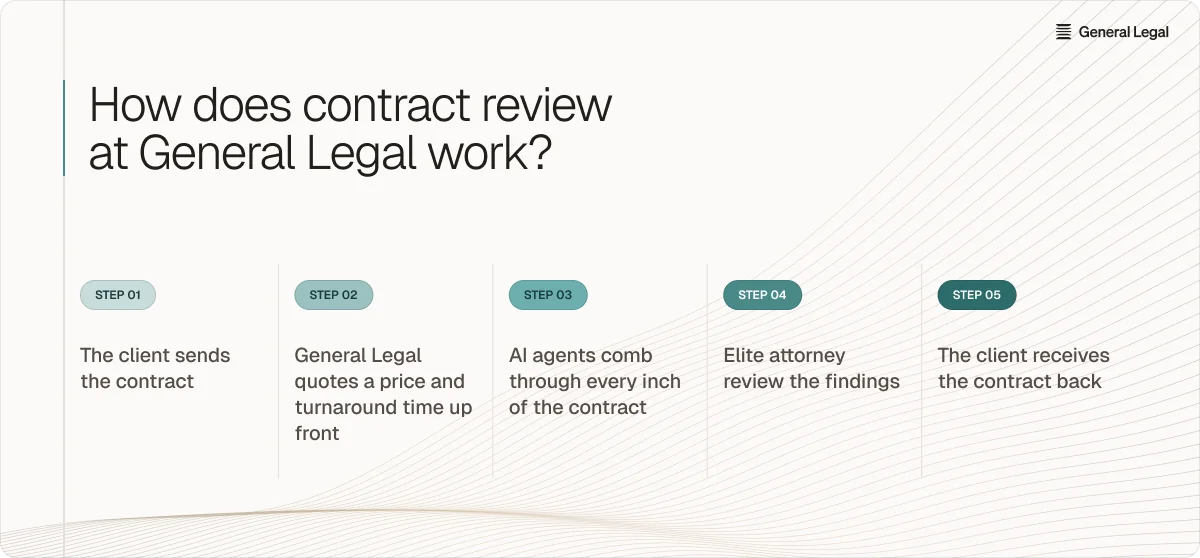
The workflow is straightforward:
- Send over the contract through Slack, email, or the client portal.
- Get a flat-fee quote and turnaround time up front.
- Let General Legal’s AI tools surface issues and prepare initial analysis.
- Have an attorney review the full agreement and the AI’s work.
- Receive the final product in hours, not days.
For founders and growing companies without significant in-house legal teams, General Legal facilitates attorney-led contract review without adding another slow, opaque legal workflow to the business.
If you like what this sounds like, you can register completely online and send over your first contract with no commitment or upfront fees. If you have questions first or want to talk through how General Legal could support your team, book a quick call.
FAQ
What should be included in a commercial contract?
A commercial contract should include the parties, scope, pricing, IP, confidentiality, compliance, liability, termination, dispute resolution, and key boilerplate terms.
How do legal teams review contracts faster?
Legal teams can use checklists, playbooks, standardized approval workflows, and contract management technology to make reviews faster.
How can legal teams control contract language at scale?
Legal teams can use a contract review playbook with standard positions, fallback language, approval thresholds, and escalation rules to control contract language at scale.
How is generative AI changing contract review for legal teams?
Generative AI is changing contract review for legal teams by surfacing issues and preparing initial analysis faster.
- Most commercial contracts contain hidden risks in clauses governing liability caps, IP ownership, termination fees, and other terms that only matter when relationships deteriorate.
- A systematic 10-point checklist covering parties, scope, pricing, IP, confidentiality, compliance, liability, termination, dispute resolution, and boilerplate can standardize contract review across commercial agreements.
- Financial terms deserve extra scrutiny since 56% of US small businesses report unpaid invoices, making clear payment triggers and remedies essential for enforceability.
- Boilerplate provisions in final pages can override entire discussions, control amendment procedures, and permit unilateral policy changes after signing.
- A checklist alone is insufficient without a supporting review process that includes playbooks, stakeholder involvement, approval thresholds, and legal support for high-stakes agreements.
- General Legal offers attorney-led contract review using AI-native workflows with flat-fee pricing and rapid turnaround for companies lacking in-house legal teams.
| Contract review risks | 90% of business users find contracts difficult to understand, causing critical liability caps, IP transfers, and termination penalties to slip through review unnoticed. |
|---|---|
| Core checklist areas | The 10-point checklist systematically covers parties, scope, pricing, IP, confidentiality, compliance, liability, termination, disputes, and boilerplate terms across commercial agreements. |
| Financial provisions | Payment terms require careful review of pricing models, late fees, dispute rights, price escalation mechanisms, and early termination costs to avoid cash flow surprises. |
| IP ownership allocation | IP clauses determine ownership of pre-existing and newly created work, license scope, and post-termination rights—misallocations can trigger multi-million dollar patent disputes. |
| Exit mechanics | Automatic renewal provisions and missed cancellation deadlines contribute to 25% SaaS overspend; mapping renewal dates and exit costs prevents unwanted commitments. |
| Boilerplate significance | Final-page terms control document hierarchy, amendment procedures, assignment rights, and incorporated policies that can change unilaterally after execution. |
| Review process essentials | Effective review requires playbooks with standard positions, cross-functional stakeholder input, pre-defined approval thresholds, and contract management technology for volume. |
| Legal partner option | General Legal provides flat-fee, attorney-led contract review using AI workflows for growth-stage companies needing fast turnaround without traditional law firm inefficiencies. |
What are the most critical sections to review in a commercial contract?
Focus on pricing and payment terms, intellectual property ownership and licensing, liability caps and indemnities, termination rights and exit costs, and dispute resolution provisions. These areas create the greatest financial and legal exposure when relationships deteriorate.
How do I know if my contract's liability cap is reasonable?
Check whether the cap applies per claim or across the entire agreement, identify which liabilities are carved out from the cap (like IP infringement or data breaches), and assess whether the carve-outs are so broad they effectively eliminate the cap's protection.
What's the difference between a contract checklist and a contract playbook?
A checklist identifies issues to look for across all contracts, while a playbook documents your organization's standard positions, acceptable fallback language, pre-approved deviations, and escalation triggers for specific terms so reviewers don't reinvent negotiation strategy on every deal.
Why do boilerplate terms at the end of contracts matter?
Boilerplate provisions control which document governs when terms conflict, whether the counterparty can unilaterally change policies after signing, how amendments must be made, and whether assignment restrictions prevent the other party from transferring the contract without your consent.
When should I involve outside legal counsel instead of reviewing a contract internally?
Bring in legal support when the contract involves significant financial commitments, complex IP allocations, unfamiliar regulatory requirements, cross-border data transfers, or when your internal team lacks expertise to assess material risks presented by specific provisions.
How can AI tools help with contract review?
AI-powered contract review tools can surface common issues, prepare initial risk analysis, identify inconsistencies, and flag deviations from standard positions faster than manual review, but human attorneys should still apply judgment, negotiate terms, and validate AI-generated analysis.
- Commercial Terms vs. Legal Terms: 5 Key DifferencesCompare commercial terms vs legal terms so you can understand key differences, spot risks, and protect your interests before signing a contract.
- How to Review a Contract: Step-by-Step Guide for Non-LawyersDiscover how to review a contract, spot risky clauses, protect your business, and know when to seek legal advice before you sign anything.
- How to Compare Legal Contracts Before You Sign: Full GuideLearn how to compare legal contracts so you can spot important changes, identify hidden risks, review key terms, and protect your interests.