
Commercial law firms are the counsel businesses turn to for help navigating the legal complexities of starting, operating, and growing a company.
On paper, 2026 has started strongly for these firms.
In the first quarter, demand grew across most core commercial practice areas, including M&A (+4.4%), litigation (+2.9%), corporate law (+2.9%), labor and employment (+2.8%), and real estate (+2.6%). Firms are coming off a year of double-digit profit growth, and many continue to see healthy workloads.
However, profit and stability aren’t the same thing. The same forces driving revenue growth are also making it more difficult for firms to attract talent, deliver services efficiently, meet client expectations, and protect margins.
With that in mind, here are the eight major challenges for commercial law firms that will separate tomorrow’s market leaders from the rest.
8 main challenges for commercial law firms amid rapid industry change
The eight main challenges for commercial law firms are largely driven by four forces: technological change, shifting client expectations, growing operational demands, and an increasingly complex business environment. Together, they are reshaping how legal services are delivered, priced, and evaluated.
1. The AI adoption dilemma
Few developments have affected the legal industry as quickly as generative AI.
Today, 79% of lawyers report using AI daily, and firms are investing heavily to keep pace. Industry spending on technology and technology-related staff grew by 10.6% in 2025 alone as firms rushed to integrate AI into research, contract review, due diligence, drafting, and other traditionally time-intensive tasks.
The business case for using AI in legal service delivery is compelling, and clients have noticed the technology’s benefits, too.
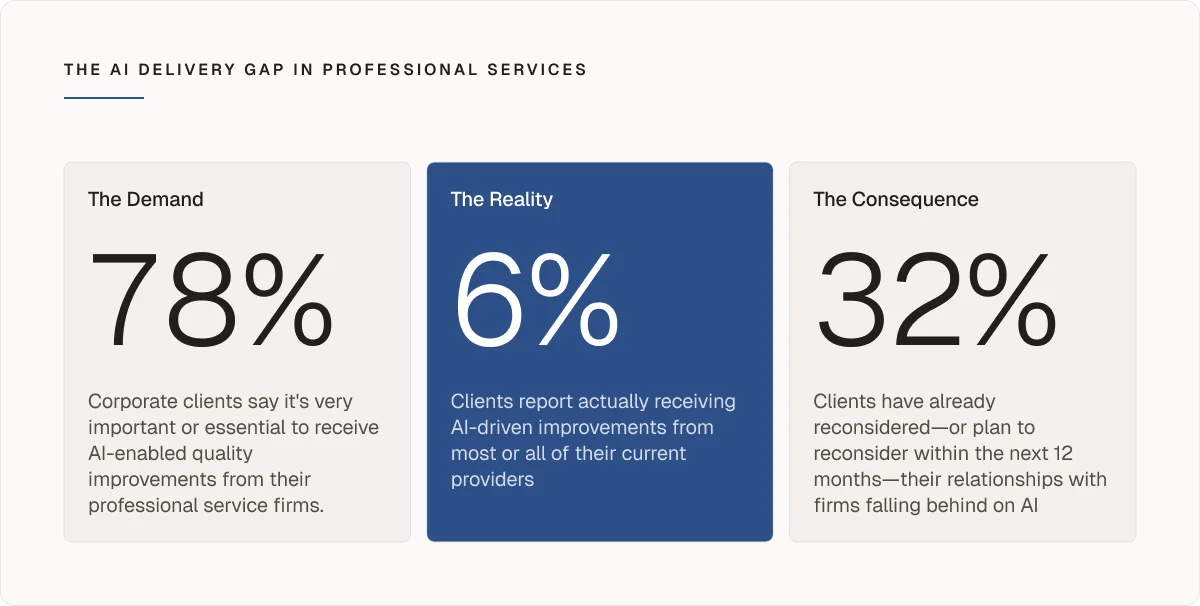
Nearly 80% of corporate clients now say AI-enabled improvements are important when selecting professional service providers, and 32% are willing to reconsider relationships with law firms they believe are falling behind.
But if firms want AI, clients expect AI, and the value proposition of AI is undeniable, where exactly is the challenge?
The answer lies in the difference between just adopting AI and doing so responsibly.
Firms must contend with numerous risks of AI in law, including hallucinations, confidentiality concerns, governance failures, and the growing use of unsanctioned “shadow AI” tools by employees. At the same time, lawyers remain professionally responsible for the advice they give, regardless of how much technology assisted in producing it.
This is where the main challenge emerges for commercial law firms: Move too slowly and risk losing clients to more technologically advanced competitors; move too quickly and risk creating substantial operational, ethical, and legal problems.
Overcoming this challenge successfully requires treating AI as a tool to augment legal expertise, while building strong governance and human oversight into every stage of adoption.
2. The billable hour crisis
For decades, the billable hour has been the foundation of the commercial law firm business model. More hours meant more revenue, making it easy for firms to price work, measure productivity, and grow profits.
While that model still dominates today, with roughly 90% of legal spend flowing through hourly billing arrangements, there are growing signs that it’s coming under pressure.
According to the 2026 Future Ready Lawyer Survey, 62% of corporate legal departments and 57% of law firms expect AI-driven efficiencies to significantly reduce the prevalence of the billable hour.
This shift is being driven by a simple reality: Clients want more certainty around legal spend, more transparency around pricing, and more value from every engagement, and AI is making those expectations easier to meet. The result is a growing tension between a business model that rewards time spent and a market that values efficiency more than ever.
Commercial law firms that effectively adapt will be those that find new ways to price and demonstrate value beyond hours worked.
3. The rise of the empowered client
Corporate clients are becoming more sophisticated, more cost-conscious, and more demanding. Equipped with stronger in-house legal teams, benchmarking data, and expanding AI capabilities, many no longer rely on outside counsel for routine legal support.
Instead, commercial law firms are being asked to provide:
- Commercial recommendations, not just legal analysis
- Industry-specific expertise and market context
- Faster turnaround times and responsiveness
- Seamless collaboration with in-house legal teams
- Data-backed insights rather than purely legal opinions
- Support on increasingly complex cross-border and regulatory matters
- Well-defined explanations that non-lawyer executives can act on
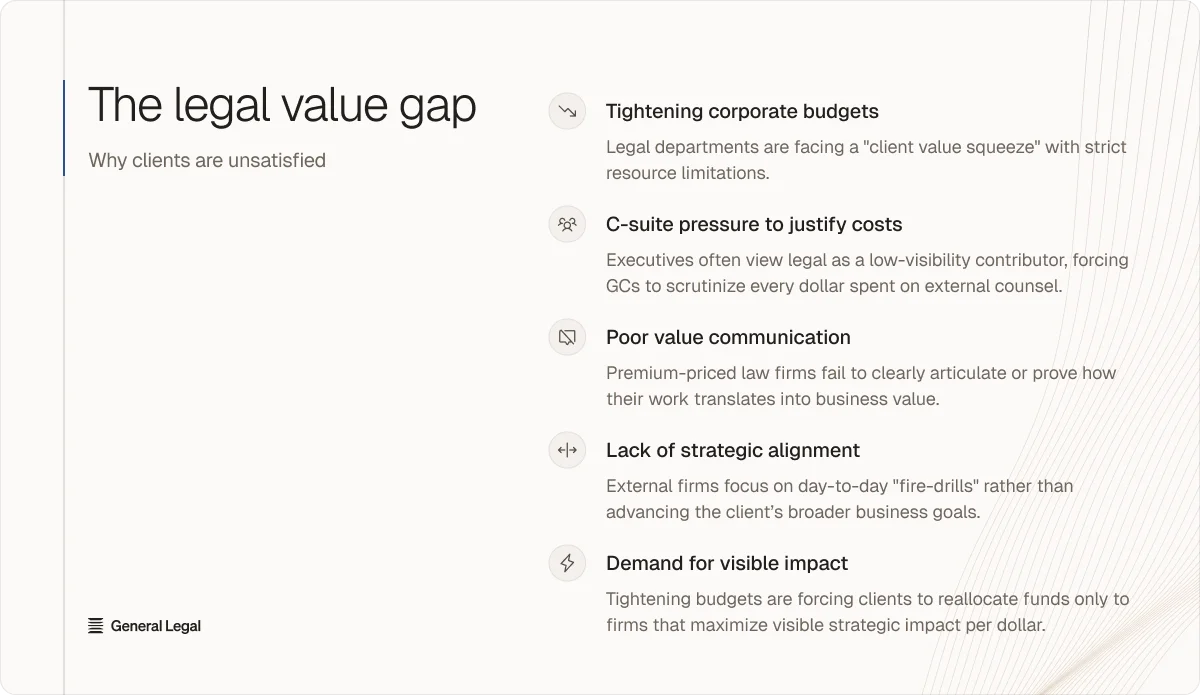
Clients are also becoming more vocal about the value they expect from law firms, with one in four corporate buyers reporting they’ve never experienced a firm that delivered excellent value despite premium pricing.
The commercial law firms that thrive will be those that understand their clients’ businesses as well as they understand the law.
4. The battle for legal talent
Attracting and retaining top legal talent remains a major challenge for commercial law firms, particularly as lawyers gain more options and become more selective about where they work.
Key drivers behind this challenge include:
- Growing competition from in-house legal teams, boutiques, and alternative legal service providers
- Rising expectations around flexibility, culture, and work-life balance
- Declining interest in the traditional partner-track model
- Increasing compensation costs and pressure to match market rates
AI is adding a new layer of complexity.
While this technology can reduce repetitive work, it’s also reshaping career expectations and professional development. Nearly 3 in 10 mid-career professionals say they would change jobs within two years if AI failed to deliver the value they expect, while 71% believe early-career lawyers need structured support to develop skills that AI can now automate.
The firms that win this battle will be those that invest in both people and the systems that help legal talent grow.
5. The growing cyber threat
Commercial law firms are prime targets for cybercriminals because they hold some of the most valuable corporate information, including M&A plans, intellectual property, litigation strategy, and confidential client communications.
A single cyberattack can lead to severe consequences, including:
- Regulatory investigations and compliance violations
- Loss of sensitive corporate and transaction data
- Business disruption caused by ransomware attacks
- Significant financial losses and remediation costs
While the average law firm data breach now costs more than $5 million, the greater risk is often reputational. A financial loss can be recovered; lost client trust can result in years of lost revenue and missed opportunities.
Avoiding this outcome requires firms to build security into every layer of their operations, from technology infrastructure to employee behavior.
6. The geopolitical ripple effect
Commercial law firms don’t operate in a vacuum. Trade disputes, sanctions, inflation, supply chain disruptions, and geopolitical conflictsnow shape both client priorities and legal demand to a greater extent.
This geopolitical and economic volatility creates both opportunity and uncertainty for law firms.
For example, tariffs and trade restrictions are generating new work in areas like regulatory compliance, contract disputes, sanctions advice, and cross-border transactions. At the same time, many businesses are delaying acquisitions, investments, and expansion plans until market conditions become clearer.
This uncertainty is also adding complexity to legal work.
M&A transactions now require deeper scrutiny of supply chains, national security risks, and geopolitical exposure, while clients expect their lawyers to translate these risks into practical business advice.
Successfully navigating this challenge requires commercial law firms to remain agile as client needs shift with changing market conditions.
7. The regulatory burden
Commercial law firms are facing growing regulatory pressure as they must comply with increasingly stringent rules while also helping clients navigate an ever-expanding web of legal obligations.
Compliance includes keeping pace with:
- AI governance and data privacy laws
- Environmental, social, and governance (ESG) reporting requirements
- Competition and antitrust regulation
- Cross-border sanctions and trade compliance
- Anti-money laundering (AML) and Know Your Client (KYC) requirements
Beyond the sheer volume of regulation, the challenge also lies in the speed at which it evolves. New reporting deadlines, stricter compliance requirements, and overlapping rules across jurisdictions require ongoing investment in technology, training, and specialist expertise.
8. The efficiency gap
Operational inefficiencies continue to hold many commercial law firms back, reducing productivity, increasing costs, and slowing client service.
According to a survey of 133 senior decision-makers from top-ranked Am Law firms, 67% of firms estimate they lose between one and three billable hours per lawyer every week due to operational friction. A further 25% estimate losses of four hours per lawyer. For a 500-lawyer firm, that equates to roughly 67,000 lost billable hours every year—and millions of dollars in lost revenue.
Common sources of inefficiency include:
- Fragmented systems and disconnected data
- Manual document, billing, and administrative workflows
- Complex client billing requirements
- Poor knowledge management and duplicated work
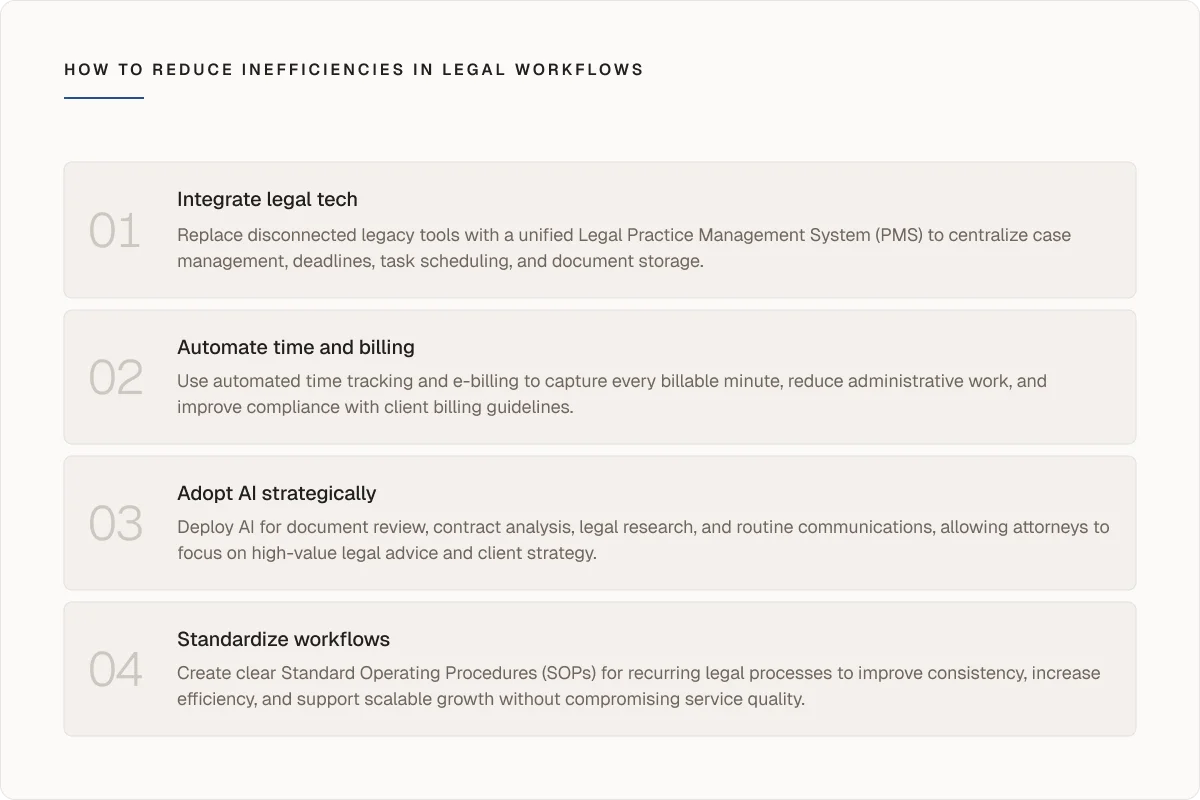
Closing the efficiency gap requires firms to streamline workflows, integrate their technology stack, and automate repetitive tasks so lawyers can focus on higher-value legal work.
What winning commercial law firms do differently
As these challenges continue to reshape the legal industry, one business model is consistently pulling ahead: the AI-native law firm.
Rather than layering AI onto decades-old processes, these law firms are redesigning how legal services are delivered from the ground up, combining technology, modern workflows, and experienced lawyers to deliver faster, more transparent, and more predictable legal services.
General Legal was built on exactly that model.
Every part of our service, from how we review contracts to how we price our work, is designed to solve the main challenges for commercial law firms.
Here’s what that looks like in practice:
AI that accelerates lawyers, not replaces them
Our AI reviews contracts in seconds, surfaces issues, drafts redlines, and prepares annotations before an experienced US-barred attorney reviews every recommendation. This means that the technology only handles the repetitive work, while the legal judgment stays with the lawyer.
Flat fees instead of unpredictable invoices
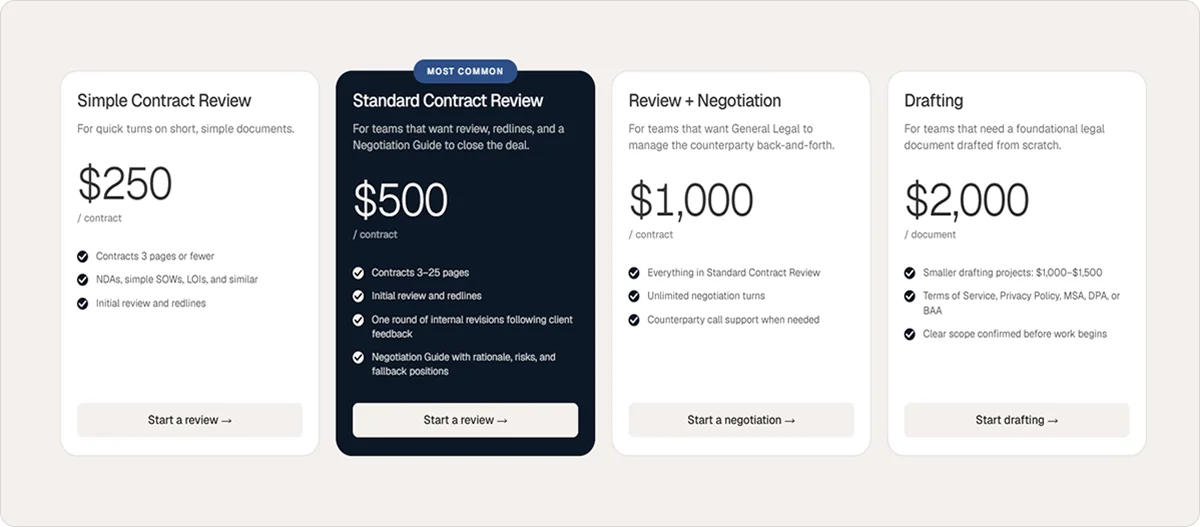
Instead of charging clients for every minute worked, we offer transparent flat-fee pricing so businesses know exactly what they’ll pay before work begins.
Commercial contracts delivered in hours, not weeks
Growing companies don’t operate on law firm timelines.
Whether it’s reviewing a customer agreement, drafting an MSA, or negotiating a DPA, our workflows are designed to turn commercial contracts in hours, helping clients keep deals moving instead of waiting for legal bottlenecks to clear.
A law firm that works where you work
Most startups don’t want another email thread. Most of our clients work with us directly through Slack, which gives them fast access to experienced commercial lawyers without the delays and friction that define many traditional firms.
BigLaw-quality advice without the BigLaw experience
While AI helps us work faster, experienced attorneys ensure the advice is commercially sound, strategically aligned, and legally defensible. The result is commercial legal support that keeps pace with fast-moving businesses without sacrificing legal quality.
Whether you’re reviewing your current legal provider or looking for commercial legal support for the first time, choosing a law firm built for today’s market can make all the difference. Register as a client online or contact the General Legal team to see how an AI-native commercial law firm can support your operations.
- Commercial law firms saw demand growth across major practice areas in early 2026 (M&A, litigation, corporate, labor, real estate), but rising revenue hasn't translated into operational stability.
- AI adoption has become a double-edged challenge: moving too slowly risks losing clients to more advanced competitors, while moving too fast without governance risks hallucinations, confidentiality breaches, and unsanctioned shadow AI use.
- The billable hour model is under real pressure, with a majority of both corporate legal departments and law firms expecting AI-driven efficiency to reduce reliance on hourly billing.
- Clients are becoming more sophisticated and demanding, wanting commercial insight and measurable value rather than just legal analysis, with one in four saying they've never experienced a firm that justified its premium pricing.
- Firms face growing risk from cybersecurity threats, geopolitical and economic volatility, and an expanding, fast-changing regulatory burden across privacy, ESG, antitrust, and AML/KYC rules.
- Operational inefficiencies, like fragmented systems and manual workflows, cost a typical 500-lawyer firm an estimated 67,000 billable hours a year, making efficiency itself a competitive advantage.
| Demand vs. stability | Q1 2026 saw demand growth across M&A, litigation, corporate law, labor, and real estate, but profit growth hasn't solved the operational pressures firms face. |
|---|---|
| AI adoption dilemma | 79% of lawyers use AI daily and clients expect it, but firms must balance speed of adoption against hallucination, confidentiality, and governance risks. |
| Billable hour crisis | About 90% of legal spend still runs through hourly billing, but 62% of corporate legal departments and 57% of firms expect AI to significantly reduce reliance on it. |
| Empowered clients | Corporate clients increasingly demand commercial insight, faster turnaround, and data-backed advice rather than pure legal analysis, and a quarter say they've never gotten a firm that justified premium pricing. |
| Talent battle | Nearly 3 in 10 mid-career professionals would switch jobs within two years if AI doesn't deliver expected value, and firms must invest in structured development for early-career lawyers. |
| Cyber risk | Law firms hold high-value data like M&A plans and litigation strategy, and the average firm data breach now costs more than $5 million. |
| Regulatory burden | Firms must track fast-evolving rules spanning AI governance, privacy, ESG, antitrust, and AML/KYC across jurisdictions. |
| Efficiency gap | 67% of firms estimate losing one to three billable hours per lawyer weekly to operational friction, equating to roughly 67,000 lost hours a year at a 500-lawyer firm. |
What is the biggest challenge facing commercial law firms today, according to this article?
AI adoption; firms must adopt it to stay competitive and meet client expectations while managing the ethical, legal, and operational risks it introduces.
Is the billable hour going away?
Not immediately, but it's under real pressure. About 90% of legal spend is still billed hourly, yet a majority of both corporate legal departments and law firms expect AI to significantly reduce its prevalence.
How much do operational inefficiencies actually cost a law firm?
A survey of Am Law firm decision-makers found 67% lose one to three billable hours per lawyer weekly to friction, which works out to roughly 67,000 lost hours a year at a 500-lawyer firm.
How is General Legal positioned to address these challenges?
As an AI-native firm, it uses AI to review contracts and draft redlines before attorney sign-off, charges flat fees instead of hourly rates, and operates through Slack rather than traditional email-based workflows.
What are the major regulatory pressures commercial law firms face?
AI governance and data privacy laws, ESG reporting requirements, antitrust regulation, cross-border sanctions and trade compliance, and AML/KYC requirements.
What is a commercial law firm?
A commercial law firm is a legal practice that advises businesses on matters such as contracts, corporate transactions, regulatory compliance, employment law, intellectual property, and commercial disputes.
What is the biggest challenge facing law firms today?
Artificial intelligence is arguably the biggest challenge facing law firms today. Firms must adopt AI to remain competitive and meet client expectations, while managing the ethical, legal, and operational risks that come with using it in legal practice.
What is the biggest challenge for a lawyer?
One of the biggest challenges for lawyers is adapting to rapid technological change while continuing to deliver accurate, commercially sound legal advice.
What are the major threats confronting the legal profession?
The major threats confronting the legal profession include technological disruption, cyberattacks, talent shortages, and regulatory pressure.
- What is an AI-native Law Firm? [The Complete Guide]Learn what an AI-native law firm is so you can understand how AI transforms legal services and improves efficiency.
- 8 Commercial Legal Issues & How to Solve Them [Explained]Discover commercial legal issues so you can identify common risks, protect your business, resolve disputes, and stay ahead of legal problems.
- 7 Best Commercial Contract Law Firms for BusinessesExplore the best commercial contract law firms so you can compare leading legal providers and evaluate their strengths.