
International commercial law governs what happens when a business deal crosses a national border. Most commercial contracts don't address any of this, and once your counterparty is incorporated in Germany, Canada, or Singapore, every question the contract leaves open becomes a problem you'll have to solve under someone else's rules.
The complication is that these gaps stay invisible until something goes wrong. A US template looks complete, the counterparty signs it, and the problem only surfaces when a payment is late, or a shipment is disputed—and neither side can say which court should hear it.
And these disputes aren't rare.
In 2024, the International Chamber of Commerce registered 831 new arbitration cases, with the total value of all pending disputes reaching USD 354 billion, a record in the institution's history. According to the ICC's full 2024 statistics report, 69% of those arbitrations involved cross-border disputes between parties in different countries.
This guide covers what changes in a commercial contract when you cross a border and what to do about it before a deal closes.
What is international commercial law?
International commercial law is the legal framework that applies when a transaction involves parties or obligations in more than one country. It draws from:
- International treaties, such as the UN Convention on Contracts for the International Sale of Goods)
- Institutional rules, such as ICC arbitration rules and Incoterms
- National legislation that fills in where no treaty covers the ground
Domestically, governing law, jurisdiction, and enforcement come with the territory. Across-border, all three have to be addressed explicitly, and a contract that omits them leaves those questions to whichever court or tribunal ends up with the dispute.
Read more: Why Do You Need a Commercial Contract?
6 legal issues that change when you cross a border
None of these feel pressing when a deal is moving fast, but they tend to show up when a payment is disputed, or a counterparty pushes back, and the contract doesn't have a clear answer.
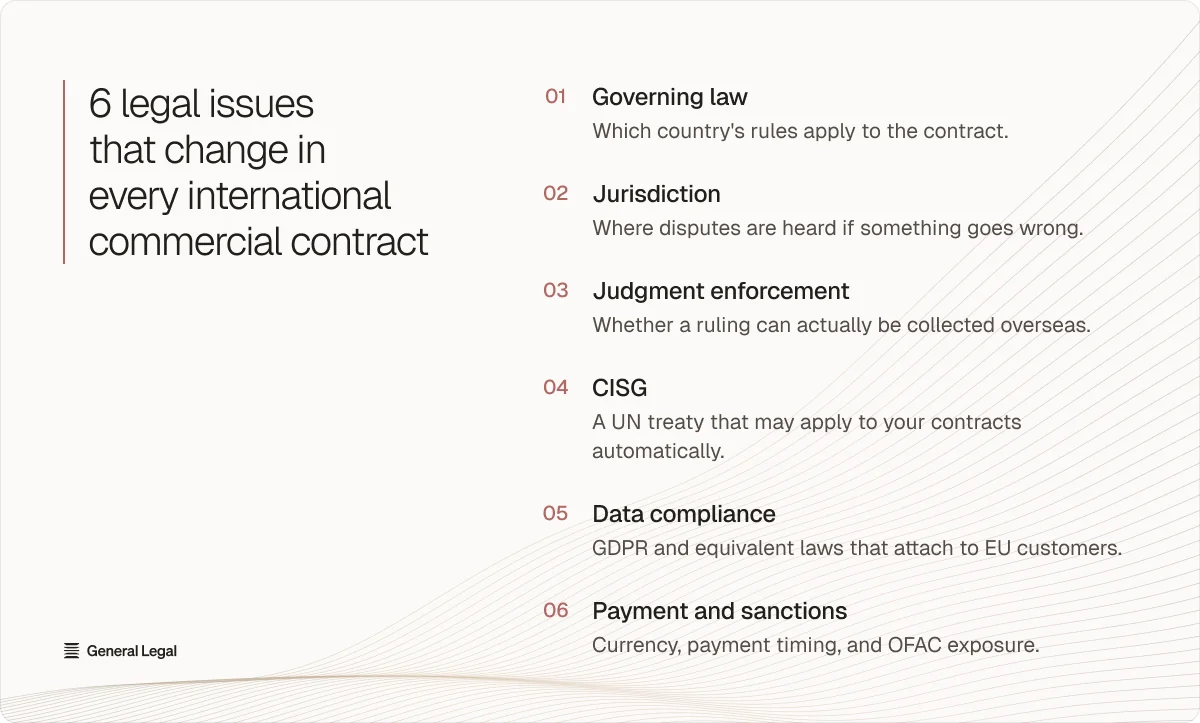
1. Governing law
Every international contract needs an explicit governing law clause. Without one, a court or arbitral tribunal makes that choice, defaulting to whichever country's law its conflict-of-law rules point to.
US companies typically choose between two options:
- New York law: Well-developed commercial case law, predictable, widely used in US markets and financial transactions
- English law: Widely used in international trade finance, shipping, and European commercial deals, and applied consistently by courts worldwide
Your choice of governing law decides how a court reads every other clause, including what your indemnification clause actually covers when tested. The choice has limits, though. Some countries apply mandatory rules regardless of what the contract selects.
2. Jurisdiction and venue
Governing law and jurisdiction are separate questions that founders routinely conflate. A contract can be governed by New York law with disputes heard in London, or it can have no jurisdiction clause at all, meaning both sides end up arguing about venue before addressing anything substantive.
The two main options for jurisdiction:
- Exclusive jurisdiction in a named court: Appropriate when both parties are comfortable litigating there, and enforcement of a judgment is realistic in that country
- International arbitration: Generally preferable for multi-jurisdiction agreements, particularly where counterparty assets are overseas
If your contract has non-exclusive jurisdiction clauses, either party can sue in any competent court. When a dispute arises, the first battle is over where the case will be heard, and jurisdictional challenges alone run up considerable legal fees before the underlying issue is even addressed.
3. Cross-border judgment enforcement
A US court judgment is easier to obtain than to collect on internationally, where enforcement depends on treaty relationships most jurisdictions don't have with the US and on whether the foreign court's procedural standards satisfy local requirements.
Arbitral awards have a different enforcement path. The New York Convention on the Recognition and Enforcement of Foreign Arbitral Awards, ratified by 172 countries, means an award issued in one signatory country is enforceable in the courts of any other, subject to narrow procedural exceptions. When a counterparty's assets are overseas, that enforceability is what makes recovery realistic.
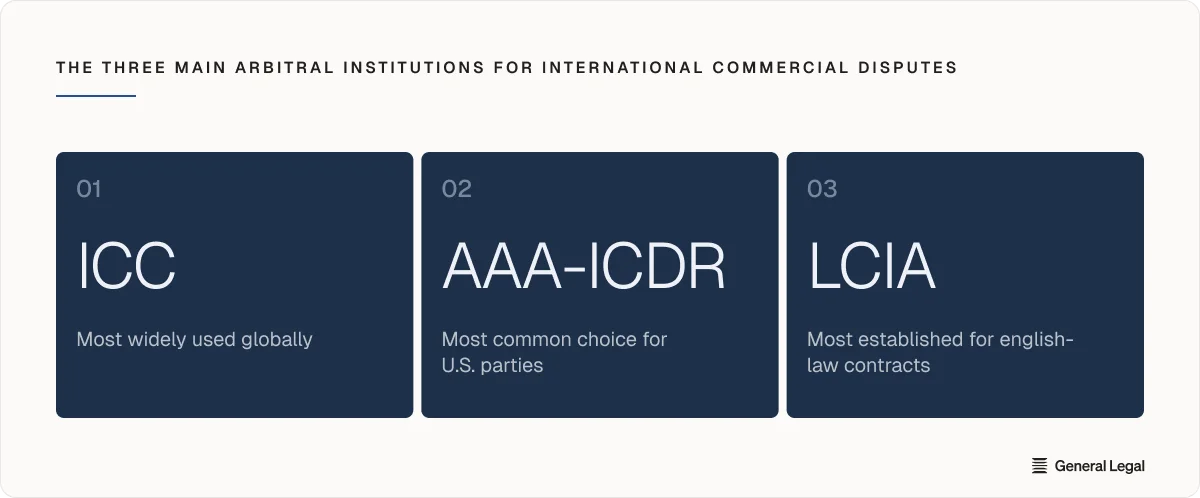
The three major arbitral institutions are:
- ICC (International Chamber of Commerce): The most widely used globally, particularly for high-value and complex disputes
- AAA-ICDR (American Arbitration Association's international arm): The most common choice for US parties in cross-border deals
- LCIA (London Court of International Arbitration): The most established institution for English-law governed contracts
Arbitration costs more than domestic litigation and rarely moves fast. Still, an award you can enforce across signatory countries is more reliable than a foreign court judgment you may never collect on.
Read more: Commercial Contract Litigation: When It Happens & How to Avoid
4. CISG applicability
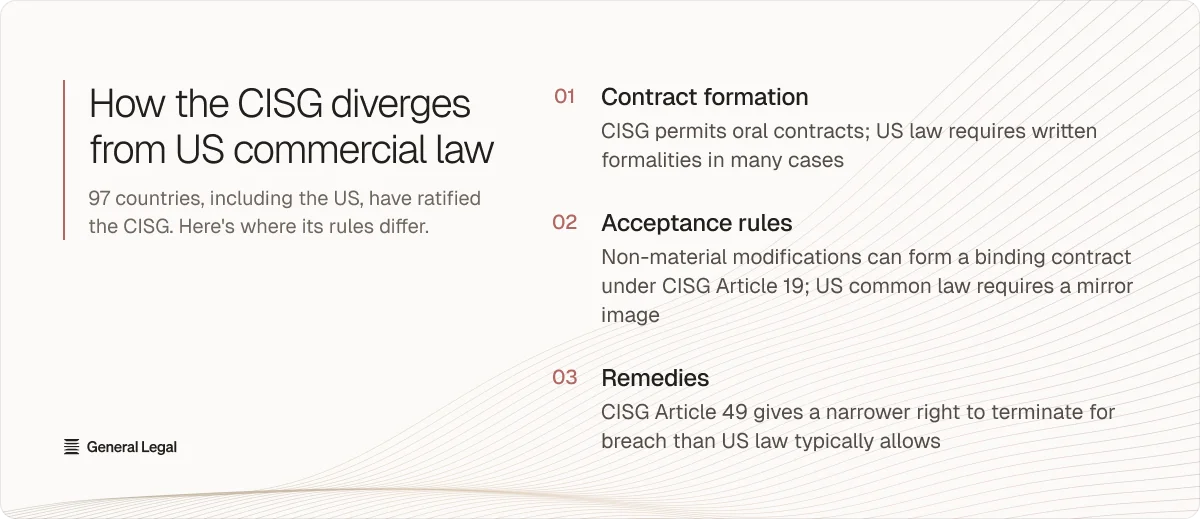
The United Nations Convention on Contracts for the International Sale of Goods, known as the CISG, automatically applies to contracts for the sale of goods between parties in countries that have both ratified it. The US ratified it in 1988, and 97 countries in total have done the same, including most EU member states, Canada, China, and Australia. The UK has not ratified the CISG, so UK counterparties fall outside the convention entirely.
The CISG differs from US commercial law in ways that may affect contracts you're already signing:
- Contract formation: The CISG imposes fewer formalities than US domestic law and permits oral contracts in most cases
- Acceptance rules: Under CISG Article 19, a reply that changes material terms such as price, quantity, delivery, liability, or dispute resolution is a counter-offer, so the “battle of the forms” plays out differently than under UCC § 2-207, and your standard terms may not end up in the deal.
- Remedies: CISG Article 49 provides a narrower right to avoid a contract for breach than US law typically allows
Opting out requires an explicit exclusion clause: "This Agreement is governed by the laws of the State of New York, and the parties expressly exclude the applicability of the United Nations Convention on Contracts for the International Sale of Goods."
US companies typically include this as standard, and with good reason. A known legal framework is easier to plan around than one that varies depending on who you're contracting with. Without the clause, the CISG can govern regardless of what either party intended.
The convention applies to goods only, which puts pure SaaS agreements generally outside its scope. If your product bundles software with physical components or hardware, it’s worth reviewing your contracts with the CISG in mind.
5. Cross-border data obligations
Signing an enterprise customer in the EU means data privacy is a contractual obligation, built into the agreement itself. The EU's General Data Protection Regulation (GDPR) requires a Data Processing Agreement (DPA) any time a US company processes personal data on behalf of an EU-based customer, and the DPA has to reflect how data actually moves, which sub-processors handle it, and what transfer mechanisms are in place.
Signing a DPA and running a lawful transfer are two different things. A DPA can satisfy GDPR’s processor requirements under Article 28, but the transfer itself can still fail Chapter V if no mechanism, such as Standard Contractual Clauses or EU-US Data Privacy Framework certification, is in place.
Similar obligations arise under Canada's PIPEDA, Brazil's LGPD, and India's Digital Personal Data Protection Act, each with its own requirements. A DPA drafted for GDPR compliance frequently fails the jurisdictions it wasn't designed for.
Read more:
- A GDPR-Compliant Vendor Doesn't Automatically Mean Your Data Transfer Is Legal
- Global DPA vs. US DPA vs. EU DPA: What Changes When Your Vendor is International?
6. Payment, currency, and sanctions terms
International contracts need payment provisions that domestic agreements typically omit. Three come up consistently:
- Currency specification: Unnamed currency leads to disputes about conversion rates and timing. Specify the currency, the conversion benchmark if applicable, and which party bears exchange rate risk.
- Payment timing: Cross-border wires can take several business days and pass through intermediary banks that deduct fees, so define when payment counts as received and who bears transfer charges
- Sanctions compliance: OFAC rules bind US companies wherever the counterparty is incorporated, and a deal involving a sanctioned person or embargoed country can be prohibited outright, with civil and criminal penalties attached
So, how different does an international agreement end up looking from the contract you already use at home?
Domestic vs. international commercial contract: What changes
What a domestic contract assumes by default, a cross-border agreement has to state explicitly. The table below shows how each element works domestically and what changes when a foreign counterparty is involved. Here's how the two look side by side:
The problem is that most growing companies face two imperfect options when a foreign counterparty sends over a contract. Signing the US template saves time but leaves the cross-border gaps open, while bringing in a large international firm often means hourly billing and weeks of back-and-forth on a deal that needed to close last week.
For many startups, the better route sits between the two.
General Legal: Cross-border contract review without the uncertainty

Cross-border deals don’t automatically require a large international law firm for every contract-related question. However, they do call for careful attention to the terms that allocate risk, define each party’s obligations, and determine what happens if something goes wrong.
General Legal provides commercial contract review through experienced, US-barred attorneys supported by AI-native workflows that help identify issues and accelerate the process. Its technology practice covers MSAs, SaaS agreements, licensing, and related commercial contracts. For companies doing business internationally, these can provide a practical starting point for reviewing the underlying agreement and identifying the provisions that may need further attention or specialist advice.
AI-powered workflows handle first-pass review and issue spotting, while attorneys bring the legal judgment and negotiation strategy needed to evaluate the proposed terms. The result is an attorney-reviewed contract work typically turned around in hours rather than days.
For commercial agreements involving international counterparties, areas to pay particular attention to include:
- Governing law and jurisdiction clause review: Reviewing the agreement's chosen law, dispute forum, and allocation of risk, and flagging issues that may require jurisdiction-specific advice
- CISG applicability: Identifying provisions relating to the international sale of goods that may warrant review, including whether the agreement should expressly address the CISG
- Data protection obligations: Reviewing DPAs and contractual data provisions, particularly where international customers, vendors, or data transfers are involved. General Legal offers data privacy services covering DPAs and US and global privacy requirements.
- Payment and sanctions provisions: Reviewing currency terms, payment timing, and contractual compliance provisions for potential issues that need to be addressed
- Dispute resolution: Reviewing dispute-resolution clauses and flagging questions about enforcement, arbitration rules, or foreign proceedings that may require specialist international counsel
Flat-fee pricing is quoted upfront. Standard commercial reviews start at $500, with full negotiations available at $1,000. Contracts can be submitted through Slack, email, or the client portal.
Create a free account to get started, or contact the team to discuss your contract needs and whether the model fits how your company buys legal work.
- The International Chamber of Commerce registered 831 new arbitration cases in 2024 worth USD 354 billion, with 69% involving cross-border disputes between parties in different countries.
- International contracts require explicit governing law and jurisdiction clauses because domestic defaults do not apply across borders, and omissions leave courts to decide these questions during disputes.
- The UN Convention on Contracts for the International Sale of Goods (CISG) automatically applies to goods contracts between parties in 97 ratifying countries unless explicitly excluded in the agreement.
- Arbitral awards under the New York Convention are enforceable in 172 countries, making international arbitration more reliable for cross-border enforcement than foreign court judgments.
- Cross-border data transfers to EU customers require a Data Processing Agreement and valid transfer mechanisms like Standard Contractual Clauses or EU-US Data Privacy Framework certification under GDPR.
- International payment terms must specify currency, conversion benchmarks, transfer timing, fee allocation, and OFAC sanctions compliance to avoid disputes and regulatory violations.
| Governing law selection | International contracts must explicitly choose governing law (typically New York or English law) or courts will apply conflict-of-law rules to make that choice during disputes. |
|---|---|
| Jurisdiction vs. governing law | Governing law and dispute forum are separate decisions—contracts can be governed by one country's law while disputes are heard in another country's courts or arbitration. |
| Arbitration enforcement advantage | The New York Convention makes arbitral awards enforceable in 172 countries, while US court judgments face significant enforcement barriers internationally. |
| CISG automatic application | The CISG governs goods contracts between parties in ratifying countries unless explicitly excluded, with different formation, acceptance, and remedy rules than US domestic law. |
| Cross-border data compliance | EU customers require DPAs under GDPR Article 28 plus valid transfer mechanisms under Chapter V, and GDPR-compliant agreements often fail other jurisdictions' requirements. |
| Payment and sanctions terms | International contracts need explicit currency specification, payment timing definitions, fee allocation, and OFAC sanctions compliance provisions that domestic agreements typically omit. |
| Common contract gaps | US templates appear complete but leave jurisdiction, CISG applicability, data transfers, and payment mechanics unaddressed until disputes surface. |
| Professional contract review | AI-powered attorney review can identify cross-border issues in commercial agreements through flat-fee services starting at $500 for standard reviews. |
Can I use my standard MSA for international customers?
You can use a standard US MSA with international customers, but it usually needs changes first. Most US templates choose a state's law and courts without excluding the CISG, providing for arbitration, or addressing cross-border data transfers.
Can I choose New York law even if neither party is based in New York?
Yes. New York law is commonly selected in international agreements with no geographic connection, and most courts in major jurisdictions will respect that choice. Mandatory local law provisions in the counterparty's country can still override specific clauses regardless of what the contract says.
Do I need a different NDA for international counterparties?
Not necessarily, but a US-drafted NDA needs a clear governing law clause and a realistic dispute resolution provision to be useful across borders. The main question is where you'd actually enforce it if the other side breached.
Does an international contract need to be in English to be enforceable?
Generally, no. Most jurisdictions enforce a contract in the language the parties chose, though some require a local-language version for certain agreements, and a foreign court will usually need a certified translation before hearing a dispute.
What is force majeure and does it work differently in international contracts?
Force majeure excuses performance when extraordinary events make it impossible to perform. Under the CISG, a parallel concept called impediment under Article 79 applies by default to goods contracts, with its own notice requirements and conditions that differ from a standard US force majeure clause.
- Commercial Contract Litigation: When It Happens & How to AvoidExplore what you need to know about commercial contract litigation so you can understand common disputes, manage legal risks & protect your business.
- 7 Best Commercial Contract Law Firms for BusinessesExplore the best commercial contract law firms so you can compare leading legal providers and evaluate their strengths.
- The Ultimate Commercial Contract Checklist for 2026: What to Review Before SigningDiscover the ultimate commercial contract checklist so you can review key terms, spot risks, and protect your business.