
Every MSA you sign, every customer paper you redline at 4:45 on a Friday, every vendor agreement you click through because the deal has to close this week, is a bet that the language holds up if the relationship goes sideways. Most of the time it does.
However, when it doesn't, the contract stops being a business document and becomes evidence.
Commercial contract litigation is what happens next, and it's more common than most founders assume. Contract disputes account for roughly 46% of the cases filed in US state courts in 2022.
Another factor nobody budgets for is time. Per the Congressional Research Service's April 2024 briefing on court deadlines, federal civil cases ran a median of 6.9 months from filing to disposition, while cases that reached trial took a median of 35.6 months.
The prevention is simple: Have the contract reviewed before you sign it.
This guide covers what commercial contract litigation actually is, what it costs, and how you can reduce your exposure to it before you ever sign a contract.
What is commercial contract litigation?
Commercial contract litigation is a civil dispute between businesses in which one party sues to enforce or defend a contractual right, usually seeking monetary damages or specific performance.
It's the contract-specific subset of commercial litigation, which also covers shareholder disputes, partnership breakdowns, and other business conflicts that don't begin with a signed agreement.
The distinction tells you where the fight starts.
Commercial contract litigation begins with a document you drafted, negotiated, or accepted without much friction. Whatever ambiguity, missing clause, or unchecked liability cap sat in that document at signing is exactly what gets litigated later.
Founders often mix up commercial and business litigation, which point at different conflicts:
The terms overlap heavily in practice, and many firms use them interchangeably, but the rough split is external versus internal conflict. Either way, the disputes that begin with a contract cluster around a short list of failure points.
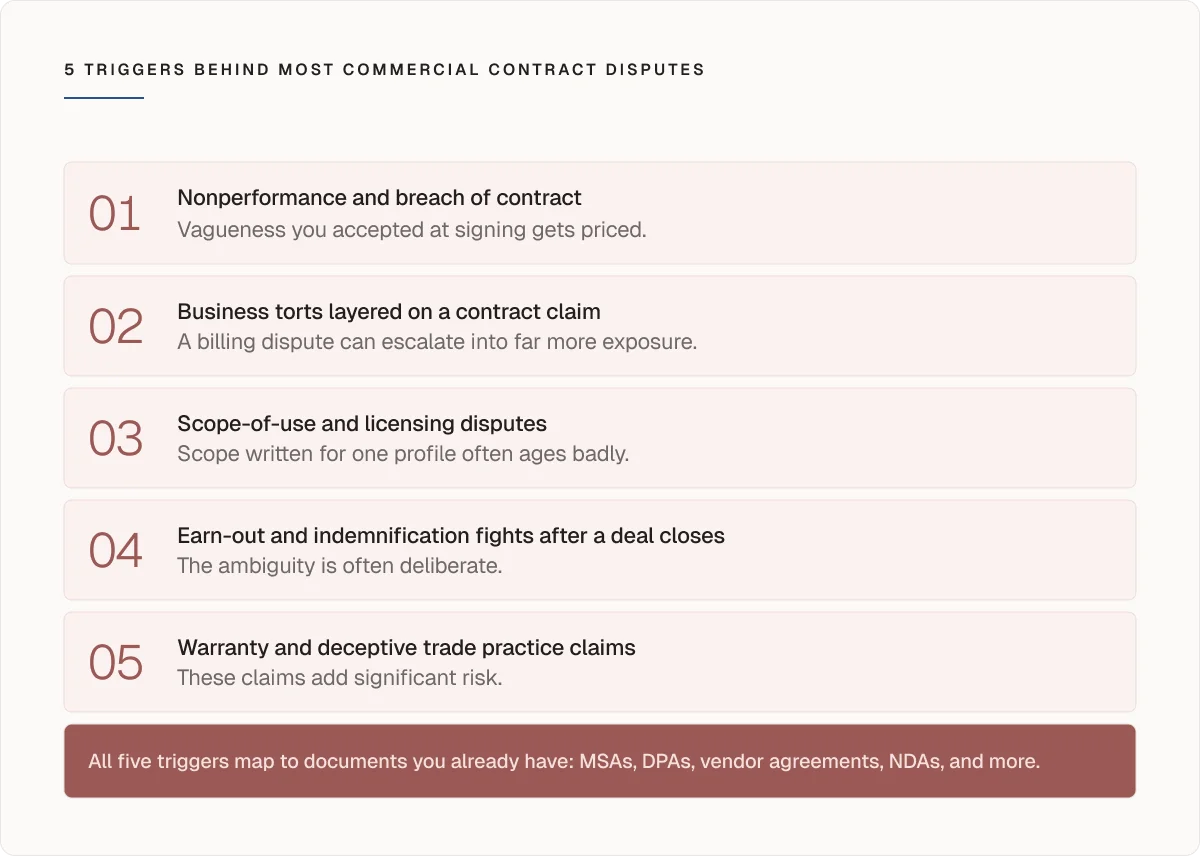
5 triggers behind most commercial contract disputes
If you've signed more than a few commercial agreements, you've probably encountered at least one of these triggers:
1. Nonperformance and breach of contract
This is the single most common trigger; one side fails to deliver, pay, or perform as promised, and the argument turns on what the document required and by when.
Breach claims are usually where the vagueness you accepted at signing gets priced. "Reasonable efforts," undefined acceptance criteria, and payment terms that don't specify a trigger are all cheap to agree to and expensive to argue about.
2. Business torts layered on a contract claim
Fraud, breach of fiduciary duty, tortious interference, and unfair competition claims often ride alongside a contract claim when one party alleges bad faith rather than simple nonperformance.
This matters because tort claims can carry punitive damages where straight contract claims generally don't. A dispute that starts as a billing disagreement can escalate into something with far more exposure once the other side adds a fraud theory.
3. Scope-of-use and licensing disputes
These surface when a customer or partner uses your software, IP, or data outside what your license agreement or DPA actually permits.
Scope language written for one customer profile ages badly. A license drafted for a 20-seat pilot rarely says anything useful about what happens when the customer's parent company starts using the product too.
4. Earn-out and indemnification fights after a deal closes
Post-closing disputes arise when terms that felt settled at signing turn out to be more ambiguous than either side realized once the numbers come in. Earn-out formulas, working capital adjustments, and indemnification caps are the usual suspects.
The ambiguity is often deliberate, since a vague term is sometimes the only way to get a deal signed. However, it just relocates the argument instead of resolving it.
5. Warranty and deceptive trade practice claims
These typically show up when a customer believes that what you sold didn't match what you promised.
For a typical startup, all five map onto documents already sitting in your inbox: the MSA with your biggest customer, the DPA your enterprise prospect's security team insisted on, the vendor agreement you signed without much scrutiny, the NDA from a partner conversation that went somewhere. Which raises the question of what one of these actually costs if it goes wrong.
What a contract dispute costs
There's no single price tag on a contract dispute, because the cost is really two variables multiplied together: the rate and the clock.
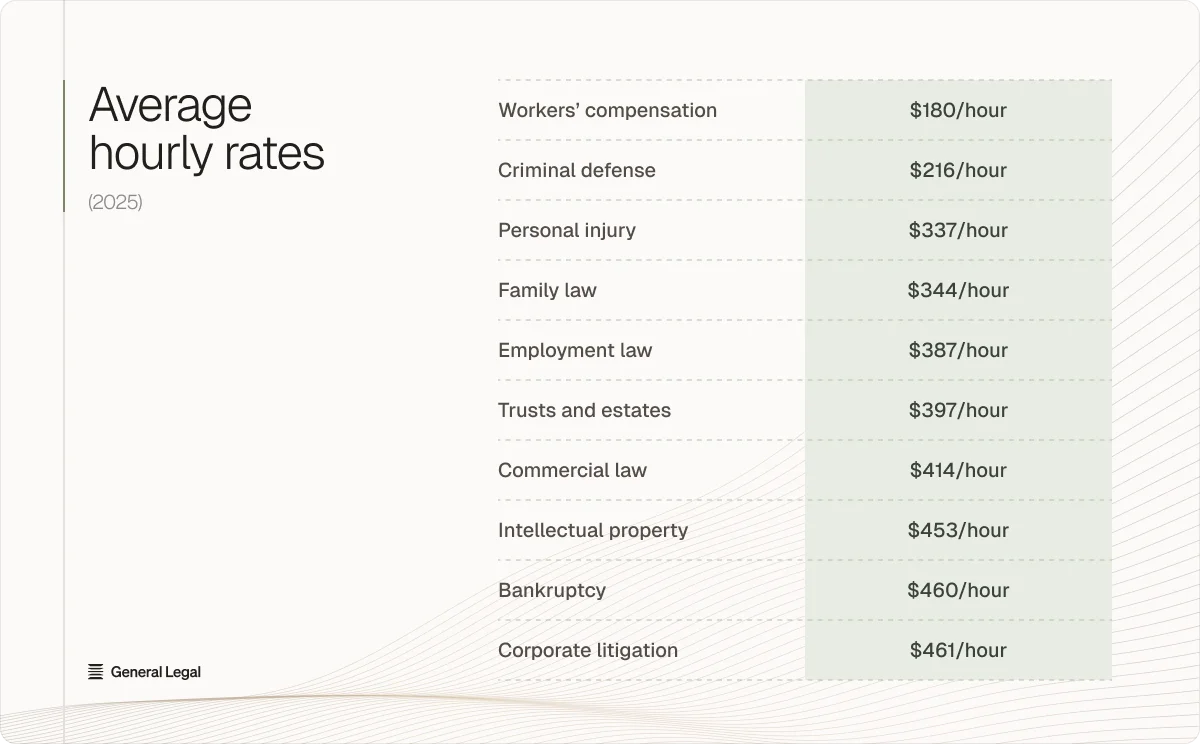
Clio's Legal Trends Report, drawing on 2025 billing data, puts the average US lawyer at $349 an hour, up 4% year over year. Corporate work sits well above that at $461, and in Washington, DC, the state-level average reaches $492.
As for the clock, per US Courts data for the 12 months ending December 2025, the median federal civil case reaches disposition in 7.0 months—but cases that actually reach trial take a median of 34.6 months from filing.
At corporate rates, every ten hours of attorney time runs about $4,600. Stretch that across three years of motions, discovery, and depositions, and the math is clear.
Most disputes never get that far, but "no trial" doesn't mean "no cost." You're paying legal fees, diverting founder and ops time, and living with an unresolved dispute against a customer or vendor for the better part of a year.
The math is blunt: The cheapest contract dispute is the one that never happens.
What a commercial litigation lawyer does
A commercial litigation lawyer's job starts once the relationship has already broken down. The work typically covers:
- Case assessment: Evaluate the strength of a claim or defense, the likely damages exposure, and whether settlement, arbitration, or litigation is the right path.
- Pleadings and motion practice: File or respond to a complaint and litigate procedural motions before the substance of the case is reached.
- Discovery: Run the document production, depositions, and interrogatories that consume most of the time and cost.
- Settlement and alternative dispute resolution: Negotiate a resolution, often through mediation or arbitration, before or during active litigation.
- Trial: Handle the small minority of cases that get there.
This is a different job from the attorney who reviews and negotiates your contracts before signature.
A contract lawyer works upstream, allocating risk, capping liability, defining indemnification obligations, choosing governing law, and building in dispute-resolution mechanisms so that a problem resolves faster and more predictably. A litigator works downstream, cleaning up whatever the upstream work left behind.
The earlier attorney's job is to make the later attorney's job unnecessary. Firms like General Legal are built around that upstream position, treating contract review as the standing discipline rather than the exception.
How to shrink your dispute surface in 4 ways
Prevention is exactly the part founders tend to sacrifice when a deal is moving fast. It's also the part that is likely to cost the most if ignored.
Here are four main practices that can reduce your chances of ever needing contract litigation:
1. Put every arrangement in writing
Verbal understandings and "we'll paper it later" are the easiest way to end up in a dispute with no clear terms to point to. The side with the document usually sets the terms of the argument.
2. Get the contract reviewed before signature
Attorney review before signature is the highest-leverage step, and the one most startups skip. When nobody on your side reads the agreement closely, the risk allocation in the document is whatever the other side's counsel decided it should be.
3. Negotiate the clauses that decide how serious a dispute can get
Four provisions do most of the work here, and they should be included in every commercial contract:
- Liability caps: Set the ceiling on what a dispute can cost you.
- Indemnification scope: Define who pays for third-party claims and how far that obligation reaches.
- Governing law and venue: Determine whose rules apply and where you'd have to show up.
- Dispute resolution: Choose arbitration or litigation, and add notice-and-cure periods that give both sides a chance to fix a problem before it becomes a filing.
None of these change how a deal feels at signing, but they can determine how bad a dispute is later.
Read more: The Ultimate Commercial Contract Checklist for 2026
4. Set the escalation path before you need it
Decide who reviews a contract dispute internally and at what dollar threshold you bring in outside counsel. Otherwise, you're improvising under pressure when a relationship turns adversarial.
This requires treating contract review as a key step rather than a bottleneck to route around, and that's where traditional law firm pricing gets in the way. At $400 or $500 an hour, review is priced as a luxury, which means that it’s often treated as optional.
That's why a growing number of startups now send this work to AI-native law firms, where the pricing model is not a surprise to avoid but a detail you can add to the overall plan.
General Legal: Flat-fee contract review before the dispute starts
The billable-hour model prices legal review by how long it takes rather than what it's worth, which produces a predictable result: work that would prevent a $91,000 dispute gets skipped because it might cost $2,000, and nobody can guarantee the cost in advance.
When the price of the contract review is quoted before the work starts, review becomes a decision you make once rather than a bill you're afraid to open.
General Legal is an AI-native commercial law firm, founded by the team that pairs elite, US-barred attorneys with AI-powered workflows built specifically for legal work, serving startups and growth-stage companies.
AI agents handle the operational layer:
- Triaging incoming documents
- Running first-pass review
- Surfacing risk
- Producing first drafts
Attorneys handle legal judgment, negotiation strategy, risk allocation, and the final review before anything reaches the client. The result is contract review that arrives fast enough to happen before a deal closes, without giving up the judgment that makes it worth doing.
That addresses the three reasons founders skip review in the first place:
- Cost isn't a question mark: Fees are quoted upfront, matter by matter, so the review has a known price before you commit.
- Speed isn't a tradeoff: Standard commercial contract reviews come back in hours.
- Nothing ships without an attorney: AI output is reviewed by a lawyer before it reaches you. What you get is a position you can act on rather than a list of machine-flagged clauses.
You can register online for free and send us a contract today, or contact our team directly to talk through your contract volume and whether the AI-native model fits how your company buys legal work.
- Contract disputes represent approximately 46% of US state court cases, with median federal cases taking 7 months to resolve but 34.6 months if they reach trial.
- The average corporate attorney rate is $461 per hour, meaning even disputes that settle early can cost tens of thousands in legal fees and diverted management time.
- Most commercial contract disputes stem from five predictable triggers: nonperformance, business torts, licensing scope disagreements, post-acquisition earn-out fights, and warranty claims.
- Four contract clauses do most of the heavy lifting in preventing expensive disputes: liability caps, indemnification scope, governing law and venue, and dispute resolution mechanisms.
- Upfront contract review by qualified attorneys prevents disputes far more cost-effectively than litigating them later, but traditional hourly billing often prices this preventive work as prohibitively expensive.
- AI-native law firms now offer flat-fee contract review that combines attorney judgment with AI-powered workflows, making preventive legal work both affordable and fast enough to happen before deals close.
| What commercial contract litigation is | A civil dispute where one business sues another to enforce or defend contractual rights, typically seeking damages or specific performance. |
|---|---|
| How common and costly it is | Contract disputes account for 46% of state court cases, with median resolution times of 7 months (or 34.6 months if tried) and corporate attorney rates averaging $461/hour. |
| Five common dispute triggers | Nonperformance and breach, business torts like fraud, licensing and scope-of-use disagreements, post-deal earn-out fights, and warranty or deceptive practice claims. |
| What litigation lawyers do | They assess claims, handle pleadings and motions, manage discovery, negotiate settlements, and try the small fraction of cases that reach trial—all downstream work after relationships break. |
| Four key preventive clauses | Liability caps, indemnification scope, governing law and venue selection, and dispute resolution mechanisms limit both the scope and cost of potential disputes. |
| Why prevention fails | Traditional hourly billing makes contract review feel expensive and unpredictable, leading founders to skip it when deals move fast—then pay far more when disputes arise. |
| The AI-native alternative | Firms like General Legal use AI agents for first-pass review and operational tasks, with attorneys handling judgment and final review, delivering flat-fee contract review in hours rather than days. |
| When to get contracts reviewed | Before signature, when the cost is known upfront and the work can actually prevent disputes, rather than after problems emerge and litigation costs escalate. |
What are examples of commercial litigation?
Common examples include breach of contract, business torts such as fraud or tortious interference, breach of fiduciary duty, licensing disputes, earn-out and indemnification fights after an acquisition, trade secret misappropriation, and warranty or deceptive trade practice claims.
What does a commercial litigation lawyer do?
A commercial litigation lawyer assesses the strength of a claim or defense, handles pleadings and motions, manages discovery, pursues settlement or arbitration, and tries the small share of cases that reach trial.
What's the difference between commercial litigation and business litigation?
Commercial litigation usually refers to disputes arising from transactions between businesses, while business litigation more often describes internal conflicts such as shareholder disputes and partnership breakdowns.
Can contract review actually prevent litigation?
Contract review can't prevent a counterparty from breaching, but it changes what happens when one does. Clear terms, a negotiated liability cap, and a defined dispute-resolution path narrow what there is to argue about and cap what the argument can cost.
- 12 Types of Commercial Law You Should Know in 2026Explore the types of commercial law so you can understand your legal needs, manage business risks, and choose the right legal support.
- Why Do You Need a Commercial Contract? [11 Practical Reasons]Learn why you need a commercial contract so you can protect your business, manage risk, and clarify responsibilities.
- What Should Be Included in a Commercial Contract: 15 ClausesLearn what should be included in a commercial contract so you can define key terms, manage risks, and protect your interests.