
When Snowflake went public in 2020, its lawyers at Cooley walked away with an estimated $150 million stake in the company, the same company they were advising. That's how venture law works.
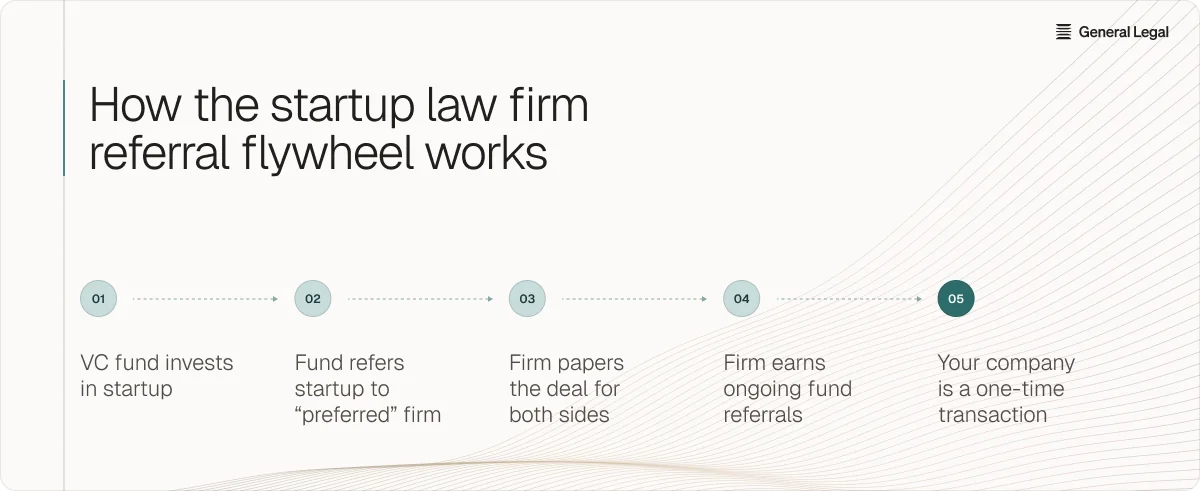
Taking equity in startup clients is now a regular practice among the firms that dominate venture-backed deals, as Bloomberg Law reported. Beyond equity, a small set of firms are at the center of a referral flywheel where funds send them deal flow, those funds become the firm's real long-term clients, and your company is, structurally, a one-time transaction.
Investor connections don't automatically make a startup law firm conflicted, but you need to know what a conflict looks like before you're staring at a term sheet you don't fully understand, signed by a lawyer who never told you whose side they were on.
This guide gives you the framework to spot the problem before you’re in it. It covers how the referral economics work, what each red flag signals in practice, and which questions to ask any firm before you sign an engagement letter.
Who your lawyer actually works for
Repeat-player firms often move faster and know the real market term because they've papered the same structure dozens of times with the same investors. The problem is when that repeat relationship starts to override the lawyer's actual duty.
Under ABA Model Rule 1.13, when a lawyer represents a corporation, the organisation itself is the client, “acting through its duly authorized constituents.”
When the company’s interests diverge from a director's, officer's, or shareholder's, the rule requires the lawyer to clarify who the client is, so nobody is confused about who the lawyer answers to.
While Rule 1.13 establishes that the company—not the investor—is the client, ABA Model Rule 1.7 governs the divided loyalty that arises from concurrent conflicts.
Rule 1.7 exists to prevent the dangerous consequences of dual representations and investor ties that were never properly disclosed, waived, or managed.
Still, a conflict of interest can be difficult to spot from the outside, unless you know what to look for.
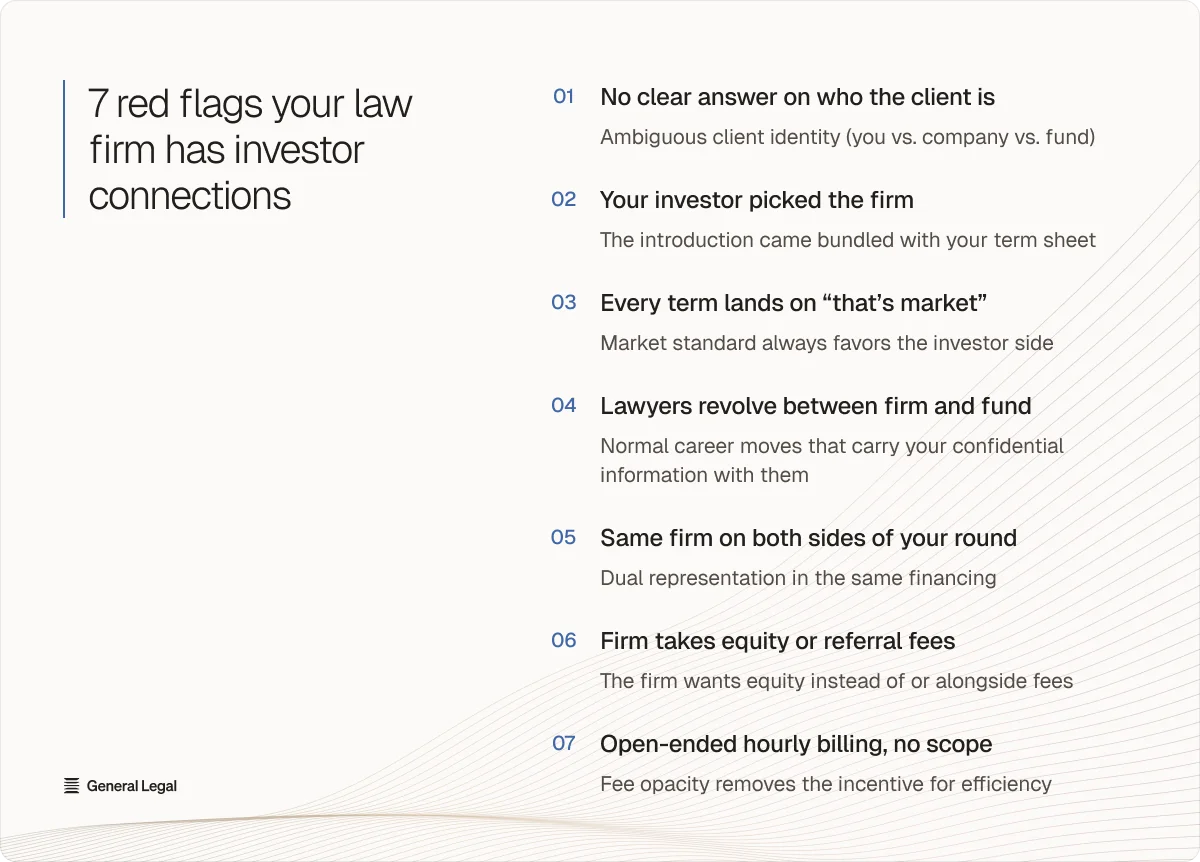
7 signs your startup law firm might have investor connections
Some of these are structural, built into how the firm operates, while others show up only when the deal is moving and you're not paying close attention.
1. No clear answer on who the client is
Ask your lawyer directly: "Who is your client here: me personally, the company, or the fund?"
Pre-formation engagements are especially murky because before the entity exists, it's genuinely unclear whether the lawyer represents the founders or the not-yet-formed company.
Get the answer in writing before the deal closes, not after the relationship turns adversarial.
2. Your investor picked the firm, and you never shopped it
If the introduction to your law firm came bundled with your term sheet, ask who that firm's real long-term client is before you sign anything. Put it directly: "Who are your 10 largest venture-fund clients, and is this fund one of them?"
If the firm gets defensive, you might have your answer.
3. Every negotiation lands on "that's just market"
Liquidation preferences, board composition, anti-dilution protection, and pay-to-play provisions all have a real range of outcomes. "Market" is not a single number.
If your counsel's answer to every pushback is "that's standard, don't worry about it," and every one of those standards favors the investor's side, something is off.
Comment 6 to Rule 1.7 makes it clear that a lawyer can't act adversely to a current client's interests even in unrelated matters, and that duty isn't diluted because the other side is a repeat client.
4. The same firm on both sides of your round
Dual representation is the clearest structural conflict in venture deals.
Rule 1.7 governs concurrent conflicts, and representing both the company and the investor in the same financing is a textbook one.
The duty runs firm-wide, not just to one lawyer, so best practice is separate counsel for the company and the investor, and separate founder counsel whenever founder and company interests diverge.
5. The firm wants equity, invests, or takes a referral fee
If your firm proposes taking equity instead of or alongside fees, that triggers Rule 1.8(a).
The terms have to be fair and disclosed in writing, you have to be advised of your right to independent counsel, and you must give signed informed consent.
Holding equity in a client company is itself a potential conflict under Rule 1.7.
Separately, traditional legal ethics rules—governed by ABA Model Rule 5.4—bar lawyers from sharing fees with nonlawyers or letting nonlawyer platforms direct their judgment.
In August 2024, the New York State Bar Association reinforced this in Ethics Opinion 1271, ruling that paying a nonlawyer platform a percentage-based fee violates New York’s Rule 5.4. While ethics laws vary by state, percentage fee-sharing remains prohibited across most traditional jurisdictions.
6. The revolving door between the firm and the fund
Your confidential information doesn't stop being confidential when your lawyer changes firms. Firm-wide adversity rules and information-flow duties mean a former lawyer, and often the firm itself, still owes you obligations that outlive the engagement.
7. Fee opacity dressed up as flexibility
Open-ended hourly billing with no defined scope, cap, or predictable turnaround is its own red flag, separate from conflict law but connected to the same trust problem.
When you don't know what the work will cost or when it will be done, you have no way to evaluate whether your lawyer is actually working in your interest.
The billable hour removes the incentive to be efficient and the transparency needed to hold anyone accountable.
The best way to test whether a firm’s incentives align with yours is to ask direct questions before you sign.
6 questions to ask before you sign an engagement letter
Ask these before you're under deal pressure, not during a term sheet negotiation when you have no leverage to switch:
- Who is the client here? Get it in writing, not just verbally.
- Which venture funds does the firm represent, and are any of them in my round?
- Is this the same deal team that represents the investor side, or a walled-off team?
- Does the firm, or any partner, hold equity in companies it represents, including mine?
- Does the firm receive any referral fee, revenue share, or platform payment tied to sending me here, or anywhere?
- What does this cost, with what scope, and what's the realistic turnaround?
If the firm can’t provide straight answers, or its responses raise concerns, the next step is deciding whether to address those issues or find different counsel.
When to switch, and when to stay
The decision comes down to whether disclosure and hygiene are present or absent:
Whether you're switching firms after spotting a red flag or choosing counsel for the first time, the goal is the same: clear incentives, transparent fees, and confidence in whose interests your lawyer represents.
That’s the standard General Legal aims to bring to startup financing.
General Legal: Venture financing without the red flags
General Legal is an AI-native law firm built for startups, covering everything from incorporation and corporate governance to SAFEs, priced financing rounds, due diligence, and cap table management.
Its Emerging Companies and Venture Capital practice supports founders through the full fundraising process, from their first VC check to later-stage rounds.
The model is primarily designed to make legal work faster and more predictable.
US-barred attorneys work alongside AI purpose-built for legal work, with flat fees quoted upfront and a median first turn of three hours or less. This means that founders know the price before work begins, rather than watching costs accumulate on an open-ended hourly meter.
This level of transparency matters when the stakes include ownership, control, and financing terms.
Besides letting clients know what their counsel will charge, General Legal strives to be 100% transparent about what the engagement covers and who the firm represents. That’s why more than 500 startups, scaleups, and enterprise clients have already put their trust in us.
If this sounds like the kind of legal partner you want, create a free account and send over your legal work to get started. If you still have questions about how General Legal can support your startup, book a quick 10-minute call with our team.
- Venture law firms regularly take equity stakes in their startup clients and maintain repeat relationships with the same VC funds, creating potential conflicts of interest that founders must scrutinize.
- ABA Model Rules 1.7 and 1.13 require lawyers to clarify who they represent and prevent divided loyalties, but conflicts remain difficult to detect without knowing the warning signs.
- Red flags include unclear client identification, investor-recommended counsel, dismissing all negotiation points as 'market standard,' dual representation, equity stakes, revolving-door hiring, and opaque fee structures.
- Founders should ask six direct questions before signing an engagement letter, including who the client is, which funds the firm represents, whether the firm holds equity, and what the work will cost.
- The decision to switch or stay with counsel depends on whether the firm provides upfront disclosure and demonstrates willingness to advocate against its own investor clients when necessary.
| Structural conflicts in venture law | Top firms take equity in clients and maintain repeat relationships with VC funds, creating incentives that may override duties to startup founders. |
|---|---|
| Legal standards for conflicts | ABA Rules 1.7 and 1.13 require lawyers to clarify who the client is and avoid concurrent conflicts, but enforcement depends on founder awareness. |
| Investor-recommended counsel | When your investor introduces you to a law firm, ask directly whether that fund is among the firm's largest clients before signing. |
| Dual representation warning | The same firm representing both company and investor in one round is a textbook conflict under Rule 1.7; best practice requires separate counsel. |
| Equity stakes and referral fees | If a firm takes equity or receives referral payments, Rule 1.8(a) requires written disclosure, advice on independent counsel, and your informed consent. |
| Questions to ask before signing | Get written answers on who the client is, which funds the firm represents, whether it holds equity, and what the work will cost with defined scope. |
| When to switch firms | Switch if you discover undisclosed dual representation, unexplained equity stakes, or refusal to clarify who the client is; stay if disclosure is proactive. |
| Transparent alternative models | AI-native firms with flat fees, upfront pricing, and clear client identification offer an alternative to hourly billing and opaque investor relationships. |
What is a conflict of interest waiver in a startup law firm engagement?
A conflict of interest waiver is a written document in which you acknowledge a firm's existing relationship with another party, typically an investor, and consent to the representation anyway. Signing one doesn't neutralize the conflict. Read it carefully before you do.
How do I find a startup law firm without investor ties?
Start by asking which venture funds the firm currently represents and whether any of them have invested in companies the firm also represented as company counsel. Firms focused on commercial contracts rather than VC financings tend to have fewer of these ties, since their work doesn't depend on fund referrals.
Can a startup founder negotiate the terms of an engagement letter?
Yes, engagement letters are negotiable. Scope, fee structure, and who the client is are all fair points to raise before signing. Most founders don't push back, but there's no rule that says they can't.
What happens to my confidential information if my lawyer joins a VC firm?
Your confidentiality protections follow the attorney, not the letterhead. A lawyer who moves from your firm to a VC is still bound by professional conduct rules on confidentiality. The original firm may also retain obligations depending on how conflicts screening was handled during the engagement.
Do early-stage startups actually need a dedicated startup law firm?
For equity and financing work, yes. A general practice firm without venture transaction experience will slow your deals and miss market-standard terms. For commercial contracts, the firm's VC network matters far less than speed, cost, and the quality of the attorney doing the work.
Can the same law firm represent my startup and my investor?
Only with written informed consent from everyone involved, and only if the conflict is consentable under Rule 1.7. Most firms in this situation ask you to sign a conflict waiver. Read it before you do. The cleaner practice is separate counsel on each side. If your firm treats that as unusual, that's a signal.
- 6 Best Law Firms for Growing Startups To Choose in 2026 [Comparison]An overview of the top law firms for growing companies.
- When to Involve a Law Firm in Startup Fundraising: 10 Clear-Cut SituationsDiscover when to involve a law firm in startup fundraising so you can manage legal risks, review deal terms & protect interests.
- Best Fractional General Counsel for Startups: 6 Top OptionsDiscover the best fractional general counsel for startups so you can find expert legal support and manage costs.