
Startup founders tend to look at law firms with some skepticism, and for good reason. It’s not rare for traditional law firms to turn a straightforward fundraising question into a five-figure legal project, because every phone call, email, and redline is on the clock.
But here’s the problem: Not hiring counsel when the stakes get high can cost you far more than involving a law firm.
In December 2024, for example, the Securities and Exchange Commission (SEC) settled charges against three companies for failing to file Form D notices for securities offerings on time, penalizing them $60,000, $175,000, and $195,000.
That’s the trade you might be making when you DIY the legal side of a raise.
Still, this doesn’t mean you need a law firm hovering over every fundraising conversation. This guide explains when to involve a law firm in startup fundraising through 10 clear-cut scenarios where skipping counsel might mean playing with fire.
Key takeaways
- Know when fundraising stops being routine Bring in counsel when the deal involves securities, complex terms, debt, or other material legal risk.
- Review the deal before you agree to it Term sheets, modified SAFEs, control rights, and priced rounds can affect dilution, ownership, and future financing.
- Clean up your records before investors do Cap tables, corporate approvals, financing documents, and IP ownership issues can slow or derail diligence.
- Choose counsel built for startups A startup-focused firm like General Legal combines specialized legal advice with upfront flat fees and AI-powered workflows for faster turnaround.
10 fundraising situations where you need legal counsel
When it comes to fundraising, a good rule of thumb is to involve counsel when the legal stakes or complexity start to materially increase. These 10 situations make that line easier to spot.
1. You’re about to accept investment for equity, a SAFE, a note, or another security
Once you take money in exchange for equity, a SAFE, a note, or another security, you’re dealing with securities laws.
The offering generally needs to be registered or fit within an exemption, and that choice affects:
- Who you can approach
- Who can invest
- What you need to disclose
- Which filings you need to make
Even a small friends-and-family round still has to comply with securities laws. Get the structure wrong, and you can end up having to unwind a transaction, deal with a regulatory issue, or explain a missing disclosure to an investor during your next round.
A lawyer can make sure the offering is set up correctly before the money changes hands.
2. You receive a term sheet or proposed investment terms
A term sheet may look preliminary, but it’s often where the terms that matter most get negotiated, including:
- Valuation and dilution
- Liquidation preferences
- Board seats and composition
- Voting and veto rights
- Pro rata rights
- Investor information rights
- Conversion rights
- Protective provisions
These terms can materially affect how much of the company you keep and how much control you have after the round, which is why looking only at the valuation can be a costly mistake.
Having legal counsel review the term sheet and assess the deal as a whole allows you to spot unfavorable terms, understand what you’re giving up, and negotiate changes before you commit.
3. An investor wants to modify a standard SAFE, note, or financing document
A SAFE (Simple Agreement for Future Equity) is a relatively short agreement that allows an investor to put money into a startup now in exchange for the right to receive equity later, typically when the company raises a priced round. Because the document is standardized, founders and investors can close a SAFE without negotiating every provision from scratch.
Given that simplicity is the whole point of a SAFE, you should pay attention when an investor wants to change this standard document. They might want:
- A different valuation cap
- A discount
- Special conversion terms
- Additional information rights
- A side letter giving them the right to invest in future rounds
Each change can affect how much equity you ultimately give up or what rights that investor has compared with everyone else, with even minor edits potentially having consequences that don’t become obvious until the SAFE converts or you raise your next round.
To avoid agreeing to terms that create unexpected dilution or give an investor rights you didn’t intend to grant, you should have a lawyer review the proposed changes before agreeing to them.
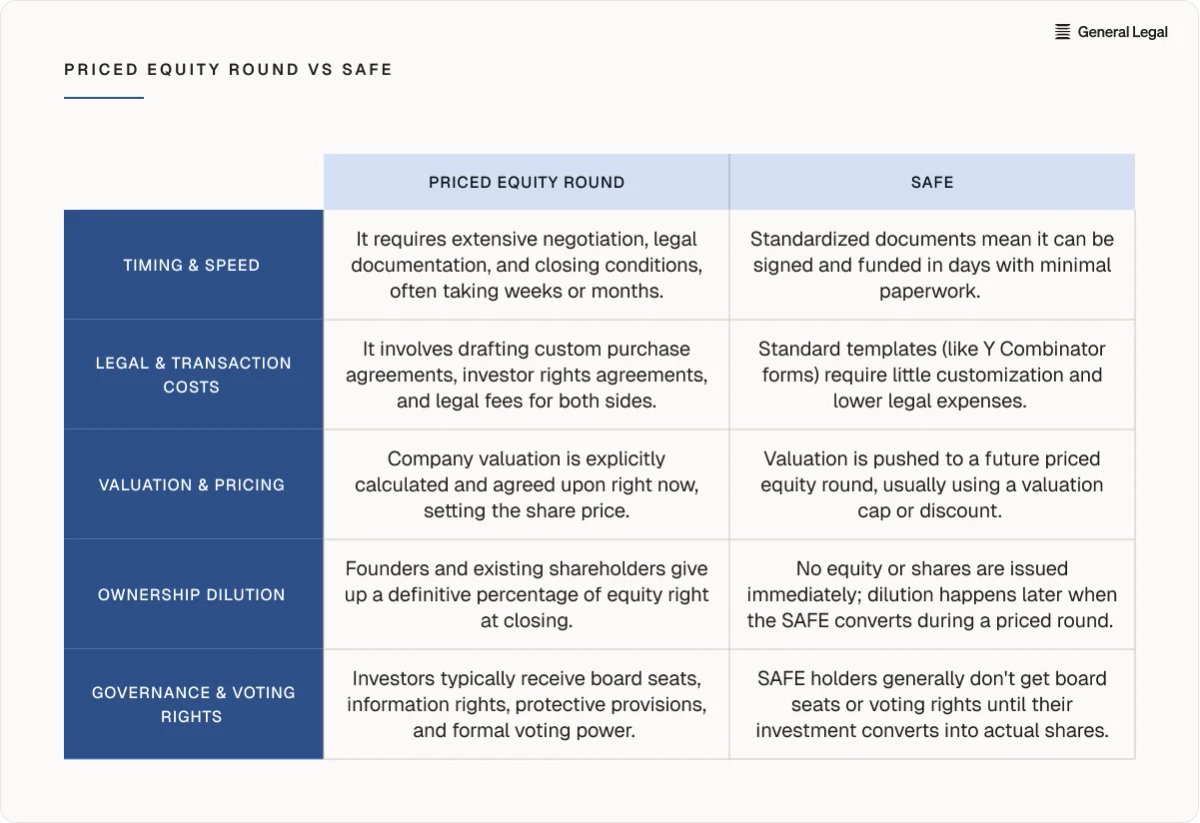
4. You’re doing a priced equity round instead of a simple SAFE
A priced equity round is different from a standard SAFE.
Instead of giving an investor a contractual right to future equity, you’re typically issuing preferred stock now, which means negotiating the rights attached to that stock and documenting the financing in much greater detail. That can include:
- Liquidation preferences
- Conversion rights
- Investor protections
- Board and voting arrangements
- Amendments to the company’s governing documents
Since there are more terms to negotiate, more documents to review, and more ways for a seemingly favorable deal to create problems for your ownership or control later, involving legal counsel is a prudent choice.
5. You’re taking on debt or venture debt that creates repayment obligations
Debt introduces a different set of legal issues, including interest, maturity, and conversion mechanics for convertible notes.
Unlike equity financing, debt has to be repaid. A venture lender may also get rights over company assets or impose restrictions on what the company can do while the loan is outstanding. Those terms can affect everything from future fundraising to your ability to operate if the business hits a rough patch.
So, if you’re taking on debt, have counsel review the terms before you sign, especially if the lender is taking security in company assets or imposing covenants, default provisions, or other restrictions on how you operate.
6. Your cap table or ownership records are complicated, incomplete, or disputed
Before investors put money into the company, they will want a clear record of the shares, options, SAFEs, notes, warrants, and other equity interests that have been issued or promised. Problems start when those records don’t match what actually happened.
For example, you might’ve promised an advisor 2% of the company without documenting the grant, issued options without recording them properly, or raised several SAFEs without modeling how they convert. A founder may also dispute the agreed ownership split, or a departing co-founder may still appear on the cap table as a shareholder.
These issues can change the ownership investors are buying into and raise questions during diligence. For this reason, you should always involve counsel before the financing if your capitalization records don’t clearly show the company’s outstanding and promised equity.
7. You aren’t certain that the company owns all of its core IP
It’s not uncommon for an independent contractor to build a critical software part or for a startup to have spun out of a university. Issues emerge when that contractor didn’t sign an agreement assigning the IP to the company or when the university retained rights to the technology the startup is commercializing. In either case, the company may not have the rights it needs to use a core asset—something investors are likely to scrutinize during due diligence.
So, if a third party helped create your core technology, you need to confirm that your company has the legal rights to use, commercialize, and transfer that technology.
The ownership of this property should be documented through the appropriate assignments, invention agreements, licenses, or other agreements.
If there’s any uncertainty about who owns your core IP, you should involve legal counsel before you start investor diligence.
8. Your corporate records aren’t investor-diligence ready
Your ownership records aren’t the only documents investors may scrutinize.
The table below breaks down the most common corporate records that should be complete and consistent before you open the data room:
| Corporate record | What should be documented |
|---|---|
| Formation documents | Certificate of incorporation, bylaws, and other organizational documents |
| Board and shareholder approvals | Resolutions and written consents approving major corporate actions |
| Stock issuances | Documentation showing that shares were properly authorized and issued |
| Option grants | Option plan, grant documents, and related approvals |
| Prior financing documents | Signed SAFEs, notes, stock purchase agreements, and side letters |
| Material contracts | Major commercial agreements and other contracts that create significant obligations |
| Employment and contractor agreements | Agreements with founders, employees, and contractors |
| Tax records and elections | Relevant tax filings, elections, and supporting documentation |
Counsel can review the corporate record as a whole, identify gaps, and clean them up before an investor’s diligence process puts them under a microscope.
9. An investor wants board, veto, voting, or other control rights
An investor may ask for a board seat, veto rights over certain decisions, approval rights for future financings, or special voting rights. These provisions can give them influence over how the company is run long after the financing closes.
For example, a veto right might let the investor block a future financing, the sale of the company, or another major transaction. A board seat can also change the balance of power in the boardroom, particularly if the investor’s representative gets a vote rather than simply observing.
So, don’t agree to these rights based on the valuation alone.
Instead, have counsel review exactly what the investor can approve, block, or control, and how those rights interact with your existing governance documents and the rights of other shareholders.
10. Your fundraising involves public solicitation, crowdfunding, international investors, or multiple jurisdictions
Not every fundraising happens through a private conversation with a handful of investors. The legal analysis can change significantly when:
- You publicly promote the raise: What you say on social media, your website, or at a pitch event can affect which securities law exemption you can use.
- You use crowdfunding: Crowdfunding comes with specific disclosure requirements and requires the offering to go through a registered intermediary.
- You raise from a large or diverse investor group: A larger pool—or one that includes non-accredited investors—can create additional securities law requirements.
- You take money from foreign investors: The deal may trigger rules involving securities, tax, withholding, or foreign investment in addition to the US requirements.
- Your company, founders, or IP span multiple jurisdictions: A cross-border structure can raise separate questions about corporate structure, IP ownership, tax, and regulatory compliance.
In these situations, you don’t want to figure out the rules after the campaign is already underway. Violating the applicable securities rules can jeopardize the offering, expose the company to regulatory action and penalties, and create problems with investors who have already put money in.
To avoid these scenarios, hire legal counsel to help you determine which rules apply before you start soliciting money, choose the appropriate offering structure, and flag jurisdiction-specific requirements before they become a problem.
Given how much complexity can come with a fundraising round, legal counsel can be useful in a wider range of situations beyond these core fundraising triggers.
Other situations where you may want to involve a law firm
You might also want to partner with a law firm in the following situations:
- You’re operating in a highly regulated industry, such as fintech, healthcare, banking, insurance, law, or accounting.
- You have a tax structure that may conflict with your financing plans, such as an S-corporation considering venture financing or qualified small business stock (QSBS).
- You’re putting additional personal capital into the company and considering using a SAFE or similar instrument for the contribution.
- You’re transferring founder shares to a new co-founder or employee, particularly where tax treatment like QSBS could be affected.
- A departing co-founder is being bought out, or a substantial block of shares is being redeemed.
- You’re bringing in a new co-founder and need to determine how much their shares should cost or how the equity should be issued.
Knowing when to involve a law firm in startup fundraising is only half the decision. You also need to know what kind of counsel to look for. Founders should generally work with a startup law firm, which regularly handles emerging companies and venture capital (ECVC) matters, not a generalist firm that only occasionally sees these deals.
For founders who want that startup expertise without the usual law firm drag, an AI-native law firm like General Legal can be an even better fit.

How General Legal can help with startup fundraising
General Legal pairs US-barred attorneys with AI-powered workflows, so AI handles the repetitive first-pass work while attorneys handle legal judgment, strategy, and the final work product.
This approach is especially suitable for startups because fundraising work often needs to move quickly. General Legal works with startups through Slack, quotes a flat fee before starting, and turns standard legal work around in hours rather than days or weeks.
When it comes to specific fundraising situations, General Legal can help with:
- SAFEs and convertible financing documents: Draft and negotiate SAFEs and other early-stage financing documents when an investor proposes changes to the standard terms.
- Priced equity rounds: Manage the legal work involved in priced financings, including governance and cap table matters.
- Debt and convertible notes: Analyze financing documents covering interest, maturity, conversion, covenants, and defaults.
- Cap tables and ownership records: Reconcile cap-table records and related corporate documents so the company’s ownership records remain consistent as it raises capital.
- IP ownership: Resolve ownership gaps through IP assignments and related employment or contractor agreements before they become investor diligence issues.
- Corporate records and diligence: Audit corporate records, approvals, and other documents investors may examine and identify gaps that need to be fixed.
- Investor control rights: Negotiate board, voting, veto, information, and other investor rights in financing documents and side letters.
General Legal can also assist with different types of startup contracts, including advisor agreements, Master Services Agreements (MSAs), one-way and mutual Non-Disclosure Agreements (NDAs), and other agreements that often come up alongside financing.
If you’re eager to start, sign up online and start sending your legal work right away. If, however, you want to learn more about the firm and its offering, schedule a quick call with our representatives first.
FAQ
What type of funding is best for startups?
There’s no single best option. Standardized SAFEs can work well for straightforward early-stage raises, while priced equity or debt may make more sense as the financing becomes more complex.
How much funding is good for a startup?
Enough to reach the next meaningful milestone without giving up more equity or taking on more obligations than necessary. The right amount depends on the company’s stage, goals, and financing structure.
What not to tell investors?
Don’t misrepresent your company’s finances, ownership, technology, or other material facts. Fundraising communications need to be accurate and complete enough to avoid misleading investors.
Are there startup law firms that bundle incorporation, IP filings, and first-round financing into one capped-fee package?
Yes. Some startup-focused firms offer bundled or flat-fee packages covering formation, IP-related work, and early financing documents. There are also startup law firms, like General Legal, that don't bundle all of these services into one package but still offer flat-fee pricing with transparent costs.
How do legal services differ for startups versus established companies?
Startups usually need outside counsel for things like incorporations, SAFEs, priced rounds, cap tables, IP assignments, employment agreements, and other documents that come up as the company grows. Established companies are more likely to have mature legal infrastructure or in-house counsel and need ongoing support across more specialized areas.
- Involve legal counsel when fundraising involves securities offerings, complex deal terms, debt obligations, or control rights that could affect ownership and company control.
- Term sheets set critical terms like valuation, liquidation preferences, and board composition that determine how much equity and control founders retain after a financing round.
- Clean corporate records—including cap tables, IP assignments, board approvals, and prior financing documents—are essential before opening due diligence to investors.
- Modified SAFEs, priced equity rounds, and investor control provisions require legal review because seemingly minor changes can create unexpected dilution or governance issues.
- AI-native law firms like General Legal offer startup-focused legal services with flat fees and faster turnaround times compared to traditional hourly-billing firms.
- Failing to properly structure securities offerings can result in significant SEC penalties, as demonstrated by recent settlements ranging from $60,000 to $195,000.
| Securities compliance | Any investment for equity, SAFEs, or notes triggers securities laws requiring proper registration or exemption compliance. |
|---|---|
| Term sheet review | Term sheets establish critical terms affecting dilution, control, and board composition that shape post-financing ownership. |
| Modified standard documents | Changes to standard SAFEs or notes can create unexpected dilution or grant unintended investor rights. |
| Priced equity rounds | Priced rounds involve issuing preferred stock with complex rights requiring negotiation of liquidation preferences, conversion terms, and governance. |
| IP ownership verification | Confirm the company legally owns core IP through proper assignments before investor due diligence uncovers ownership gaps. |
| Corporate records cleanup | Complete formation documents, board approvals, stock issuances, and prior financing records before opening the data room. |
| Investor control rights | Board seats, veto rights, and approval provisions can limit founder control over future financings and major decisions. |
| Alternative legal models | AI-native firms like General Legal combine attorney expertise with technology for flat-fee pricing and faster turnaround. |
When should I involve a lawyer in my startup fundraising?
Involve legal counsel when dealing with securities offerings, term sheets, modified SAFEs, priced equity rounds, debt financing, unclear IP ownership, messy corporate records, investor control rights, or fundraising involving public solicitation or international investors.
Why does it matter if an investor wants to modify a standard SAFE?
Modified SAFEs can change valuation caps, discounts, conversion terms, or grant special rights that affect how much equity you give up or create unexpected dilution when the SAFE converts in future rounds.
What corporate records do investors review during due diligence?
Investors examine formation documents, board and shareholder approvals, stock issuances, option grants, prior financing documents, material contracts, employment agreements, and tax records to verify the company's legal structure and ownership.
What happens if my company doesn't own its core IP?
If contractors or third parties created core technology without proper assignment agreements, your company may lack legal rights to use or commercialize that asset, which investors will flag during diligence and could derail the financing.
How is an AI-native law firm different from a traditional firm?
AI-native firms like General Legal use AI for repetitive first-pass work while attorneys handle strategy and final review, enabling flat-fee pricing and faster turnaround compared to traditional hourly-billing models.
Can I get penalized for not filing securities forms correctly?
Yes. The SEC recently settled charges against three companies for failing to file Form D notices on time, imposing penalties of $60,000, $175,000, and $195,000 respectively.
- What Should Be Included in a Commercial Contract: 15 ClausesLearn what should be included in a commercial contract so you can define key terms, manage risks, and protect your interests.
- The Ultimate Commercial Contract Checklist for 2026: What to Review Before SigningDiscover the ultimate commercial contract checklist so you can review key terms, spot risks, and protect your business.
- How to Compare Legal Contracts Before You Sign: Full GuideLearn how to compare legal contracts so you can spot important changes, identify hidden risks, review key terms, and protect your interests.