
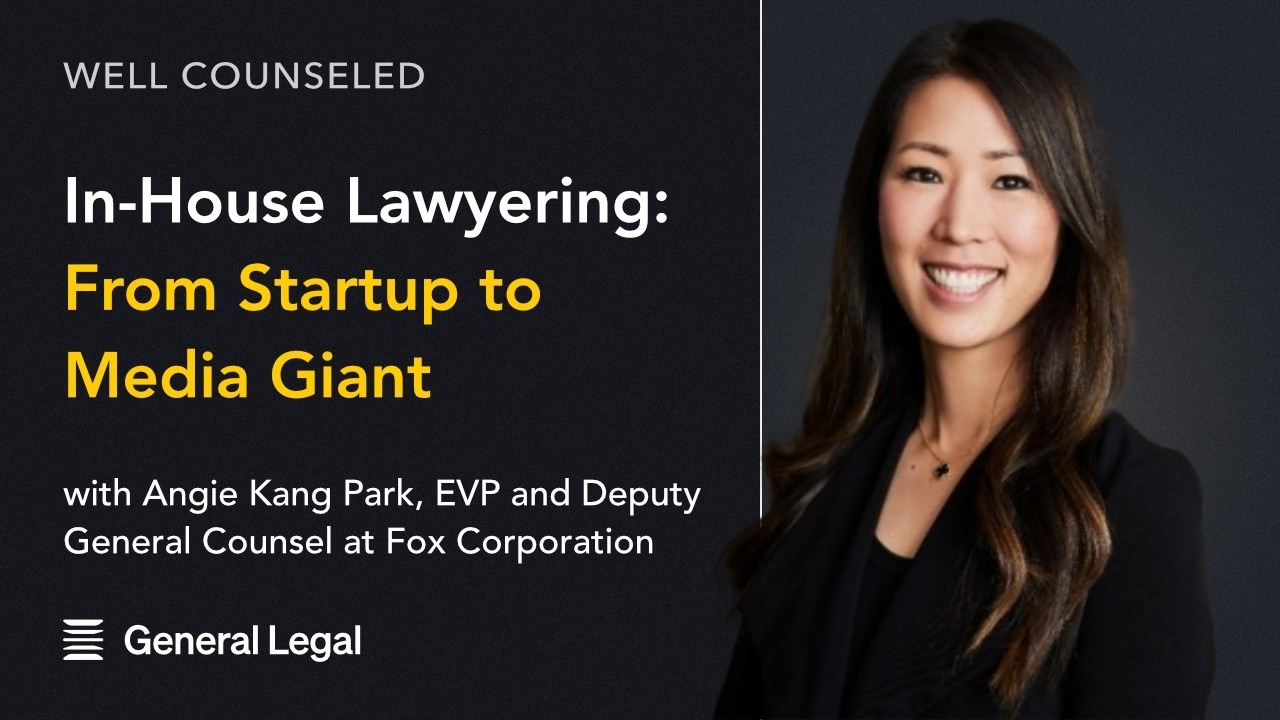
What happens to a company's legal team as the business grows from an ambitious startup into an industry leader? In this episode of Well Counseled, our host Katrina Barry sits down with Angie Kang Park, Executive Vice President and Deputy General Counsel at Fox Corporation, to explore her career across Latham & Watkins, Hulu, Disney, and Fox. Angie reflects on joining Hulu in its early days, helping its legal function evolve alongside the business and navigating the organizational changes that followed Disney's acquisition of control.
Drawing on her experience across different stages of company growth, Angie discusses how the role of in-house counsel changes as businesses mature, how legal teams balance risk with commercial priorities, and what it takes to lead through periods of transformation. She also shares her perspective on business judgment, mentorship, and the importance of empathy in legal leadership.
“To be successful as an in-house attorney, you have to also be willing to accept risk and know which risks to take.”
Chapters
- 00:22Introduction: Meet Angie Kang Park
- 01:51From Latham & Watkins to Hulu's Startup Days
- 04:48Building and Scaling Hulu's Legal Team
- 07:33What Makes Streaming and Entertainment Law Different
- 08:33Navigating Hulu's Transition to Disney
- 13:13BigLaw vs. In-House: Thinking Like a Business Partner
- 15:28Strategic Leadership and Managing Legal Teams
- 18:11Making High-Stakes Decisions in Streaming and Tech
- 19:28Career Advice for the Next Generation of Lawyers
- 22:33Counsel in 60: High-Speed Q&A
- 25:13Why Great Legal Teams Are Built on Empathy
Transcript
Katrina: Hey everyone, welcome back to Well Counseled. Think about everything that has to happen legally behind the scenes for you to just press play on a streaming app: content licensing, advertising, data mergers, all of it. Today's guest has been building that machinery from the inside for almost her entire career. My guest is Angie Kang Park, Executive Vice President and Deputy General Counsel at Fox Corporation and General Counsel for Fox Digital Platforms. She started her career in M&A at Latham and Watkins, then spent nearly 14 years at Hulu, rising through business and legal affairs as the company grew from an early streaming player into a major platform, starting as a joint venture among NBCU, Fox and Disney, and then being fully controlled by Disney. From there, she became deputy chief counsel for direct-to-consumer at Disney before moving to her current role at Fox. Today, we're getting into what it was actually like building legal infrastructure for a streaming company during the biggest shift in how people watch television, what changed when Hulu became fully controlled by Disney, and what she's learned moving across three very different legal environments. Angie, welcome to the show.
Angie: Thank you so much for having me.
Katrina: All right, let's just start right at the very beginning. So you started in M&A at Latham and Watkins. What took you from there into in-house work at Hulu?
Angie: Yep. So I started in the M&A and corporate group at Latham, and I was largely doing M&A corporate work for startup companies in the tech space and tech and media. So that was my intro to this world. One of my very close colleagues had went over to Hulu, and a year later he called me and he said, "There's a position open at Hulu." At the time I had no interest in leaving the law firm. I frankly thought I might be a partner one day, but I had, for so long, handled these tech deals just from the outside that I really wanted to see what it was on the inside. So I just said I would interview for the fun of it and went and met the team, and they were in a warehouse in West LA, very startupy. Engineers sleeping on the ground, there was a ticker on the wall. They were trying to count how many subscribers they would get on a day by day basis because they had so little at the time. And just the energy and the aura was so exciting. And seeing it from the inside completely changed my trajectory. At that time, when I had gone to interview, Hulu was actually up for sale. Any M&A lawyer knows you do not go to a company that's up for sale. But I was that convinced that this environment was step two in my career, and it was the best risk that I ever took.
Katrina: So, when you joined Hulu, how many employees were there, and were you the second in-house for Hulu?
Angie: So, there were probably less than 100 total employees when I joined. I believe I was the third or fourth lawyer to join.
Katrina: So, Hulu in 2011 looked nothing like what Hulu looks like today, right? What was it like walking into that legal team at that stage?
Angie: It was completely different because it was a true startup company. So, as a lawyer for Hulu, you were expected to do everything, and we were called "generalists," and you basically had to do anything, whether it was a major content deal with Sony, which I did not know how to do, or distributing the Hulu app on an Amazon platform, which I also didn't know how to do. We had just launched Hulu Japan, so doing the Japanese international work, or the lease agreement, from big to small, you basically had to figure out how to do every little thing, and we were one team, very flat in structure, and so regardless of how high or low you were on the totem pole, it was just you. Everyone was doing everything to basically get the startup company to go forward. So that was a very different experience because of course, over time it had to grow into a more sophisticated legal team with more structure.
Katrina: So, you spent almost 14 years at Hulu. Walk me through how your job actually changed as the company scaled.
Angie: Yeah, so started very general and was doing a little bit of everything, whether it was advertising, content licensing, data review, lease agreements, all the things. Soon enough, as the company started to grow and we needed more specialists, I started to specialize in the content space. So then, what was called content acquisitions, basically acquiring, pre-made shows like Modern Family or those types of shows for the service. That was in my remit, as well as what we call content originals. So original content that's produced for your service to premiere on your service. Those were under my remit as well. So I focused. I started to narrow in, focus in on content, and that was my bread and butter for many, many years. Then in 2019, when Disney took full control of Hulu, my role expanded to then be not just content, but then just leading the Hulu legal team generally, and some of the subgroups like litigation, corporate, ad sales, legal that went over to Disney. There were centers of excellence within Disney to support those groups. But the remaining teams all remained within Hulu Legal, and I led that team then. Then as we started to go further, then we became Disney DTC and Disney Plus, Hulu, and ESPN Plus came under my remit. It wasn't just Hulu anymore. So then that expanded the role, obviously, to then not just be about Hulu, a general entertainment company, but now you have Disney Plus, which is kids and family and a whole new set of legal issues that come with that, and then ESPN Plus, which is sports and a lot of live sports, which has a completely different set of rights and legal issues to think through. So I guess to summarize, over the course of 14 years, my role went big, then narrow, then back to big, and then bigger.
Katrina: I'm curious with on the Disney side. I mean, that's when I met you, right? You were, I think, you were still with Disney. Did you get to go to Disneyland a lot?
Angie: You do. You do get a silver pass as an employee.
Katrina: Amazing.
Angie: You have to monitor the employee site and frequently check to see when there's an available date. But my kids had the benefit of just having Disney available any weekend. But they got very sick of Disneyland, which was great because then we didn't have to go so frequently. But it was definitely a perk.
Katrina: So, what is something about streaming media legal work that's completely different from traditional entertainment law?
Angie: Yeah, so it's very tech-focused because when you think of traditional entertainment, you're producing shows, you're working through the production elements of putting a show together and then distributing it. From a streaming perspective, you're thinking, okay, when that show is distributed to all the consumers at home, in what resolution do we have to stream it? What are the backend systems to protect the content to make sure it's not pirated? And when we put it up on this site, what is the algorithm that we would deploy to make sure that Kat, who typically watches comedies, would watch this comedy that we're putting up on our site? And so you're thinking through all the tech elements behind the scenes as you're negotiating the contracts too, and that's I would say the main differentiator for deals in the streaming space versus just true entertainment.
Katrina: Was there a specific moment that you would say during that stretch that you really it just tested you, something you look back on as, say, a turning point.
Angie: I would say in 2019 when Disney took over full operational control was probably the biggest turning point where things did change quite significantly. Hulu was a joint venture owned by three major media companies, but because it was a joint venture, we had a lot of autonomy and independence, right? And so it was this true tech company where the decision making was all held within, and we could do and say whatever was right for Hulu, and the Hulu culture was very strong. Once Disney took control, things started to change, and in success, that's what happens, right? So it's not a bad thing. It's just that the company became successful, and in success, we became part of a major media company. But parts of the legal org were then pulled apart into Disney. There was one voice in the room now, and so we had to make sure that all of Hulu's goals were aligned with Disney's goals, which often, not often, but at times could conflict. But we had to work through all those things, and so it was just a major difference that the hardest part for me, as I stepped into the role of leading the team, was to keep them motivated, still believing that the Hulu spirit was there, that the work was still the same, that the company was still the same. The spirit that we held so firm, and we would say that we bleed green because Hulu was a green company, that was still there, and that they still wanted to work there, and that was the hardest part to manage through to maintain that culture within the team.
Katrina: Okay, so what's the biggest lesson that you took from navigating a change in operational control and culture from the inside.
Angie: The lesson that I learned was basically what works from a management perspective. That was a really hard time for me because I was growing into my role, managing this large team, and then at the same time, simultaneously having to learn how to be a good manager to make sure that I can keep to the company lines of what Disney feels is right for Hulu, but still carry the water and the weight of the team that wanted to remain Hulu. So I think the biggest lessons I learned were just how to manage through tough situations to keep a team motivated, happy, advocate. Always stand firm on what you believe are the right principles, despite being under the ownership of a major media company. And there's ways to do it. There's ways to create the rapport, to lead with honesty, integrity, and all the things, and have people trust you. So when you do come to Disney and try to explain and advocate on behalf of your team that you're met with open arms versus it being a difficult conversation. But it was the management lesson that I learned the most through those times.
Katrina: So you went from a team of three at Hulu to then what did that legal org structure like? How many people were on the legal team at Disney.
Angie: Let's see.
Katrina: I know, tough questions. I don't know if you can remember, but roughly, you went from an in-house team of three to...
Angie: Yeah. I think at our high point, we probably had about 40 on the legal team. Doing different things, obviously.
Katrina: So you then became deputy chief counsel for direct consumer at Disney. How did your role evolve once you were operating at that scale?
Angie: Yeah. Well, at that scale too. I was then leading Hulu, Disney Plus, ESPN Plus. What is true today that was not public back then was that we were trying to come to a place where all these apps could be available in one place and merge them together, which is no easy feat from many perspectives. One from a culture perspective, I think from the Hulu side, people felt that we're losing a bit of Hulu independence and the Huluness of it from a rights perspective, to merge all these separate services into one and make it one home very complicated, and also just differing objectives and goals from the different business executives. So navigating all that, the place that I was in, and managing all the different obstacles or challenges, I think was a key component of my job then. Make sure the boat is not sinking from a rights perspective, from a team perspective, and from a business executive perspective.
Katrina: So at this point, now you've worked inside big law, a fast-growing streaming company, and then one of the largest media companies in the world. What's the biggest difference in how legal actually operates at each of those?
Angie: So the easiest one is big law, like law firms. You're project-by-project based, and so you helicopter in, you work on the project, and you do it well, and then you helicopter back out, and then you move on to the next client and project. And I mentioned this earlier, but the biggest draw for in-house, and what was true at Hulu and is continuing to be true at Fox, is you are a core component of the business. You know the products from beginning to end. You're participating in the life cycle planning of all, the strategizing of all these products and services, and very much so. Which I would say is different when you're outside counsel versus inside. Is you have to wear a business hat, maybe more so than a legal hat, because you have to understand the business. You have to know where they need to get, and then let the law get you there. And so I would say maybe the distinction is just big law versus in-house because I think my experience at Hulu and Fox are very similar in that way.
Katrina: So is there a skill that you would say mattered at one stop that you didn't expect to matter at the next.
Angie: I wouldn't say that. I think honestly, to work at a streaming company, whether you're at Hulu or Disney at large or Fox, all skills are required and necessary. I know that's an easy answer to say, but the streaming space is so it's new in a lot of ways. And even though it's not necessarily new right now, the issues that confront streaming and tech in general and AI now bleeding through. There's not a lot of precedent to it, and so you have to creatively solve different problems as they come in the streaming space, in particular, because the issues are so new and never before answered.
Katrina: Yeah. So you're operating at a pretty senior level now. Tell me about the responsibilities that come with this role.
Angie: The main one is that my business clients, the CEOs whom I service in my group services, rely on me to make strategic decisions to enable all of the projects that they foresee. They, I'm in the room to strategize with them how we get from A to B or A to Z, and with anything in tech, you're planning much, much ahead, so you have to really be on the ball to be a great advisor to understand where they need to go, where you can take them, what regulatory or legal issues that they might face that they might want to consider, and ultimately, if it's a go, then figuring out a plan to get the teams mobilized to get them there. So just being that thought partner for business clients is probably, honestly, my favorite part of this role. I think the ability to be creative and problem-solve at a high level with information that's held pretty tight, because oftentimes I'm brought in early on before anything is released to the teams. It's something that I really value about my job, that I can have a seat at the table to influence how something is rolled out.
Katrina: So tell me about the other side. What is the hardest part of the job that doesn't necessarily show up on the resume or the title?
Angie: Definitely the pains that come with management, and I say that. So I definitely think the hardest is the burden that comes with managing a team. I take very seriously that honor and privilege to manage a team of folks, but at the same time, it is the thing that causes me to not sleep at night. If there are issues among the team or even bandwidth concerns, they're overworked and or challenges occur. I have this unfortunate personality where I just always want to fix things immediately and personally feel like even that small thing was resolved otherwise I won't sleep for days and I'll think about it. So I think the burden I feel is that because I've been placed in this role, leading this amazing team, that they feel motivated and fulfilled with their jobs. Otherwise, how can you ask them to give so much of their life to this job. So I would say that doesn't show up on my resume. How much I lose sleep over trying to manage the team and keep them motivated. But that is obviously an important part of the job.
Katrina: Is there a moment in your career where you've ever had to make a really tough call with actual real stakes attached, and if so, what's something that you took away from that?
Angie: When you work for a tech company, I feel like every decision you make has so much stakes behind it, especially being in a streaming service. I mean, consumers can decide to cancel their Fox One subscription, and then you have churn, and you're losing revenue and all the things, right? So, any even small decision of like, oh my goodness, should we put this consent button on this page? Well, if you do. And you might have a lot of people who opt out, and then you lose and have canceled subscribers. Or should we license this show and put all this money into the budget to produce it? Well, it could get you all these viewers and subscribers and advertiser dollars and all the things, but it could not, and it could be a total flop. And so it does feel like at tech and streaming companies, that every decision you make tends to have pretty a lot of potential for big consequences and stakes.
Katrina: Okay, so for the next generation, right? For a young attorney who wants a career like yours, what would you tell them to actually go do?
Angie: So I'm pretty partial to having started at a law firm. I think it provides you great training, and it's skills that, it's just drafting and at least on the transactional side, contractual review and having it be at the highest levels and the highest standards, and that kind of training is just to me so necessary to be a great lawyer. So I would say if you can and you have the opportunity, I would say start at a law firm. Yeah. If you can't or that's not your desire, that's absolutely fine. And we have a lot of great attorneys on my team who didn't take that traditional path. But I would say pursue the area of law where you want to end up. And so, no, pretty, do some diligence. Meet a lot of people, network to understand what the areas of law are, so you can get a head start. Tech or streaming is where you want to land. I would say you start there, pretty early on in your career.
Katrina: What's a mistake you see attorneys make when they move from a firm into an in-house role? They do make mistakes.
Angie: Yeah, I see this somewhat often where people who come straight from a law firm into in-house will tend to be a little bit conservative, because when you're outside counsel, you don't have the business people breathing down your neck to say, "Wait, why did you advise me on that?" And so they tend to come at it from like, "I'm going to point out every single risk in this contract, and show my worth, and here's all the 200 markings on this contract." And to be successful as an in-house attorney, obviously you have to be smart, but you have to also be willing to accept risk and know which risks to take, and understand from the business what risks you should take, and let them lead and go from there. So I do see some pure law firm lawyers coming in-house, having that gauge a little bit off, that then takes a little bit of time to work through.
Katrina: Yeah, that makes sense. What's one thing you wish someone had told you earlier in your career?
Angie: Probably, actually, someone did tell me this so I guess this is unfair, but to make strong mentors from day one, and I will tell you the people who I call, even when I was thinking of taking this job at Fox, were the same five people that have mentored me from day one, and a lot of them came from Latham and Watkins also, and those are the people who will continually look after you. I think everyone in the legal sphere understands how hard it is, and these decisions aren't easy. And so, really making strong mentors from day one was probably the thing that carried me through. Even till today.
Katrina: All right, Angie. So I don't know if you know about this segment. It's called Counsel in 60. So it's just a quick fire round. So the first answer that will come to your mind, don't overthink it. Just, are you ready to do the fire round, rapid fire round now?
Angie: Let's do it.
Katrina: Okay. One word. What's the emotion you feel most on a big deal closing day?
Angie: Relief.
Katrina: Fastest paced era of your career. Hulu's early days or now?
Angie: Hulu's early days.
Katrina: One sentence. What's the best piece of advice you ever got as a young associate?
Angie: Make a good impression.
Katrina: What's one show or movie you think is really underrated?
Angie: I don't know if it's underrated, but The Bear on Hulu to me is such good television. I think season one was great. The later seasons were not as popular, I would say. But it is such good television all throughout.
Katrina: What is it about?
Angie: It's about a restaurant in Chicago.
Katrina: Oh, okay. I've heard about this. Multiple people have told me about this.
Angie: It is so good.
Katrina: Okay, if you weren't practicing law, what would you be doing?
Angie: I would be a professor.
Katrina: Oh!
Angie: Which is what I thought I was going to be when I went to law school. I thought I would end up with a PhD and be a law professor.
Katrina: I can see you as a professor.
Angie: Is that a good thing or a bad thing?
Katrina: No, that's a great thing. It's a great thing.
Angie: Yeah, so I try to teach and do some workshops here and there for college students or law students, but that's what I would be doing.
Katrina: You never know. You still might be a professor-
Angie: If I had a minute of extra time!
Katrina: And one prediction for where streaming is headed in say, the next five years.
Angie: Streamers will really lean into live content, and I say that because Fox One, which is a Fox-owned streaming service, very reliant on live television. On Tubi, we also have live channels and FAST channels. We're seeing Netflix really get into the live game, and not just Netflix, but all the other streamers. I think that will be something that other streamers will really lean into. I also think the bundling game is going to continue to get stronger. As consumers have so many options and they're all disaggregated. I think there will be just more and more bundles of you can get Paramount Plus, Fox One and Tubi and I've got Netflix all together for some price.
Katrina: You need each one for sports. I need ESPN. I need YouTube TV. So I can see that happening too. Last question from me, and I'll let it be the final one. So if someone only remembers one thing about what it takes to build legal infrastructure for a company moving very fast, what should it be?
Angie: You've got to build a team leading with empathy. I think that's critically important because it does not matter how fast you're going or you need to go. If without a motivated team, without understanding what your team needs, and building on the infrastructure with kindness and empathy for them, it really won't matter. You won't get very far and you won't get very fast unless you build the team with the human element first, and that's always what I try to stick to.
Katrina: I love that. Well, Angie, this has been awesome. You're amazing. Thank you for coming on and sharing this with all of us. If you want to connect with Angie or learn more about her work, the links are in the show notes. And if you or your company have any legal needs, check us out at general.legal. All right, so that is a wrap on this episode of Well Counseled. New episodes drop every week with founders, VCs, accelerator leads, and legal pros. If this was helpful, follow the show and send it to someone who needs it. Quick note, as always, before we go, this show is for informational and entertainment purposes only. It is not legal advice, and it doesn't create an attorney-client relationship. If you need advice for your specific situation, talk to a lawyer. I'm Katrina Barry. This has been Well Counseled, and we will see you next week.