
Startup contracts are the legal agreements that define how founders, employees, customers, investors, and partners work together—and who bears the risk when things go sideways.
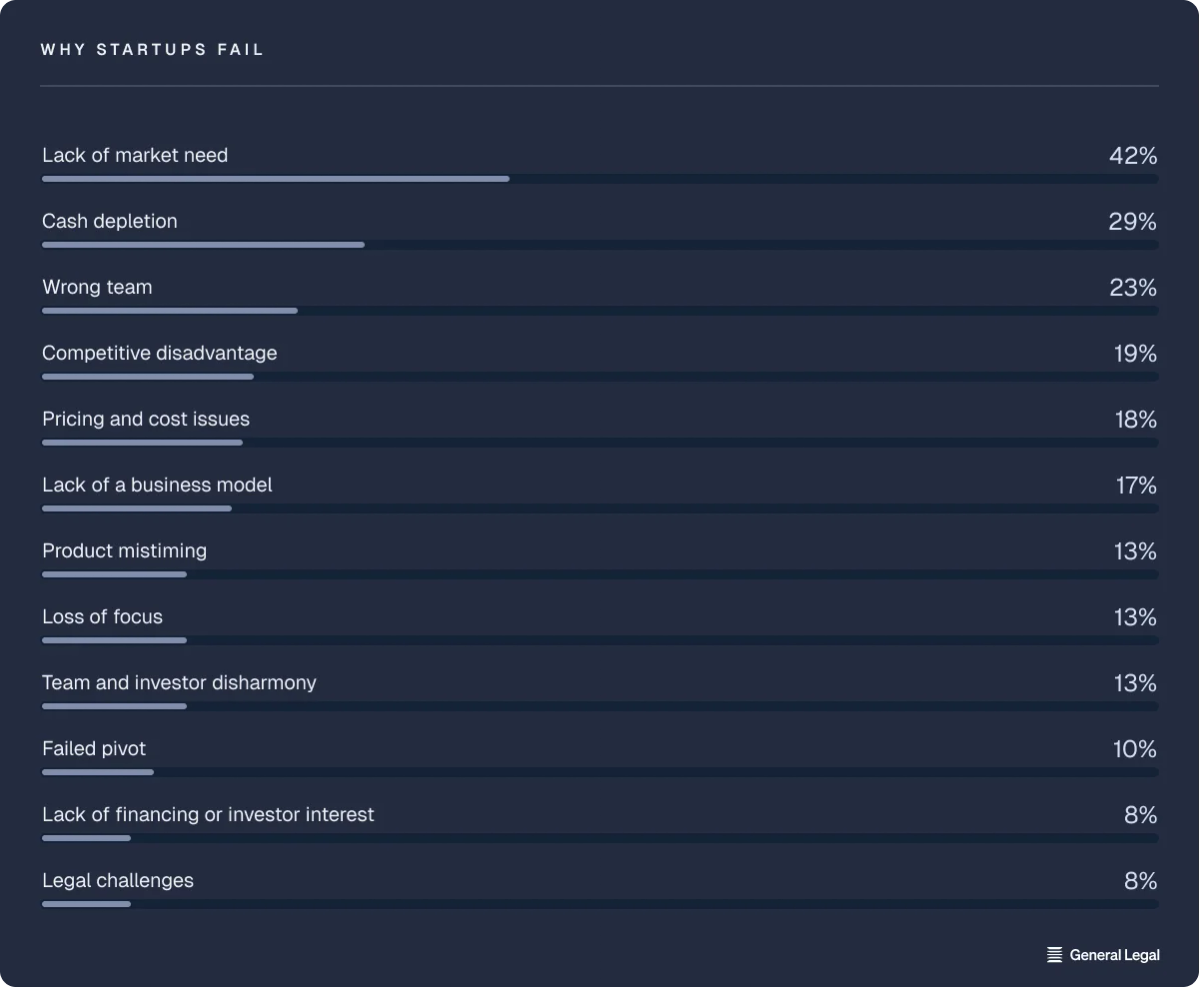
According to CB Insights, 29% of startups fail after running out of cash. Bad payment terms, weak collection provisions, unfavorable supplier agreements, and expensive contractual commitments can all accelerate that cash burn. Another 13% fail because of disharmony among teams or investors, which is the exact kind of conflict that founder, equity, IP, and decision-making agreements are designed to contain.
To help you avoid these scenarios and build a strong legal foundation from day one, this guide breaks down nine must-have startup contracts, explaining what they do, when you need them, and what happens when you get them wrong.
Key takeaways
- Put core startup contracts in place early Focus on founders, IP, customers, employees, contractors, privacy, fundraising, vendors, and confidentiality.
- Match contracts to the business Add agreements as you raise capital, hire, sell to enterprise customers, license IP, or take on other new relationships.
- Protect the economics of the business Clear terms can prevent ownership disputes, unpaid work, unexpected liabilities, and unfavorable commercial commitments.
- Use templates for straightforward agreements Reputable templates can handle simpler contracts, while complex or high-stakes agreements warrant legal review.
- Get legal help when the stakes are higher General Legal offers templates plus attorney-led contract review, drafting, and negotiation at flat fees.
9 startup contracts founders can’t afford to ignore
The right startup contract stack depends on the company’s stage, structure, workforce, business model, and customers.
However, the goal isn’t to drown your startup in legal paperwork. It’s to put the right protections in place before you need them.
These nine startup contracts are designed to do exactly that.
1. Founders’ agreement
A founders’ agreement sets the rules between a startup’s co-founders, establishing:
- Who owns what
- Who is responsible for what
- How major decisions get made
- What happens if one founder stops contributing or walks away
Having these rules in writing is essential because verbal agreements fall apart fast when the company changes.
Harvard Business School Professor Noam Wasserman, the author of “The Founder’s Dilemmas,” has found that founder conflict can contribute to up to 65% of high-potential startup failures.
While a founders’ agreement can’t stop founders from disagreeing, it can prevent a disagreement from becoming a company-threatening dispute.
2. Intellectual property assignment agreement
An intellectual property (IP) assignment agreement transfers ownership of the IP created for a startup to the company, including code, designs, inventions, content, and other work products.
These valuable work products can be created by founders, employees, freelancers, developers, designers, and agencies, so the agreement is needed to establish a clear chain of ownership. This clarification matters because paying someone to create something for your startup doesn’t automatically mean you own it.
For example, if a freelance developer builds your MVP without a proper assignment, you could discover during fundraising that the person who wrote the code still owns it. An investor now has a very reasonable question: What exactly am I investing in if the company doesn’t own its core technology?
3. Customer terms
Customer terms define what your startup sells, what the customer pays, and where the financial and legal risk sits if the deal goes wrong. For a B2B startup, that usually means a Master Services Agreement (MSA) with an order form or Statement of Work (SOW); for a SaaS or self-serve product, it may be terms of service.
These terms should lock down the provisions that directly affect your economics, including:
- Scope
- Payment timing
- Acceptance criteria
- Renewals
- Support
- IP ownership
- Data obligations
- Warranties
- Indemnification
- Liability limits
The ultimate goal of your customer contract should be to protect the revenue you worked so hard to win.
For example, if a customer expects custom integrations that were never included in the price, a clear SOW can stop a $20,000 deal from turning into months of unpaid engineering work. If they demand unlimited liability after a data incident, a negotiated liability cap determines whether one bad event threatens the company.
4. Employee offer letter
An employee offer letter sets out the core terms of the relationship between a startup and a new employee, including:
- Their role
- Compensation
- Benefits
- Start date
- Reporting structure
- Key employment conditions
For an early-stage startup, this is where you turn a verbal hiring conversation into well-defined, documented terms.
If you tell a candidate they will receive $120,000 plus equity, but the written offer only specifies the salary, you have created unnecessary ambiguity around a material part of the compensation package.
The letter should also clarify what the employee is being hired to do and include appropriate confidentiality and IP protections.
5. Independent contractor agreement
An independent contractor agreement governs the terms of a startup’s engagement with a freelancer, consultant, or other non-employee worker, covering:
- What work they will perform
- How they will be paid
- Who owns the resulting IP
- How either side can end the relationship
The agreement should tie the engagement to specific deliverables, deadlines, and payment milestones, so a $15,000 project doesn’t gradually become three months of open-ended work.
There’s also a separate classification issue founders should pay attention to.
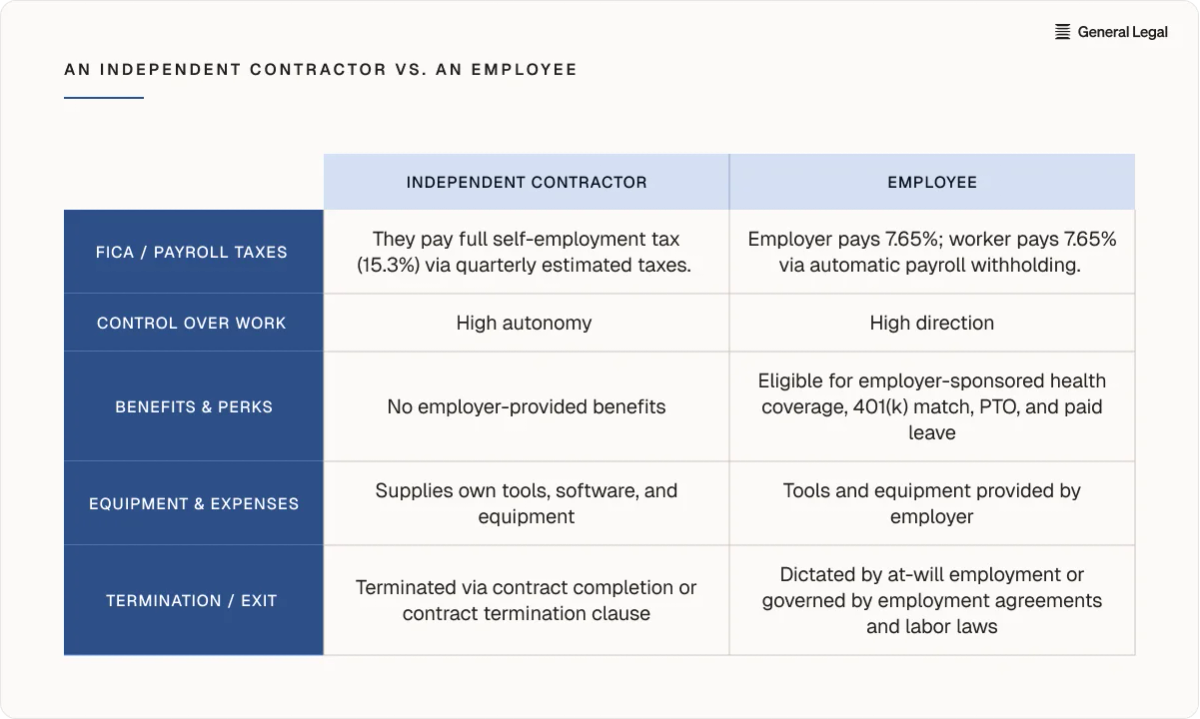
Calling someone a contractor in the agreement doesn’t make them one, as worker status depends on the actual circumstances of the relationship and applicable law. Still, state labor audits reveal that anywhere from 10% to 30% of employers misclassify workers.
If a court or government agency finds a worker was improperly classified, the underlying independent contractor agreement—including its work-for-hire and IP assignment clauses—can be invalidated or challenged in court, creating severe risks for startups raising capital or going through M&A due diligence.
6. Privacy policy
A privacy policy explains how your startup collects, uses, shares, stores, and protects personal information and what rights users have over that data.
If your startup collects email addresses, account information, payment details, cookies, analytics data, or other personal information, the policy needs to reflect what the company actually does with it. This includes:
- Identifying third-party vendors
- Explaining tracking technologies
- Describing retention practices
- Addressing any requirements that apply to the users or jurisdictions involved
The most important part to remember is to never include inaccurate privacy promises, as they can create separate legal exposure.
Europe, in particular, takes privacy compliance seriously. If your startup is subject to the General Data Protection Regulation (GDPR), certain serious violations can result in fines of up to $23.34 million or 4% of worldwide annual revenue, whichever is higher.
Read more: A GDPR-Compliant Vendor Doesn’t Automatically Mean Your Data Transfer Is Legal
7. Y Combinator’s SAFE
A SAFE (Simple Agreement for Future Equity) is a financing contract that gives an investor the right to receive equity in a startup later in exchange for investing money now. It typically converts into shares when the company completes a future-priced financing.
For an early-stage startup, a SAFE can make fundraising considerably simpler than negotiating a full-priced equity round. This helps explain why SAFE has become such a prevalent fundraising instrument, helping YC portfolio companies raise over $15 billion since 2013.
However, as simple as a SAFE looks, its terms still determine how much of your company you’re giving away. The valuation cap, discount, conversion mechanics, and any pro rata rights can materially affect your ownership once the SAFE converts.
That’s why this contract deserves close attention before you accept an investor’s money. If an investor wants to change the standardized SAFE, consider involving a law firm to review the proposed terms and understand exactly how those changes could affect your ownership and future dilution.
8. Vendor/supplier contract
A vendor or supplier contract is the commercial agreement you use when your startup pays another company to provide the goods or services it needs to operate. It covers clauses like:
- Pricing
- Payment terms
- Delivery or performance standards
- Termination
- Liability
- Confidentiality
This contract is important because your startup’s obligations to customers can depend on what your vendors deliver. If your customer contract promises a certain level of uptime, support, or implementation, but your vendor agreement contains weak service commitments or lets the vendor suspend service without meaningful notice, your startup absorbs the gap.
The contract should also address the less obvious sources of exposure, including whether the vendor can:
- Raise prices during the term
- Renew automatically
- Subcontract the work
- Restrict your ability to migrate away
- Disclaim responsibility for a critical dependency
9. Non-disclosure agreement (NDA)
Startups regularly need to share information they aren’t ready to make public, including:
- Product plans
- Source code
- Financial projections
- Customer lists
- Pricing
- Trade secrets
A non-disclosure agreement (NDA) restricts how that confidential information can be used and disclosed.
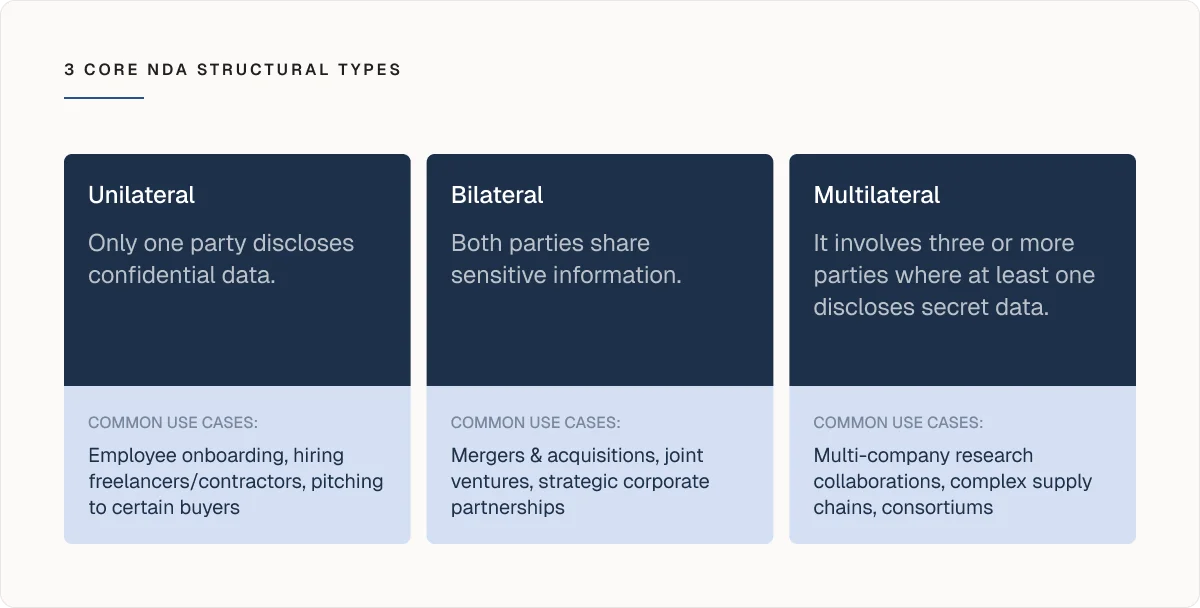
A one-way NDA protects information disclosed by one party, making it useful for sharing information with a contractor or potential partner. A mutual NDA requires both parties to protect each other’s confidential information while exploring a partnership or collaboration.
Pro tip:
Not every discussion requires an NDA, and many investors won’t sign one at the initial pitch stage. So, only use this contract when sensitive information genuinely needs protection, not as a reflex before every conversation.
Read more: The Most Common NDA Pitfall Isn’t What You Think [Explained]
Other startup contracts you’ll need at different stages
The need for contracts doesn’t stop once the basics are in place.
The table below breaks down the common triggers that create a need for additional startup contracts, so you can see what may become relevant as the company grows:
| When you… | Which startup contracts to consider | What they cover |
|---|---|---|
| Raise additional funding or add investors | • Stock purchase agreement • Investor rights agreement • Board/stockholder consents • Equity incentive plan and option agreements | • Equity issuances • Investor rights • Corporate approvals • Equity compensation |
| Start selling to enterprise customers | • Service-level agreement (SLA) • Data Processing Agreement (DPA) • Security addenda | • Customer scope • Service commitments • Data processing • Security requirements |
| Build a larger team | • Employment agreements • Equity / option grants • Employee handbook and policies • Separation agreements | • Employment terms • Equity compensation • Workplace policies • Employee departures |
| Bring on advisors | • Advisor agreement | • Advisory responsibilities • Compensation • Confidentiality • Termination terms |
| License technology or IP | • Licensing agreement • Software license agreement • End-User License Agreement (EULA) | • Permitted uses • License restrictions • Usage rights • Ownership rights |
| Manage more purchasing and procurement | • Purchase orders • Purchase agreements | • Product or service specifications • Pricing and payment • Delivery requirements • Remedies for breach |
| Lease commercial space | • Commercial lease | • Rent and operating costs • Lease term • Permitted use • Landlord and tenant obligations |
Many of these simpler startup contracts can be drafted independently using a reputable, startup-appropriate template. For agreements involving significant money, equity, IP, regulatory obligations, or complex commercial relationships, it’s better to involve counsel to avoid commercial or legal terms that fail to protect the company when the stakes are higher.
General Legal offers both options.
Create quality startup contracts without the law firm drag
General Legal is an AI-native law firm built for companies that need substantial legal work without the traditional law firm drag. Its model combines highly qualified US-barred attorneys with AI-native workflows to deliver commercial legal work at a pace that matches how modern startups actually operate.
For straightforward, standard-form documents, General Legal offers a comprehensive Template Library. These templates are released under a CC0 license, so you can use, modify, and redistribute them freely.
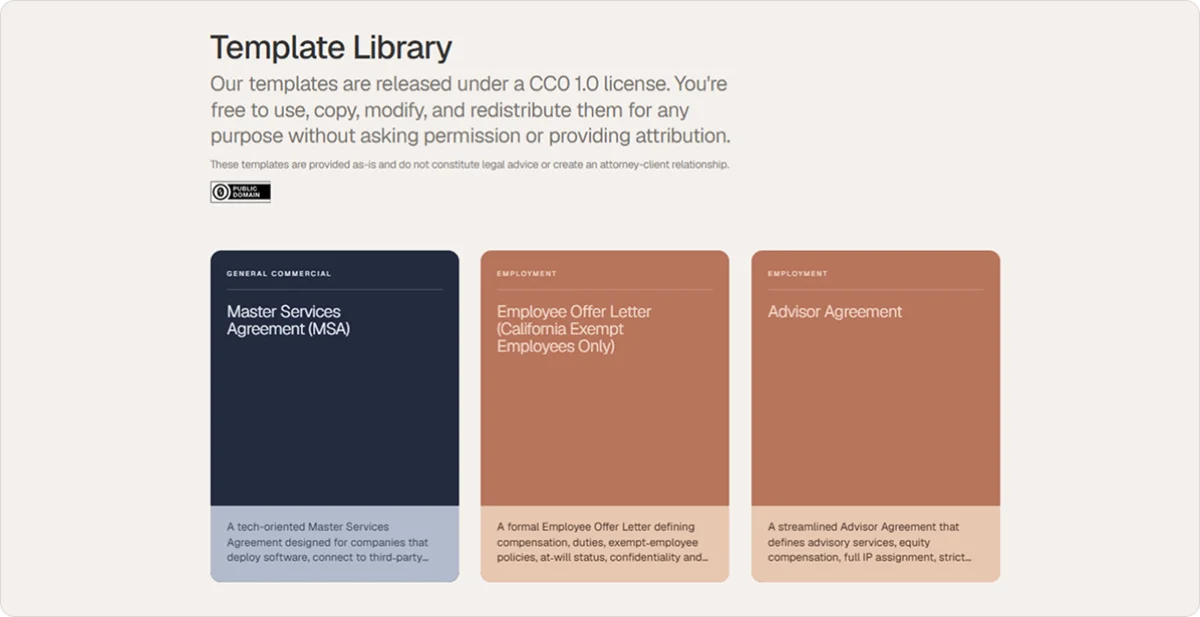
These templates are provided as-is and aren’t a substitute for legal advice.
When you need more than a template, send General Legal the contract through Slack, email, or the client portal.
This option makes sense when the contract is legally or commercially complex, or when the cost of getting it wrong is higher than the cost of having counsel involved. In particular, use legal counsel when you need to account for legal contract requirements that depend on your state, industry, business model, or your specific deal.
After sending the request, the best-matched General Legal attorney will confirm the scope, give you a flat-fee quote and turnaround time upfront, and then work on:
- Reviewing and redlining a contract someone sent you
- Drafting an agreement from scratch
- Negotiating directly with the other side
Standard commercial reviews start at $250 for shorter contracts and $500 for standard reviews, while full negotiations are $1,000; foundational documents such as a TOS, privacy policy, MSA, DPA, or Business Associate Agreement (BAA) drafted from scratch are $2,000.
If this model seems suitable for your startup’s legal needs, sign up online right away and start sending contracts for review, drafting, or negotiation. For questions about the service or overall fit, book a quick call with our team first.
FAQ
Can I legally write my own contract?
Yes, you can legally write your own contract. However, complex or high-stakes agreements are better reviewed by legal counsel.
Do company formation companies provide the contracts startups need?
Not usually. Company formation companies typically handle incorporation documents, while operating contracts require additional legal work.
Are there companies that review vendor contracts for early-stage startups?
Yes. Legal providers like General Legal can review and redline vendor contracts, including pricing, liability, termination, and other key terms.
How can startups build legal foundations using contract management tools?
Startups can use contract management tools to organize, track, and administer agreements, but they shouldn’t rely on them to replace legal judgment.
How do startups handle contract volume with limited legal staff?
Startups can handle contract volume with limited legal staff by standardizing routine agreements, using templates and contract management tools, and reserving legal review for complex or high-risk contracts.
- Startups need nine core contracts covering founders, IP, customers, employees, contractors, privacy, fundraising, vendors, and confidentiality to protect the business and prevent common failure scenarios.
- Founder conflict contributes to up to 65% of high-potential startup failures, making a founders' agreement essential for clarifying ownership, responsibilities, and exit scenarios before disputes arise.
- IP assignment agreements are critical because paying someone to create work for your startup does not automatically transfer ownership, which can derail fundraising if founders don't own core technology.
- Customer contracts should define scope, payment timing, liability limits, and other economic terms to prevent revenue-generating deals from becoming unpaid work or existential liability risks.
- Additional contracts become necessary as startups raise funding, hire teams, sell to enterprise customers, license IP, or lease space, with legal counsel recommended for high-stakes or complex agreements.
| Founders' Agreement | Establishes ownership, responsibilities, decision-making rules, and exit terms among co-founders to prevent disputes that threaten the company. |
|---|---|
| IP Assignment Agreement | Transfers ownership of code, designs, and other work products to the company, preventing ownership ambiguity that can block fundraising or M&A. |
| Customer Terms | Defines what you sell, payment terms, liability caps, and risk allocation through MSAs, SOWs, or terms of service to protect revenue and limit exposure. |
| Employment and Contractor Agreements | Documents compensation, roles, IP ownership, and confidentiality for employees and contractors while addressing misclassification risks that can invalidate agreements. |
| Privacy Policy | Explains data collection, use, storage, and user rights; must accurately reflect practices to avoid regulatory penalties up to $23.34M or 4% of revenue under GDPR. |
| SAFE and Fundraising Documents | Simplifies early fundraising but requires careful review of valuation caps, discounts, and conversion mechanics that determine future ownership dilution. |
| Vendor/Supplier Contracts | Governs pricing, delivery standards, termination, and liability with external providers whose performance can directly impact your customer obligations. |
| Additional Stage-Specific Contracts | Enterprise sales, larger teams, advisor relationships, IP licensing, and office leases each trigger new contract requirements as the startup scales. |
Can I legally write my own startup contracts?
Yes, you can legally write your own contracts, and reputable templates can handle simpler, straightforward agreements. However, complex or high-stakes contracts involving significant money, equity, IP, regulatory obligations, or intricate commercial relationships warrant legal review to avoid terms that fail to protect the company.
What happens if I don't have an IP assignment agreement with contractors or employees?
Without a proper IP assignment, the person who created the work may still own it even though you paid them. During fundraising or M&A, investors will question what they're actually investing in if the company doesn't own its core technology, code, or designs, potentially derailing the deal.
Why does worker misclassification matter for independent contractor agreements?
Calling someone a contractor in an agreement doesn't make them one—worker status depends on the actual relationship and applicable law. If a court or agency finds misclassification, the contractor agreement and its IP assignment clauses can be invalidated, creating severe risks during fundraising or M&A due diligence.
When should I use an NDA with potential investors or partners?
Use an NDA only when genuinely sensitive information needs protection, not reflexively before every conversation. Many investors won't sign NDAs at the initial pitch stage, so reserve them for situations involving trade secrets, detailed financials, source code, customer lists, or proprietary product plans.
How can early-stage startups handle contract volume with limited legal resources?
Startups can standardize routine agreements using reputable templates, organize contracts with management tools, and reserve legal review for complex or high-risk situations. Services like General Legal offer flat-fee attorney review starting at $250 for shorter contracts and $500 for standard reviews.
What contract risks directly accelerate cash burn or cause startup failure?
Bad payment terms, weak collection provisions, unfavorable supplier agreements, and expensive contractual commitments can all accelerate cash burn, which causes 29% of startup failures. Additionally, 13% fail due to team or investor disharmony that founder and equity agreements are designed to contain.
- Why Do You Need a Commercial Contract? [11 Practical Reasons]Learn why you need a commercial contract so you can protect your business, manage risk, and clarify responsibilities.
- The Ultimate Commercial Contract Checklist for 2026: What to Review Before SigningDiscover the ultimate commercial contract checklist so you can review key terms, spot risks, and protect your business.
- When to Involve a Law Firm in Startup Fundraising: 10 Clear-Cut SituationsDiscover when to involve a law firm in startup fundraising so you can manage legal risks, review deal terms & protect interests.