
You’ll likely need a legal contract at some point in your life, whether to hire a contractor to redo your kitchen, rent an apartment, or close a business deal. While the contract itself isn’t optional, hiring a lawyer to draft it often is.
According to the Legal Services Corporation’s Justice Gap Study, many Americans don’t enter the market for legal services, and nearly half cite cost as the reason. However, being unable—or unwilling—to hire a lawyer doesn’t mean you can’t put a contract in place.
The key is knowing how to draft one that’s legally enforceable.
This step-by-step guide will show you how to make a legal contract without a lawyer, while helping you recognize when a DIY approach stops being practical and starts becoming a liability.
Can I legally write my own contract?
Yes, you can. No US law requires a contract to be drafted, reviewed, or approved by an attorney. However, just because you’re allowed to do it doesn’t mean you should.
Generally, self-written contracts work best when the deal is straightforward, the obligations are easy to understand, and the financial stakes are relatively limited. Common examples of these contracts include:
- Freelance and consulting agreements
- Non-disclosure agreements (NDAs)
- Service contracts
- Simple partnership agreements
- Personal property lease agreements
- Independent contractor agreements
These are routine agreements with well-understood terms and limited legal complexity.
That’s also how organizations approach self-service contracting. According to Deloitte, only 14% of organizations report significant use of self-service contracts, with this approach primarily being used for NDAs.
Does my contract need to be in writing?
Your contract doesn’t necessarily need to be in writing. A verbal agreement can create a binding contract as long as both parties clearly agree to the same terms and all the required elements of a valid contract are present.
That said, depending on the state, these agreements commonly need to be in writing:
- Real estate purchase and sale agreements
- Contracts that can’t be fully performed within one year
- Certain sales of goods above a specified value (often $500 under the Uniform Commercial Code)
- Suretyship agreements, where one party agrees to cover another’s debt or obligation
These requirements generally fall under a set of legal rules known as the Statute of Frauds.
However, even when the law doesn’t require a written contract, putting the agreement in writing is almost always the smartest move.
Written contracts reduce misunderstandings, create a traceable record of what was agreed upon, and are significantly easier to enforce if a dispute arises.
Keep in mind that the format itself rarely determines whether a contract is enforceable. Courts routinely recognize contracts created in a variety of formats, provided the essential legal requirements are met.
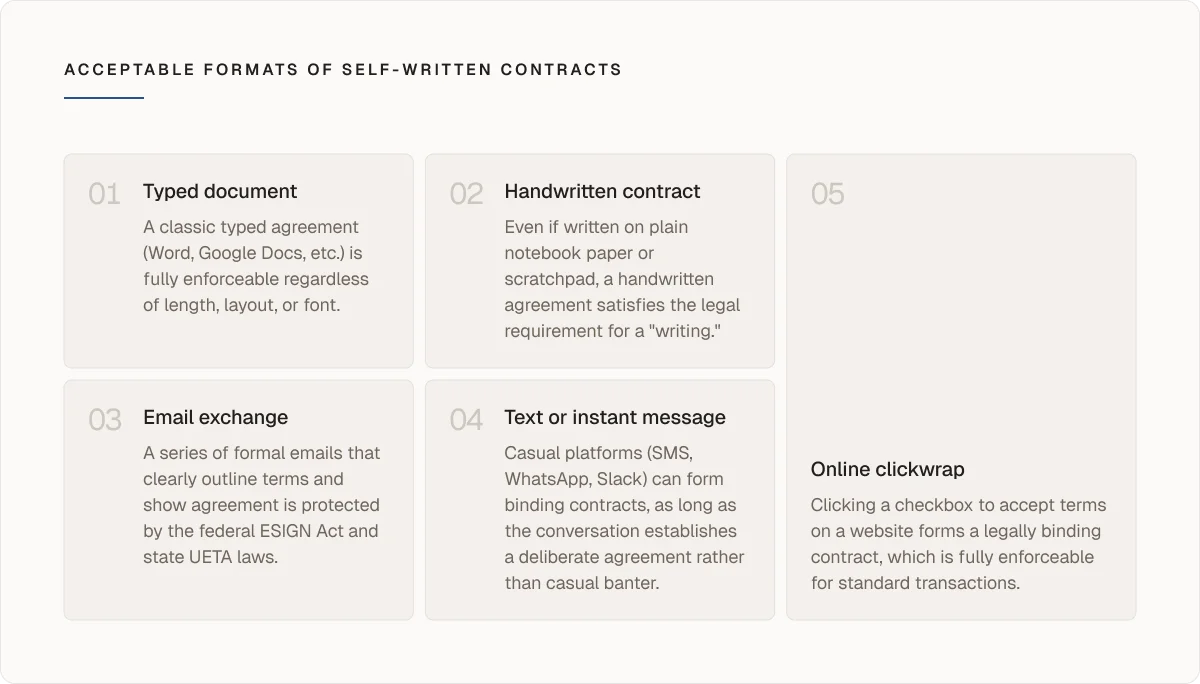
However, while courts give parties plenty of freedom in how they document an agreement, they set firm rules around what that agreement must contain.
What makes a contract legally binding?
A contract is legally binding when it contains a handful of essential elements recognized by law. Miss even one, and a signed agreement may become difficult or even impossible to enforce.
1. A valid offer
Every contract starts with an offer. One party must propose specific terms that are detailed enough for the other party to understand what’s being exchanged.
This means defining the key elements of the deal, such as the goods, services, pricing, timeline, or scope of work. If important details are still up for debate, you’re likely negotiating rather than making a legally valid offer.
2. Acceptance of the terms
For a contract to be legally binding, the other party must accept the offer as presented. If they change a material term, they’re not accepting the offer; they’re making a counteroffer that must be accepted in return.
While signatures are the most common way to demonstrate acceptance, what matters legally is that both parties have agreed to the same deal, not the method used to prove it.
3. An exchange of value
A contract isn’t legally enforceable unless both parties bring something to the table. This exchange, known as consideration, can involve money, services, goods, intellectual property, or even a promise to do (or not do) something.
Without a reciprocal exchange of value, you’re typically looking at a gift or informal promise rather than a contract.
4. Mutual intent to be bound
Both parties must understand that they’re entering a legal agreement, not discussing possibilities or exploring options. Lawyers often refer to this as a “meeting of the minds”—a shared understanding of what each party is agreeing to.
Casual conversations, preliminary negotiations, and vague statements of intent generally don’t create enforceable contracts because the parties haven’t demonstrated an intent to be legally bound.
5. Legal capacity
A well-drafted contract can still be unenforceable if one of the parties lacks the legal ability to enter into the agreement. The most common red flags are:
- Being under the legal age required to enter a contract
- Lacking the mental capacity to understand the agreement and its consequences
- Signing while subject to severe impairment, intoxication, or coercion
- Signing on behalf of a business without authority to bind the company
This last issue is particularly common in business transactions. For example, a startup employee may sign a contract even though only a founder or an executive has the authority to act on the company’s behalf. If a dispute arises later, questions about that person’s authority can create an entirely separate legal battle before the underlying contract terms are ever addressed.
6. A lawful purpose
An agreement to engage in illegal activity isn’t enforceable, regardless of how well it’s drafted, how detailed the terms are, or whether both parties signed it.
This requirement extends beyond obviously illegal conduct.
Depending on the circumstances, contracts may also need to comply with industry-specific regulations, employment laws, consumer protection rules, and other legal requirements. If the underlying agreement violates the law, a court may treat the contract as void from the outset.
Once you understand these legal requirements, creating the contract itself becomes much more straightforward.
How to make a legal contract without a lawyer: A step-by-step guide
There’s no single format that every contract must follow. However, most enforceable contracts contain the same core information and follow a broadly similar structure—one you can replicate in seven steps.
1. Start with a reputable contract template
For most everyday agreements, starting from a template is smarter than drafting from a blank page. A well-structured template provides a proven framework, helps ensure you don’t overlook important clauses, and reduces drafting time.
Even sophisticated legal teams often rely on templates to create consistency, reduce risk, and speed up the contracting process, with 92% of organizations maintaining standard contract forms.
That said, not all templates are created equal. Before using one, pay attention to a few common pitfalls:
- Outdated language: Older templates may not reflect current laws, regulations, or business practices.
- Jurisdiction mismatches: A template written for one state or country may not work properly in another.
- Poor customization: Generic templates often require modifications to accurately reflect the deal you’re making.
For these reasons, it’s generally best to start with a verified or attorney-reviewed template rather than a random document found through a web search.
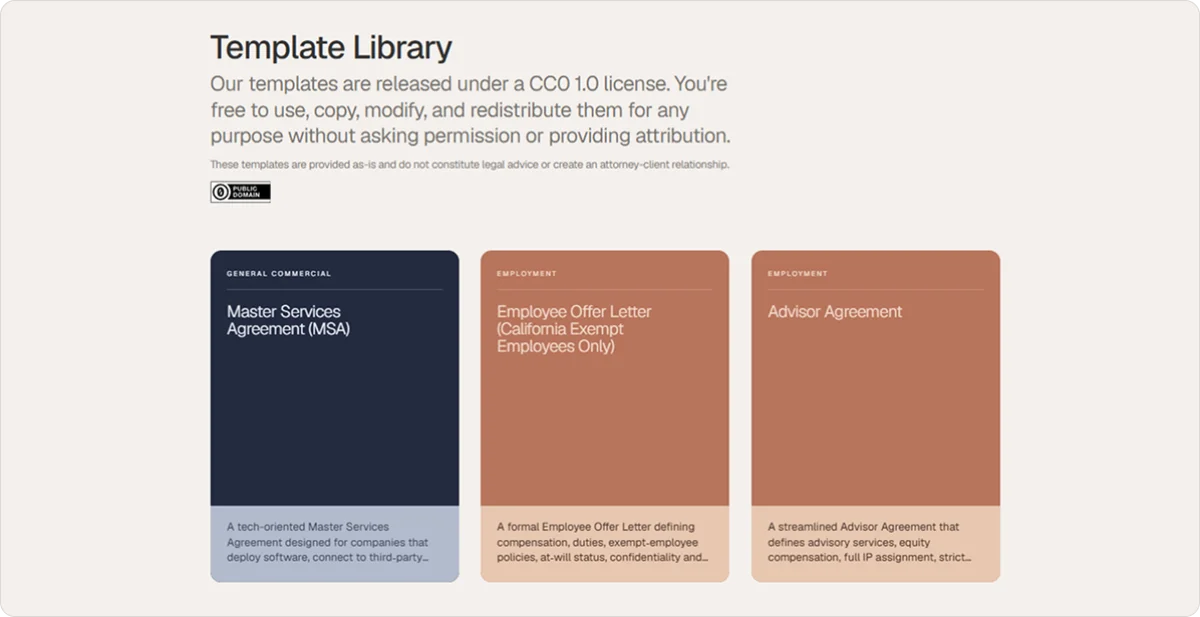
For startups and high-growth companies, a great place to start is General Legal’s Template Library, which provides agreements released under a CC0 1.0 license. The templates are free to use, modify, and redistribute, and they include:
- Master Services Agreement (MSA) for software, platform, and integration services
- One-Way NDA and Mutual NDA for confidentiality protection
- Advisor Agreement for startup advisors receiving equity compensation
- Business Associate Agreement (BAA) for healthcare and HIPAA-related use cases
Regardless of the template you choose, treat it as a starting point rather than a finished document.
2. Identify the parties to the agreement
Identify everyone bound by the contract using their full legal names. If a business is involved, use its complete legal name, including any designation like LLC or Inc. Where appropriate, add relevant contact information.
Accurate identification reduces the risk of disputes over who is responsible for performing the agreement and who can enforce it if problems arise.
Pro tip:
Not all templates are written from a neutral perspective. Before customizing one, determine whose interests it was designed to protect. A vendor agreement drafted for buyers, for example, may shift more legal risk to the vendor through liability, indemnification, payment, and termination provisions.
3. Define the deal in specific terms
Describe exactly what the agreement covers. Define the products, services, rights, or obligations being exchanged, along with any specialized terms that could be interpreted differently by the parties.
For example, instead of stating that a startup contractor will “build an AI feature,” specify which functionality will be delivered, what systems it will integrate with, and what constitutes a completed deliverable.
If certain work falls outside the scope of the engagement, identify those exclusions explicitly to avoid misunderstandings later.
4. Document payment, deadlines, and obligations
If money is changing hands, specify exactly how much will be paid, when the payment is due, and what happens if the payment is late. Avoid vague language such as “payment upon completion.” Instead, define what completion means and when invoices must be paid.
The agreement should also assign responsibility for key obligations.
For instance, a startup hiring a freelance designer might require the designer to deliver final assets by a specific date while requiring the company to provide branding materials and feedback within a defined timeframe.
5. Add clauses that protect both parties
The main terms of a contract explain the deal. Protective clauses address what happens when that deal encounters problems.
These clauses are also one of the easiest elements to miss when drafting a contract, especially if you’re using a template.
A University of Chicago Law Review analysis of 500,000 contracts found that the inclusion of dispute resolution provisions was driven largely by the template used, even among sophisticated organizations with legal counsel.
The table below highlights some of the most common protective clauses to consider:
| Clause | What it does | When to include it |
|---|---|---|
| Termination | Defines how and when the agreement can end | Ongoing service, employment, advisory, or vendor relationships |
| Confidentiality | Protects sensitive information from disclosure | Contractor engagements, fundraising discussions, partnership negotiations, product development projects |
| Purpose & Permitted Use | Restricts how shared information, data, or intellectual property may be used | NDAs, AI vendor agreements, pilot programs, data-sharing arrangements, partnership discussions |
| Dispute Resolution | Establishes how disputes will be handled | Commercial agreements, vendor contracts, long-term business relationships |
| Governing Law | Determines which jurisdiction's laws apply | Cross-state transactions, remote teams, international business relationships |
| Limitation of Liability | Caps potential financial exposure | Software agreements, consulting engagements, professional services contracts |
| Indemnification | Allocates responsibility for certain claims or losses | Vendor relationships, technology licensing, data-sharing arrangements |
| Force Majeure | Addresses events outside either party's control | Long-term projects, supply agreements, recurring service contracts |
6. Review the contract for gaps and ambiguities
Read the contract as if a dispute has already occurred. Look for undefined terms, inconsistent deadlines, missing responsibilities, vague deliverables, and provisions that could reasonably be interpreted in more than one way.
Pro tip:
Even if you don’t hire a lawyer to draft your contract, you can reach out to one for a contract review. This will allow you to identify ambiguous language, missing provisions, and other issues that could create problems later.
7. Sign, date, and store the agreement
Once the contract is finalized, it should be dated and signed by all parties, either electronically or on paper. Each party should retain a copy of the fully executed agreement for its records.
If you need to alter the contract later, document the changes in a written amendment rather than relying on informal emails or verbal understandings. The amendment should also be signed by all parties.
With the basic structure in place, the next step is drafting the agreement in a way that reduces ambiguity and risk.
How to make a legal contract without a lawyer: Best practices
Few drafting practices have a greater impact on contract quality than using simple and precise language.
According to Deloitte, roughly 90% of business people find contracts difficult or impossible to understand, and an average business contract requires approximately 17 years of education to read comfortably. If the people signing the agreement struggle to understand it, there’s a good chance a future judge, arbitrator, employee, or business partner will, too.
So, when drafting a contract, you should:
- Use plain English instead of legal jargon: Replace archaic phrases and unnecessary legal terminology with straightforward language whenever possible.
- Keep sentences short: Long sentences increase the risk of confusion and make important obligations harder to identify.
- Define obligations precisely: Avoid vague phrases like “reasonable support” and “timely delivery” unless those terms are specifically defined.
- Use terms consistently: If you refer to something as the “Services” in one section, don’t call it the “Work,” “Deliverables,” or “Project” elsewhere in the agreement.
- Use obligation words carefully: Generally, “shall” creates an obligation, “will” describes a future event, and “may” grants discretion. Mixing these words can create unintended ambiguity.
Researchers at MIT found that one of the biggest language-specific problems in contracts is a drafting technique known as center-embedding.
Center-embedding occurs when a sentence is interrupted midway through by a lengthy definition, condition, or exception before returning to the original thought. As a result, readers must hold multiple pieces of information in memory at the same time, making the contract significantly harder to follow.
- No US law requires a contract to be drafted or reviewed by an attorney, and self-drafted contracts generally work best for straightforward agreements like NDAs, freelance agreements, and simple service contracts.
- A contract doesn't have to be in writing to be enforceable, but certain agreements, like real estate sales or deals lasting over a year, fall under the Statute of Frauds and must be written, and writing things down is almost always safer anyway.
- A legally binding contract requires six elements: a valid offer, acceptance, an exchange of value (consideration), mutual intent to be bound, legal capacity of both parties, and a lawful purpose.
- The recommended drafting process has seven steps, starting from a reputable, jurisdiction-appropriate template and ending with reviewing for gaps, then signing, dating, and storing the executed agreement.
- Protective clauses like termination, confidentiality, dispute resolution, governing law, limitation of liability, indemnification, and force majeure are among the easiest elements to miss, especially when using a generic template.
- Roughly 90% of business people find contracts difficult to understand, so the article recommends plain English, short sentences, consistent terminology, and avoiding center-embedding, where a sentence is interrupted by a long clause before finishing the original thought.
| Can you legally write your own contract? | Yes, no US law requires an attorney to draft, review, or approve a contract, though it works best for straightforward deals like NDAs or freelance agreements. |
|---|---|
| Does it need to be in writing? | Not always; verbal agreements can be binding, but certain agreements like real estate sales fall under the Statute of Frauds and must be written, and writing it down is safer regardless. |
| What makes a contract legally binding | Six elements are required: a valid offer, acceptance, consideration (an exchange of value), mutual intent to be bound, legal capacity, and a lawful purpose. |
| Step-by-step drafting process | Start from a reputable template, identify the parties, define the deal specifically, document payment and deadlines, add protective clauses, review for gaps, then sign, date, and store the agreement. |
| Templates worth starting from | General Legal's free Template Library offers CC0-licensed agreements including an MSA, one-way and mutual NDAs, an advisor agreement, and a BAA. |
| Protective clauses to watch for | Termination, confidentiality, dispute resolution, governing law, limitation of liability, indemnification, and force majeure clauses are commonly missed, especially with generic templates. |
| Best practices for clarity | Use plain English, short sentences, consistent terminology, and be careful with 'shall,' 'will,' and 'may,' since roughly 90% of business people find contracts hard to understand. |
| When to get a lawyer involved | Even without hiring a lawyer to draft it, having one review the finished contract can catch ambiguous language and missing provisions before they become expensive problems. |
Can I legally write my own contract without a lawyer?
Yes, no US law requires a contract to be drafted, reviewed, or approved by an attorney, though it's best suited to straightforward agreements like NDAs, freelance agreements, and simple service contracts.
Does a contract have to be in writing to be enforceable?
Not always; verbal agreements can be binding, but certain contracts, like real estate sales, deals lasting over a year, and larger goods sales, must be written under the Statute of Frauds.
What are the required elements of a legally binding contract?
A valid offer, acceptance of the terms, an exchange of value (consideration), mutual intent to be bound, legal capacity of both parties, and a lawful purpose.
Should I start from a template when writing my own contract?
Yes, a reputable, jurisdiction-appropriate template reduces the risk of missing important clauses; General Legal's Template Library offers free, CC0-licensed agreements like MSAs and NDAs as a starting point.
What clauses do people most often forget to include?
Protective clauses like termination, confidentiality, dispute resolution, governing law, limitation of liability, indemnification, and force majeure, which address what happens when the deal runs into problems.
When should I get a lawyer involved even if I drafted the contract myself?
When the stakes are high, having a lawyer review the finished contract is usually far cheaper than fixing a drafting mistake after the fact.
- The Startup Advisor Contract: What to Include & What to AvoidLearn what you need to know about the startup advisor contract so you can define equity, protect your business, and avoid costly legal mistakes.
- Commercial Contract Litigation: When It Happens & How to AvoidExplore what you need to know about commercial contract litigation so you can understand common disputes, manage legal risks & protect your business.
- How to Compare Legal Contracts Before You Sign: Full GuideLearn how to compare legal contracts so you can spot important changes, identify hidden risks, review key terms, and protect your interests.