
If you only manage a dozen contracts, a proper Contract Management System (CMS) is likely overkill. A simple stack of Google Docs, a shared Drive folder, and a spreadsheet of renewal dates is all you need to track key obligations and deadlines.
However, add another dozen contracts, a few customers, vendors, and hiring agreements, and that system starts showing cracks fast.
That’s because a standard contract lifecycle has over 40 friction points where delays, missed handoffs, and poor visibility can slow deals down or create risk. Contract disputes are also the single most common type of civil litigation businesses face, which is a fight most startups don’t have the cash or the runway to take on.
That’s why more founders are investing in dedicated contract management software.
In this guide, we’ll break down the eight best startup tools for managing contracts, from full contract lifecycle systems to specialized platforms that solve specific parts of the contracting workflow.
How we chose the 8 best startup tools for managing contracts
As World Commerce & Contracting highlights, organizations lose an average of 9% of annual revenue through poor contract management. Meanwhile, Zefort’s 2025 State of Contract Management report found that as many as 71% of businesses can’t locate at least 10% of their active contracts, exposing them to a number of financial and legal risks.
That’s why contract tools are no longer judged solely on their ability to collect signatures. Founders need systems that can keep contracts searchable, track obligations, flag upcoming renewals, automate approvals, and create a reliable system of record as the business grows.
You also can’t evaluate this category by feature count alone. The best platform for a Fortune 500 legal department is often the wrong choice for a 20-person startup that needs a contract system live this week, not after a six-month implementation project.
To build this list, we reviewed more than 30 contract management and contract lifecycle management (CLM) tools and evaluated them across five areas:
- Independent User Validation (30%): We analyzed verified reviews, ratings, and review volume on G2, Capterra, and Gartner Peer Insights to prioritize real customer experience over vendor marketing claims.
- Startup Fit & Ease of Adoption (25%): We assessed implementation speed, onboarding complexity, pricing accessibility, and ease of use for non-legal teams.
- Contract Lifecycle Coverage (20%): We evaluated support for drafting, negotiation, approvals, e-signatures, repositories, renewals, reporting, and post-signature management.
- Contract Intelligence & Workflow Automation (15%): We measured capabilities like metadata extraction, obligation tracking, approval routing, clause libraries, contract search, and AI-assisted review.
- Integrations & Scalability (10%): We reviewed integrations with tools commonly found in startup stacks, including Slack, HubSpot, Salesforce, Google Workspace, Microsoft 365, and Zapier, as well as each platform’s ability to scale alongside company growth.
An overview of the 8 best startup tools for managing contracts
| Tool | Primary strength | Ranking | Best for |
|---|---|---|---|
| 1. PandaDoc | Proposal-to-contract revenue workflows | 4.7/5 on G2 4.5/5 on Capterra | Sales-led startups that turn proposals into signed contracts at high volume |
| 2. Juro | Browser-native contract collaboration | 4.6/5 on G2 4.8/5 on Capterra | Fast-growing startups that want business teams to self-serve contracts |
| 3. Ironclad | Enterprise-grade workflow orchestration | 4.4/5 on G2 4.4/5 on Capterra | Scaling startups that need enterprise-grade contract workflows before they become enterprise-sized |
| 4. Contractbook | Contract data activation | 4.7/5 on G2 4.7/5 on Capterra | Lean startups that automate operational workflows from signed agreements |
| 5. ContractSafe | Contract repository visibility | 4.7/5 on G2 4.8/5 on Capterra | Small teams that need a reliable system for tracking renewals and obligations |
| 6. Concord | Affordable end-to-end CLM | 4.2/5 on G2 4.6/5 on Capterra | Budget-conscious startups that want full contract lifecycle management without enterprise pricing |
| 7. SpotDraft | AI-assisted legal operations | 4.5/5 on G2 4.8/5 on Capterra | Startups that need legal to support the business without becoming a bottleneck |
| 8. LinkSquares | AI-powered contract analysis | 4.7/5 on G2 4.3/5 on Capterra | Startups that need AI-powered visibility across hundreds of existing contracts |
Ratings are based on publicly available review platforms at the time of publication and should be treated as a point-in-time snapshot rather than a definitive measure of product quality.
1. PandaDoc: Best for sales-led startups that turn proposals into signed contracts at high volume
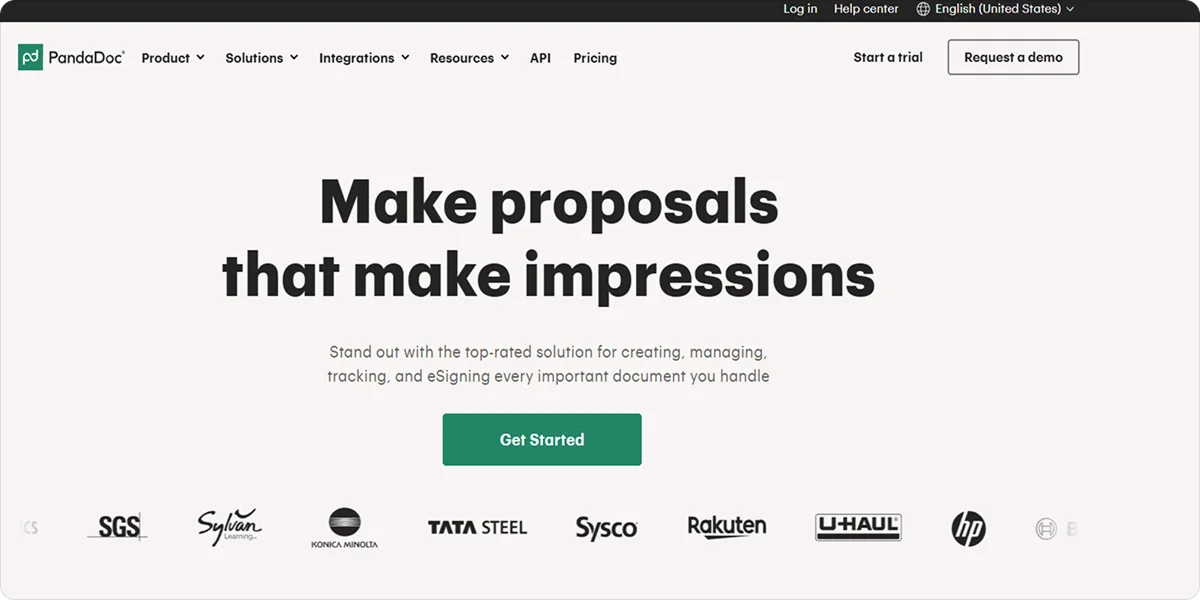
PandaDoc is a document workflow platform that combines proposal creation, contract generation, approvals, e-signatures, and document management in a single system.
It’s particularly well-suited for sales-led startups because it sits directly inside the revenue workflow. Strong integrations with HubSpot, Salesforce, and other CRM platforms allow teams to generate agreements from existing deal data, reducing manual work and helping reps move prospects from quote to signature faster.
Standout features
PandaDoc keeps contract execution tightly connected to the sales process, with tools like:
- Drag-and-drop document builder: Create branded proposals, quotes, and agreements from reusable templates without relying on design or legal resources for every document.
- Document tracking and analytics: Monitor when recipients open, review, and sign documents to prioritize follow-ups and identify stalled deals.
- Built-in payment collection: Accept ACH and card payments directly from signed documents to shorten the gap between closing a deal and getting paid.
Pricing
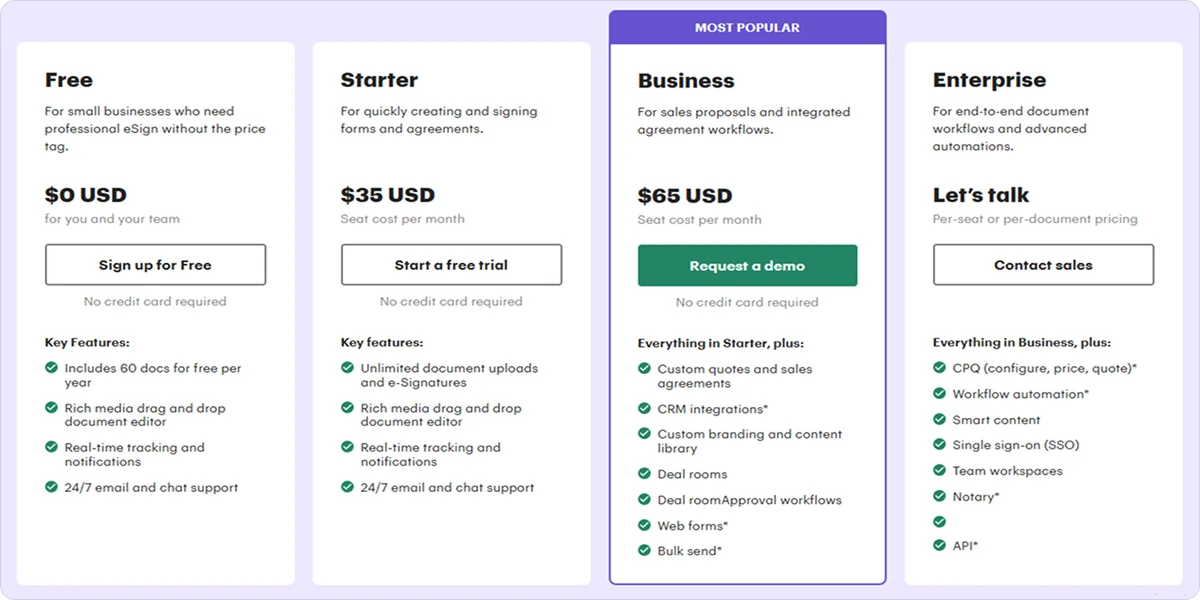
PandaDoc uses a tiered subscription model, with plans ranging from a free e-signature offering to more advanced packages that include workflow automation, integrations, and additional administrative controls.
2. Juro: Best for fast-growing startups that want business teams to self-serve contracts
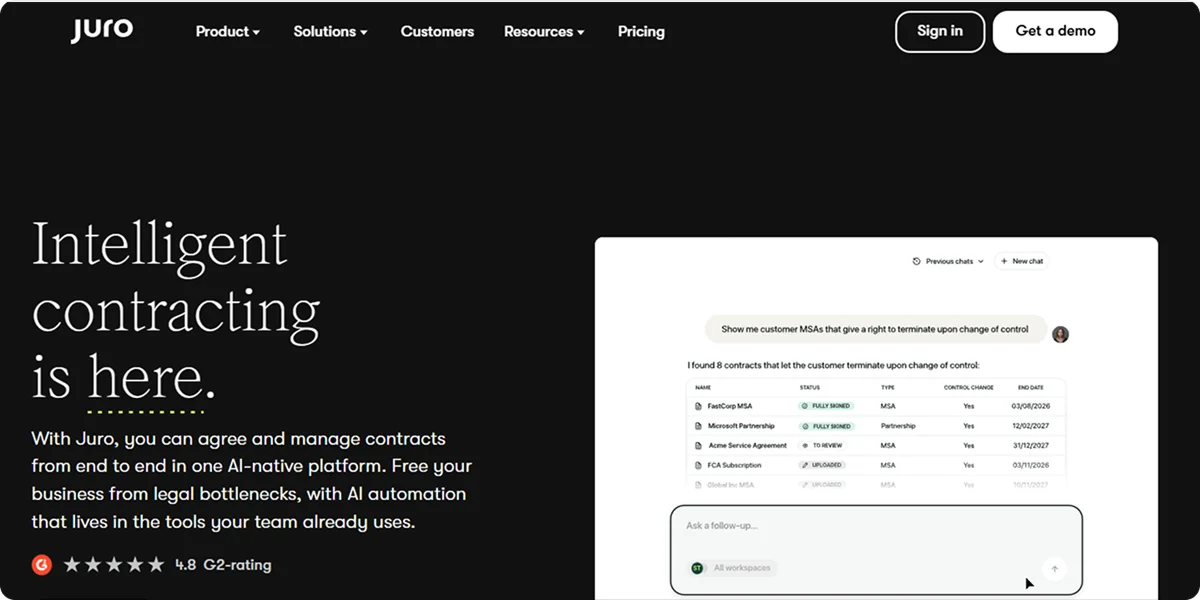
Juro is a CLM platform that lets teams draft, negotiate, approve, sign, and manage agreements entirely within a browser. Its design prioritizes collaboration across sales, HR, operations, and legal teams rather than serving as a tool used exclusively by lawyers.
Juro shines for startups that want business teams to self-serve contracts because it removes legal bottlenecks without sacrificing control. Conditional templates, approval rules, and built-in guardrails allow non-legal employees to generate compliant agreements on their own, freeing legal teams and founders from routine contract requests.
Standout features
Juro keeps contracting work inside a single environment, with capabilities like:
- Browser-native editor: Draft, negotiate, approve, and sign agreements without moving between Word files, PDFs, and separate e-signature tools.
- Collaborative redlining: Review edits, negotiate terms, and hold internal discussions alongside counterparties without creating version-control headaches.
- AI contract intelligence: Extract key metadata, identify unusual clauses, and search contract repositories using natural-language queries.
Pricing
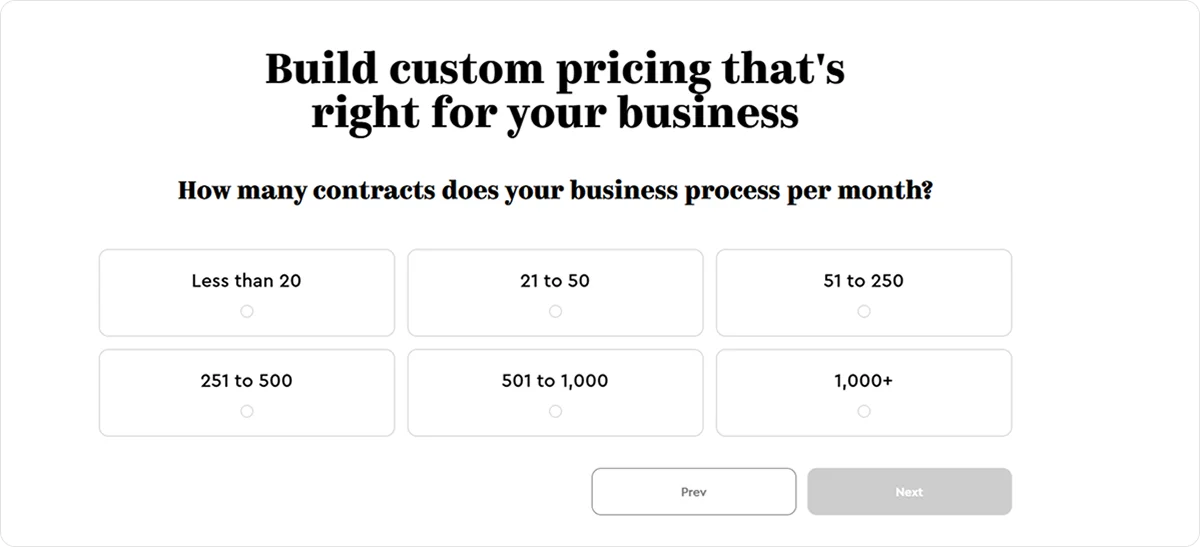
Juro doesn’t publish standard pricing on its website, requiring prospective customers to contact the sales team for a custom quote.
3. Ironclad: Best for scaling startups that need enterprise-grade contract workflows before they become enterprise-sized
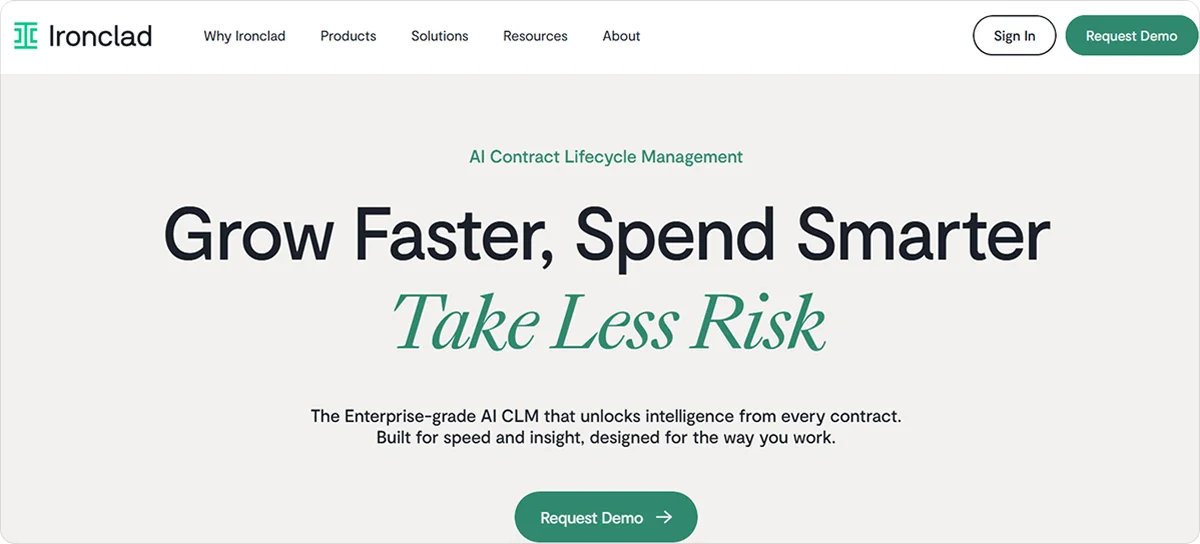
Ironclad is a CLM platform built for organizations with increasingly complex contracting requirements. It combines contract creation, negotiation, approvals, repository management, and AI-powered analysis in a system designed to support legal, finance, procurement, and sales teams as they scale.
It’s a strong fit for startups preparing for rapid growth because it brings structure to processes that often become chaotic during later funding rounds, larger customer deals, and expanding compliance requirements. Teams can establish sophisticated controls early rather than rebuilding their contract operations every time the business doubles in size.
Standout features
Ironclad helps standardize and govern contract operations across the company, with features like:
- No-code workflow designer: Configure conditional approval paths that automatically route agreements to the right stakeholders based on deal terms, contract value, or risk level.
- Clickwrap management: Deploy legally binding click-to-accept agreements across products and websites while maintaining a detailed audit trail for compliance purposes.
- Slack and Salesforce integrations: Launch, track, discuss, and approve contracts within the systems teams already use every day.
Pricing
Ironclad follows a custom enterprise pricing model, with costs available only through direct discussions with its sales team.

4. Contractbook: Best for lean startups that automate operational workflows from signed agreements
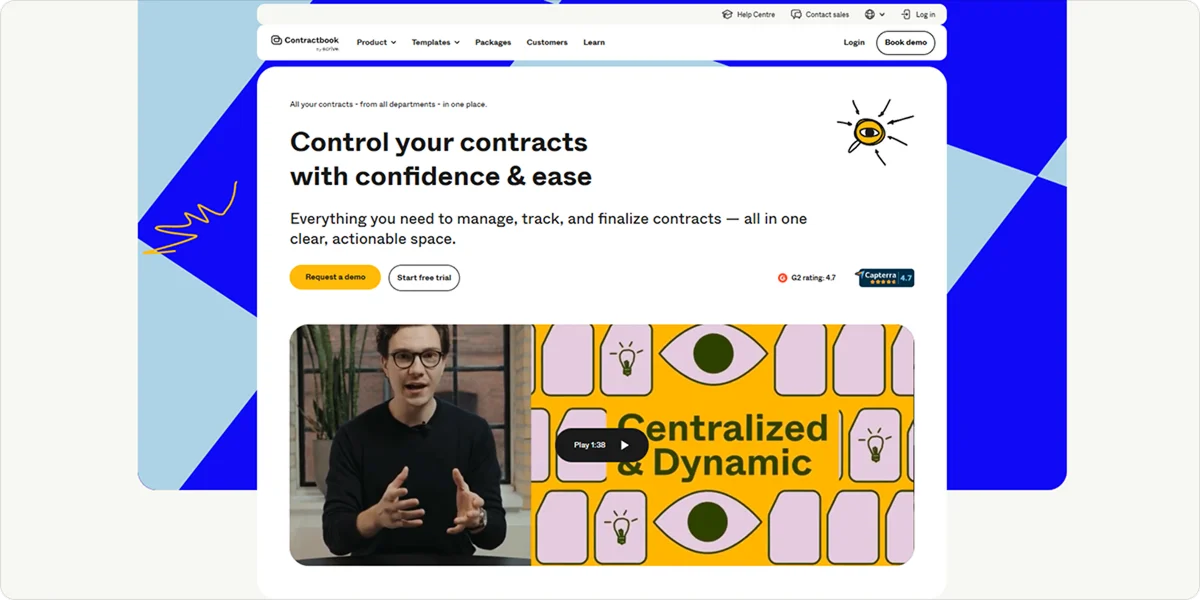
Contractbook is a cloud-based CLM platform that helps startups create, manage, store, and automate agreements from a single workspace.
Fast-moving teams will benefit from Contractbook because it treats signed agreements as operational data rather than static documents. This makes it easier to connect contracts to onboarding, finance, HR, and other business processes without adding administrative work every time a document is executed.
Standout features
Contractbook focuses heavily on turning contract data into actions across the business, with capabilities including:
- AI-powered contract import: Convert legacy PDFs and scanned agreements into searchable records by extracting key metadata automatically.
- Questionnaire-based document creation: Generate customized agreements from structured forms that populate contract fields without manual drafting.
- Renewal tracking and task management: Assign responsibilities, monitor obligations, and receive reminders before important deadlines are missed.
Pricing
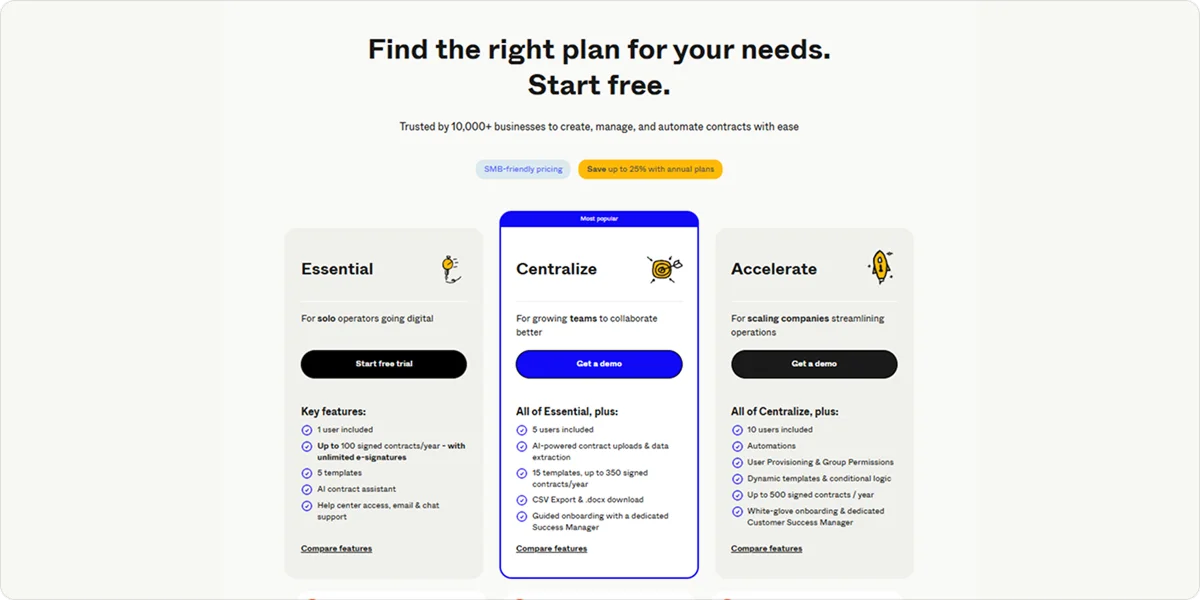
Contractbook offers several subscription tiers, but organizations typically need to speak with the company directly to get accurate pricing.
5. ContractSafe: Best for small teams that need a reliable system for tracking renewals and obligations
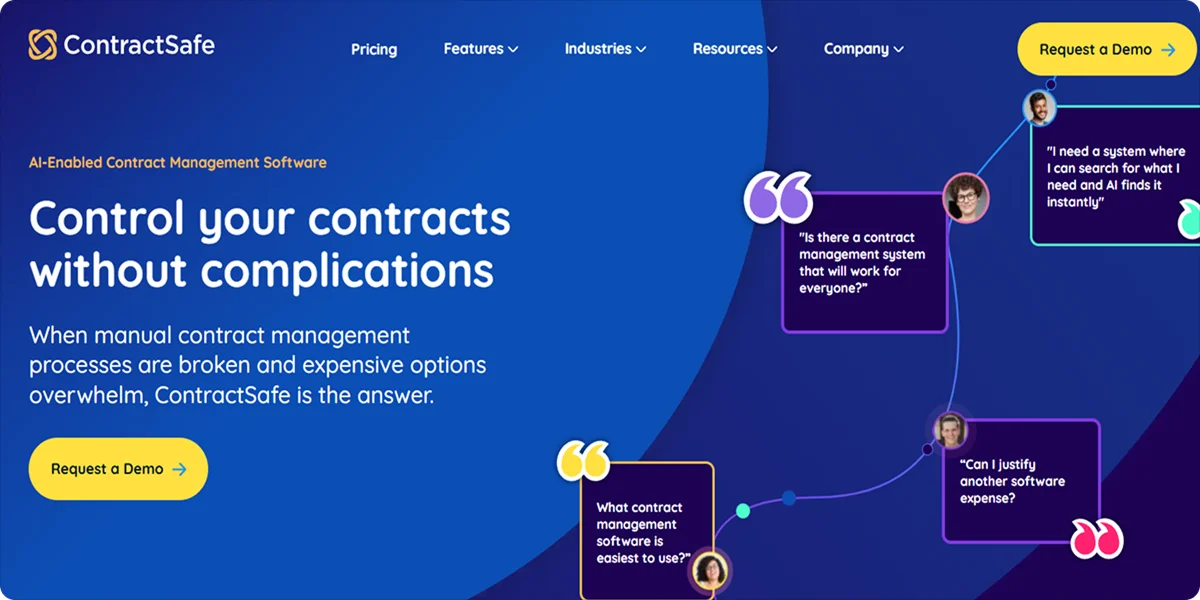
ContractSafe is a contract repository and management platform focused on storing, organizing, and retrieving agreements without the complexity of a full enterprise CLM system.
It’s particularly well-suited for small teams because it solves one of the most common contract management problems: forgetting what happens after the agreement is signed. Automated alerts and clear visibility into key dates help founders and operators stay ahead of renewals, notice periods, and contractual commitments before they turn into expensive surprises.
Standout features
ContractSafe prioritizes visibility and accessibility over heavyweight workflow customization, with tools like:
- AI data extraction: Pull key terms, dates, and contract details from uploaded agreements to reduce manual data entry.
- Advanced search and tagging: Locate specific contracts, clauses, counterparties, or terms in seconds instead of digging through folders and inboxes.
- Custom dashboards and reporting: Surface contract activity, upcoming milestones, and repository insights in a format that’s easy for non-legal teams to understand.
Pricing
ContractSafe publishes starting prices for its plans, with costs ultimately determined by the features required and the volume of active contracts being managed.
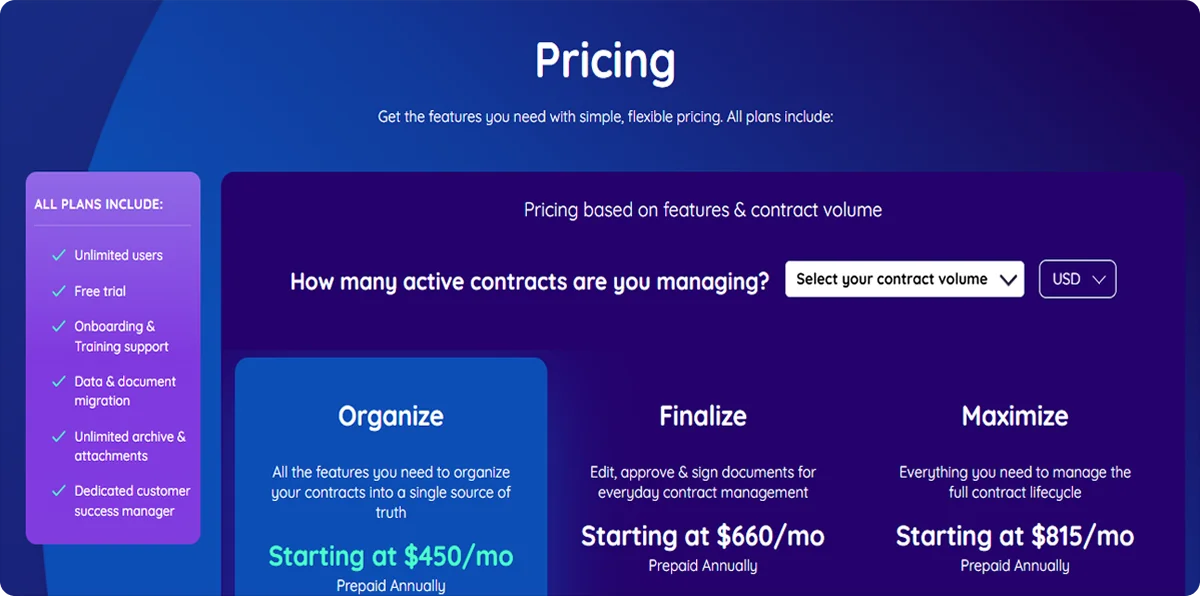
6. Concord: Best for budget-conscious startups that want full CLM without enterprise pricing
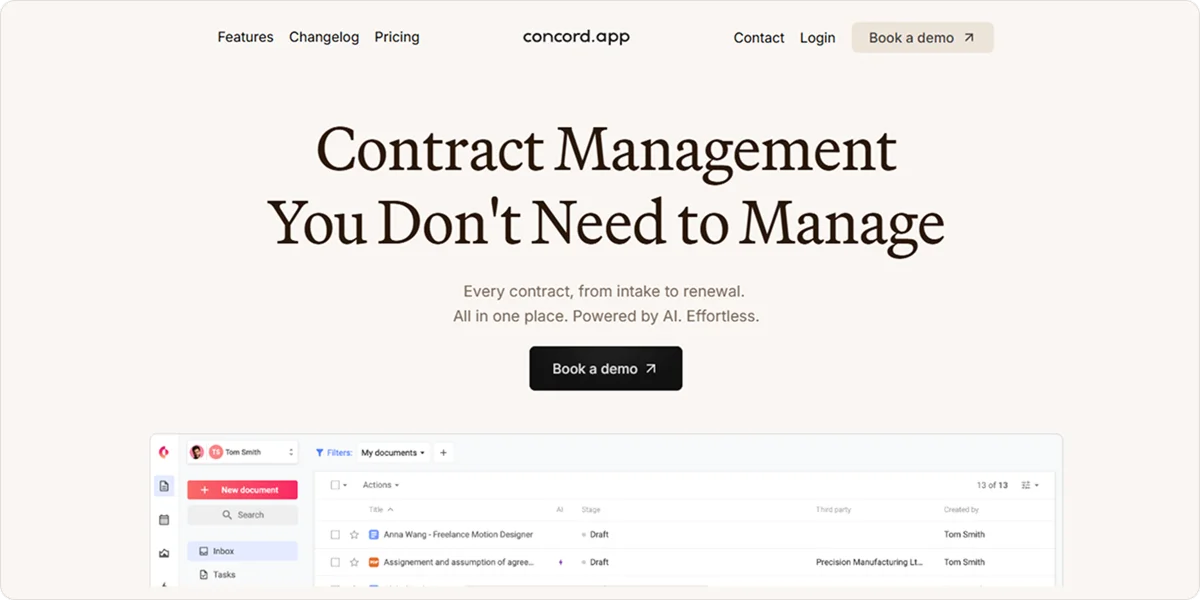
Concord is a CLM platform that brings drafting, negotiation, approvals, e-signatures, and contract storage into a single workspace.
Lean startups will get the most value from Concord because it delivers broad functionality at a cost that’s easier to justify early on. Teams can replace a patchwork of separate tools and manual processes with a single platform while avoiding the implementation burden and overhead that often come with larger systems.
Standout features
Concord emphasizes cross-functional collaboration and day-to-day usability, with capabilities including:
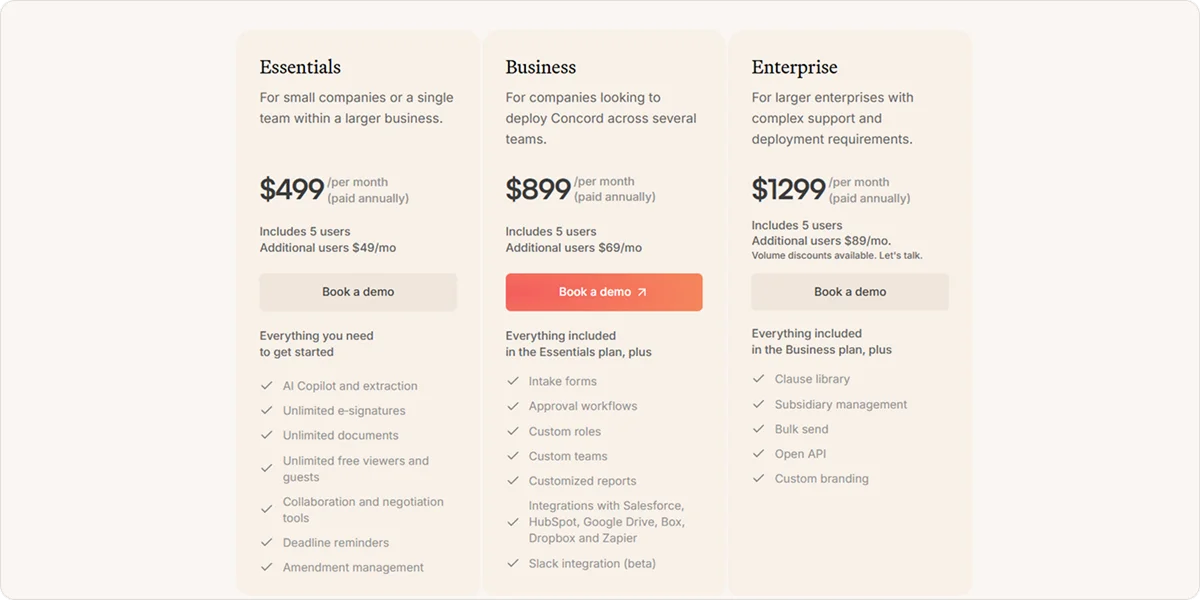
- Unlimited viewer access: Give stakeholders visibility into agreements without purchasing additional licenses for every employee who needs occasional access.
- Version history and audit trails: Track every edit, comment, and document revision to maintain accountability throughout the negotiation process.
- Live contract collaboration: Review, discuss, and revise agreements with internal teams and counterparties directly within a shared workspace.
Pricing
Concord publicly lists its subscription tiers, making it easier for startups to estimate costs before engaging with sales.
7. SpotDraft: Best for startups that need legal to support the business without becoming a bottleneck
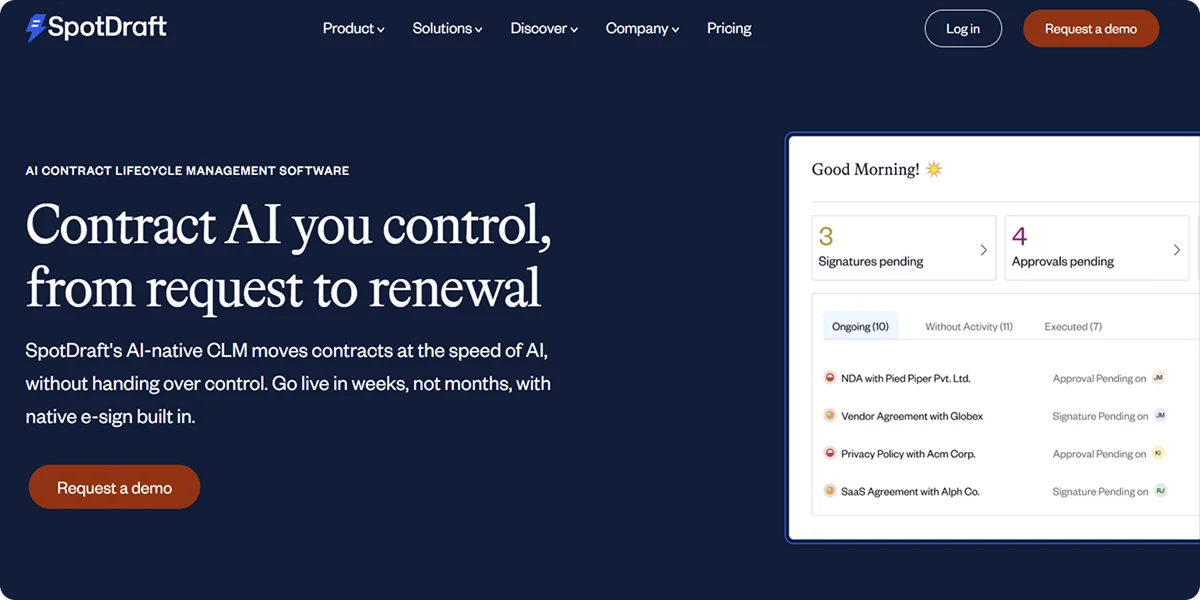
SpotDraft is an AI-powered CLM platform that combines contract creation, review, approval workflows, repository management, and legal operations tooling.
Startups with lean legal resources will benefit from SpotDraft because it helps distribute routine contract work across the business while maintaining consistent legal standards. Structured request flows, automated review processes, and standardized playbooks make it easier for legal teams to focus on higher-value work instead of repetitive administrative tasks.
Standout features
SpotDraft is geared toward operationalizing legal processes within the organization, with capabilities including:
- VerifAI contract review: Identify non-standard clauses and receive fallback language recommendations based on predefined legal playbooks.
- DraftMate AI: Convert existing Word agreements into reusable contract templates with automatically generated variables and fields.
- Smart data capture: Extract key contract terms and metadata from executed agreements to build a searchable, audit-ready repository.
Pricing
SpotDraft offers customized pricing based on factors like user counts or contract volume, with quotes provided through its sales team.
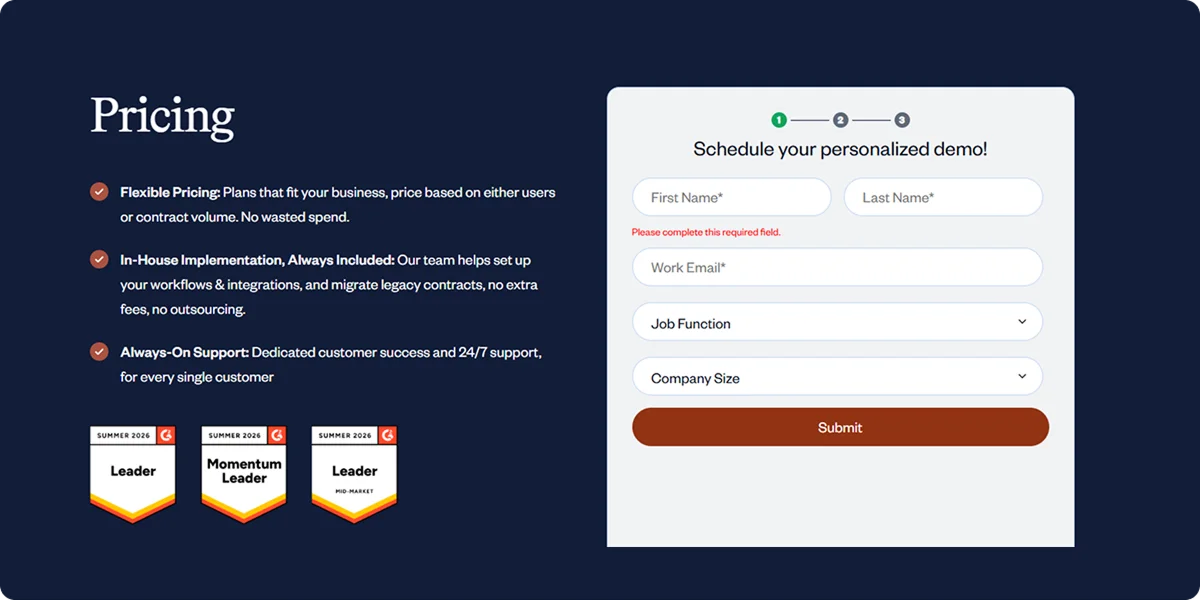
8. LinkSquares: Best for startups that need AI-powered visibility across hundreds of existing contracts
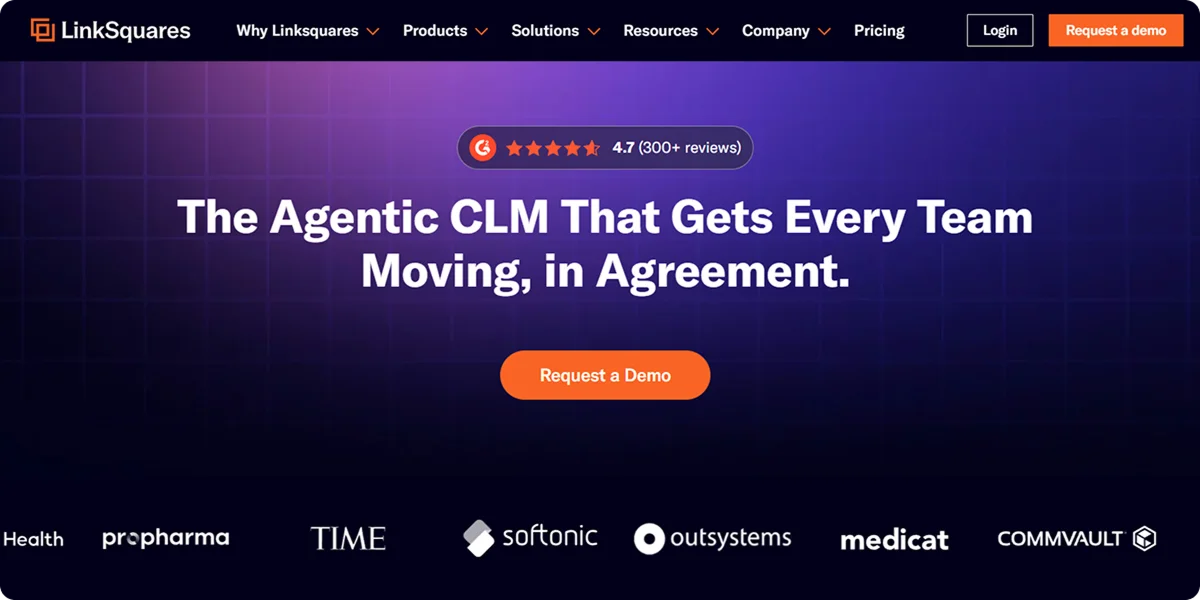
LinkSquares is an AI-driven CLM platform that allows companies to organize, analyze, and manage large contract portfolios.
It’s particularly well-suited for startups with expanding contract volumes because its AI can quickly surface the information hidden inside executed agreements. Rather than digging through folders, PDFs, and shared drives, teams can identify key obligations, renewal dates, risk areas, and business commitments across their entire contract portfolio in a fraction of the time.
Standout features
LinkSquares centers contract management around extracting actionable insights from legal data, offering tools like:
- Autonomous risk scoring: Flag potentially problematic clauses and prioritize agreements that require closer legal review.
- Agentic AI redlining: Generate proposed edits and contract revisions based on predefined legal standards and clause preferences.
- Smart tags and metadata extraction: Categorize agreements automatically and pull key contract details into a searchable database for faster reporting and due diligence.
Pricing
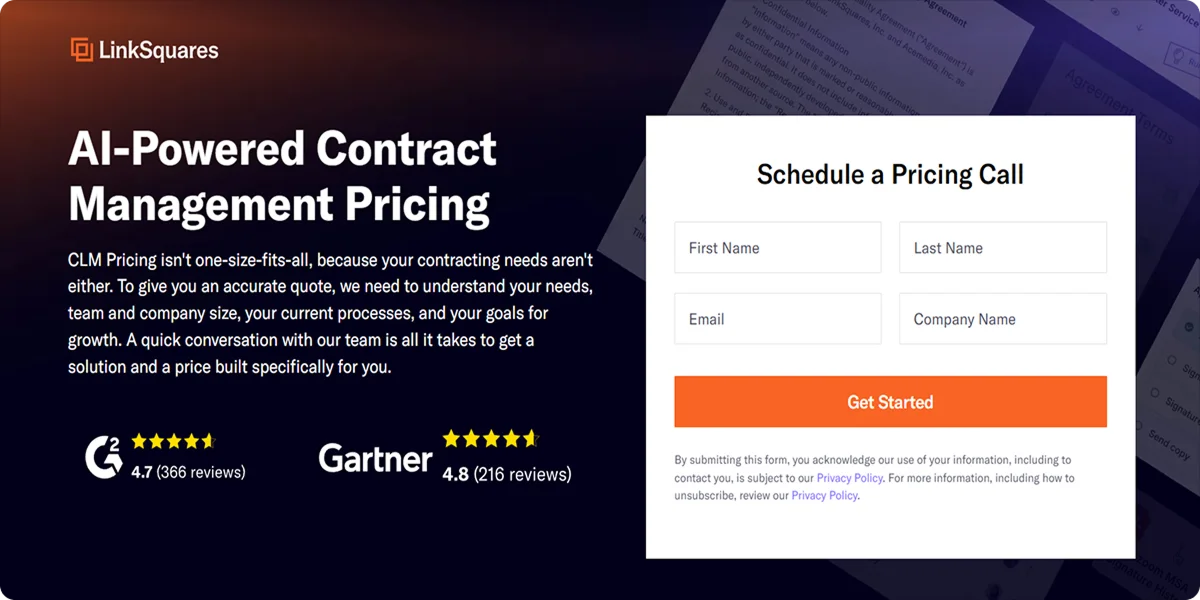
LinkSquares doesn’t publish standard pricing, instead providing customized proposals based on each company’s requirements and contract management needs.
What is the best startup tool for managing contracts?
The best startup tool for managing contracts mainly depends on your contract volume, internal legal resources, and the complexity of the agreements you’re signing.
For example, a Series A SaaS startup with a small legal or operations function may find a platform like Juro particularly useful. Its browser-based workflow, approval controls, and self-service capabilities help business teams generate routine agreements without creating constant legal bottlenecks.
On the other hand, a Series C company with multiple departments, complex approval chains, and growing compliance requirements may be better served by a platform like Ironclad. Its workflow automation, governance controls, and scalability are designed for organizations that are starting to operate more like enterprises.
However, for many startups, contract management software isn’t the biggest problem that needs solving.
Early-stage and growth-stage companies often struggle less with storing contracts and more with reviewing, negotiating, drafting, and turning them around quickly.
That’s why some startups choose not to invest in a contract management platform at all—at least initially. Instead, they partner with an external legal team that can handle the legal work while providing the speed and responsiveness needed to keep the business running efficiently.
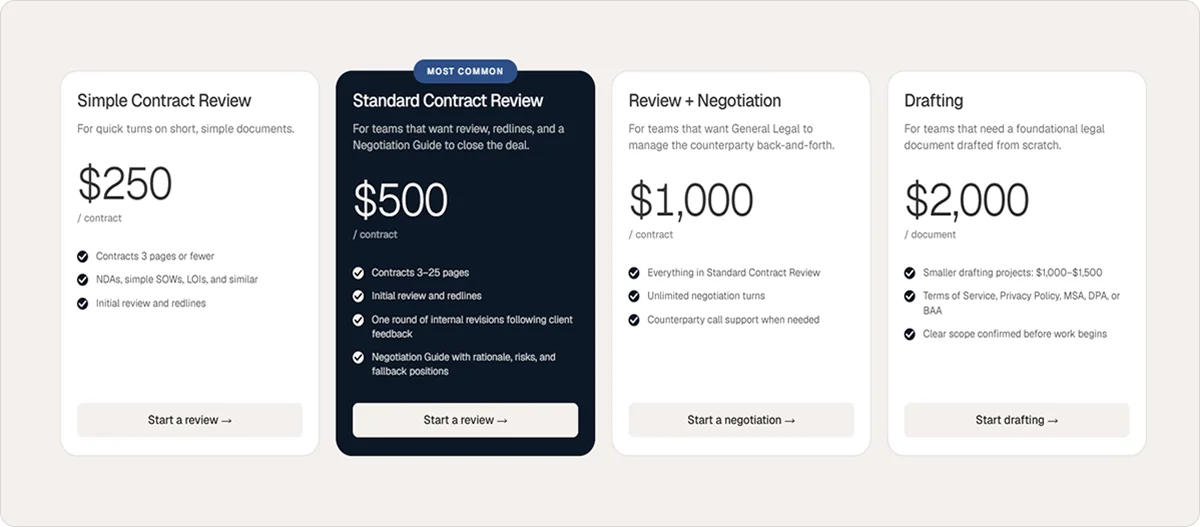
For those companies, an AI-native law firm like General Legal can be a practical alternative, combining attorney-led contract review, drafting, negotiation support, and fixed-fee pricing without requiring a complex software implementation.
When General Legal makes more sense than contract tools
Some of the best startup tools for managing contracts on this list now include useful AI capabilities. However, in most cases, those AI features are still layered on top of software that your team has to operate themselves.
The platform can summarize a contract, flag unusual language, or suggest edits; it can’t tell you whether a provision reflects standard market terms, how much leverage you have in a negotiation, or which risks are actually worth accepting.
For that reason, outsourcing contract work to General Legal may be a better fit for:
- Seed to Series B startups without in-house legal counsel
- Founders who are still reviewing contracts themselves
- B2B startups regularly negotiating customer and vendor agreements
- Teams that need legal support but can’t justify hiring a full-time General Counsel
- Companies that care more about getting contracts reviewed and negotiated than building a formal legal operations function
General Legal sits somewhere between traditional law firms and contract software.
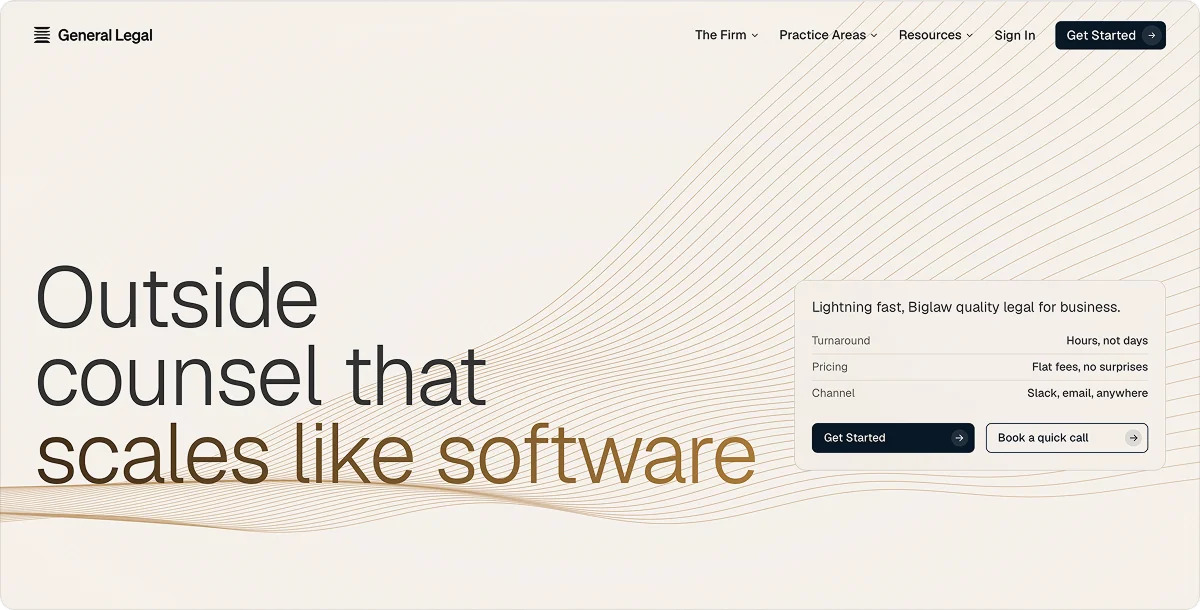
Unlike a software platform, you’re not buying a tool and figuring out the legal work yourself. Unlike a traditional law firm, you’re not waiting days for a response, navigating endless email threads, or worrying about billable-hour surprises. General Legal combines attorney-led legal advice with AI-powered workflows that accelerate review, drafting, and negotiation without removing lawyers from the process.
The workflow is intentionally simple.
You send a contract through Slack, email, or the client portal. General Legal’s AI performs the initial review, identifies issues, and prepares redlines. A US-barred attorney then reviews the document, applies legal judgment, aligns the recommendations with your business objectives, and delivers a contract you can rely on.
The result is the speed and efficiency startups expect from modern software combined with the legal expertise, accountability, and professional judgment that software alone can’t provide.
If your startup needs help reviewing, drafting, or negotiating contracts, create an account with General Legal online and get started immediately. Alternatively, contact our team directly to discuss your legal needs before submitting your first matter.
- A simple system of Docs, Drive, and a spreadsheet is fine for a handful of contracts, but cracks appear once volume grows across customers, vendors, and hiring agreements, given a standard contract lifecycle has over 40 friction points.
- Poor contract management carries real cost: organizations lose an average of 9% of annual revenue to it, and 71% of businesses can't locate at least 10% of their active contracts, per cited research.
- Tools were scored on independent user validation (30%), startup fit/ease of adoption (25%), lifecycle coverage (20%), intelligence/automation features (15%), and integrations/scalability (10%), covering PandaDoc, Juro, Ironclad, Contractbook, ContractSafe, Concord, SpotDraft, and LinkSquares.
- Each tool suits a different need: PandaDoc for sales-led proposal-to-contract workflows, Juro for business teams self-serving contracts, Ironclad for enterprise-grade governance at scale, ContractSafe for simple renewal and obligation tracking, and LinkSquares for AI-driven visibility across large existing portfolios.
- AI features embedded in these platforms can summarize and flag issues, but the article argues they can't reliably judge negotiation leverage, business risk, or true market-standard terms.
- For startups whose main problem is reviewing, drafting, and negotiating contracts rather than storing them, the article suggests an AI-native law firm like General Legal can be a more direct fit than adding contract management software.
| When you need a CMS | A handful of contracts can run on Docs, Drive, and a spreadsheet; more volume across customers, vendors, and hires exposes the 40+ friction points in a typical contract lifecycle. |
|---|---|
| The cost of poor management | Organizations lose an average of 9% of annual revenue to poor contract management, and 71% of businesses can't locate at least 10% of their active contracts. |
| Evaluation method | Tools were scored on independent user reviews (30%), startup fit/adoption ease (25%), lifecycle coverage (20%), intelligence/automation (15%), and integrations/scalability (10%). |
| Sales-workflow pick | PandaDoc, for turning CRM-driven proposals into signed contracts with built-in payment collection. |
| Self-serve and enterprise picks | Juro lets non-legal teams draft, negotiate, and sign within guardrails; Ironclad adds no-code approval routing and clickwrap management as companies grow. |
| Repository/visibility picks | ContractSafe for small teams tracking renewals, and LinkSquares for AI-driven visibility across large existing contract portfolios. |
| The limits of software | These tools can summarize and flag contract issues, but per the article they can't assess negotiation leverage, real business risk, or true market-standard terms, which is where the article positions General Legal's attorney-led model as an alternative. |
Is contract management software the same as CRM software?
No. Contract lifecycle management (CLM) software manages contracts, while customer relationship management (CRM) software manages customer and sales relationships.
When does a startup actually need dedicated contract management software?
Once contract volume grows beyond a handful of agreements; a standard contract lifecycle has over 40 friction points where delays, missed handoffs, and poor visibility can create risk.
What's the biggest limitation of AI features built into contract management tools?
They can summarize a contract or flag unusual language, but per the article they can't reliably assess whether a provision reflects market terms, how much negotiating leverage you have, or which risks are worth accepting.
Which tool is best for a startup with a small legal team that wants business teams to self-serve?
Juro, per the article, because its browser-native workflow and approval guardrails let non-legal teams generate compliant agreements without constant legal bottlenecks.
When might an AI-native law firm be a better fit than contract software?
When the startup's real problem is reviewing, drafting, and negotiating contracts rather than storing them; the article positions General Legal as a fit for Seed-to-Series B startups without in-house counsel in that situation.
Is CLM the same as CRM?
No. Contract lifecycle management (CLM) software manages contracts, while customer relationship management (CRM) software manages customer and sales relationships.
What is the best contract management software?
The best contract management software depends on your contract volume, legal resources, and business needs, but Juro, Ironclad, and PandaDoc are among the strongest options for startups.
Which AI tool is best for contracts?
There’s no single best AI tool for contracts. The right choice depends on whether you need contract review, contract management, drafting, or negotiation support. In some cases, an AI-native law firm like General Legal may be a better fit than software alone.
- 6 Best Harvey Alternatives for Law Firms [2026 Comparison]Explore the best Harvey alternatives so you can compare legal AI tools by cost, features, workflows, and ease of adoption.
- 7 Leading Contract Automation Tools for Legal Teams in 2026Discover leading contract automation tools for legal teams so you can compare features, workflows & solutions that fit your needs.
- 9 Best Legal Tech Companies for Contract Solutions [Comparison]Discover the best legal tech companies for contract solutions so you can compare features, workflows, and services.