
A redline is a list of decisions in an arbitrary order. It runs clause by clause, the way lawyers draft. Meanwhile, founders have business priorities in mind: what does this cost me, and do I sign?
A typical enterprise markup carries 30 to 60 changes. Most of them are clean-ups, cross-references and wording a customer's counsel needed to see. Usually, about three of them affect cost or risk. A good lawyer finds those three. A better one presents them clearly so the client can decide in two minutes rather than spending an evening sifting through issues.
Our Explainers present those three key decisions in an accessible way.
What is an Explainer?
An Explainer is a single page that, from a piece of legal work, consolidates the decisions a client must make. We also use them to walk clients through template refreshes and security-term alignment, but they are most useful for counterpositions. In that use case, an explainer flags the deal’s top three issues, ranked by their importance to the business. Each issue then covers the following four elements.
- The ask and the counter in one sentence. "They asked for 12 months at usage fees. We set 90 days at regular fees."
- A position line. The line plots our preferred position, our counter, your prior deals and the counterparty's ask on one scale. You see how far we moved and how far the counterparty wants us to go, before reading a word of analysis.
- Commercial impact. One or two sentences explain the impact in business terms.
- In practice. A worked example with realistic numbers shows what would happen under this contract, at this price, if the clause is ever triggered.
Everything else in the markup still gets a short margin note to the counterparty. The Explainer is for our client, specifically the person approving the deal.
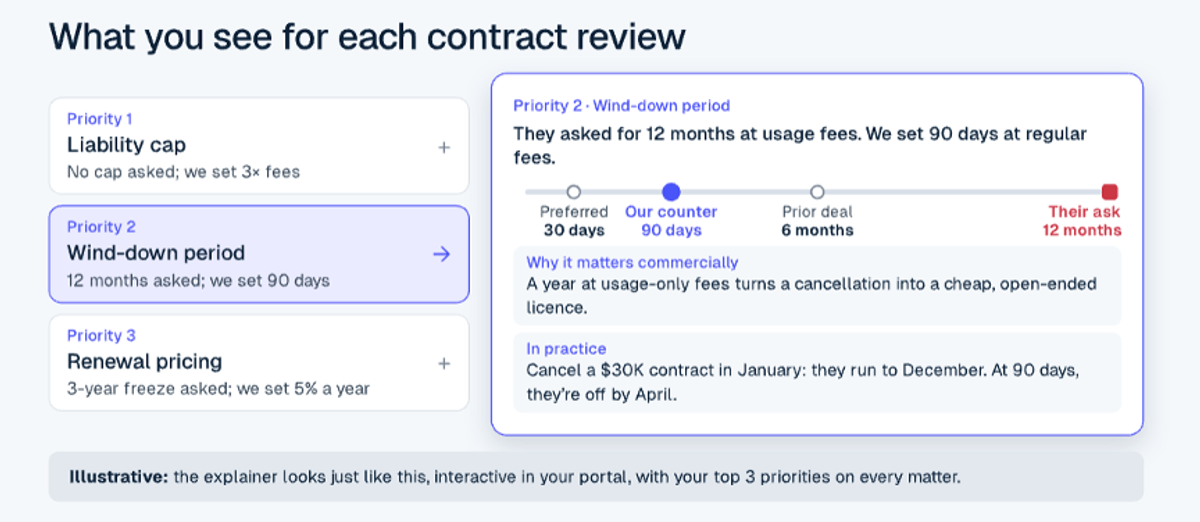
Figure 1: An Explainer in the counterpositions use case. Three ranked issues on the left; the open issue shows the counter on a line against the preferred position, a prior deal and the counterparty's ask.
One worked example: a liability cap, round two
This example is illustrative; every term and figure below is invented.
Picture a SaaS company, our client, selling to a customer ten times its size. The buyer’s procurement team sends back a markup with forty changes. Three of them affect cost or risk:
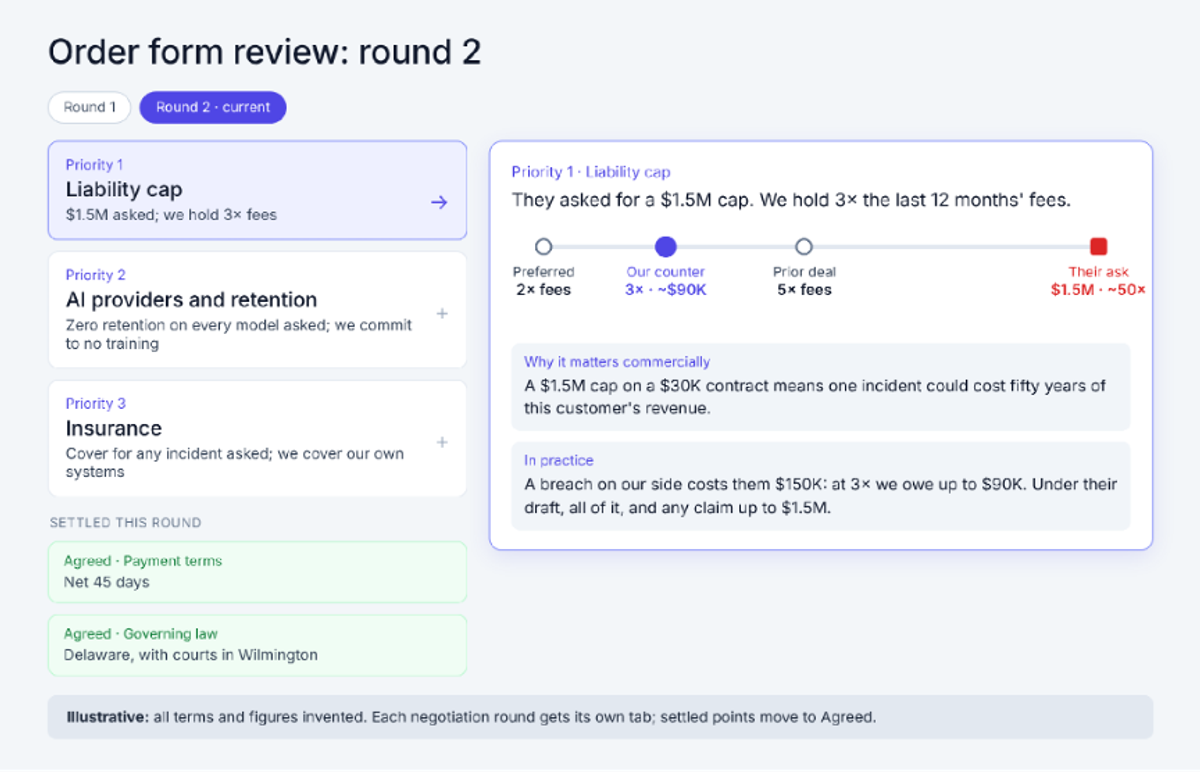
Figure 2: Round two of an illustrative Explainer. The liability cap is open; two settled points sit below as Agreed.
Much of the deal’s risk lies in the liability cap. On the position line, our counter sits at 3x the annual fee, our client’s last comparable deal at 5x and the customer's ask far to the right, at roughly 50x the annual fee. The "in practice" box then applies the arithmetic: if our client causes a $150K breach, they pay up to $90K under our counter and the full $150K, as well as any other claim up to $1.5M under the buyer's draft. With both figures side by side, a founder can decide at a glance.
Because negotiations rarely end in one round, the Explainer covers every round, neatly categorized with its own tab. Open issues stay on top; newly settled points move below, marked in green as "Agreed." A founder who opens round three sees the issues still open without rereading the whole history.
Example 2: a renewal, with the company's own history
This example is also illustrative; every term and figure below is invented.
The second example is a renewal. The customer wants uncapped liability for data and content claims, the right to resell and automatic renewal removed. The Explainer ranks the three asks:
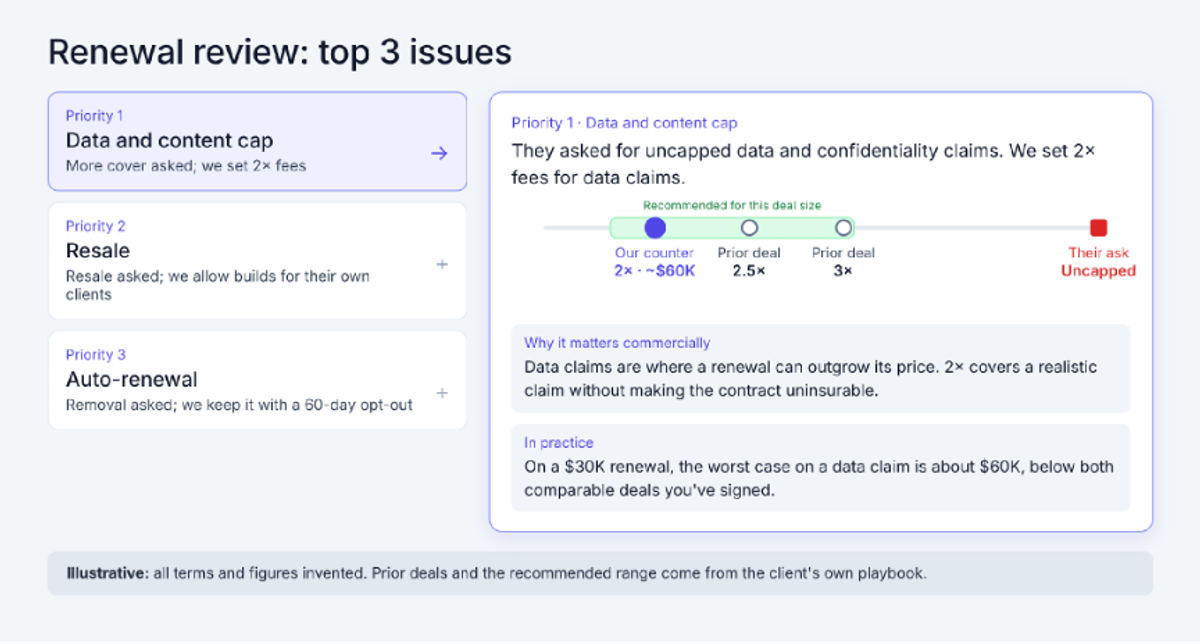
Figure 3: An illustrated renewal cap. The counter sits inside the recommended range for the deal size, beside two prior deals and the customer's ask.
This time, the liability cap comes with more context. Alongside the ask and the counter, it plots two comparable deals the company has already signed and shades the range we recommend for a deal this size in green. The counter sits inside the recommended range and below both prior deals.
Without the explainer, a founder would have to rebuild the comparison with prior deals from memory or a spreadsheet.
What changes when the decision is this clear
- Approvals come back in one reply. When the trade-off is laid out, the answer is "approved" or a one-line correction, not a call.
- The Explainer is easy to share. Because it is a link, a co-founder or sales lead who was not on the deal can catch up in two minutes.
- Follow-up questions focus on strategy. Because the explainer covers what each clause means, clients can spend their questions on strategy, which is the best use of a lawyer's time.
How we strive for clarity
We treat clarity as a set of constraints that we apply to every review.
- Three issues, ranked. Each Explainer covers three issues, ranked by what they cost the business. Many memos skip ranking because it’s the hardest part of the review, however it is very important information for a company’s leaders.
- The same shape every time. Each issue contains the ask and counter in one sentence, the position line, the commercial impact, and a worked example. By the second Explainer, a client knows where to look.
- Position as a picture. The line shows our preferred position, our counter, the prior deal and the counterparty's ask on one scale. A reader can judge the distance between positions faster visually than in prose.
- Your history, not the market's. We build each client a playbook from its templates, its recent deals and their sizes, and we update it as each deal closes. The playbook supplies the "Prior deal" marker and the green recommended range on the line. Market data is useful, but your own last deal is the more relevant benchmark.
- Business words, realistic numbers. Explainers use business terms and no clause numbers. A line such as "If you cancel this $30K contract in January, it still runs to December" tells a founder more than a paragraph on termination mechanics.
- One tab per round. Open issues appear on top and settled points appear below as Agreed. A reader in round three does not need to reread issues resolved in prior rounds.
- A cover note that ends in recommendations. The note covers what we accepted that you should know about, where you can concede if the counterparty pushes back and two or three recommendations that need only a "confirmed" or a correction. It also states any assumptions we made so you can catch them before the markup goes out.
We still annotate every change in the redline with a short note to the counterparty explaining our position. The Explainer sits on top of the redline and is written for the person who ultimately signs.
Getting to yes faster
A founder's attention is one of the scarcest resources in a deal. Every hour spent decoding a redline is an hour not spent closing the next one. In the counterpositions use case, Explainers turn a markup into three decisions, each with the context needed to move quickly.
If you're a General Legal client, you'll see an Explainer on your next commercial review, interactive in your portal, with your top three priorities on every matter. If you are not a client yet, talk to us and send over a contract that's been sitting in your inbox.
- AI in corporate law in 2026: Use cases & key benefitsExplore how AI in corporate law helps you streamline contracts, manage legal risks, improve compliance, and make better business decisions.
- Contract review automation: Top benefits & Use casesA deep dive into how General Legal automates contract review
- Contract Review & the AI-Native ModelEarly clients of General Legal find our contract review service "magical". Founders and operators get sales contracts...