
Eudia AI won over major clients like Graybar and Duracell by keeping lawyers in Word and Outlook, applying company-approved positions automatically, and eliminating repetitive contract work at scale. Graybar reported completing due diligence 98% faster while Duracell cut contracting costs by 50% after eliminating hourly billing.
But although Eudia was one of the pioneers in the space, legal AI didn’t stop with Eudia.
According to Bloomberg Law, every surveyed firm with more than 500 attorneys reported using legal-specific AI tools in 2025—a sign of just how quickly adoption of generative AI for law firms has gone mainstream.
This means that Eudia now has real competition, including in the exact spots where it’s weakest:
- Opaque, top-down enterprise pricing with zero self-serve option
- A model that can struggle with the chaos of external M&A outside your own playbook
- A price tag that puts it out of reach for anyone who isn’t running a Fortune 500 legal department
If you’re evaluating Eudia AI alternatives, this guide breaks down the top seven options, pointing out where they outperform Eudia and which teams they’re best suited for.
An overview of the 7 best Eudia AI alternatives
| Alternative | Deployment model | Ratings | Best for |
|---|---|---|---|
| 1. Harvey | Enterprise SaaS | 4.6/5 on Gartner 4.8/5 on G2 | Am Law firms and enterprise legal operations |
| 2. CoCounsel | Cloud SaaS | 4/5 on Gartner 4.8/5 on G2 | In-house teams needing authoritative legal research |
| 3. Spellbook | Microsoft Word add-in | 4.7/5 on G2 | Contract lawyers drafting and negotiating agreements |
| 4. Eigent AI | Self-hosted open source | N/A | Security-conscious enterprises requiring self-hosted AI |
| 5. Kira Systems | Enterprise SaaS | N/A | Corporate M&A teams reviewing large contract portfolios |
| 6. Luminance | Enterprise SaaS | 4.9/5 on Gartner 4.7/5 on G2 | Enterprises managing high-volume contract workflows |
| 7. iManage Work | Cloud or on-premises DMS | 4.4/5 on Gartner 4.4/5 on G2 | Large firms centralizing legal knowledge and documents |
Ratings are based on publicly available review platforms at the time of publication and should be treated as a point-in-time snapshot rather than a definitive measure of product quality.
Alternative #1: Harvey

Harvey is one of the most widely adopted legal AI products on the market, serving over 142,000 professionals across more than 1,500 law firms and in-house legal teams worldwide.
It’s also used by more than 75 Am Law 100 firms, making it one of the most established legal AI vendors in the enterprise market.
Harvey is particularly well-suited for these major law firms because it was designed for high-volume legal work at scale, combining legal research, drafting, due diligence, and collaboration workflows into a single platform that can support hundreds or even thousands of legal professionals simultaneously.
Why choose Harvey as an Eudia AI alternative
Harvey outperforms Eudia in several areas.
Its Harvey Vault product can analyze up to 10,000 documents simultaneously during large M&A transactions, making it a stronger choice for large-scale due diligence projects. It also offers deeper legal research capabilities through partnerships with providers like LexisNexis, giving users access to case law, regulations, and legal authorities across multiple jurisdictions.
This makes it a strong Eudia AI alternative for law firms, transaction-heavy legal teams, and organizations that prioritize legal research, due diligence, and cross-border legal work over company-specific knowledge management.
That said, Eudia remains a better fit for in-house legal departments looking to operationalize institutional knowledge, enforce internal playbooks at scale, and combine AI workflows with human legal services under a single platform.
In addition, Harvey is also known for high pricing, enterprise seat minimums, and lengthy implementations, so it isn’t the right alternative if your biggest issue with Eudia is cost or procurement friction.
Alternative #2: CoCounsel
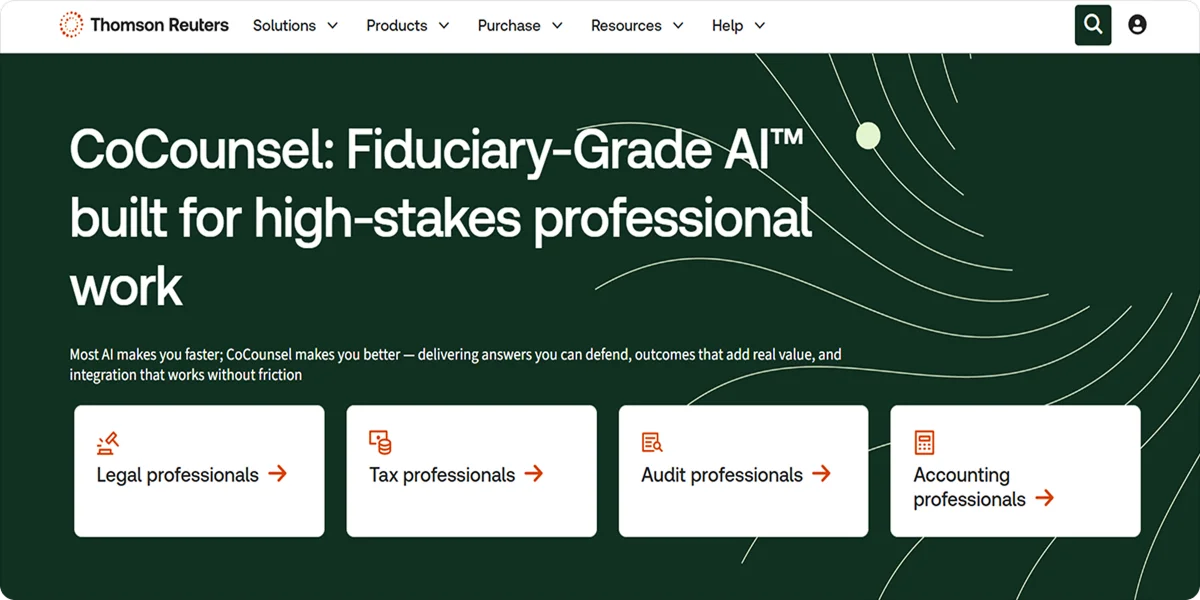
CoCounsel is Thomson Reuters’ AI legal assistant, built on top of the same legal content ecosystem that powers Westlaw and Practical Law. More than one million users rely on the platform, which is designed around Thomson Reuters’ Fiduciary Grade AI framework—a model focused on verifiable outputs, authoritative legal sources, and the security standards required in regulated professions.
Why choose CoCounsel as an Eudia AI alternative
The biggest advantage CoCounsel has over Eudia is its access to Thomson Reuters’ legal research ecosystem. While Eudia is optimized around a company’s internal documents and playbooks, CoCounsel can search millions of court opinions, statutes, regulations, and secondary sources, producing research-backed answers with traceable citations.
As a result, CoCounsel is often the better choice for litigation teams, highly regulated industries, and legal departments whose work revolves around finding, validating, and applying legal authority.
If your lawyers spend more time researching statutes, reviewing case law, drafting memoranda, or responding to regulatory questions than managing large-scale contracting workflows, you’ll likely get more value from CoCounsel’s research stack than from Eudia’s broader operational approach.
However, teams that don’t already rely on Westlaw or Practical Law may find the economics less compelling since much of CoCounsel’s value comes from its deep integration with the Thomson Reuters ecosystem.
Alternative #3: Spellbook
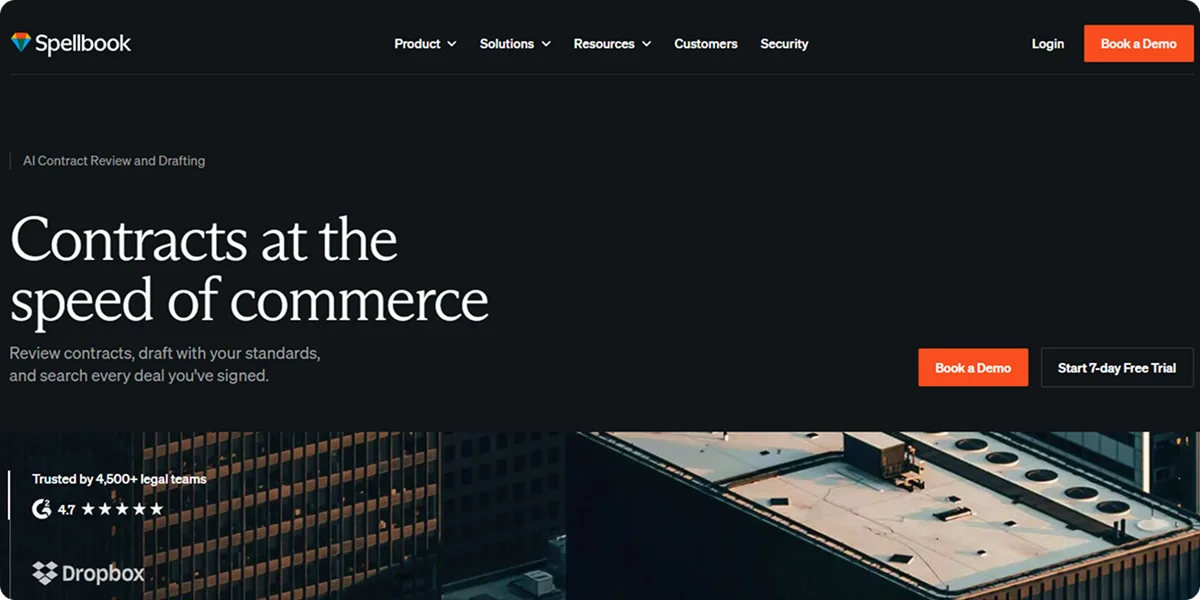
Spellbook is a contract-focused AI assistant that works directly inside Microsoft Word, helping lawyers draft, review, redline, and negotiate agreements without leaving their existing workflow. The platform is trusted by more than 4,500 law firms and in-house legal teams across over 80 countries, making it one of the most widely adopted AI tools for transactional legal work.
Unlike broader legal AI platforms that attempt to centralize legal operations across an organization, Spellbook is designed around a much narrower goal: helping lawyers work faster inside the contracts they’re actively handling.
Why choose Spellbook as an Eudia AI alternative
Spellbook’s biggest advantage is simplicity. Because it lives inside Microsoft Word, lawyers can start using it immediately without lengthy implementations, training programs, or workflow redesigns. This makes it particularly appealing for smaller legal teams, boutique firms, and transactional attorneys who want practical drafting assistance rather than a large-scale legal operations platform.
The platform also excels at clause-level work. Whether you’re drafting a new provision, evaluating proposed redlines, or looking for alternative language during negotiations, Spellbook can provide suggestions directly within the document.
Its ability to learn from saved precedents and drafting preferences is another advantage for lawyers who want AI assistance tailored to their personal drafting style.
However, this also means that teams looking for enterprise-wide workflow automation, large-scale document analysis, or complex legal research will likely find Spellbook too specialized.
Alternative #4: Eigent AI
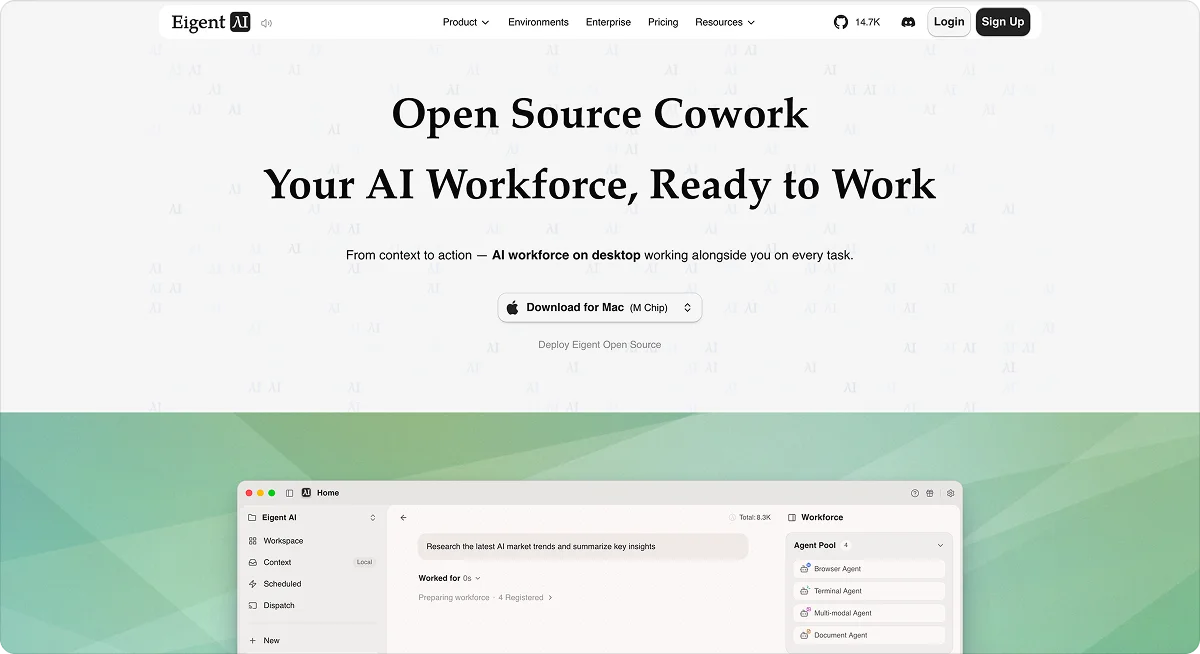
Eigent AI is an open-source AI agent platform that automates complex workflows through teams of specialized agents capable of researching information, analyzing documents, browsing the web, writing code, and executing tasks in parallel.
The company claims its multi-agent architecture can reduce up to 500 hours of work to roughly 50 minutes while allowing a single user to handle workloads traditionally spread across entire teams.
Because it can be self-hosted, supports both commercial and open-source models, and gives organizations complete control over where their data is stored and processed, Eigent is particularly well-suited for security-conscious enterprises that can’t rely on vendor-managed AI infrastructure.
Why choose Eigent AI as an Eudia AI alternative
Ownership is the main reason teams choose Eigent over Eudia.
Rather than committing to a managed platform with vendor-controlled infrastructure, organizations can deploy Eigent on their own systems, select the models they want to use, and connect agents directly to internal tools and data sources. This level of control is especially valuable for enterprises with strict security, compliance, or data residency requirements.
Eigent also takes a dramatically different approach to pricing. It offers a free tier, transparent pricing, and self-serve access. Teams can start testing workflows immediately instead of navigating procurement reviews and implementation projects before seeing value.
The tradeoff is that Eigent requires significantly more technical ownership. Configuration, integrations, governance, and ongoing maintenance remain the responsibility of the organization, making it a better fit for technically sophisticated teams than legal departments looking for a fully managed solution.
Alternative #5: Kira
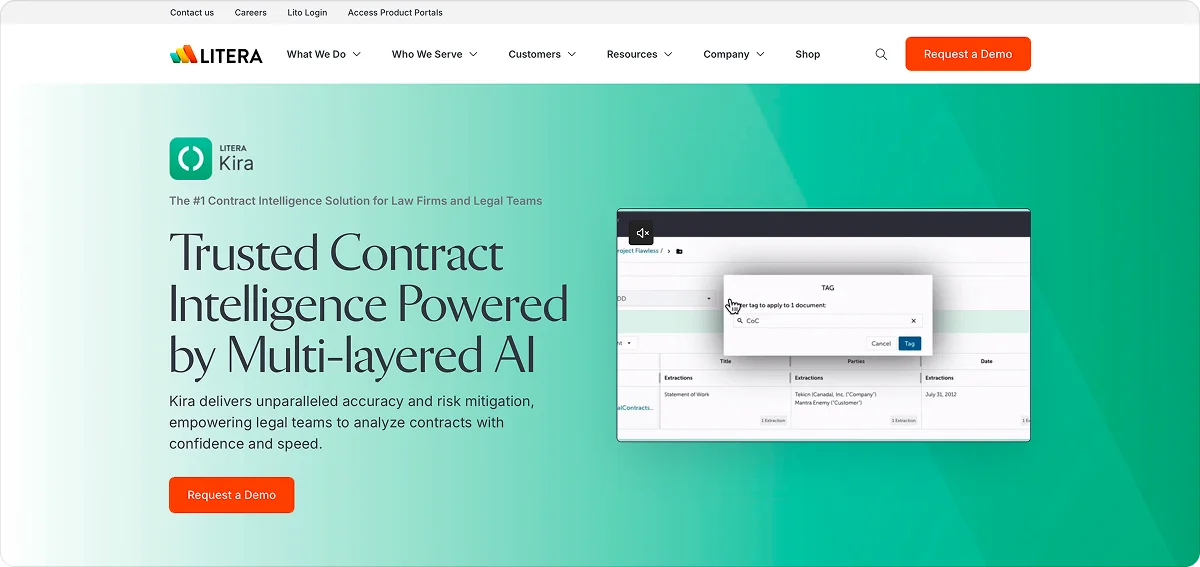
Kira is one of the most established contract intelligence platforms in the legal industry. Trusted by 70% of the world’s top 50 law firms, including four of the UK’s Magic Circle firms, Kira has spent more than a decade refining its AI models for legal document review.
This focus on accuracy has made Kira a staple of high-stakes transactional work.
Its multi-layer AI architecture combines generative AI with proprietary models trained on more than 45,000 lawyer hours, enabling legal teams to identify key clauses, assess risk, and review thousands of agreements with a level of precision that has made it a standard tool in corporate M&A and due diligence workflows.
Why choose Kira as an Eudia AI alternative
Kira’s main strength is scale.
When legal teams need to review thousands of contracts during an acquisition, divestiture, financing, or corporate restructuring, speed matters, but consistency matters even more.
Kira was built specifically for these scenarios, with pre-trained models capable of extracting hundreds of contract provisions across large document sets and turning unstructured agreements into structured data that can be analyzed, reported on, and shared across deal teams.
The platform is also particularly effective when dealing with legacy contracts. Strong OCR capabilities, detailed audit trails, and highly traceable extraction results make it well-suited for situations where legal teams need defensible outputs rather than conversational AI assistance.
For organizations evaluating Eudia alternatives, Kira is the better choice when the primary challenge is understanding what’s buried inside thousands of existing agreements.
The limitation is that Kira remains highly focused on analysis. Teams looking for AI-powered drafting, negotiation support, or day-to-day legal workflow assistance may find it too narrow, particularly outside major transaction and due diligence projects.
Alternative #6: Luminance
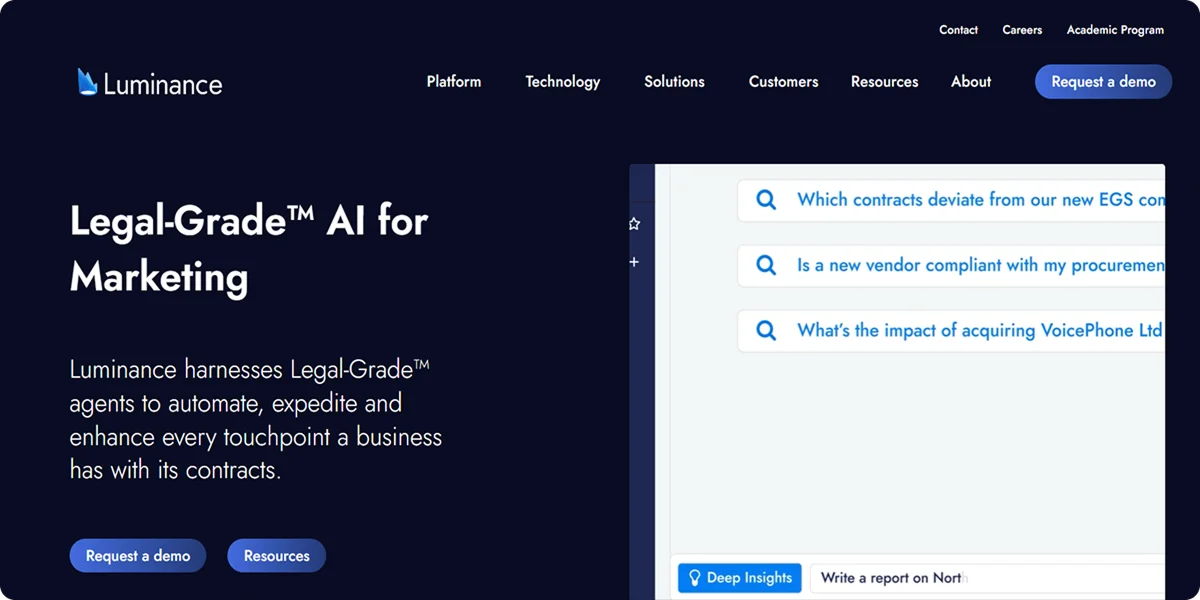
Luminance is an AI-powered contract lifecycle management platform that allows legal teams to review, negotiate, analyze, and manage contracts throughout their entire lifecycle.
Built by Cambridge mathematicians and adopted by many of the world’s largest enterprises, the platform combines contract intelligence, due diligence, compliance monitoring, and automated negotiation within a single system.
Its focus on high-volume legal work has delivered significant efficiency gains for customers, including 99% faster responses to business queries, 80-page master service agreements reviewed in under five minutes, and more than 500 hours saved on contract generation. These capabilities have made Luminance particularly popular among contract-heavy businesses.
Why choose Luminance as an Eudia AI alternative
Luminance is built around the idea that much of legal work can be automated before a lawyer ever touches the document.
Its strongest differentiator is contract review automation. The platform can review incoming agreements, compare them against approved positions, generate redlines, identify risks, and support negotiation workflows across large contract portfolios. For organizations processing hundreds or thousands of agreements each year, these efficiencies can create a meaningful operational advantage.
Luminance is also one of the few alternatives that competes with Eudia on institutional intelligence. Its contract analysis engine continuously learns from prior agreements, negotiation history, and approved language, helping legal teams maintain consistency across large-scale contracting operations.
The downside is that some of the same frustrations buyers have with Eudia still apply here.
Luminance is an enterprise platform with a substantial implementation process, sales-led procurement, and pricing that is difficult to justify for smaller teams. Companies looking for a lightweight, self-serve solution may find themselves trading one enterprise commitment for another.
Alternative #7: iManage Work
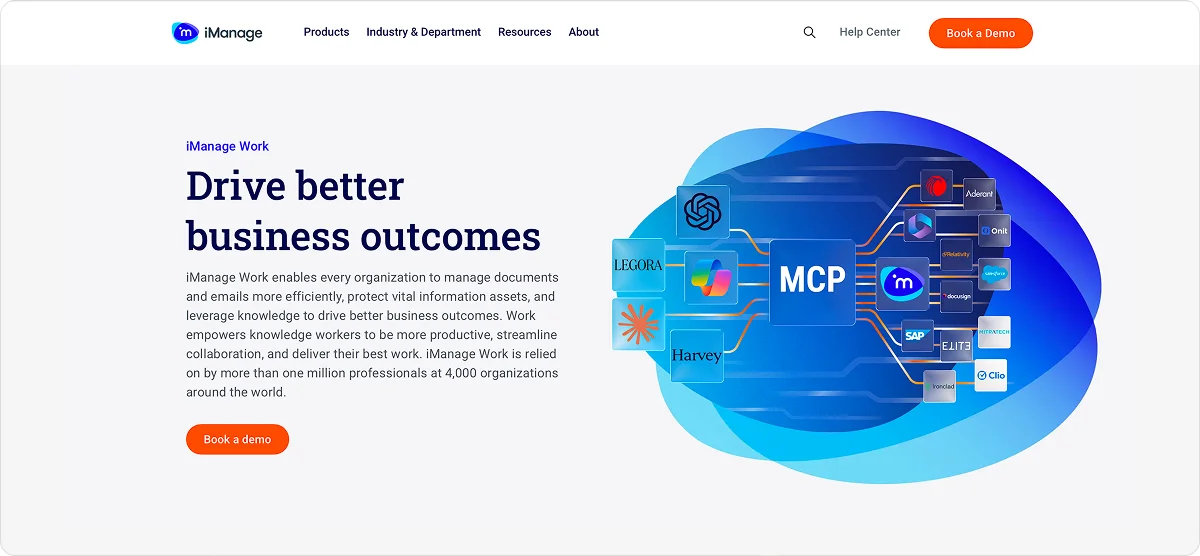
iManage Work is a document and email management platform designed to help organizations store, organize, secure, and retrieve institutional knowledge at scale.
Used by more than one million professionals across 4,000 organizations worldwide, it serves as the system of record for many of the world’s largest law firms and corporate legal departments.
In recent years, the company has expanded beyond traditional document management by introducing AI-powered capabilities, allowing users to search, summarize, analyze, and extract insights from their document repositories.
This combination of knowledge management and AI-powered search makes iManage particularly valuable for companies that manage large volumes of documents and emails and need a reliable way to surface information across years of institutional history.
Why choose iManage Work as an Eudia AI alternative
For many organizations, Eudia’s centralized Company Brain is the reason they adopted the platform. If you appreciate the idea of having institutional knowledge available on demand but want that intelligence built directly into the system where your documents and emails already live, iManage is one of the strongest alternatives available.
Governance is another major differentiator. Features like permission-aware search, audit trails, threat monitoring, and native OCR capabilities make iManage especially attractive to large enterprises with strict compliance and information governance requirements.
However, this also means that iManage solves a different problem than most legal AI platforms.
While it has added AI-powered search and analysis, its core strength remains document management rather than workflow automation. Plus, organizations hoping to escape long implementations, enterprise procurement cycles, or complex deployments may find that iManage introduces many of the same operational challenges they were trying to avoid in the first place.
What is the best Eudia AI alternative for your organization?
The best Eudia AI alternative depends on what’s leading you to evaluate other options.
If Eudia simply feels too large, expensive, or enterprise-focused for your needs, a more lightweight platform like Spellbook can deliver many of the same contract review and drafting capabilities without the lengthy implementation process, custom pricing discussions, or procurement overhead.
Similarly, if Eudia’s focus on internal legal operations has left you needing deeper legal research, litigation support, or citation-backed analysis, platforms like Harvey or CoCounsel may be a better fit. Both are designed around external legal work and authoritative legal content instead of operationalizing company-specific workflows.
If, however, you’re less interested in replacing Eudia’s software and more interested in replicating its broader operating model, the conversation changes.
Unlike most legal AI vendors, Eudia doesn’t just sell software. Through Eudia Counsel, the company also operates an AI-native law firm under Arizona’s Alternative Business Structure (ABS) framework, combining AI-powered workflows with legal service delivery under a single model.
If your goal is to pair AI-native technology with experienced legal operators who can actually help execute the work, General Legal is the closest alternative.
When General Legal is the best Eudia AI alternative
Most Eudia alternatives force a tradeoff. You can get better legal research with Harvey or CoCounsel, lower costs and self-serve access with Spellbook or Eigent, and stronger contract intelligence with Kira or Luminance.
What you typically can’t get is all of those advantages at once.
General Legal was built around a different premise. Clients get legal work completed accurately, quickly, and at a predictable cost.
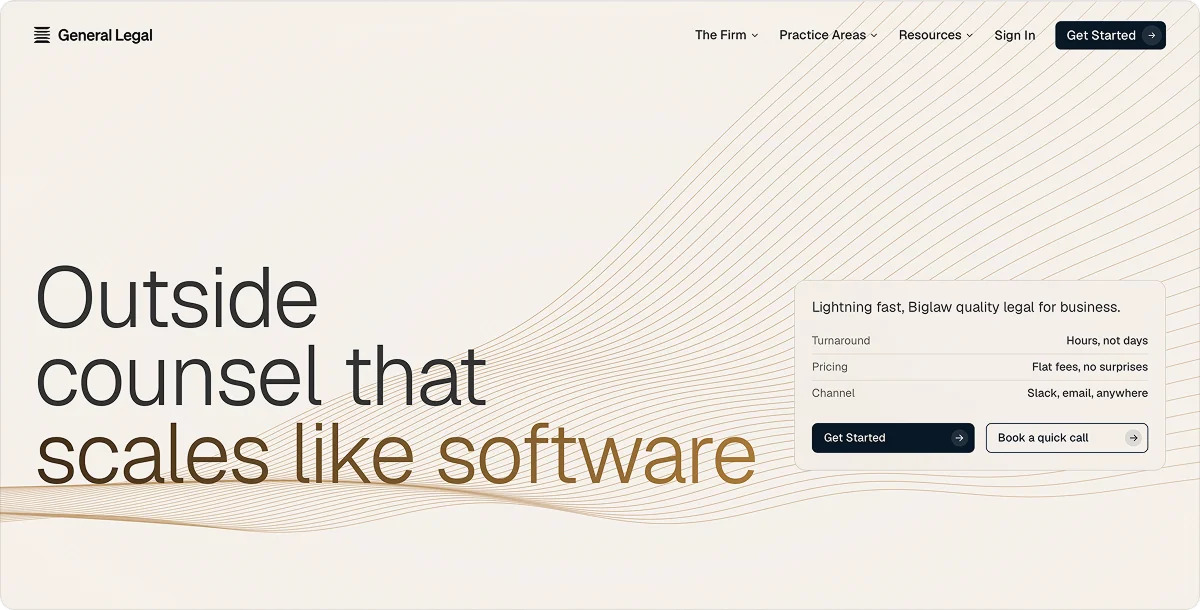
Instead of selling another platform that legal teams have to purchase, implement, learn, and manage, General Legal combines AI-native workflows with experienced attorneys who are responsible for the final work product.
There are no:
- Enterprise software implementations
- Multi-month onboarding projects
- Seat minimums
- Opaque enterprise pricing conversations before you can get value
Clients just need to send work through Slack, email, or the client portal, and they’ll receive a flat-fee quote with a defined turnaround time.
The economics are also fundamentally different.
While most legal AI vendors bill companies for access to software, General Legal charges for outcomes. AI handles the repetitive parts of legal work, allowing attorneys to focus on judgment, strategy, and risk assessment. The result is contract reviews delivered in hours rather than days, with pricing that is often closer to a SaaS subscription than a traditional law firm engagement.
Most importantly, General Legal avoids the major gap that exists in nearly every legal AI platform.
Software can identify issues, suggest edits, and surface risks. A competent person still has to decide what matters, determine negotiating strategy, and ultimately stand behind the advice. General Legal’s attorneys remain accountable for that final layer of judgment, giving clients both the speed of AI and the professional responsibility of a law firm.
Ready to get started?
Create your account online and start sending contracts today. There are no commitments, retainers, or upfront fees. If you’d like to learn more first, book a 10-minute intro session to see whether General Legal is the right fit for your team.
- Eudia won major clients like Graybar and Duracell by keeping lawyers in Word and Outlook and automating repetitive contract work, but its opaque enterprise pricing and Fortune 500-oriented model leave it out of reach for many teams.
- The best Eudia alternative depends on use case: Spellbook fits teams wanting simplicity, Harvey and CoCounsel fit legal research needs, and Kira and Luminance fit large-scale contract analysis.
- Harvey serves 142,000+ professionals across 1,500+ firms and can analyze up to 10,000 documents at once through Harvey Vault, but carries high pricing and lengthy implementations.
- CoCounsel's edge is Thomson Reuters' legal research ecosystem (Westlaw, Practical Law), making it strongest for litigation teams and regulated industries rather than internal operations.
- Spellbook lives inside Microsoft Word and is used by 4,500+ firms, offering fast adoption for smaller and transactional teams, though it's too specialized for enterprise-wide workflow automation.
- General Legal is positioned as the closest alternative to Eudia's broader vision: rather than selling another software platform, it combines AI-native workflows with attorneys who remain accountable for the final work product, at flat-fee pricing with no implementation.
| Eudia's strengths and gaps | Eudia won clients like Graybar (98% faster due diligence) and Duracell (50% lower contracting costs) but has opaque enterprise pricing and struggles outside its own playbook. |
|---|---|
| Harvey | Serves 142,000+ professionals across 1,500+ firms, analyzes up to 10,000 documents via Vault, but comes with high pricing and enterprise seat minimums. |
| CoCounsel | Built on Thomson Reuters' Westlaw/Practical Law ecosystem, strongest for litigation and regulated industries needing citation-backed research. |
| Spellbook | A Microsoft Word-native contract assistant used by 4,500+ firms, offering fast adoption for smaller and transactional teams. |
| Eigent AI | A self-hosted, open-source agent platform giving security-conscious enterprises full control, at the cost of more technical ownership. |
| Kira and Luminance | Both specialize in large-scale contract analysis and due diligence; Kira is trusted by 70% of the world's top 50 firms, and Luminance offers full contract lifecycle management. |
| iManage Work | A document management platform with AI-powered search, used by 1M+ professionals, strongest for institutional knowledge and governance rather than workflow automation. |
| General Legal's positioning | Rather than another software platform, General Legal pairs AI-native workflows with attorneys accountable for the final work, delivered at flat fees with no seat minimums or implementation. |
What is Eudia AI?
Eudia AI is an enterprise legal platform that helps in-house legal teams manage workflows, organize institutional knowledge, and apply AI across legal operations.
Who owns Eudia?
Eudia is a privately held company founded by Omar Haroun and backed by investors including General Catalyst.
Which Eudia alternative is best for a smaller or transactional legal team?
Spellbook is the strongest fit, since it's Word-native and can be adopted without lengthy implementations, procurement reviews, or enterprise contracts.
Which alternative is best for legal research rather than internal operations?
Harvey and CoCounsel are both stronger for legal research, since they're built around legal authority, case law, and citation-backed analysis rather than internal legal-operations workflows.
How is General Legal different from the other alternatives on this list?
The others are software platforms companies must purchase, implement, and manage. General Legal combines AI-native workflows with experienced attorneys who remain accountable for the final work product, charging flat fees with no seat minimums or implementation projects.
What are the best Ontra or Legora alternatives according to this guide?
The guide names Ironclad and Juro as leading Ontra alternatives, and Harvey and CoCounsel as leading Legora alternatives, with General Legal offered as an option for teams wanting AI-native legal services rather than another software platform in either case.
How can generative AI improve knowledge sharing across a global law firm?
Generative AI can improve knowledge sharing across a global law firm by making internal expertise, precedents, research, and work product searchable and accessible through natural language queries.
What are the best Ontra alternatives?
The best Ontra alternatives include Ironclad and Juro. Organizations looking for AI-native legal execution alongside technology may prefer General Legal.
What are the best Legora alternatives?
The best Legora alternatives include Harvey and CoCounsel. General Legal is another compelling option for organizations that want AI-native legal services rather than another software platform.
What are the best Harvey alternatives?
The best Harvey alternatives include CoCounsel, Legora, and Eudia. An AI law firm like General Legal is a strong alternative for teams that want legal work completed by AI-enabled attorneys rather than handled entirely through software.
- 7 Best Legora Alternatives for AI Legal Teams [Compared]Explore the best Legora alternatives so you can compare legal AI platforms, find the right fit & streamline your legal workflows.
- 7 Best Ontra Alternatives for Contract Automation [Compared]Discover the best Ontra alternatives so you can compare contract solutions, find the right fit, and streamline legal workflows.
- 7 Best Contract Review AI Tools for Legal Teams [Comparison]Explore the best contract review AI tools and find the right solution to review agreements faster, and reduce legal risks.