
The legal industry has spent decades making expertise visible and pricing invisible.
As a result, most people don't struggle to find legal help. In fact, 70% of clients who hired a lawyer in 2025 say they had an easy time hiring one through referrals, Google searches, and other online channels. As for the pricing, that's where transparency often breaks down.
This guide aims to provide the clarity that's often missing by demystifying how much it costs to hire a lawyer, so you know what to expect before your consultation.
How much does it cost to hire a lawyer?
If you're looking for a single number, hiring a lawyer costs about $350 per hour. That's broadly in line with national averages across the legal industry and serves as a reasonable benchmark for what many clients can expect when working with an attorney on an hourly basis.
However, the key qualifier here is "on an hourly basis."
While hourly billing has traditionally dominated the legal industry, many lawyers now offer alternative fee arrangements that can significantly change your final lawyer cost. This shift is being driven in part by advances in technology and AI, which allow certain types of legal work to be completed more efficiently than before.
For this reason, you should understand the different ways lawyers charge for their services before estimating what your legal issue might cost.
How different fee structures affect lawyer costs
The four most common lawyer fee arrangements each have different advantages, tradeoffs, and use cases. Learning more about these can help you choose the billing model that best fits your legal needs.
1. Hourly billing
Hourly billing is exactly what it sounds like: You pay for the time your lawyer spends working on your case. This includes activities like:
- Legal research
- Drafting documents
- Reviewing contracts
- Attending meetings
- Responding to emails
- Appearing in court
Time is typically tracked in smaller increments (often six-minute intervals) and multiplied by the lawyer's hourly rate.
Despite significant advances in legal technology, hourly billing remains the dominant pricing model in the industry. Roughly 90% of legal spend still flows through billable-hour arrangements—a system that traces its roots back to the 1950s and remains largely unchanged today.
From a cost perspective, hourly billing is straightforward but often difficult to predict.
| Cost advantages | Cost disadvantages |
|---|---|
| You only pay for the time spent on your legal needs. | The final cost is difficult to predict. |
| Simple legal tasks can be relatively inexpensive if they're completed quickly. | Costs increase with every additional email, call, meeting, revision, or unexpected complication. |
| Detailed invoices show where money is spent. | Budgeting becomes difficult because the total fee depends on future events and workload. |
Pro tip:
Ask whether paralegal and support staff time is billed separately and at what rate.
2. Flat fees
Under a flat-fee arrangement, a lawyer charges a predetermined price for a specific legal service, regardless of how many hours it takes to complete. The scope of work is defined in advance, and the fee remains the same as long as the assignment stays within that scope.
Flat fees work best when the legal work is predictable, standardized, and unlikely to change significantly. Common examples include:
- Drafting a will or other estate planning documents
- Reviewing or preparing straightforward contracts
- Forming a business entity
- Filing trademark applications
- Handling traffic violations or certain criminal proceedings
In 2024, 59% of law firms offered flat-fee services either exclusively or alongside hourly billing, while only 41% relied solely on hourly rates. Firms adopting AI more enthusiastically have been among the most likely to adjust their pricing models, helping accelerate the move away from billable-hour arrangements.
This shift is primarily driven by client demand for cost certainty.
| Cost advantages | Cost disadvantages |
|---|---|
| You know the total cost upfront. | The fee may exceed what hourly billing would've cost. |
| Work that remains within scope doesn't increase the bill. | Costs can increase if the matter expands beyond the original scope. |
| Lawyer inefficiencies don't increase your costs. | Lawyers often build a risk premium into the price to account for unexpected work. |
One limitation of flat-fee pricing is that, while the price itself may be fixed, it often isn't publicly available. Many law firms require prospective clients to schedule a consultation before receiving a quote, making it difficult to compare options or estimate costs in advance.
That puts many clients back where they started: searching for pricing information that isn't readily available.
General Legal takes the opposite approach.
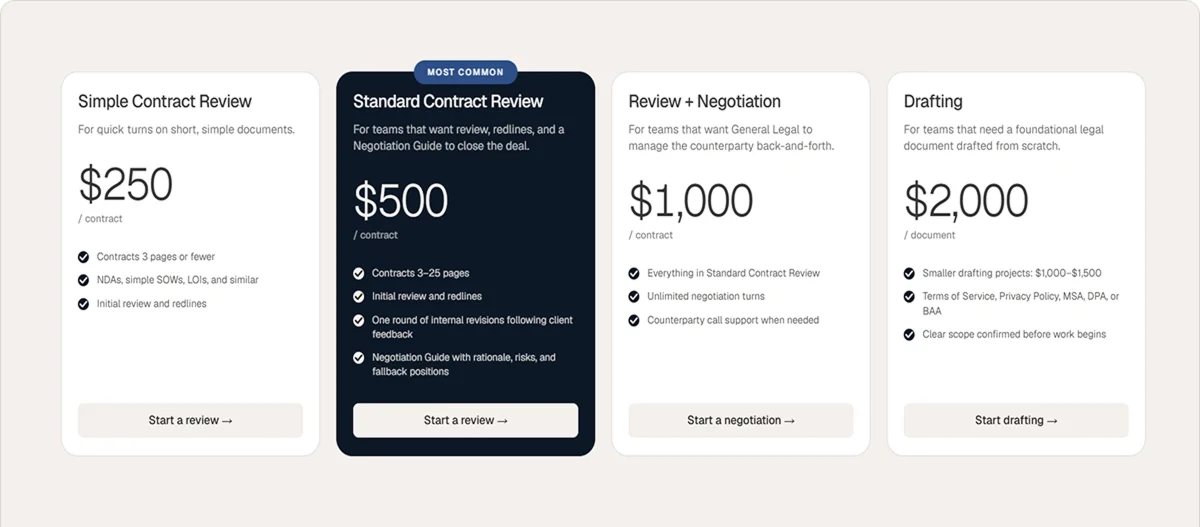
This AI-native law firm publishes transparent pricing for many common legal services, including contract reviews, employment documents, and SAFE financings, which all start at $250. By making pricing visible upfront, General Legal allows clients to evaluate legal costs before starting an engagement.
3. Retainer fees
A retainer fee is an upfront deposit paid to a lawyer before work begins. The money is held in a trust account and drawn down as legal services are provided. If there are any funds left by the end of the engagement, they're generally refunded to the client.
Retainers are commonly used for legal matters where the amount of work is difficult to predict in advance, including:
- Family law and divorce cases
- Employment disputes
- Criminal defense
- Real estate issues
- Probate and estate administration
- Immigration cases
- Ongoing business legal support
From a cost perspective, a retainer is usually not the total cost of hiring the lawyer. Instead, it functions as a prepayment against future legal fees.
In 2023, average lawyer retainers ranged from approximately $2,000 to $4,000, depending on the practice area.
| Cost advantages | Cost disadvantages |
|---|---|
| You secure legal help with a single upfront payment. | You must commit a large sum before work even begins. |
| Unused retainer funds are often refundable. | The retainer is usually not the total cost of the representation. |
| Costs are paid from an existing balance as work is completed. | You may need to replenish the retainer if it runs low. |
4. Contingency fees
Under a contingency fee arrangement, a lawyer is paid only if they successfully recover money for the client through a settlement, judgment, or other financial award.
Contingency fees are most commonly used in:
- Personal injury lawsuits
- Medical malpractice claims
- Workers' compensation cases
- Certain employment disputes
- Social Security disability appeals
- Veteran benefits appeals
In exchange for taking that risk, lawyers typically receive a percentage of the recovery, often around 30%, though the exact amount depends on the case and fee agreement.
| Cost advantages | Cost disadvantages |
|---|---|
| You pay no attorney fees upfront. | The lawyer keeps a portion of your recovery. |
| You pay attorney fees only if money is recovered. | The percentage fee can exceed what hourly billing would've cost. |
| Legal representation is accessible without significant savings. | Case expenses may be deducted from your recovery. |
Pro tip:
Ask whether litigation expenses like court fees, expert witnesses, and medical records are included in the contingency fee or deducted separately.
What influences the cost of hiring a lawyer: 6 key factors
The fee structure you choose can have a major impact on legal costs, but it's far from the only factor that determines what you'll ultimately pay.
The six factors below help explain why two lawyers can charge dramatically different amounts for seemingly similar legal work.
1. Practice area
Not all legal work requires the same level of expertise, risk, or specialization. A lawyer handling a straightforward traffic violation typically charges far less than one advising on a corporate acquisition, intellectual property dispute, or complex tax matter. As a general rule, the more specialized and technically demanding the practice area, the higher the cost.
One useful source for comparing costs across practice areas is Clio's annual Legal Trends Report, which lists average hourly rates, such as:
- Workers' compensation: $180/hour
- Criminal defense: $216/hour
- Personal injury: $337/hour
- Family law: $344/hour
- Employment law: $387/hour
- Trusts and estates: $397/hour
- Commercial law: $414/hour
- Intellectual property: $453/hour
- Bankruptcy: $460/hour
- Corporate litigation: $461/hour
This doesn't mean every lawyer in a given practice area charges the same rate. However, if you're trying to estimate legal costs before speaking with an attorney, the practice area is often the best place to start.
2. Matter complexity
Even within the same practice area, costs can vary significantly based on the complexity of the work. For example, a simple contract review will typically cost far less than negotiating a multi-party commercial agreement, just as an uncontested divorce will cost less than a custody dispute headed for trial.
Factors that commonly increase matter complexity include:
- Multiple parties or stakeholders
- Disputes involving multiple jurisdictions
- Extensive legal research requirements
- Large volumes of documents or evidence
- Numerous witnesses or expert testimony
- Regulatory or compliance issues
- Court appearances and litigation
- High financial stakes or potential liability
As complexity increases, so do legal fees, regardless of the billing model used.
3. Lawyer experience
More experienced lawyers commonly charge higher rates than their newer colleagues, because their experience reduces risk. Lawyers who have handled similar matters for years can often spot issues faster, avoid common mistakes, and draw on a deeper body of knowledge when advising clients.
The difference in cost based on this factor can be substantial.
According to data from the US Court of Federal Claims, lawyers with 20 to 30 years of experience charge roughly $511–$606 per hour, compared to approximately $219–$328 per hour for lawyers with fewer than four years of experience.

Pro tip:
The most affordable lawyer isn't always the lowest-cost option. A more experienced lawyer may charge a higher hourly rate but spend less time completing the work, resulting in a lower total bill.
4. Geographic location
Lawyers in major metropolitan areas and high-cost regions typically charge more than those in smaller cities or rural markets.
According to Clio's Legal Trends Report, average lawyer rates range from $196 per hour in West Virginia to $492 per hour in the District of Columbia.
Keep in mind that a higher hourly rate doesn't always mean you're paying more in relative terms. Lawyers in places like New York City or San Francisco often charge higher rates because the cost of doing business is also higher.
Pro tip:
If your case doesn't require local counsel, consider comparing quotes from lawyers in multiple markets.
5. Statutory and court-regulated fees
In some areas of law, attorney fees are partially regulated by statutes, court rules, or fee schedules rather than being determined entirely by market rates.
Probate is one of the most common examples.
In certain states, probate attorney fees are calculated using formulas tied to the value of the estate, while other states allow courts to review fees for reasonableness. This means that two estates requiring similar amounts of legal work may generate different legal fees depending on the jurisdiction.
6. Lawyer seniority and firm size
The same legal issue can cost substantially different amounts depending on who handles it and where they work. A senior partner at a large national law firm will often charge several times more than a junior lawyer at a small local practice.
That's because established firms often have stronger reputations, larger support teams, deeper specialization, and more sophisticated operational infrastructure to handle high-stakes matters. Senior lawyers at these firms command premium rates ($600–$900 per hour), which can become exceptionally high at the top end of the market.
Recent court filings have revealed partner billing rates exceeding $2,000 per hour at several BigLaw firms, including A&O Shearman, Kirkland & Ellis, and Latham & Watkins. In some cases, top-tier partners have even commanded rates several times higher, reaching $4,000–$6,000 per hour.
Rates like these are often beyond the budget of most founders, operators, and small businesses. However, advances in legal technology have made it possible to deliver many types of legal work at BigLaw-quality standards without BigLaw pricing.
General Legal and the new economics of legal services
General Legal was built around a simple question: What if you could keep the expertise of BigLaw firms and remove much of their inefficiency?
We're an AI-native law firm that combines experienced US-barred attorneys with proprietary AI systems and technology-enabled workflows. The goal isn't to replace lawyers; it's to make great lawyers more productive.
That efficiency shows up in our pricing.
Instead of billing by the hour, we primarily offer flat-fee pricing. Contract reviews start at $250, standard commercial contract reviews cost $500, and full contract negotiations typically cost $1,000. More complex drafting projects are priced separately based on scope.
Traditional law firms rely on teams of lawyers, manual workflows, email-heavy communication, and hourly billing. General Legal uses AI to triage legal work, identify issues, summarize documents, highlight risks, and prepare initial work products. Then, an attorney reviews the document, applies legal judgment, makes strategic decisions, and stands behind the final work.
Technology also helps ensure that each engagement reaches the right attorney quickly.
Requests are evaluated based on subject matter, complexity, urgency, attorney expertise, and availability, so work can be assigned accurately from the start. The result is less administrative overhead and fewer hours spent on work that doesn't create value for clients.
In other words, General Legal doesn't lower prices by using less experienced lawyers. It does so by reducing the amount of time lawyers spend on tasks that technology can handle more efficiently.
If you're ready to get started, sign up online and send your first legal request directly to our team. For most agreements, we support companies doing business in all 50 states. If, however, you're still evaluating your options or have additional questions about pricing, scope, or timing, reach out via email. Our team is happy to discuss your needs before you commit to anything.
- The average lawyer charges about $350 per hour, but actual cost depends heavily on the lawyer, the type of work, and how the engagement is billed.
- Hourly billing still accounts for roughly 90% of legal spend even though flat fees offer more cost certainty; in 2024, 59% of law firms offered flat fees exclusively or alongside hourly billing.
- Retainers (commonly $2,000-$4,000) and contingency fees (commonly around 30% of recovery) are the two other major fee structures, each suited to different kinds of unpredictable or high-risk matters.
- Six factors drive cost beyond the fee structure itself: practice area, matter complexity, lawyer experience, geographic location, statutory/court-regulated fees, and lawyer seniority or firm size.
- Senior BigLaw partners can bill $600-$900 per hour on average, with some top-tier partners at firms like Kirkland & Ellis reportedly charging $2,000-$6,000 per hour on the highest-stakes matters.
- General Legal offers transparent flat-fee pricing (contract reviews starting at $250, standard reviews at $500, full negotiations around $1,000) by using AI to triage and prepare work before an attorney applies final judgment.
| Average cost | Hiring a lawyer costs about $350 per hour on average, though actual pricing varies by lawyer, work type, and billing model. |
|---|---|
| Hourly billing | Still the dominant model at roughly 90% of legal spend, offering pay-only-for-time-used flexibility but poor cost predictability. |
| Flat fees | 59% of firms now offer flat fees for predictable work like contract reviews or entity formation, giving clients upfront pricing certainty. |
| Retainers and contingency | Retainers ($2,000-$4,000 typical) suit unpredictable matters like family law; contingency fees (around 30% of recovery) suit personal injury and similar claims where no fee is owed unless money is recovered. |
| What drives cost up | Practice area, matter complexity, lawyer experience, location, statutory fee rules, and firm seniority can each significantly raise or lower the final price. |
| The high end | Senior BigLaw partners can charge $600-$900 per hour on average, with some top-tier rates reported as high as $4,000-$6,000 per hour. |
| General Legal's approach | The firm publishes transparent flat-fee pricing and uses AI to triage and prep documents so attorneys spend less time on tasks technology handles well. |
Can someone else pay for my lawyer?
Sometimes. Personal injury lawyers often work on contingency, insurance policies may cover legal defense costs, and some people qualify for public defenders, legal aid, or pro bono representation.
Do lawyer fees cover all legal costs?
Not necessarily. Clients may also owe court filing fees, expert witnesses, depositions, mediation costs, and travel expenses; the fee agreement should spell out what's included.
What is the most a lawyer can charge per hour?
There's generally no legal maximum. While the average is around $350 per hour, highly specialized attorneys have reportedly charged as much as $6,000 per hour.
Why is flat-fee pricing often hard to find upfront?
Many firms require a consultation before quoting a flat fee, even though the price itself is fixed, which makes it hard for clients to compare options in advance; General Legal instead publishes its flat-fee pricing directly.
Is a more experienced lawyer always more expensive overall?
Not necessarily. A more experienced lawyer may charge a higher hourly rate but complete the work faster, sometimes resulting in a lower total bill than a less experienced lawyer working the same matter.
- Fractional General Counsel Cost: What to Expect in 2026Learn how you can assess fractional general counsel costs, compare legal options, and choose pricing that fits your startup's needs.
- How Much Does it Cost to Draft a Legal Contract? [2026 Guide]Explore what drives legal contract drafting costs, compare pricing models, and learn how to budget for reliable legal support without unexpected fees.
- How Much Does it Cost to Incorporate a Startup? [Guide]Learn how much does it cost to incorporate a startup so you can compare formation options, legal fees, filing costs, and ongoing expenses.