
The rate you're quoted depends on which billing model you happen to walk into, and the data shows those models are moving in opposite directions.
Law firm rates are climbing well ahead of inflation. Thomson Reuters Institute's Law Firm Rates Report 2026 found that worked rates rose 7.4% across all segments through the first half of 2025, and 9.4% at Am Law 100 firms, against PCE inflation of 2.8%.
Meanwhile, another Thomson Reuters Institute report found that 90% of legal dollars still flow through hourly billing arrangements, even as firms invest heavily in AI. And the cost of handling contracts badly is higher than the cost of handling them well.
This guide breaks down the six factors that determine how much it costs to draft a legal contract and explains how to read a quote before you sign an engagement letter.
What does a contract cost? The benchmark data
Most contracts don't come with a price, because the dominant billing model doesn't produce one until the work is finished. Under hourly billing, the quote is an estimate of someone's time, and the invoice is the actual price.
Firms also differ in how they set rates, and public benchmarks bracket the market:
Run the math on the top tier, and it stops being abstract. Twenty hours of partner time at $1,635 is $32,700—for a vendor agreement that a growth-stage company needs back by Thursday.
Those firms excel at bet-the-company litigation, complex M&A, and novel regulatory questions. They aren't built to price a standard MSA at a number that survives contact with a startup's burn rate.
That mismatch is why so much routine work is changing. The State of the US Legal Market report found clients shifting demand away from the most expensive firms toward lower-cost alternatives, with corporate legal departments reporting spending expectations at levels not seen since the pandemic.
Before you pay anyone, though, it's worth asking whether you need to.
Can you draft a contract without a lawyer?
Yes, you can create a contract without hiring a lawyer. No US law requires a contract to be drafted or approved by an attorney, and an agreement between two competent parties is enforceable whether or not a lawyer touched it.
The more important question is whether you should. A template handles the shape of an agreement well, but it typically can’t manage the specific allocation of risk in your deal because it was written for an average counterparty, which may be far from yours.
If you're starting from a template, start from one an attorney actually drafted. General Legal's Template Library publishes agreements under a CC0 1.0 license, free to use, modify, and redistribute without attribution, including:
- Master Services Agreement (MSA)
- One-way NDA and mutual NDA
- Advisor agreement
- US data processing addendum (DPA)
- Business associate agreement (BAA)
- California exempt employee offer letter
Read more: What Should Be Included in a Commercial Contract: 15 Clauses
6 factors that determine the cost of drafting a legal contract
Every quote depends on the same six variables. Knowing which one is driving yours tells you what to negotiate.
1. The billing model behind the quote
The model shapes the final number more than the document does, and it decides who carries the risk of a bad estimate. There are three main models:
- Hourly billing: You're billed in tenths of an hour for every email, call, and redline, and you don't learn the total until the invoice arrives.
- Flat fees: You're quoted a price for the deliverable before work starts, which shifts the estimating risk onto the lawyer.
- Retainers and subscriptions: You pay a recurring monthly fee for ongoing counsel, which suits steady volume but not a single MSA.
Hourly billing also creates a misalignment: The firm's revenue rises the longer your negotiation drags on.
2. The complexity of the underlying deal
A one-page mutual NDA and a multi-year enterprise SaaS agreement with SLAs, indemnities, and data-processing terms are not the same job, even though both fall under "a contract."
Complexity shows up as clauses that require a decision rather than a template. Every negotiated liability cap, IP assignment, or exclusivity term is a judgment call someone has to make and defend, and judgment is the expensive part.
3. The difference between drafting and reviewing
Drafting from scratch costs meaningfully more than reviewing someone else's paper, because the lawyer is building the risk allocation from zero instead of reacting to a draft that already exists.
Providers that publish fixed fees price the two separately for exactly this reason, and the gap is usually substantial. If a quote doesn't distinguish them, that's the first question to ask.
4. The number of negotiation rounds
Under hourly billing, every round the counterparty pushes back costs you money whether or not the pushback was reasonable.
The uncomfortable part is how little of that spend is well directed. World Commerce & Contracting found that only 16% of commercial practitioners believe contract negotiations focus on the right topics, and just 39% believe their contracts are effective at delivering the intended outcome.
5. The length of the document
Page count is a rough proxy for how much of a contract a lawyer has to hold in their head at once, which is why most fixed-fee providers price by length rather than by document name.
6. The lawyer's market and firm tier
Geography and brand carry a premium that has little to do with marginal skill on a commercial contract. Partners at top-25 firms average $1,635 an hour against $845 at firms ranked 76–100, so the same work moves by a factor of two before anyone opens the document.
What should you actually include in your budget?
For a company without in-house counsel, the practical planning approach is per matter rather than as one annual legal budget. Decide which agreements get paid attorney attention and which get a template, then price only the first group.
Whichever billing model you end up with, the warning signs in a quote are the same:
- Vague scope, such as "contract review" with no definition of what's included
- Undefined revision rounds
- Retainers that draw down without itemized reporting
- Any firm that won't give you a number before you've had a sales call
Read more: Contract Review Cost: Pricing, Cost Drivers & Savings
How General Legal changes the economics of contract drafting
Adoption itself is no longer the differentiator between using AI and being AI-native. 8am's 2026 Legal Industry Report, drawn from more than 1,300 legal professionals surveyed in late 2025, found nearly 70% now use general-purpose AI tools at work, more than double the prior year, with 42% using legal-specific AI. Time savings are real: 38% save one to five hours a week, and nearly one in four save six or more.
Firms are getting faster, but under hourly billing, faster means fewer billable hours, so efficiency has to be absorbed or priced back in. That's the structural gap an AI-native firm exists to close, and it only closes if the pricing model changes alongside the workflow.
General Legal is an AI-native law firm that pairs experienced, US-barred attorneys with AI systems built specifically for legal work, serving startups and growth-stage companies. AI agents handle the administrative and analytical layer while attorneys handle legal judgment, negotiation strategy, risk assessment, and client counsel.
The result is a firm that can price a contract as a product rather than an estimate, without compromising the judgment clients are actually paying for.
Three mechanisms make that possible:
- Faster first-pass review: AI systems read the full document and surface issues, annotations, and proposed redlines before an attorney opens it, so attorney time goes to the clauses that carry risk.
- No administrative drag: Intake, scoping, scheduling, and status updates are automated, removing the coordination hours traditional firms bill as part of a matter.
- Published prices instead of estimates: A fixed fee removes the negotiation-round exposure that makes hourly engagements impossible to forecast.
Our commercial model is matter by matter, with no traditional counsel relationship required. We quote pricing upfront as a flat fee, and work comes in through email, Slack, or our client portal.
You can create a free account with no commitment or upfront fees and send us a document for a quote, or book a 10-minute working session with our team to walk through your current contract workflow and see whether the AI-native model fits how your company buys legal work.
- Hourly rates at top US law firms rose 7.4% overall and 9.4% at Am Law 100 firms in 2025, far exceeding 2.8% inflation, with 90% of legal spend still flowing through hourly arrangements.
- Am Law 100 firms average $1,145 blended hourly rates, with top-tier partners charging $1,635 per hour—making a standard 20-hour contract cost over $32,000.
- You can legally draft contracts without a lawyer, but templates cannot tailor risk allocation to specific deals without attorney judgment on negotiated terms.
- Complexity, billing model, drafting versus review, negotiation rounds, document length, and firm tier collectively determine what you pay for contract work.
- AI-native firms combine attorney judgment with AI-driven document analysis to offer flat-fee pricing, eliminating hourly billing's misalignment where longer negotiations increase law firm revenue.
- Only 16% of commercial practitioners believe contract negotiations focus on the right topics, meaning much hourly spend is poorly directed under traditional models.
| Hourly rate inflation | Law firm rates rose 7.4–9.4% in 2025, triple the 2.8% inflation rate, with Am Law 100 blended rates at $1,145/hour |
|---|---|
| Billing model impact | Hourly billing creates unpredictable costs and misaligned incentives; flat fees shift estimating risk to the lawyer |
| Self-drafting limitations | Contracts are legally valid without lawyers, but templates cannot customize risk allocation for specific deals |
| Six cost drivers | Billing model, deal complexity, drafting vs. review, negotiation rounds, document length, and firm tier determine total price |
| Negotiation inefficiency | Only 16% of practitioners believe negotiations focus on the right issues, wasting billable hours under hourly models |
| AI-native economics | AI handles document analysis and admin work while attorneys manage judgment, enabling fixed pricing without quality compromise |
| Adoption vs. integration | 70% of legal professionals use AI, but hourly billing captures efficiency gains as fewer billable hours unless pricing model changes |
Do I have to pay a lawyer to draft an NDA?
No. NDAs are among the most standardized documents a company signs, and a free attorney-drafted template covers most straightforward situations. Paying for review makes sense when the NDA is attached to a deal where the confidential information itself is the valuable asset.
Is a flat fee better than an hourly rate for contract work?
For a defined deliverable, usually yes, because a flat fee moves the risk of a bad time estimate onto the lawyer and removes the negotiation-round exposure that makes hourly invoices unpredictable. Hourly can still suit genuinely open-ended advisory work with no fixed output.
Can ChatGPT draft a contract?
It can produce a draft, but it can't give legal advice, carry malpractice insurance, or apply professional judgment to your specific risk position. General-purpose AI tools are a reasonable way to understand what a clause does and a poor way to decide whether you should accept it.
Do startups need a lawyer for every contract?
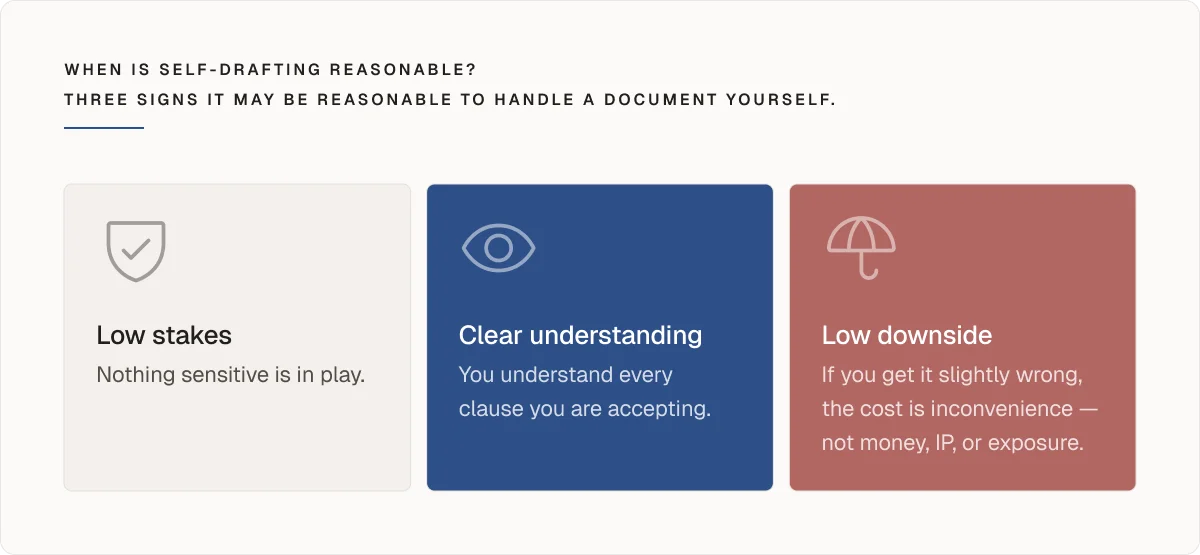
Not necessarily. A practical rule is to template anything low-stakes and standardized, and buy attorney review for anything involving money changing hands, IP or data, liability caps, or a counterparty with their own lawyer.
- How Much Does It Cost To Hire a Lawyer? [2026 Guide]Learn how much does it cost to hire a lawyer and discover what affects legal fees, compare pricing, and choose the right option.
- 6 Best Outside General Counsel Law Firms [Comparison]Explore the best outside general counsel law firms so you can compare legal support, expertise, pricing & fit for your business.
- 8 Best Startup Tools for Managing Contracts [Comparison]Explore the best startup tools for managing contracts so you can compare features, workflows, and legal support.