
The Delaware Certificate of Incorporation filing fee is $109, plus $9 for each additional page. Everything above that line is a decision about how much legal judgment you're buying. According to Clio's 2025 Legal Trends Report, lawyers working in business formation and compliance charge an average of $378 per hour, and 41% of firms still bill exclusively by the hour.
Whether your first-year bill lands in four figures or five depends on how many hours your cap table, co-founder vesting schedule, and first employment agreements take.
Understanding where the money goes, and where it doesn't need to go, is the difference between a clean cap table and a $10,000 fundraise delay eighteen months from now.
And incorporation is just the first line item, not the full bill.
This guide breaks down the four cost buckets every dollar lands in and explains how much it costs to incorporate a startup with a structure that can withstand a potential investor’s diligence process.
The 4 cost categories of startup incorporation
Every dollar you spend incorporating lands in one of four buckets. Once you understand the categories, the comparisons get a lot simpler.
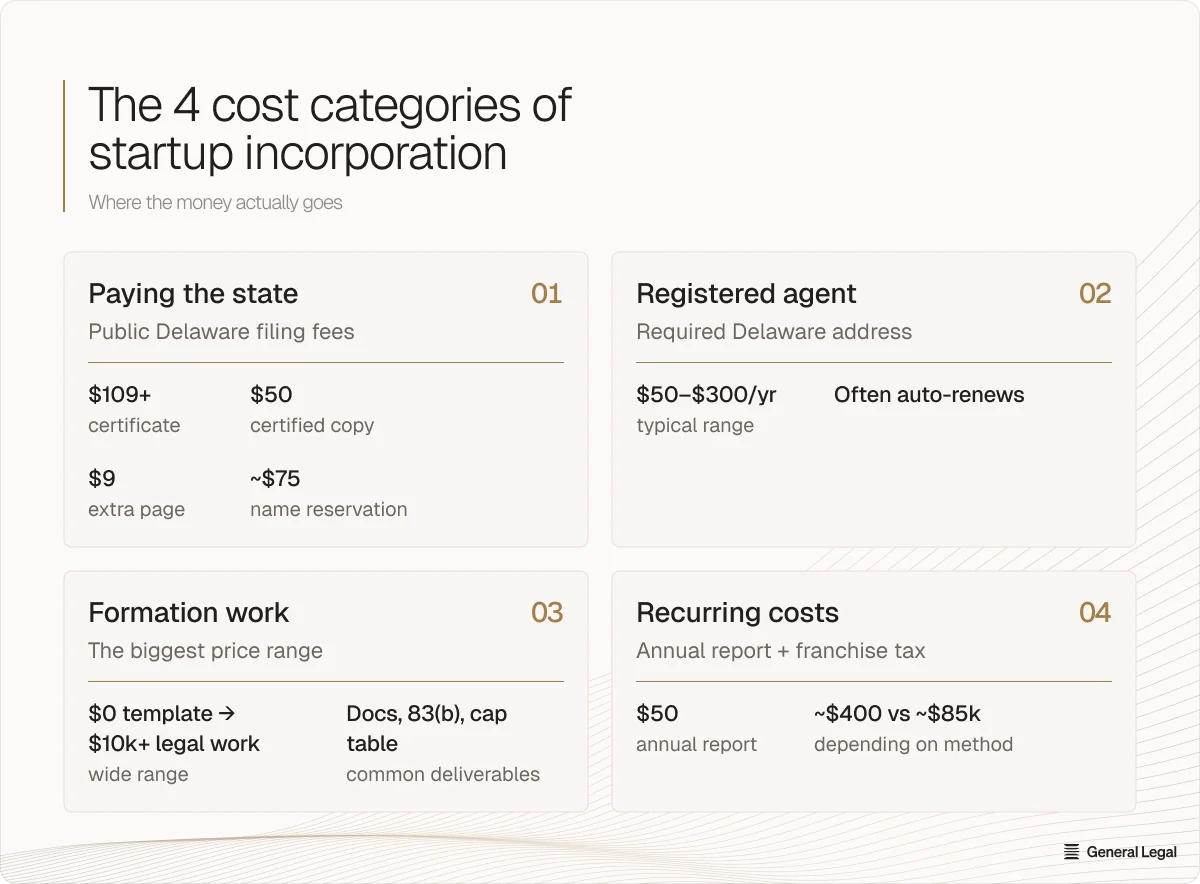
1. Paying the state
Delaware is the default jurisdiction for venture-backed startups, as the standard VC financing documents are written against Delaware law—incorporate elsewhere and someone has to rewrite them for your state before your round can close.
Its fees are public and non-negotiable:
- Certificate of Incorporation: $109 minimum, rising with authorized share count
- Each additional page: $9
- Certified copy of your certificate: $50
- Name reservation ahead of filing: around $75
The state doesn't care whether you used a template or hired a lawyer; it charges the same either way.
2. Keeping a registered agent
Delaware requires every corporation to maintain a registered agent with a physical Delaware address. According to providers' official sites, market rates typically run $50–$300 per year, though most formation services bundle the first year into their fee and renew at their own rate afterward.
This is a mandatory line item and a small one. It's also the one most likely to auto-renew at a price you never compared.
3. Buying the formation work
This is where nearly all the price variance lives, from a $0 template to a $10,000 partner-billed engagement. It covers the charter, bylaws, board consents, founder stock purchase agreements, invention assignment agreements, the 83(b) filings, and your initial cap table.
Everything above the state's $109 is a decision about how much risk you're willing to carry into your first term sheet.
4. Carrying the recurring and downstream costs
Delaware corporations owe an annual report and franchise tax every March 1, whether or not you've earned a dollar. The report is $50, but the tax depends entirely on which of two calculation methods you use.
Delaware defaults to the authorized shares method, which is the wrong one for most startups. A company with 10 million authorized shares owes roughly $85,000 under that method and the $400 minimum under the assumed par value method. The state will bill you under the default until you recalculate, so check the notice before you pay it.
3 ways to incorporate, and what each one costs
Founders realistically choose between three paths, and each can be equally right depending on your experience, available funds, company structure, and personal preferences.
1. Online formation services
For a straightforward, single-jurisdiction, one- or two-founder company, formation platforms are fast, cheap, and honest about their limits. For example:
Atlas documents were built in collaboration with Cooley LLP, but Stripe states that Atlas isn't a law firm and doesn't provide legal, tax, or accounting advice. That distinction matters more than it sounds because it means that you're getting Cooley-informed templates, not Cooley judgment applied to your facts.
However, these platforms stop being enough the moment your situation gets slightly non-standard: founders on uneven vesting, IP built before incorporation, an advisor taking equity, a foreign co-founder.
None of them will catch that, because none of them are reviewing your situation. Firms like General Legal sit at exactly that line, applying attorney review to the facts a form can't ask about.
Read more: How to make a legal contract without a lawyer
2. Flat-fee startup lawyers
According to Clio's 2025 Legal Trends Report, 71% of clients would rather pay a flat fee for an entire matter than watch an hourly meter run, and 59% of firms now bill flat fees exclusively or alongside hourly rates.
Formation is the obvious candidate for this type of pricing, because the scope is known before anyone starts work.
However, offering flat fees and running on them are two different things. Thomson Reuters Institute's 2026 State of the US Legal Market found that roughly 90% of legal dollars still move through hourly billing, which is why a firm can quote a fixed price for the incorporation package and bill by the hour for everything that comes after.
3. Hourly Big Law
A Delaware C-corp formation plus founder agreements at a large firm is billed by the hour, and those hours are getting more expensive. Thomson Reuters research found that Am Law 100 lawyers have crossed $1,000 per hour while the rest of the market averages around $600, with worked rates growing by 7.3% in 2025.
At those rates, a formation package is a five-hour conversation away from four figures, and most firms want a retainer before anyone opens a document.
Big Law firms offering discounted or deferred formation work are running a loss-leader play, betting the relationship pays off at your Series A. That's not necessarily a bad trade. Just recognize it as business development rather than a startup-friendly price, and read what the hourly model costs you on every question after the discounted one.
All three routes share one deadline that overrides the rest.
The 30-day clock that decides whether you saved anything
Under 26 U.S.C. § 83(b), a founder receiving restricted stock has 30 days from the transfer date to file this election with the IRS, which can be done via Form 15620.
Miss it, and there's no do-over. If you never file, you owe ordinary income tax on the amount by which the shares' fair market value exceeds what you paid for them rather than at the near-zero value on the grant date.
This is the single highest-leverage five-minute filing in the entire formation process, and sophisticated investors ask about it in diligence as a matter of routine.
What year one actually costs
Once you're formed, you're carrying an annual franchise tax plus a $50 annual report fee and foreign qualification fees if you operate outside Delaware.
The bigger number is the legal work that follows. Founder agreements, employment documents, IP assignments, and the commercial contracts every early customer and vendor deal requires add up.
And the cost of getting them wrong is higher than the cost of getting them right.
World Commerce & Contracting's 2025 contract management research found that poor contracting practices erode value equivalent to 8.6% of annual revenue, with the worst performers losing 15% or more.
Line those up against the year-one estimate and the shape of the budget becomes clear: Incorporation is a small fraction, and the recurring commercial work is most of it. So what should you actually plan to spend?
How much should you budget?
The answer is that there's no single number, because the routes differ not just in price but also in what you're actually buying and how the bill gets calculated.
What none of this shows is what happens when the cheaper route goes wrong. A botched founder stock issuance, a missing IP assignment, or a structure that spooks diligence counsel all surface at the same moment—when someone else's lawyer reads your documents closely for the first time.
That's the expensive part, as the fix lands on a timeline you don't control, billed by the hour because nobody quotes a flat fee for cleaning up a mess they didn't make.
Which leaves founders picking between two imperfect options:
- A platform that's honest about not reviewing your facts
- An hourly firm that reviews everything and prices it in a way that makes you hesitate to ask a second question.
Neither is what a company at this stage actually needs.
Read more: Outside General Counsel for Startups: What to Expect?
General Legal: An alternative that understands what startups need
There is another model worth considering: an attorney who reads your actual situation, at a price you know before the work starts.
General Legal is an AI-native law firm that pairs elite, US-barred attorneys with AI-powered workflows built specifically for legal work. Its Emerging Companies & Venture Capital practice covers the full formation lifecycle: incorporation, company governance, cap table management, and financing rounds from SAFEs through Series F, with tax counsel alongside it for QSBS planning and equity compensation.
Backed by Y Combinator, SV Angel, Susa Ventures, and Box Group, the firm serves more than 320 companies, and its team combines experienced attorneys, legal operators, and former Casetext AI builders, including corporate attorneys trained at Fenwick & West and Cooley.
For a founder, this means:
- Flat fees quoted upfront: You know the cost before you commit, so the decision to involve a lawyer isn't a bet on how many hours a question turns into.
- AI-accelerated first passes: Automating the administrative and analytical layer takes the labor out of the work that hourly firms bill most of their time for.
- Matter-by-matter engagement: No retainer and no standing counsel relationship, so a single incorporation or a single SAFE is a reasonable thing to buy.
- Turnaround in hours: Speed is what makes review happen before a deadline instead of after a problem.
We publish a full pricing schedule for common services, and deliver through Slack, email, or the client portal rather than email chains.
If you're past "will this company exist" and into "will this company survive a term sheet," you can create a free account and send us the work, or book a 15-minute call with no commitment.
- Delaware incorporation filing costs $109 minimum, but total first-year expenses range from hundreds to tens of thousands depending on legal complexity and service model chosen.
- The 83(b) election must be filed within 30 days of receiving restricted stock and cannot be extended—missing this deadline triggers ordinary income tax on vesting instead of capital gains treatment.
- Delaware franchise tax defaults to the authorized shares method which can cost $85,000+ for startups with 10 million shares, but recalculating under assumed par value method reduces it to $400 minimum.
- Formation platforms like Stripe Atlas ($500) work for simple structures, but non-standard situations—uneven vesting, pre-incorporation IP, foreign co-founders—require attorney review that templates cannot provide.
- Big Law hourly rates now exceed $1,000/hour at top firms, while flat-fee models eliminate billing uncertainty and align better with founders' need for predictable legal costs.
- Poor contracting practices erode 8.6% of annual revenue according to industry research, making proper legal structure worth far more than the initial incorporation cost.
| State filing fees | Delaware charges $109 base plus $9 per additional page; registered agent costs $50–$300 annually |
|---|---|
| Formation service options | Stripe Atlas ($500), LegalZoom ($149–$399), flat-fee lawyers ($1,000–$5,000), or Big Law hourly ($1,000+/hour) |
| 83(b) election deadline | Must file within 30 days of restricted stock transfer or face ordinary income tax on vesting—no extensions allowed |
| Annual Delaware costs | $50 report plus franchise tax: $400 minimum under assumed par value method, $85,000+ under default authorized shares method |
| When templates aren't enough | Uneven founder equity, pre-incorporation IP, advisors, or foreign co-founders require attorney review beyond platform capabilities |
| Downstream legal costs | First-year expenses mostly come from employment agreements, IP assignments, and commercial contracts, not incorporation itself |
| Cost of getting it wrong | Botched founder stock or missing IP assignments surface during investor diligence, causing expensive fixes on someone else's timeline |
| AI-native firm alternative | General Legal combines attorney review with AI workflows for flat-fee pricing, matter-by-matter engagement, and hours-not-weeks turnaround |
Do I need a lawyer to incorporate a startup?
No US law requires an attorney to form a corporation, but you should bring one if you have uneven founder contributions, IP created before incorporation, advisors taking equity, or a fundraise planned within six to twelve months.
What is an 83(b) election and when is it due?
An 83(b) election lets founders be taxed on restricted stock at transfer value instead of vesting value. It must be filed with the IRS within 30 days of the transfer, and this deadline cannot be extended—missing it means paying ordinary income tax on each vesting tranche.
How much is Delaware franchise tax?
Delaware franchise tax is $175 minimum under the authorized shares method or $400 under the assumed par value method. Most venture-backed startups use assumed par value to avoid bills reaching $85,000+ for 10 million authorized shares. It's due every March 1 with a $50 annual report.
Can I switch from an LLC to a C corp later?
Yes, but conversion requires separate legal and tax work. Most venture investors won't fund an LLC, so if raising capital is in your plan, incorporating as a Delaware C-corp from the start costs less than converting later.
- How Much Does It Cost To Hire a Lawyer? [2026 Guide]Learn how much does it cost to hire a lawyer and discover what affects legal fees, compare pricing, and choose the right option.
- 5 Best Company Formation Companies for Startups [Comparison]Explore the best company formation companies so you can compare your options, choose the right provider & build your business.
- Best Fractional General Counsel for Startups: 6 Top OptionsDiscover the best fractional general counsel for startups so you can find expert legal support and manage costs.