
Most founders skip the startup advisor contract, treat it as a formality, or copy-paste a template from Google. However, a template sets terms for the average advisor relationship, while yours has a specific person, a specific ask, and specific things you can't afford to lose: the customer introductions, the product roadmap they'll see, the code or design work they might touch.
That's often how cap-table damage happens, as an advisor with equity, no defined scope, no confidentiality obligation, and no termination mechanism is a liability disguised as a favor.
This guide covers what the startup advisor contract has to do, what the market actually pays, and which mistakes to avoid.
What does a startup advisor contract do?
A startup advisor contract answers six questions in writing:
- What the advisor is doing
- What they're paid in equity
- How long the arrangement lasts
- Who owns the work product
- What stays confidential
- What happens when either side wants out
Everything else in the document serves those six answers. Before you can draft any of them, though, you have to be clear about which relationship you're describing, because founders routinely blur four:
The advisor and consultant line matters most for drafting. Scope for an advisor is defined in hours or meetings, not milestones, because there's no work product to tie payment to.
The board line matters for how you talk about it. An advisory board sounds like a governance body and isn't one. Advisors don't vote, can't bind the company, and carry no fiduciary duties. Conflating the two in your cap-table conversations with investors is an avoidable error.
How much equity should an advisor get?
Advisor equity depends on two variables: company stage and level of engagement.
FAST, the Founder Institute's Founder/Advisor Standard Template, is the closest thing to a standard reference, splitting advisors into a standard tier committing to monthly meetings and an expert tier adding contacts and active project work. Set against Carta's observed medians, the gap is wide:
Median grants run below even the standard tier at every stage, and only about 10% of pre-seed advisors receive 1% or more. That top decile is for brand-name operators with genuine network access, not for monthly check-ins.
Also, the Founder Institute notes it's common to cap the entire advisory pool at around 5% of fully diluted equity. However, percentage is only half the mechanics.
Vesting, cliffs, and acceleration
How equity vests determines whether it works as an incentive or just sits on your cap table as dead weight.
The norm for advisor grants is two-year monthly vesting, notably shorter than the four-year schedule standard for employees and founders. Advisor relationships have a shorter natural half-life than employment, and the schedule should match the expected engagement window rather than defaulting to whatever your option plan says for full-time hires.
Cliffs are where practice genuinely diverges. Zero to three months is the observed range, and it's negotiable rather than fixed. If you've already run the month-long trial period, you may not need one.
There are two more mechanics to be aware of:
- Acceleration: Single-trigger acceleration on an acquisition, where unvested shares vest immediately on a change of control, is a negotiable point. Decide your position before an advisor raises it mid-negotiation.
- Milestone-based vesting: Tying tranches to outcomes, such as closing a priced round or delivering three qualified introductions, pays for results rather than tenure.
Settle the equity, and you've settled the visible half of the agreement. The clauses around it do the protective work.
8 clauses to include in a startup advisor contract
Equity terms get all the attention in founder conversations, but the clauses that actually protect your company in a dispute are the ones nobody talks about at a coffee meeting.
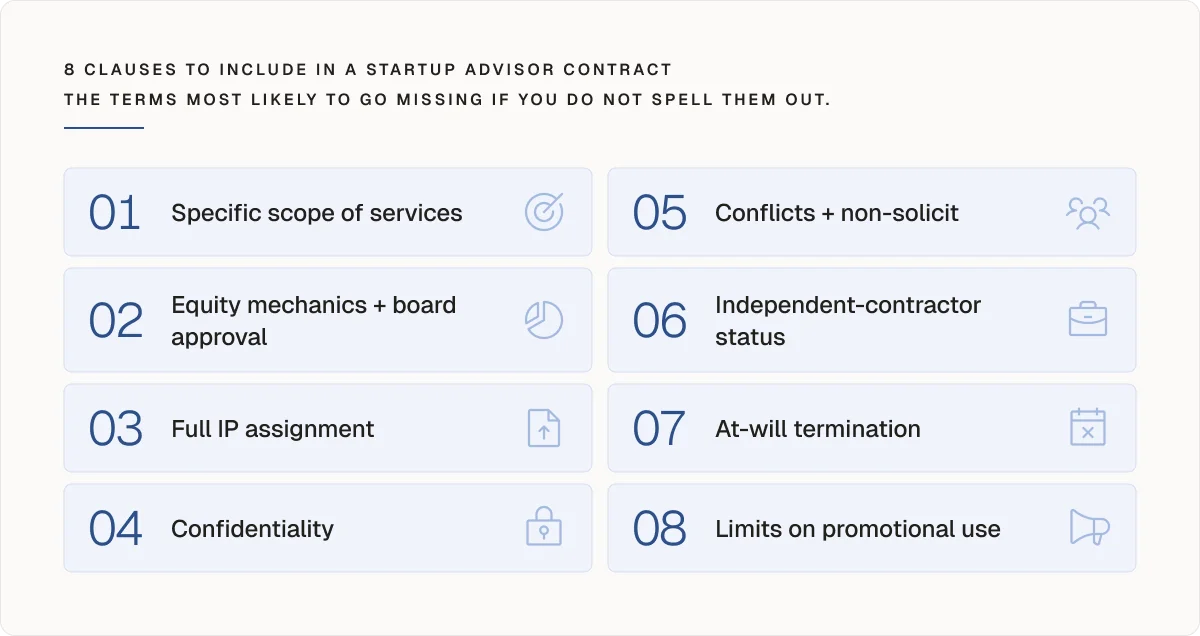
1. A specific, numeric scope of services
"General strategic advice" is not an enforceable standard, and it's the most common drafting failure in advisor papers. Name the number: six meetings a year, ten hours a quarter, a defined number of introductions. Vague scope is unenforceable scope.
2. Exact equity mechanics and board approval
Clarify the number of shares or options, the vesting schedule, any cliff, and confirmation that the grant was formally approved by the board. Skipping board approval is a diligence flag that surfaces during your next financing.
3. Full IP assignment
Any work product, feedback, or ideas the advisor contributes during the engagement need to belong to the company, unambiguously, in writing.
4. Confidentiality
Advisors see cap tables, roadmaps, and financial projections. That access needs an obligation attached to it rather than an assumption of discretion.
5. Conflict-of-interest restrictions and non-solicitation
Advisors often sit on multiple boards or advise multiple companies in adjacent spaces. The contract should address conflicts directly and prevent the advisor from poaching your employees.
6. Independent-contractor status
Make sure to use explicit language confirming the advisor is a contractor, which matters for tax treatment and for avoiding misclassification exposure.
7. At-will termination
Either side should be able to end the relationship without cause, with clear treatment of unvested equity when they do.
8. Limits on promotional use
If you want the advisor's name and logo on your site or deck, get that permission in writing rather than assuming it.
For a starting draft that already includes the protective clauses most templates skip, General Legal publishes a Template Library under a CC0 1.0 license, free to use, modify, and redistribute without attribution. It covers an advisor agreement alongside an MSA, a one-way NDA, a mutual NDA, and a BAA.
Knowing what to include is half of the work. The other half is knowing what can go wrong.
7 mistakes to avoid
Most of the damage in advisor relationships comes from a small, repeatable set of mistakes.
1. Handshake equity
"We'll paper it later" is how a former advisor ends up owning a slice of your company with no obligations attached. Paper the relationship before the first meaningful contribution.
2. Grants above the benchmarks
If you're offering 1% to a pre-seed advisor for monthly check-ins, you're granting at the very top of the expert tier for standard-tier work. Anchor to the data, not to what a founder friend says they gave someone.
3. A missed 83(b) window
If an advisor receives restricted stock rather than options, they have 30 days from grant to file an 83(b) election, now on Form 15620. The deadline is statutory under IRC § 83(b), can't be extended, and can't be revoked once filed. Miss it, and the advisor owes ordinary income tax at every future vesting event as the company appreciates. This is the advisor's own tax question rather than yours, but the deadline belongs in your paperwork.
4. An ISO grant to an advisor
Incentive stock options are reserved by statute for employees. Advisors are contractors, so they receive non-qualified options instead, and the spread on exercise is taxed as ordinary income. Getting this wrong on a grant document is a cleanup problem you don't need.
5. Restricted stock after a meaningful 409A
Restricted stock awards make sense early, before a real valuation exists. Once your company has one, options are the appropriate instrument, and using the wrong one creates avoidable tax exposure.
6. Misclassification risk
Treating an advisor like a de facto employee in schedule, control, and integration while calling them a contractor on paper is a classification risk. It doesn't disappear because everyone's comfortable with the arrangement.
7. A bloated advisory pool
Every additional advisor grant chips away at the same shared pool. If that pool creeps past the common 5% ceiling, expect investors to ask why.
General Legal: Getting an advisor agreement done without a BigLaw retainer
Free frameworks exist for a reason, and for a standard relationship, they can be enough.
Where a template typically falls short is on customization and board approval. Every advisor relationship has something unique, whether it’s a conflict with the advisor's day job or a non-standard vesting request. That's where an attorney earns a fee, and it's worth knowing what that costs before you assume it's out of reach.
General Legal is an AI-native law firm whose Employment Law services cover this work, with advisor and consultant agreements drafted around equity compensation, full IP assignment, and clean termination. AI agents handle the first-pass drafting and issue spotting, while US-barred attorneys make the judgment calls and deliver the final document.
For an advisor agreement, that means you get:
- A scope clause that's actually enforceable: Numeric commitments are drafted against the relationship you described, not a placeholder phrase.
- Equity mechanics matched to your stage: You get the right instrument for where your 409A sits, with vesting and cliff terms you chose rather than inherited from a template.
- The board approval step handled: It prevents the grant from becoming a diligence flag at your next round.
- A redline you can send: When an advisor's counsel has already marked up your draft, our review process recommends a position on each change.
We quote a flat fee based on the service you need, with no hourly billing and no surprise invoice.
You can create a free account and send the draft over, or book a 10-minute working session if you want to talk through the structure before anyone drafts anything.
- Most advisor agreements fail because founders use vague scope language instead of specific, numeric commitments like meeting frequency or deliverables, making the contract unenforceable.
- Median advisor equity grants run significantly below published frameworks: 0.23% at pre-seed versus FAST's 0.50% standard tier, with only 10% of advisors receiving 1% or more.
- Advisor equity should vest over two years with monthly vesting rather than the four-year employee schedule, reflecting the shorter natural duration of advisory relationships.
- Critical protective clauses include full IP assignment, confidentiality obligations, conflict restrictions, independent contractor status, and at-will termination with clear unvested equity treatment.
- Common mistakes include handshake equity arrangements, granting ISOs to non-employees, missing the 30-day 83(b) election window, and letting the advisory pool exceed 5% of fully diluted equity.
- Advisors are independent contractors without fiduciary duties or voting rights, distinct from board members, consultants hired for specific deliverables, or employees.
| Core contract purpose | Defines what the advisor does, equity compensation, duration, IP ownership, confidentiality, and termination—six questions answered in writing to prevent cap-table damage. |
|---|---|
| Advisor versus other roles | Advisors provide ongoing counsel without fiduciary duties, unlike board members who vote and owe duties, or consultants hired for specific deliverables against milestones. |
| Market equity benchmarks | Carta's median pre-seed advisor grant is 0.23%, well below FAST's 0.50% standard tier, with total advisory pools typically capped around 5% of fully diluted equity. |
| Vesting structure | Two-year monthly vesting is standard for advisors, shorter than employee schedules, with zero to three-month cliffs and optional milestone-based or acceleration triggers. |
| Essential protective clauses | Specific numeric scope, exact equity mechanics with board approval, full IP assignment, confidentiality, conflict restrictions, contractor status, at-will termination, and promotional limits. |
| Handshake equity risk | Papering the relationship before the first meaningful contribution prevents former advisors from owning equity slices with no obligations attached. |
| Tax and classification pitfalls | Advisors can't receive ISOs (employee-only), must file 83(b) within 30 days for restricted stock, and treating them like employees creates misclassification risk. |
| When to use legal counsel | Templates handle standard relationships, but customization for conflicts, non-standard vesting, board approval, and redline negotiations warrant attorney review at flat fees. |
How much equity should an advisor get?
Advisor equity depends on stage and commitment level. At pre-seed, the FAST Agreement sets its standard tier at 0.50%, while Carta's data through 2023 puts the observed median at 0.23%. Watch your aggregate as closely as the individual grant, since it's the total across your advisory group that shows up at a financing.
Can an advisor receive ISOs?
No. Incentive stock options are reserved by statute for employees. Advisors, as independent contractors, receive non-qualified options instead, and the spread on exercise is taxed as ordinary income.
What happens if we terminate an advisor early?
It depends on your termination and vesting clauses. A well-drafted contract specifies at-will termination and states exactly how much equity has vested at the termination date, with unvested shares typically stopping there.
Do we need an NDA on top of the advisor agreement?
Not usually. A properly drafted advisor agreement already includes a confidentiality clause covering the same ground a standalone NDA would, which is why most good templates build it in rather than requiring a second document.
What is the 83(b) election deadline?
Thirty days from the date of transfer, under IRC § 83(b)(2). The election can't be revoked once filed, and missing the window means the advisor faces ordinary income tax at each future vesting event as the shares appreciate. It applies to restricted stock, not options.
- Commercial Contract Litigation: When It Happens & How to AvoidExplore what you need to know about commercial contract litigation so you can understand common disputes, manage legal risks & protect your business.
- Why Do You Need a Commercial Contract? [11 Practical Reasons]Learn why you need a commercial contract so you can protect your business, manage risk, and clarify responsibilities.
- How to make a legal contract without a lawyer? [Guide]Learn how to make a legal contract without a lawyer so you can draft clear terms and avoid common mistakes.