
According to Robert Half, commercial law is the No. 1 in-demand legal practice area in 2026, which makes sense given that nearly every meaningful business decision eventually becomes a commercial law question.
However, commercial law isn’t a single practice area.
It encompasses at least 12 distinct types, ranging from how you structure your company to what happens when it faces financial distress. Choosing the wrong type of commercial counsel can mean paying for expertise you don’t need while leaving the legal risks that matter most unaddressed.
To help you know exactly which counsel to call—and when—this guide breaks down the 12 types of commercial law you’re most likely to run into in 2026.
12 types of commercial law every founder, operator, and business leader should know
Commercial law provides the legal framework for running a business, from its day-to-day operations and commercial relationships to compliance, disputes, and major business events.
These 12 areas cover the commercial legal issues businesses encounter as they grow, compete, transact, and navigate changing commercial environments.
1. Contract law
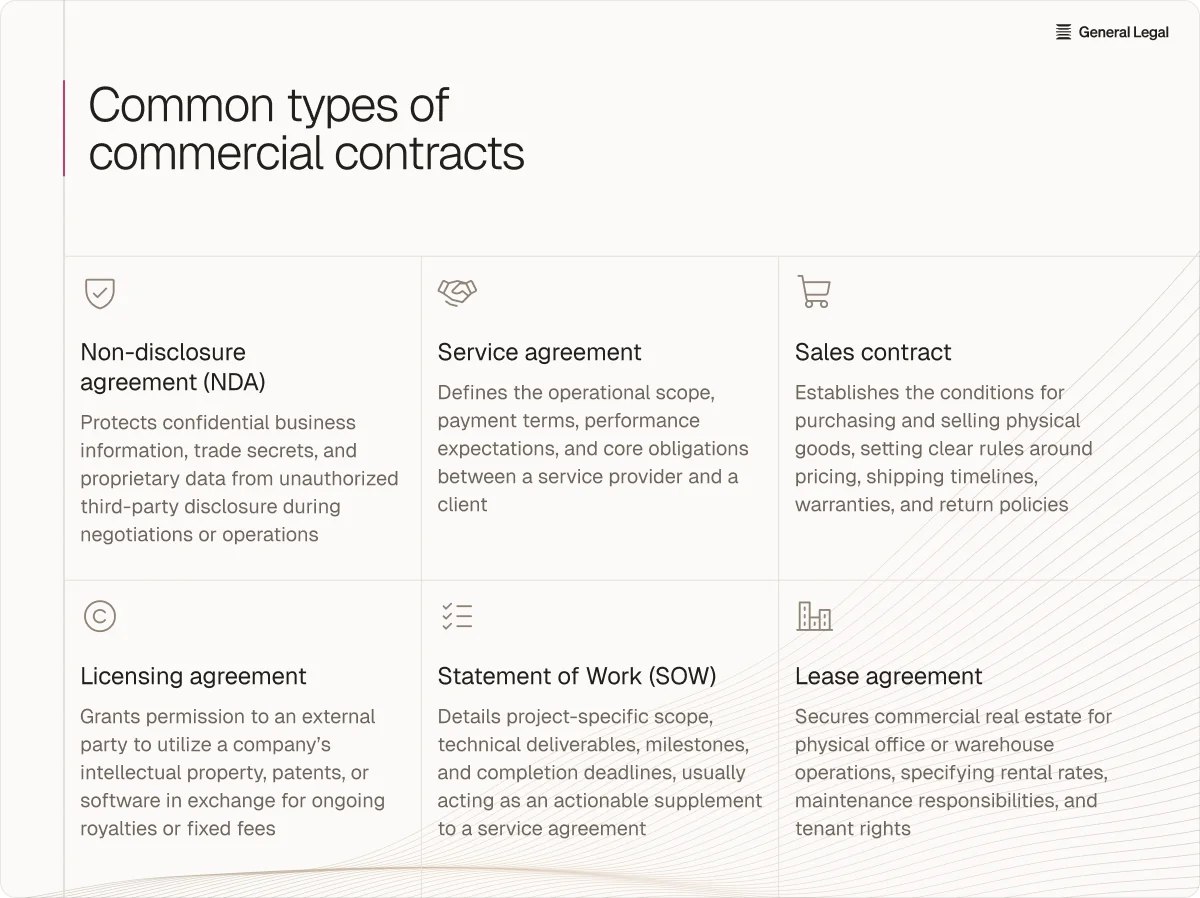
Contract law governs the legally binding agreements that businesses and individuals enter into. It establishes each party's rights and obligations and provides a framework for enforcing those obligations when one side fails to perform.
For businesses, contract law covers the full lifecycle of an agreement, from structuring and negotiating terms to reviewing obligations, managing risk, and resolving breaches.
When to call a contract lawyer:
- You’re negotiating terms with a customer, supplier, partner, or other business.
- The other party proposes terms that create unusual or potentially significant liability.
- You’re unsure whether an existing agreement adequately protects your business.
- A counterparty has failed to meet its contractual obligations.
- You need to enforce your rights or negotiate a resolution after a contract dispute arises.
2. Corporate law
Corporate law deals with the legal structure and lifecycle of a company, including its formation, governance, ownership, restructuring, and eventual dissolution.
There are differing views on how corporate law relates to commercial law. Some professionals treat them as separate but closely related areas of business law, while others consider corporate law a subset of commercial law.
For the purposes of this guide, we treat corporate law as a distinct type of commercial law because it provides the legal structure a business needs to operate, enter into commercial relationships, and pursue its broader business activities.
When to call a corporate lawyer:
- You’re choosing a legal structure for a new business and need advice on how to set it up.
- You’re bringing on co-founders and need to establish ownership and decision-making arrangements.
- You’re raising capital and need to structure the transaction and related shareholder rights.
- You’re changing your company’s ownership or equity structure.
- You’re considering buying, selling, or merging with another business.
- You’re restructuring the company and need to understand the legal implications.
- You’re unsure about your obligations as a director, shareholder, or investor.
- Your board or shareholders need guidance on a significant corporate decision.
3. Employment law
Employment law shapes the legal relationship between a business and its workforce, covering the rights, obligations, and standards that apply throughout that relationship. In a commercial setting, this extends beyond individual employee rights to issues that affect how a company hires, structures, manages, and changes its workforce.
For a growing company, employment issues can quickly become material legal exposure.
The Equal Employment Opportunity Commission secured $660 million for workers in FY2025—including a record $528 million through pre-litigation resolutions—which is a useful reminder that employment compliance isn’t just an HR concern.
When to call an employment lawyer:
- You’re hiring your first employees and need employment agreements that fit your business.
- You’re hiring executives and need to structure compensation or restrictive covenants.
- You’re unsure whether your workplace policies comply with applicable employment laws.
- You’re considering layoffs, redundancies, or another significant workforce change.
- You’re acquiring a company and need to assess its existing employment liabilities.
- An employee raises a discrimination, retaliation, wage, or wrongful termination claim.
- You need to negotiate severance or another employee exit arrangement.
4. Intellectual property law
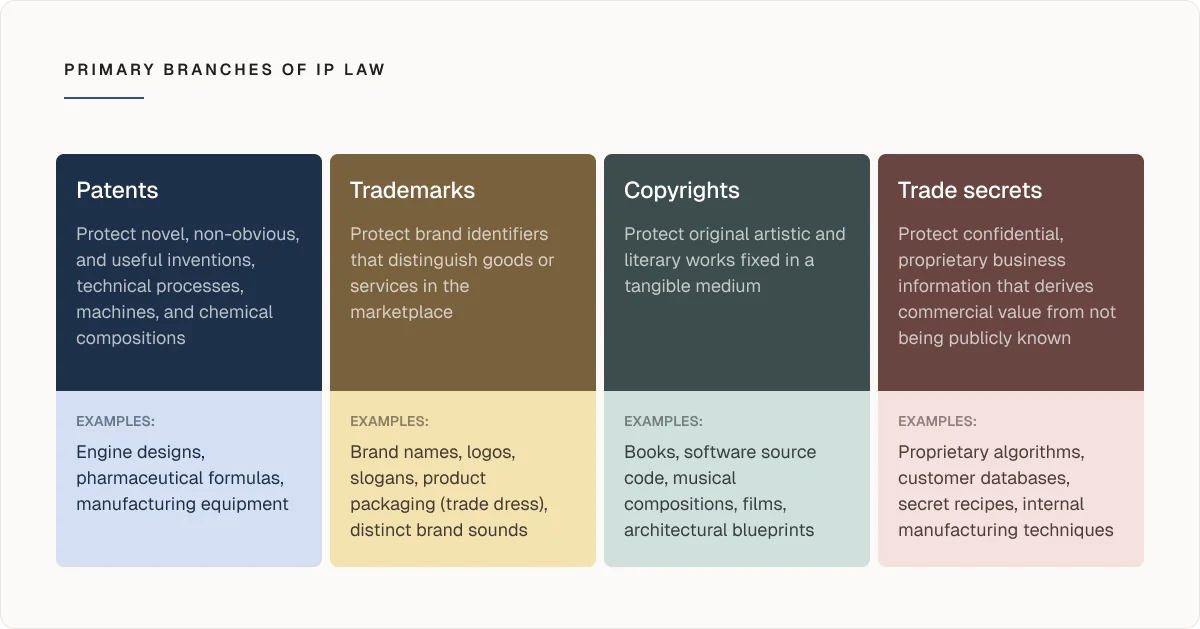
Intellectual property law deals with the legal rights attached to creations of human thought, from inventions and software to brand names, creative works, and confidential business information.
Unlike physical property, IP is intangible and can be used by multiple people without being depleted. This makes it easier to copy, misuse, or exploit without the owner’s permission, which is why businesses need legal protections around their intellectual property. The scale of that demand is clear in the trademark data: The United States Patent and Trademark Office received over 672,000 trademark applications by late August 2026—up 11.5% from the comparable period the year before.
Besides trademarks, IP law covers patents, copyrights, and trade secrets, each protecting a different type of business asset.
When to call an IP lawyer:
- You’re launching a brand and want to protect its name, logo, or other identifying assets.
- You’re developing a product or invention and need to assess patent protection.
- You’re creating software, content, or other original works and need to establish ownership.
- You’re sharing proprietary information with employees, contractors, investors, or potential partners.
- You’re licensing your IP to another business and need to structure the arrangement.
- You believe another company is using your IP without permission.
- You have received a claim that your business has infringed someone else’s IP.
5. Consumer protection law
Consumer protection law sets the rules for how businesses can market, sell, and provide products and services to the public.
In a commercial context, it’s designed to prevent consumers from being misled, exploited, or exposed to unsafe products and unfair terms. This includes rules around:
- Advertising claims
- Product safety
- Warranties
- Refunds
- Pricing
- Unfair contracts
- Handling of customer data
The consequences of getting these rules wrong can extend well beyond an unhappy customer. The FTC secured $1.8 billion in consumer relief in FY2025 through enforcement actions against fraudulent business and investment schemes, showing just how much financial and regulatory exposure businesses can face when they fall short of consumer protection requirements.
When to call a consumer protection lawyer:
- You’re launching a product or service and want to check that your marketing claims are compliant.
- You’re concerned that a product, promotion, or business practice could be considered misleading or unfair.
- A regulator has opened an investigation into your company’s consumer practices.
- A customer complaint has escalated into a legal claim or broader dispute.
6. Competition law
Competition law, known as antitrust law in the US, aims to keep markets open and competitive by limiting conduct that gives businesses an unfair advantage.
In practice, it covers conduct like price fixing, market allocation, and other cartel activity, as well as the misuse of market power and government review of major mergers and acquisitions.
When to call a competition lawyer:
- You’re planning a merger or acquisition and need to assess potential antitrust issues.
- You’re entering a joint venture and need to understand its competition-law implications.
- You’re negotiating pricing, distribution, or supply arrangements that could affect competition.
- You’re concerned that a proposed business practice could restrict or disadvantage competitors.
- You’re dealing with a competitor and need to know where legitimate competition ends and unlawful conduct begins.
- Your company has been accused of cartel conduct.
7. International trade law
International trade law comes into play when business crosses national borders. It provides the rules for moving goods, services, and capital between countries, helping companies navigate the tariffs, customs requirements, trade agreements, and other rules that can affect a cross-border transaction.
This type of commercial law can also become critical when a company faces anti-dumping investigations, trade disputes, or problems with counterfeit goods entering a market.
When to call an international trade lawyer:
- You’re entering a cross-border sales, distribution, agency, or supply agreement.
- You’re unsure how a product should be classified for customs purposes.
- You’re expanding into a new country and need to understand the trade rules that will apply.
- You’re dealing with export controls, sanctions, or restricted-party screening.
- You’re structuring a transaction involving letters of credit or other forms of trade finance.
- Customs authorities are challenging a shipment, classification, valuation, or country-of-origin determination.
- You’re facing a trade investigation.
- A cross-border business dispute requires international arbitration or another formal dispute process.
8. Banking and finance law
Banking and finance law sits at the intersection of business funding and financial regulation. It covers the legal arrangements that let companies borrow money, raise capital, use assets as collateral, and issue or trade financial instruments.
When to call a banking and finance lawyer:
- You’re taking on debt and need to negotiate a loan, credit facility, or other financing.
- You’re raising capital and need to structure a private placement or securities offering.
- You’re issuing shares, notes, bonds, or other financial instruments.
- A lender wants security over your company’s assets, and you need to understand the implications.
- You’re reviewing financing terms and aren’t sure what you’re agreeing to.
- You’re restructuring existing debt or negotiating with lenders during financial difficulty.
- You’re preparing for an SEC filing, disclosure, or other securities-law requirement.
- You’re facing a financial regulatory investigation or compliance issue.
9. Tax law
Tax law determines how businesses are taxed on what they earn, sell, own, and transact. In commercial practice, it reaches beyond calculating a company’s tax bill to the legal structuring of transactions and the tax consequences of business decisions.
When to call a tax lawyer:
- You’re deciding between an asset sale and a share sale.
- You’re negotiating a business agreement that includes tax warranties, indemnities, or other tax provisions.
- You’re facing a tax audit, investigation, or dispute with a tax authority.
- You’re considering a transaction or business arrangement and want to use available tax credits, deductions, or reliefs legally.
10. Insurance law
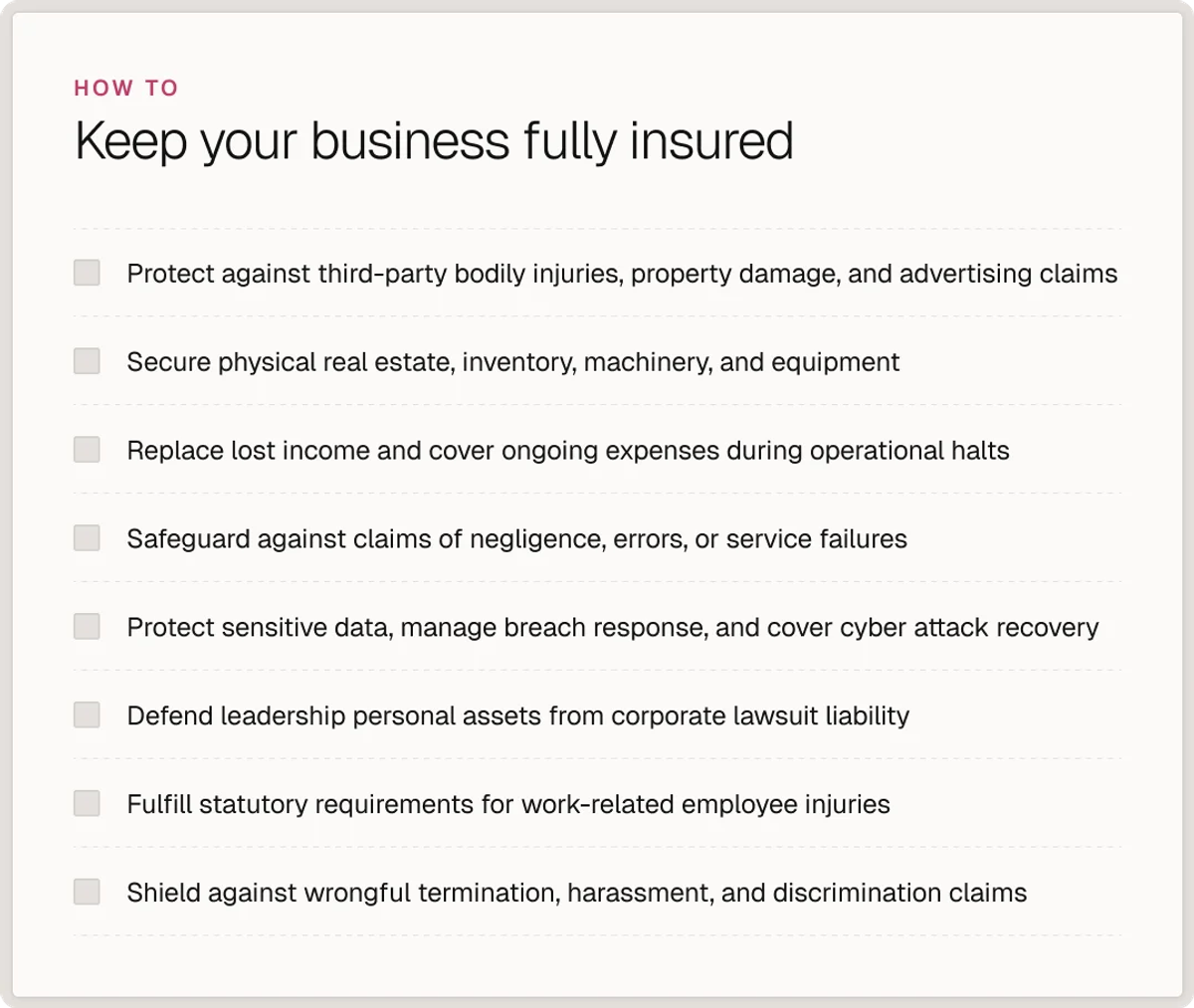
Insurance law shapes the legal relationship between a business and its insurers, determining what coverage means, what insurers and policyholders owe each other, and how disputes over coverage are resolved.
For a company, insurance is ultimately about transferring financial risk, but the value of that protection depends on what the policy actually covers. A policy that looks comprehensive on paper can still leave a business exposed if key risks, exclusions, or coverage conditions aren’t properly understood.
When to call an insurance lawyer:
- You’re buying commercial insurance and need help assessing the terms, exclusions, limits, or deductibles.
- You’re negotiating coverage for a significant business risk, such as cyber liability or directors’ and officers’ liability.
- Your insurer has denied a claim, and you believe the loss should be covered.
- You’re unsure how a policy applies to a specific loss or business interruption.
- You’re facing a third-party claim and need to understand whether your insurer has a duty to defend you.
- You’re negotiating with an insurer over the value or scope of a claim.
- You’re involved in a high-value insurance coverage dispute, arbitration, or litigation.
11. Bankruptcy and insolvency law
Bankruptcy and insolvency law becomes relevant when a business can no longer meet its financial obligations. Insolvency describes the financial problem; bankruptcy is the legal process that can be used to address it. For businesses, this can mean:
- Negotiating with creditors
- Restructuring debt
- Continuing operations under Chapter 11
- Liquidating assets when recovery isn’t viable
These options matter because financial distress doesn’t necessarily mean a company has to shut down. In fact, commercial Chapter 11 filings reached a 10-year high in 2025, highlighting how often businesses choose an alternative path instead of liquidation.
When to call a bankruptcy and insolvency lawyer:
- You’re struggling to pay debts as they come due and need to understand your options.
- You’re considering restructuring your debt rather than shutting down the business.
- A lender or creditor is threatening legal action or seeking to seize company assets.
- You’re negotiating new payment terms, forbearance, or a settlement with creditors.
- You’re considering filing for any form of bankruptcy protection.
- You’re buying a distressed business and need to understand its outstanding liabilities.
- You’re winding down the business and need to understand how its assets and creditors should be handled.
12. E-commerce law
E-commerce law applies commercial law to businesses that sell, market, and transact online. It isn’t a standalone code, but a combination of legal rules that shape digital transactions and online business operations.
In practice, it covers:
- Online contracts and terms
- Consumer protection
- Data privacy and security
- Digital advertising
- Responsibilities of online platforms and marketplaces
For startups and other digital-first businesses, e-commerce law issues can arise across the entire customer journey, from the moment someone lands on a website to the way their payment and personal data are handled.
When to call an e-commerce lawyer:
- You’re launching an online store and need website terms, privacy notices, and refund policies.
- You’re setting up an online checkout and need to make sure the transaction terms are legally sound.
- You’re collecting customer data and want to understand the privacy and security rules that apply.
- You’re launching digital advertising, email campaigns, or influencer partnerships and want to review the claims and disclosures.
- You’re selling through a marketplace and need to understand your obligations to customers and the platform.
- You’re using third-party software, cloud services, or other vendors to run your online business and need appropriate contracts.
- A customer, platform, regulator, or competitor has raised a legal complaint about your online business.
Note that you don’t need a different lawyer every time a new legal issue comes up. Work with a commercial law firm, and you can handle the full range of legal needs that come with building and running a business in one place.
For startups looking to move fast without sacrificing legal quality, partnering with General Legal is a more efficient way to manage the legal side of growth.
General Legal: Commercial law built for growth
General Legal is an AI-native law firm built for growing companies. Its highly qualified attorneys combine legal expertise with AI-native workflows to deliver commercial legal work more efficiently and predictably than traditional firms, with flat-fee pricing and direct access to counsel.
This approach addresses many of the challenges for commercial law firms that can make founders hesitant to seek legal help in the first place: slow turnaround times, opaque pricing, and traditional firms’ rigid, email-heavy workflows.
General Legal can help you with the following types of commercial law:
Ready to get started?
Register online and start sending legal matters to General Legal right away. Or, if you want to discuss your needs first, book a quick consultation to explore how we can help your team handle commercial legal work more efficiently.
- Commercial law encompasses at least 12 distinct practice areas, from contract and corporate law to bankruptcy, competition law, and e-commerce regulations.
- Choosing the wrong type of commercial counsel can result in paying for irrelevant expertise while leaving critical legal risks unaddressed.
- Employment law violations carry significant financial exposure, with the EEOC securing $660 million for workers in FY2025, including $528 million through pre-litigation resolutions.
- Financial distress doesn't always mean business closure—commercial Chapter 11 filings reached a 10-year high in 2025 as businesses pursued restructuring alternatives.
- E-commerce law isn't a standalone code but a combination of legal rules governing digital transactions, data privacy, online advertising, and platform responsibilities.
- Working with a commercial law firm allows businesses to address multiple legal needs in one place rather than engaging separate counsel for each issue.
| Contract law | Governs binding business agreements from negotiation through breach resolution and enforcement. |
|---|---|
| Corporate law | Covers company formation, governance, ownership, capital raises, M&A, and restructuring decisions. |
| Employment law | Addresses hiring, workplace policies, executive compensation, layoffs, and employment-related claims with significant financial exposure. |
| Intellectual property law | Protects trademarks, patents, copyrights, and trade secrets from unauthorized use or infringement. |
| Consumer protection law | Sets rules for marketing, product safety, warranties, refunds, and customer data handling, with the FTC securing $1.8 billion in relief in FY2025. |
| Competition and antitrust law | Prevents anti-competitive conduct like price fixing and governs merger reviews to maintain open markets. |
| International trade law | Navigates tariffs, customs, export controls, sanctions, and cross-border transaction requirements. |
| Bankruptcy and insolvency law | Provides restructuring options and creditor negotiation alternatives when businesses face financial distress. |
What is the definition of commercial law?
Commercial law is the body of law governing the rights, relationships, and conduct of people and organizations engaged in business and commercial activities.
What are the five principles of contract law?
The five main principles of contract law are offer, acceptance, consideration, capacity, and legality.
What are some examples of contract law?
Some examples of contract law are sales agreements, service agreements, employment agreements, NDAs, partnership agreements, licensing agreements, and vendor contracts.
Are there legal services that use AI to handle commercial law for lower fees?
Some legal services use AI to handle commercial legal work more efficiently, with firms like General Legal using those efficiencies to offer more predictable or lower-cost services.
How do fixed-fee legal services work for commercial law problems?
Fixed-fee legal services set a predetermined price for a defined commercial service or scope of work, rather than charging for each hour a lawyer spends on the matter. This approach is primarily made possible by combining AI-native workflows with experienced attorneys.
- Commercial Contract Litigation: When It Happens & How to AvoidExplore what you need to know about commercial contract litigation so you can understand common disputes, manage legal risks & protect your business.
- Commercial Law vs. Business Law: 5 Main DifferencesCompare commercial law vs business law so you can understand their differences, identify your legal needs & choose the right fit.
- Why Do You Need a Commercial Contract? [11 Practical Reasons]Learn why you need a commercial contract so you can protect your business, manage risk, and clarify responsibilities.