
A commercial contract is a legally binding agreement that sets out the rights, obligations, and expectations of the parties in a business relationship.
How you draft this document matters because it can make or break your position when things go wrong.
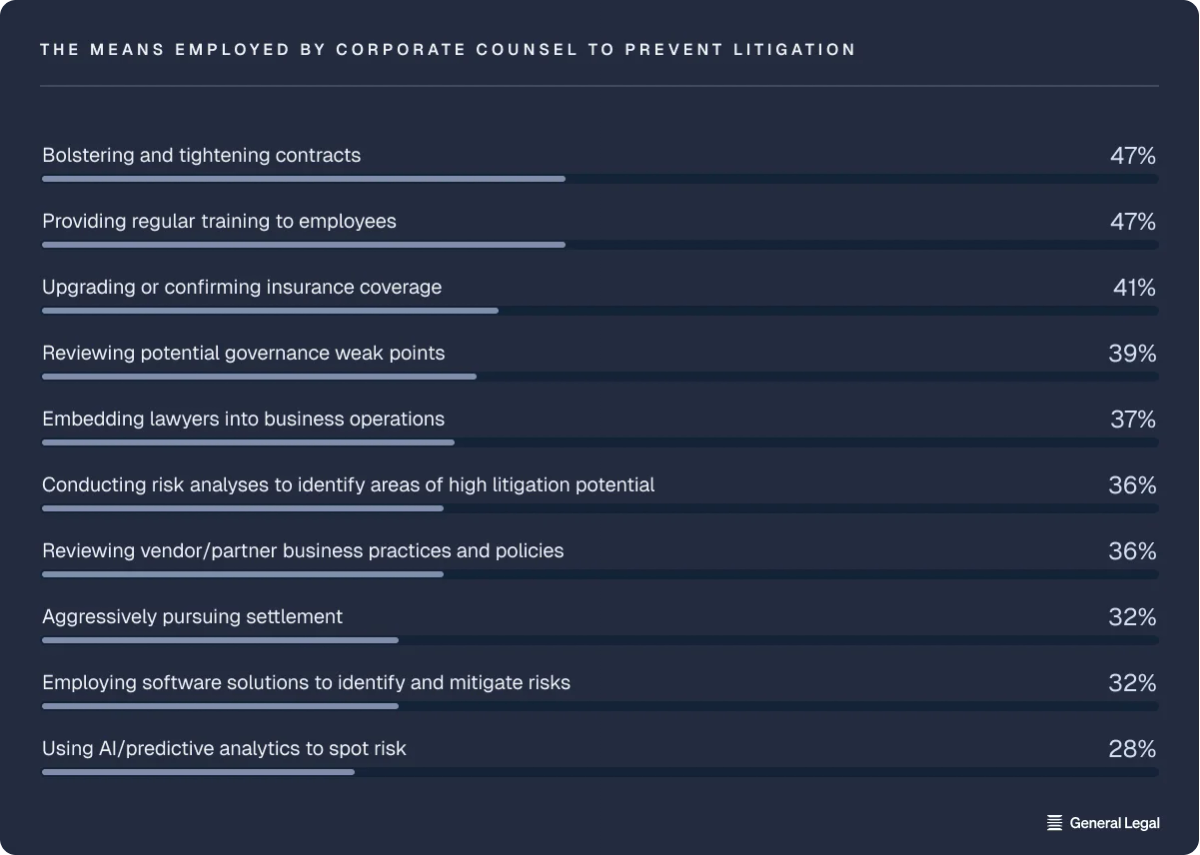
According to Norton Rose Fulbright’s 2026 Annual Litigation Trends Survey, based on more than 400 US general counsel and in-house litigation leaders, contracts were the top area of litigation concern. This helps explain why 46% of respondents are bolstering and tightening contracts to prevent litigation.
Much of that effort comes down to making sure the contract addresses the relationship's pressure points, rather than leaving them to interpretation later.
This guide explains what should be included in a commercial contract, grouping the 15 key clauses into the foundations of the commercial relationship, provisions that protect the parties and manage risk, and terms that govern the relationship over time.
Key takeaways
- Start with the commercial basics Clearly define the parties, scope, payment terms, term, and change management.
- Focus on the clauses that allocate risk Representations, indemnities, liability limits, confidentiality, data protection, and IP can have the biggest financial consequences.
- Make the contract work when things go wrong Well-defined termination, force majeure, and dispute resolution provisions give both parties a defined path through disruption or conflict.
- Match the contract to the actual deal The right clauses depend on the transaction, the parties, the data and IP involved, and the risks the relationship creates.
- Get legal help when the stakes are high General Legal can review an existing contract or draft one from scratch, with AI accelerating the work and US-barred attorneys responsible for the final legal product.
Setting the foundations of the commercial relationship
These five types of clauses set out the basic mechanics of the deal, giving the rest of the contract a solid foundation.
1. Parties
Who the agreement is between is the starting point for any commercial contract.
This clause identifies the parties that are taking on rights and obligations under the deal, so there’s no ambiguity about who’s responsible for performing it or entitled to enforce it.
Pay close attention to the parties’ full legal names and details, and confirm that every entity that needs rights or obligations under the contract is included. This matters particularly where subsidiaries, affiliates, or guarantors are involved, as an entity that isn’t a party generally can’t take on contractual obligations or claim contractual rights.
2. Scope of work
In a commercial relationship, vague expectations can easily turn a routine disagreement into a contractual dispute.
The scope of work clause prevents this outcome by precisely defining the goods or services to be delivered, together with:
- Milestones
- Deadlines
- Performance standards
Where a Statement of Work (SOW), specification, or proposal forms part of the deal, identify it clearly and state which document takes priority if they conflict.
The clause should clearly set out what is out of scope and make obligations measurable. For example, an AI startup providing an automated customer support platform might agree to deliver access to the platform, integrate it with two specified customer systems, support up to 50,000 customer interactions per month, and meet defined uptime and response time requirements.
Pro tip:
For services, be precise about whether the provider is promising to use reasonable skill and care or to deliver a specific result.
3. Payment and pricing
Payment and pricing are a core commercial term because they determine the financial obligations between the parties and the consequences of failing to meet them.
This clause should define:
- Price and compensation structure
- Invoice timing and payment deadlines
- Accepted payment methods and currency
- Applicable taxes, including VAT treatment
- Expenses, delivery charges, foreign exchange costs, and third-party fees
- Payment milestones, installments, and retention arrangements
- Interest, fees, and other consequences for late payment
If prices can change during the term, the contract should also say when an adjustment is permitted and how it’s calculated.
4. Term and renewal
This clause sets the contract’s lifespan, including:
- When it starts
- When it ends
- Whether it renews automatically or requires the parties to agree to an extension
An automatic renewal can keep an ongoing deal running smoothly, but it can also lock a business into another term if the deadline is missed.
For longer or higher-value agreements, make sure the renewal terms work with any changes to pricing, minimum commitments, or other commercial terms.
5. Change control
Commercial arrangements rarely stay exactly as agreed. A customer may request additional features, an accelerated delivery date, or a different scope, while the resulting change may affect the price, timetable, or dependencies.
A change control clause sets out how those changes are proposed, recorded, and approved.
Changes can also shift the balance of risk between the parties, which is why the contract should determine how any resulting increase in liability or exposure is allocated.
Protecting the parties and managing risk
These six clauses often carry the contract’s biggest legal and financial consequences.
1. Representations and warranties
Contracts often rely on one party taking the other’s word on matters important to the deal, such as its authority to sign, ownership of assets, legal compliance, or the accuracy of information it has provided.
This clause turns those assurances into contractual commitments.
A representation is essentially a statement of fact made to induce the other party to enter the deal, while a warranty is a contractual promise that a stated fact or condition is true.
If a representation or warranty proves inaccurate, it can trigger contractual remedies and, depending on the agreement, indemnification obligations.
2. Indemnification
This clause answers a simple question: If a particular problem occurs, which party picks up the bill?
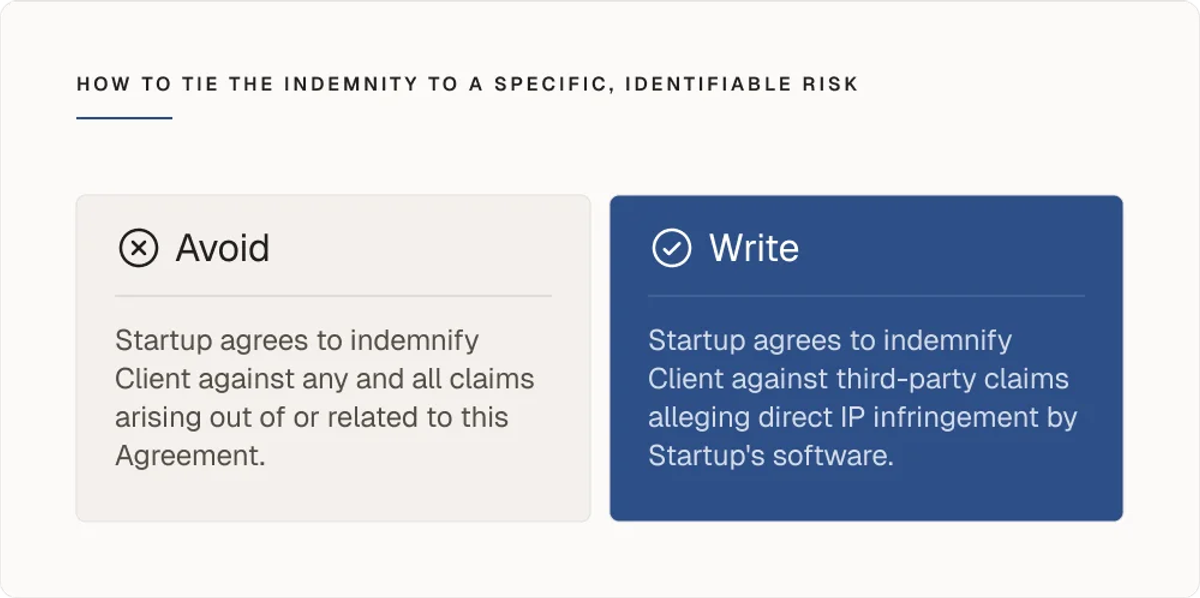
It’s a contractual promise to compensate the other party for specified losses, often where a third party makes a claim arising from the deal. For example, if a SaaS startup’s software infringes someone else’s IP and the customer gets sued, an IP indemnity may require the startup to cover the resulting claim and legal costs.
The clause should define the following:
- Covered claims, losses, damages, and legal costs
- Specified events that trigger the indemnity
- Exclusions and limitations
- Responsibility for defending and settling claims
- Any financial caps or other limits on the indemnifying party’s exposure
Make sure to always match the indemnity to the actual risks of the deal.
Broad language can shift far more exposure than intended, so check exactly which claims are covered, whether there are appropriate exclusions, and whether the financial protection is proportional to the risk being allocated.
3. Limitation of liability
When something goes wrong, a liability clause determines how much of the resulting financial damage one party can recover from the other. The clause typically:
- Sets a maximum liability cap
- Excludes certain categories of loss (e.g., loss of goodwill)
- Identifies liabilities that are subject to different rules
The right structure depends on the deal and the risks involved. A supplier may seek a cap tied to fees paid over a defined period, while a customer may reasonably push for greater protection if the supplier handles sensitive data or operates a business-critical system.
4. Confidentiality
Commercial relationships often require parties to share information they would never want in a competitor’s hands, from trade secrets and proprietary methods to pricing, financial data, customer information, and the terms of the deal itself. A confidentiality clause sets the rules for protecting that information. It should define:
- Confidential information covered by the clause
- Permitted uses and recipients
- Exceptions to the confidentiality obligation
- Required security, return, or destruction of information
- The duration of the confidentiality obligation, including any period after termination
If confidential information includes personal data, the contract may also need separate privacy and security obligations to address the legal requirements that apply to that data.
5. Data protection and security
A contract that involves personal data needs to account for both the commercial data flows and the laws that govern them, including:
- General Data Protection Regulation (GDPR)
- California Consumer Privacy Act (CCPA)
- Health Insurance Portability and Accountability Act (HIPAA)
Protecting sensitive personal information is crucial because a breach can carry serious financial and legal consequences.
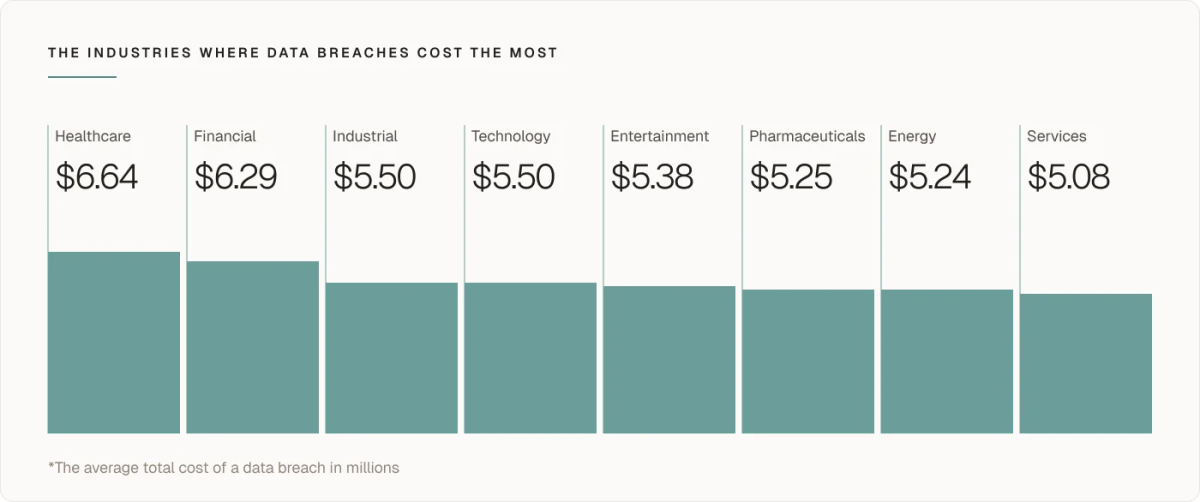
Take healthcare data as an example. IBM’s 2026 Cost of a Data Breach Report found that healthcare breaches cost an average of $6.64 million, the highest of any industry for the 13th consecutive year.
To ensure personal data is properly protected throughout the relationship, this commercial contract clause or data protection schedule should cover:
- The types of personal and sensitive data involved
- The parties’ roles and responsibilities in processing that data
- Permitted processing, security measures, and access controls
- Sub-processors and other third-party access
- International data transfers
- Breach notification and cooperation obligations
- Assistance with data subject rights and other regulatory requirements
Pro tip:
Draft this clause around the actual data flow.
If a supplier hosts customer data, accesses employee records, or uses an overseas support team, the contract should address those specific activities. A generic promise to “comply with applicable privacy laws” won’t cover those details.
Read more:
- The Real DSAR Problem: Finding Where Personal Data Lives
- A GDPR-Compliant Vendor Doesn’t Automatically Mean Your Data Transfer Is Legal
- So Which Privacy-Enhancing Technology Should You Use?
6. Intellectual property
Intellectual property (IP) can be one of the most valuable assets involved in a commercial deal, particularly when the relationship involves software, product development, creative work, or proprietary technology.
That’s why the commercial contract should distinguish between:
- Background IP (IP owned by a party before the contract)
- Foreground IP (IP created during the engagement)
- Licenses and usage rights (permissions each party receives to use IP it doesn’t own)
- Third-party and open-source IP (materials subject to separate licensing restrictions)
Never assume that paying for a deliverable means owning all of the IP behind it. A software provider may retain ownership of its underlying platform while granting the customer a license to use it. So, make sure that license covers the uses the business actually needs, including access by group companies, employees, contractors, or replacement service providers where relevant.
The contract should also account for what happens to those (and other) rights over the life of the relationship.
Managing the relationship over time
These four clauses govern what happens after the contract is signed, giving the relationship a framework for handling the problems that arise over time.
1. Termination
Contracts need a clear exit route when the relationship stops working.
A termination clause sets out when either party can end the agreement—for example, following a material breach, insolvency, or simply for convenience—and what notice is required.
The key is to make those rights practical: A fixable breach will often include a notice and cure period, while serious failures may justify immediate termination.
The clause should also cover what happens after termination, including:
- Final payments
- Return or deletion of data
- Handover of work in progress
- Any ongoing obligations (e.g., confidentiality)
2. Force majeure
Commercial relationships can be disrupted by events no party could reasonably prevent, such as:
- Natural disasters and extreme weather events
- War, terrorism, and civil unrest
- Government actions, restrictions, or shutdowns
- Pandemics and public health emergencies
- Strikes and other major labor disturbances
- Significant supply chain breakdowns
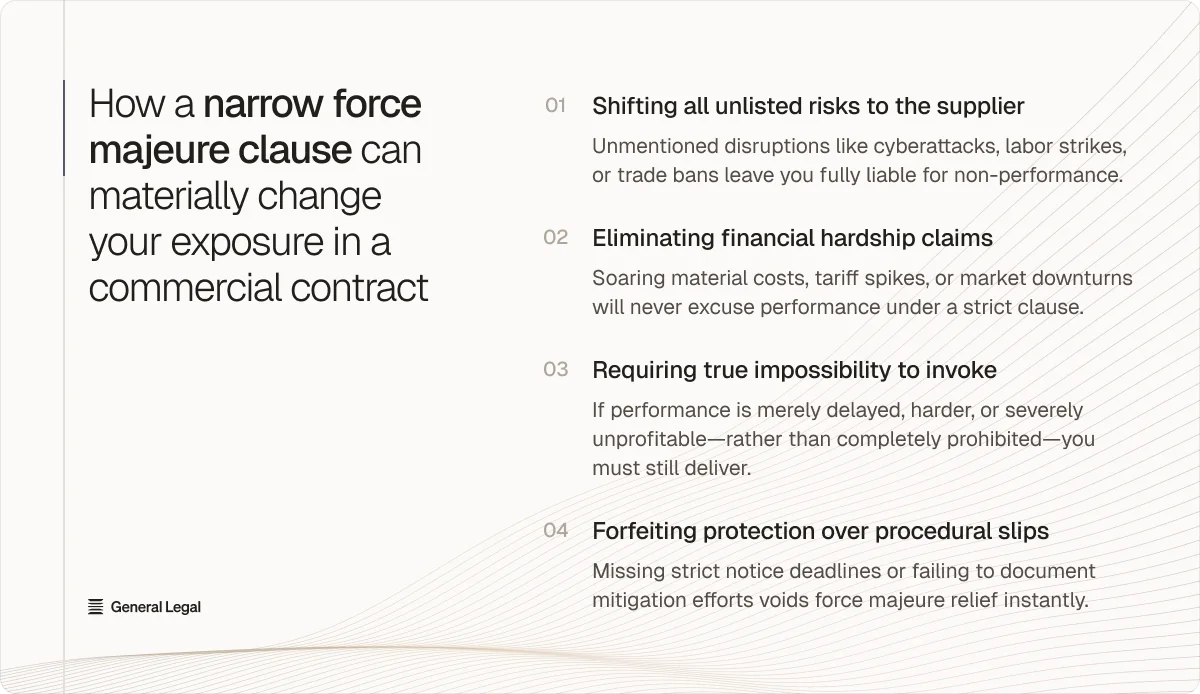
A force majeure clause sets the rules for what happens when one of these events prevents or delays a party from fulfilling its contractual obligations. It should also require prompt notice, reasonable mitigation, and updates while the disruption continues, and set out what happens if it lasts beyond an agreed period.
Pro tip:
Keep the trigger specific. Ordinary staffing problems, poor planning, or financial difficulty shouldn’t become a free pass for non-performance.
3. Dispute resolution
A dispute resolution clause gives the parties a process to follow before a disagreement turns into a full-blown fight, with common approaches including:
- Negotiation between the parties or senior representatives
- Mediation with an independent third party
- Arbitration under agreed rules
- Litigation in the courts
A staged process can make sense for many commercial relationships, but it shouldn’t prevent a party from seeking urgent court relief (for example, to protect confidential information or stop misuse of IP).
4. Governing law and jurisdiction
Contractual language can be interpreted differently across legal systems, so the contract should settle upfront which rules apply and where disputes will be heard.
The governing law clause identifies the legal system used to interpret the agreement, while the jurisdiction clause identifies the courts or other forum with authority to resolve disputes.
In cross-border deals, getting this wrong can mean litigating overseas and taking advice from unfamiliar counsel.
Where possible, consider whether the chosen law and forum are aligned with the dispute resolution process elsewhere in the contract.
Other clauses to consider
Depending on the nature of the transaction, the commercial relationship, and the parties involved, a contract may also need the following clauses:
- Restrictive covenants: These provisions limit activities like competing with the business or soliciting its customers or employees.
- Assignment: The assignment clause governs whether and when a party can transfer its rights or obligations under the contract to another entity.
- Notices: Formal notice provisions set out the permitted methods for giving contractual notices and when those notices are considered received.
- Waiver: A waiver provision makes clear that a party’s failure to enforce a contractual right doesn’t necessarily mean it has given up that right.
- Severability: This provision keeps the rest of the agreement in effect if a court or other authority finds one term unenforceable.
- Entire agreement: An entire agreement clause establishes that the written contract is the parties’ complete agreement and can limit reliance on prior discussions or representations.
- Audit rights: Audit provisions allow one party to inspect specified records or systems to verify contractual compliance.
- Business continuity and disaster recovery: These provisions require measures for maintaining critical services and recovering operations after a major disruption.
- Non-disparagement: A non-disparagement clause restricts specified negative or damaging statements about the other party.
- Acceptance procedures: Acceptance provisions establish how the parties will determine whether delivered goods, services, or work product meet the agreed requirements.
- Definitions and interpretation: These provisions define key terms and establish rules for interpreting the agreement.
For startups and growing companies without a dedicated legal function, a list like this can get overwhelming fast. If you’re unsure how these clauses apply to your deal, drafting a commercial contract from scratch alone may not be the best option.
In this scenario, you have two practical options: Use a reputable template for a standard agreement, or bring in a lawyer when the deal is more complex or the risks are higher. General Legal, an AI-native law firm, offers both options.
How General Legal can help with your commercial contract
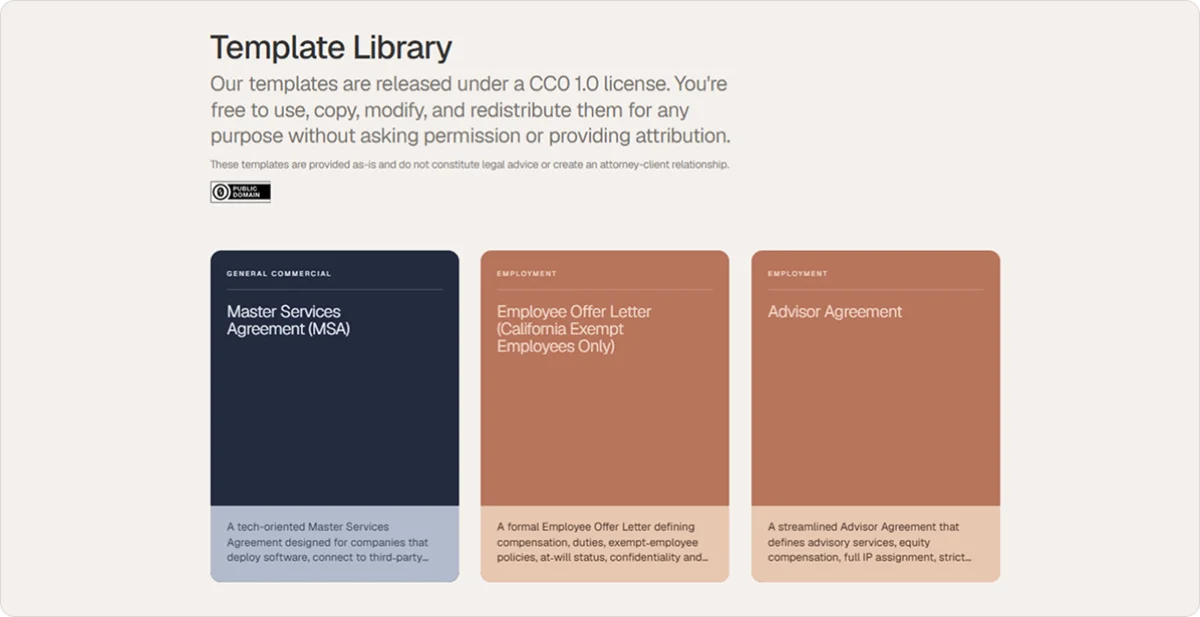
General Legal’s Template Library includes ready-to-use agreements for common startup and commercial needs, including:
- Master Services Agreements (MSAs) for software, integrations, and ongoing platform services
- One-way and mutual NDAs for protecting confidential information
- Terms of Use for governing access to and use of a website or product
The templates are released under a CC0 1.0 license, so you can use, copy, modify, and redistribute them without asking permission or providing attribution.
If, however, your contract is high-value, heavily negotiated, business-critical, or just outside your comfort zone, a lawyer can review an existing agreement or draft one from scratch. Here, General Legal takes a different approach from the traditional law firm model by offering:
- Contracts returned in hours, not weeks: AI handles the routine contract work so attorneys can turn around commercial agreements in hours rather than days or weeks.
- Top-firm legal judgment: The work is performed and delivered by highly qualified US-barred attorneys, who are responsible for the final product.
- Flat-fee pricing: You get an upfront price instead of watching an hourly bill climb while a contract sits in review.
- Practical communication: Work can happen directly in Slack, where founders already operate, rather than through endless email chains.
You can start with a solid template and a commercial contract checklist when that’s enough, and bring in experienced counsel when the deal calls for it.
If you would like to bring in legal help straight away, register online and send General Legal your first commercial contract for review or drafting. Have questions first? Book a quick 10-minute call to discuss how General Legal can help.
FAQ
What clauses should be in a contract?
Clauses that should be in a contract include:
- Parties
- Scope and obligations
- Payment and pricing
- Term and termination
- Representations and warranties
- Confidentiality
- Intellectual property
- Limitation of liability
- Indemnification
- Dispute resolution
- Governing law and jurisdiction
What are the 7 essential elements of a contract?
The seven essential elements of a contract are offer, acceptance, consideration, mutual assent or intent to be bound, legal capacity, a lawful purpose, and sufficiently definite terms.
What is the difference between an agreement and a contract?
The difference between an agreement and a contract is enforceability. An agreement is a mutual understanding between parties, while a contract is an agreement that satisfies the applicable legal requirements and creates obligations that the law will enforce. In other words, every contract is an agreement, but not every agreement is a contract.
- Commercial contracts should address the relationship's pressure points rather than leaving them to interpretation, as contracts are the top litigation concern for 46% of US general counsel surveyed.
- The 15 key clauses fall into three categories: foundational commercial terms (parties, scope, payment, term, change control), risk allocation provisions (representations, indemnities, liability limits, confidentiality, data protection, IP), and relationship management terms (termination, force majeure, dispute resolution, governing law).
- Data protection clauses must address actual data flows and specific regulatory requirements like GDPR, CCPA, and HIPAA, as healthcare data breaches alone cost an average of $6.64 million according to IBM's 2026 report.
- IP provisions should clearly distinguish between background IP, foreground IP, licenses, and third-party IP, as paying for a deliverable doesn't automatically mean owning all the IP behind it.
- Liability clauses determine maximum exposure and exclude certain loss categories, with the right structure depending on the deal's specific risks such as whether sensitive data is handled or business-critical systems are operated.
- Well-drafted termination, force majeure, and dispute resolution clauses provide defined paths through disruption or conflict, with termination provisions covering exit routes, final payments, data handling, and ongoing obligations.
| Foundation clauses | Parties, scope of work, payment terms, term/renewal, and change control establish the basic mechanics and commercial terms of the relationship. |
|---|---|
| Risk allocation clauses | Representations, indemnities, liability limits, confidentiality, data protection, and IP provisions carry the biggest legal and financial consequences. |
| Payment and pricing structure | Must define compensation, invoice timing, payment methods, taxes, expenses, milestones, and consequences for late payment including interest and fees. |
| Data protection requirements | Contracts involving personal data must address GDPR, CCPA, HIPAA compliance, specify data types, processing roles, security measures, sub-processors, and breach notification obligations. |
| IP ownership and licensing | Distinguish background IP (pre-existing), foreground IP (created during engagement), usage licenses, and third-party IP to prevent ownership disputes. |
| Indemnification provisions | Specify which party covers losses for particular problems, defining covered claims, triggering events, exclusions, defense responsibilities, and financial caps. |
| Termination and exit | Set clear exit routes for breach, insolvency, or convenience, with notice requirements and post-termination obligations for payments, data return, and handover. |
| Dispute resolution process | Establish whether parties will use negotiation, mediation, arbitration, or litigation, with staged processes preventing escalation while preserving urgent relief rights. |
What's the difference between a representation and a warranty in a commercial contract?
A representation is a statement of fact made to induce the other party to enter the deal, while a warranty is a contractual promise that a stated fact or condition is true. If either proves inaccurate, it can trigger contractual remedies and potentially indemnification obligations.
Does paying for a deliverable mean I own all the intellectual property behind it?
No. A software provider may retain ownership of its underlying platform while only granting the customer a license to use it. You must ensure the license covers your actual needs, including access by group companies, employees, contractors, or replacement service providers where relevant.
What should a data protection clause cover if my contract involves personal data?
It should cover the types of personal and sensitive data involved, the parties' processing roles and responsibilities, permitted processing and security measures, sub-processors, international data transfers, breach notification obligations, and assistance with data subject rights and regulatory requirements under laws like GDPR, CCPA, or HIPAA.
How should I structure a liability cap in a commercial contract?
The right structure depends on the deal and risks involved. A supplier may seek a cap tied to fees paid over a defined period, while a customer may push for greater protection if the supplier handles sensitive data or operates business-critical systems. The clause should set a maximum liability cap, exclude certain loss categories, and identify liabilities subject to different rules.
What events should a force majeure clause cover?
It should cover events no party could reasonably prevent, such as natural disasters, war, terrorism, government restrictions, pandemics, and significant supply chain breakdowns. However, it should not cover ordinary staffing problems, poor planning, or financial difficulty. The clause should require prompt notice, reasonable mitigation, and specify what happens if the disruption exceeds an agreed period.
When should I use a contract template versus hiring a lawyer?
Use a reputable template for standard, lower-risk agreements. Bring in a lawyer when the deal is high-value, heavily negotiated, business-critical, involves complex IP or data flows, or is outside your comfort zone, as experienced counsel can identify risks and pressure points that templates may not address.
- Commercial Terms vs. Legal Terms: 5 Key DifferencesCompare commercial terms vs legal terms so you can understand key differences, spot risks, and protect your interests before signing a contract.
- How to Compare Legal Contracts Before You Sign: Full GuideLearn how to compare legal contracts so you can spot important changes, identify hidden risks, review key terms, and protect your interests.
- Why Do You Need a Commercial Contract? [11 Practical Reasons]Learn why you need a commercial contract so you can protect your business, manage risk, and clarify responsibilities.