
The distinction between commercial terms vs. legal terms is real and useful, but it isn't a permission slip to skim half the MSA. The provisions that decide how much you owe when something breaks, or whether you can recover at all, sit squarely in the overlap.
World Commerce & Contracting's 2025 contract management whitepaper puts average value erosion, the deviation between what a contract was supposed to deliver and what it did, at 8.6%. WorldCC's ROI of Contracting Excellence research puts the best performers at a little over 3% and the worst above 20%.
The same whitepaper found only 39% of commercial practitioners believe their contracts effectively deliver the intended outcome, and just 16% believe negotiations focus on the right topics. Nearly 90% of business users say they find contracts difficult or impossible to understand.
Every clause in a signed contract is a legal term, whether or not a lawyer wrote it. This guide covers what sits on each side of the line, why the overlap is where founders get hurt, and what you need to notice before anything reaches counsel.
What are commercial terms?
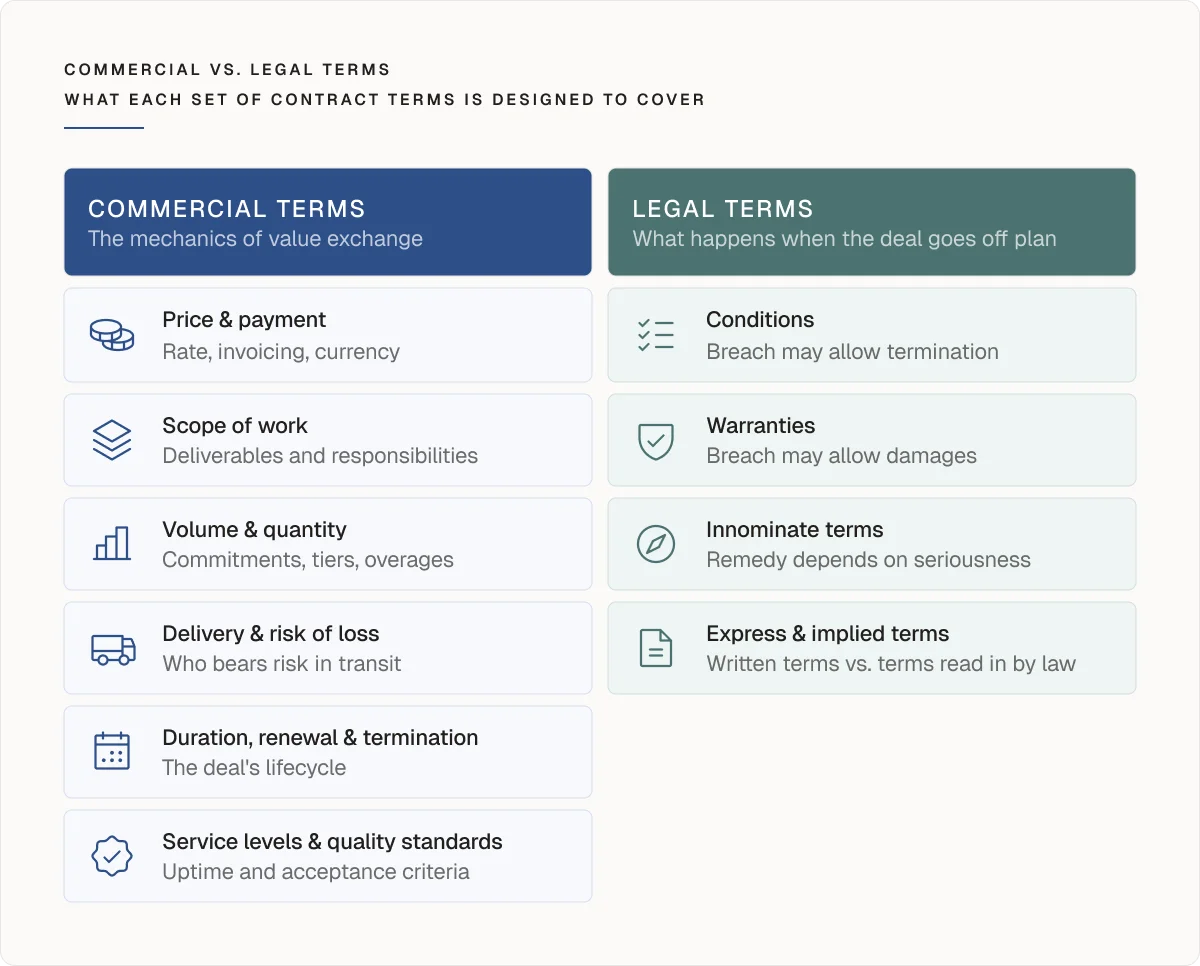
Commercial terms are the mechanics of value exchange: the provisions that answer what each side is agreeing to do, and on what terms. In practice, that covers:
- Price and payment terms: Rate, invoicing schedule, currency, and late-payment consequences
- Scope of work or services: Deliverables, responsibilities, and performance requirements
- Volume and quantity: Minimum commitments, usage tiers, and overage rules
- Delivery and risk of loss: Allocation of risk while goods or work product are in transit
- Duration, renewal, and termination triggers: The deal's lifecycle
- Service levels and quality standards: Uptime commitments and acceptance criteria
These reflect the value and risk of the deal as negotiated by people who understand the market, the product, and the relationship, and they are the reason a commercial contract exists in the first place.
Many contract systems use modular drafting: a short order form capturing deal-specific terms sits on top of a longer set of general terms incorporated by reference. That's exactly why the order form feels negotiable, and the general terms feel fixed. Structurally, on the vendor's side, they usually are.
What are legal terms?
Legal terms answer a different question: What happens when the deal doesn't go as planned? They cover rights and remedies, how disagreements get resolved, and whether the agreement is enforceable at all.
Contract law classifies these by consequence:
- Conditions: Fundamental terms where breach lets the wronged party terminate the whole contract
- Warranties: Lesser terms where breach gives rise to damages but not termination
- Innominate terms: Terms where the remedy depends on how serious the breach turns out to be
- Express and implied terms: What's written into the contract, versus what courts or statutes read into it regardless
Then there's boilerplate, the back-of-the-contract provisions most people scroll past to reach the signature block. Boilerplate looks like filler, but it isn't. Governing law and jurisdiction, indemnification, limitation of liability, warranties and disclaimers, confidentiality, notices, entire agreement, severability, no waiver, assignment, and force majeure all live back there.
This is where one-sided language quietly accumulates, because nobody on the business side reads it closely, and everyone assumes it's standard. It often isn't.
Commercial terms vs. legal terms: 5 key differences
Side by side, the split may look tidy at first glance. The five differences below are the ones to check.
1. What you'll actually be agreeing to
Commercial terms commit you to doing something: delivering, paying, or performing to a standard. Legal terms commit you to a framework for what follows if you don't. One is a promise about the ordinary course, the other about the exception. Both are enforceable.
2. Who you'll be negotiating with
Commercial terms get negotiated between business teams who understand the market. Legal terms are usually drafted by counsel and, in most startup deals, never negotiated by anyone. That asymmetry is the whole problem. The side with a lawyer reading the back half sets the back half.
3. How much you'll be able to move them
Commercial terms are expected to change deal by deal, which is why they sit in the order form. Legal terms are presented as standard, and the presentation does most of the work. However, "standard" is a claim, not a constraint. Vendors redline their general terms more often than their paper suggests.
4. What you'll be left holding if it breaks
If a commercial term underdelivers, you get a worse deal than you wanted. If a legal term is wrong, you may have no practical way to do anything about it.
A liability cap reading "aggregate liability shall not exceed fees paid in the prior twelve months" is a number your sales team is comfortable with, right up until it's the number capping your recovery after a vendor outage costs you a customer.
5. Where you'll find the two overlapping
Four provisions belong on both lists, and they're the ones that matter most:
WorldCC's Most Negotiated Terms research has ranked limitation of liability at or near the top for years, ahead of price and indemnification. Three of the four hardest-fought provisions in commercial contracting are legal terms.
That's not a coincidence, and it explains where the damage concentrates.
Why the overlap is where founders get hurt
These provisions get fought over precisely because they allocate real dollars. They're also enforced on their exact words rather than on what either side assumed was standard. Treating the two areas separately with no overlap is how one-sided boilerplate survives deal after deal. Business teams assume legal has it covered; counsel, if they're in the room at all, assume the commercial terms are locked and out of scope.
The fix is making sure someone reads the whole contract rather than just the pages another person flagged.
Does the law define "commercial"?
There's no single statutory definition of "commercial" in US law. The closest operative framework is the Uniform Commercial Code.
UCC Article 2 governs transactions in goods, excluding security transactions and certain consumer-protected sales. Goods are all things movable at the time of identification to the contract, which doesn’t include money, investment securities, and things in action.
Beyond that, commercial law is an umbrella covering business, commerce, and consumer transactions, assembled from federal, state, and international rules rather than one clean code.
Here's why it matters if you sell software. For contracts mixing goods and services, courts apply the predominant-purpose test from Bonebrake v. Cox to decide whether Article 2 applies. Physical, boxed software has been treated as a good. However, pure SaaS generally falls outside Article 2 entirely, which means your warranty and remedy provisions aren't riding on UCC default rules. They stand entirely on what your contract says.
For software companies specifically, there's no statutory safety net catching the gaps. Which makes knowing what to look for more valuable.
4 red flags to catch before a contract reaches a lawyer
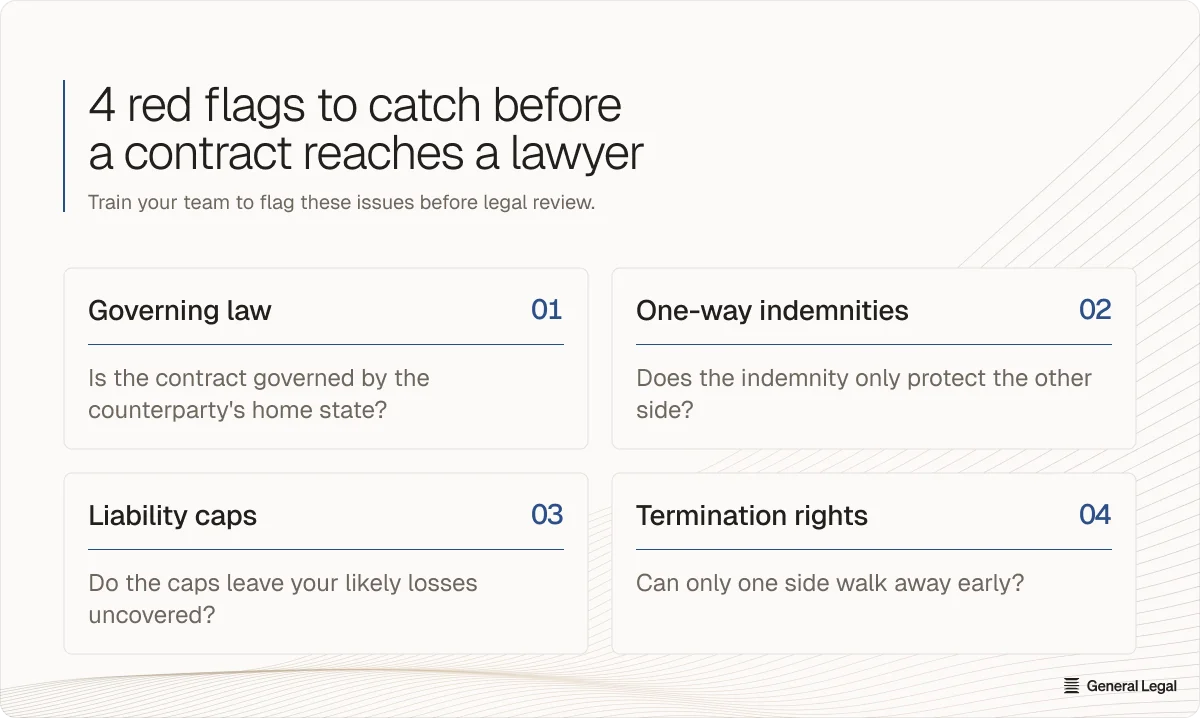
None of this requires a law degree, just a team that knows what to flag:
1. Governing law set to the counterparty's home state: This is especially important if you have no operations or connections there. Litigating on unfamiliar turf under unfamiliar law is expensive before anyone argues the merits.
2. One-way indemnities: An indemnity that only runs in the counterparty's favor means you're funding their third-party claims and absorbing your own. Mutuality is the ask that's hardest to argue against in principle.
3. Liability caps that exclude your likely damages: Check whether the cap's carve-outs are symmetrical and whether the damages you'd realistically suffer are the ones excluded from recovery.
4. Termination rights that only run one way: Confirm the exit rights match the commercial term you thought you negotiated. A three-year commitment with a 30-day convenience termination on the vendor's side only is a one-year deal wearing a three-year label.
Catching red flags narrows the problem, but it doesn't solve it. Someone still has to read the other 38 pages, which is where the model you use for legal review starts to matter.
Read more: Contract Review & the AI-Native Model
General Legal helps you with the whole contract, not just the legal pages
Whole-document review is the obvious answer and almost nobody does it, for a reason worth naming. At hourly rates, a full read of a 40-page MSA is a real invoice for a deal that may not close, and it takes days you don't have when the counterparty wants signature on Monday.
So the review gets scoped down to the pages someone flagged, and the overlap goes unread again.
General Legal is an AI-native law firm that pairs elite, US-barred attorneys with AI-powered workflows built specifically for legal work, serving startups and growth-stage companies.
AI agents read every page first, triaging the document, surfacing risk, and marking issues with proposed redlines. That division of labor is what keeps AI out of the judgment seat.
Attorneys then handle judgment: whether a cap is defensible for this deal, whether an indemnity is survivable, what to concede, and what to hold. Because the mechanical pass is automated, reading the whole agreement costs roughly what reading part of it used to.
For a contract on your desk right now, that means:
- The full agreement, not the flagged pages: MSAs, DPAs, NDAs, vendor agreements, ToS, and EULAs read end to end
- A redline you can send: Issues marked with a recommended position rather than a list of observations
- A negotiation guide cover letter: On a standard review, a walkthrough of every change, the risk of accepting the original language, and a fallback where one makes sense
- An attorney's name on it: AI output is reviewed by a US-barred lawyer before it reaches you
- An answer inside the deal window: Standard commercial contracts returned in hours rather than days
We quote a flat fee upfront, from $250 for a short review to $2,000 for foundational drafting. Work comes back through Slack, email, or the client portal, matter by matter, with no retainer or standing counsel relationship required.
You can create a free account and send the MSA today, or book a 10-minute working session to walk through how your team currently splits contract review and where the seams are.
- Commercial terms define what you'll deliver and pay, while legal terms determine your remedies and exposure when something goes wrong—both are equally enforceable.
- The four provisions that live in both worlds—limitation of liability, indemnification, warranties, and termination rights—are where founders face the greatest financial risk.
- WorldCC research shows limitation of liability is negotiated more than price, yet 90% of business users find contracts difficult to understand and most never read the back half.
- One-sided boilerplate survives deal after deal because business teams assume legal has reviewed it, while counsel assumes commercial terms are locked and out of scope.
- Red flags like asymmetric indemnities, one-way termination rights, and liability caps excluding your likely damages can be caught before a lawyer even sees the contract.
- Pure SaaS contracts fall outside UCC protections, meaning warranty and remedy provisions stand entirely on what your contract says with no statutory safety net.
| Commercial vs. legal terms | Commercial terms govern what you do; legal terms govern what happens when things break. Both are enforceable. |
|---|---|
| The dangerous overlap | Liability caps, indemnities, warranties, and termination rights are both commercial and legal—and the most negotiated contract provisions. |
| Who negotiates what | Business teams negotiate commercial terms; legal terms are usually drafted by counsel but often go unreviewed and unenforced by the other side. |
| Why boilerplate survives | Business assumes legal reviewed it; legal assumes commercial is locked. The overlap goes unread, and one-sided language accumulates. |
| SaaS and the UCC gap | Pure SaaS falls outside UCC Article 2, so your warranty and remedy terms stand entirely on contract language with no statutory defaults. |
| Red flags to catch early | Watch for counterparty governing law, one-way indemnities, asymmetric liability caps, and unilateral termination rights before counsel sees it. |
| Whole-document review | AI-native workflows let attorneys review every page at a fraction of traditional cost, catching risks in the overlap that scoped reviews miss. |
What are examples of legal terms?
Common legal terms include governing law and jurisdiction, indemnification, limitation of liability, warranties and disclaimers, confidentiality, force majeure, termination rights, severability, entire agreement clauses, notices, and assignment restrictions.
What counts as a commercial contract?
A commercial contract is a legally binding agreement governing the exchange of goods, services, or value in a business context, covering each party's obligations, performance expectations, payment structure, and risk allocation. For startups, that means MSAs, vendor and supplier agreements, DPAs, NDAs, Terms of Service, and EULAs.
Are commercial terms negotiable if the legal terms aren't?
Both are negotiable; they're just presented differently. Commercial terms usually sit in an order form built to be changed, while legal terms sit in general terms presented as fixed, which is a drafting convention rather than a rule.
Who should review the legal terms in a contract?
An attorney should read the entire agreement, not only the sections labeled legal. The provisions that cause the most damage, including liability caps and indemnities, depend on how the commercial and legal terms interact, so reviewing either in isolation misses the risk.
- The Ultimate Commercial Contract Checklist for 2026: What to Review Before SigningDiscover the ultimate commercial contract checklist so you can review key terms, spot risks, and protect your business.
- How to Compare Legal Contracts Before You Sign: Full GuideLearn how to compare legal contracts so you can spot important changes, identify hidden risks, review key terms, and protect your interests.
- Contract Law vs. Commercial Law: 5 Key DifferencesCompare contract vs commercial law so you can understand their differences, identify the right legal framework & protect your business in every deal.