
Startups and other lean companies rarely have the luxury of hiring every executive role full-time.
That’s why fractional leadership has taken off, with SMEs accounting for 61.4% of global fractional executive demand in 2025.
While seasoned Chief Financial Officers (CFOs), Chief Marketing Officers (CMOs), and Chief Operating Officers (COOs) are among the most sought-after roles, outsourced legal leadership is becoming increasingly popular.
Most VC-backed startups don’t hire their first General Counsel (GC) until around Series B or once revenue reaches roughly $5–$10 million, when contracts, fundraising, employment, and regulatory work justify bringing legal in-house.
If you’re not there yet—or you just don’t want another six-figure executive on the payroll—an outside GC can give you senior legal judgment without the full-time overhead.
This guide covers the six best outside General Counsel firms for startups at different stages and with varying legal needs.
How we chose the 6 best outside General Counsel firms for startups
Cost is one of the biggest reasons outside General Counsel law firms are an attractive option for startups. However, hiring an outside GC doesn’t make legal spend predictable.
In fact, Gartner found that only 20% of legal matters sent to outside counsel stay within their original budget range. This figure helps explain why controlling outside counsel costs consistently ranks among the biggest concerns for legal departments, with 84% of them designating it a high priority in 2024, according to the Thomson Reuters Institute’s 2024 Legal Department Operations Index report.
Since legal spend can be unpredictable, it shouldn’t be the only selection criterion for an outside GC. That’s why we screened more than 40 firms against a total of five criteria:
- Dedicated OGC Offering (30%): We assessed whether the firm has a clearly defined outside GC, fractional-GC, or equivalent ongoing service designed to function as a startup’s legal partner.
- Startup Expertise (25%): We looked at the firm’s experience with startups and venture-backed companies, including its startup practice, financing work, and demonstrated understanding of early-stage legal needs.
- Breadth of Legal Support (20%): We evaluated whether the firm can handle the recurring work a startup actually needs from a GC, from commercial contracts and corporate governance to fundraising, employment, IP, privacy, and regulatory matters.
- Model and Pricing Flexibility (15%): We considered how each firm structures its engagement, including subscriptions, retainers, flat fees, fractional arrangements, and other models that can make legal spend more manageable.
- Scalability and Differentiation (10%): We examined whether the firm can adapt as a startup grows and, importantly, whether it brings something substantially different to the table. A list of six startup law firms offering the same legal model wouldn’t give founders much choice.
An overview of the 6 best outside General Counsel firms for startups
| Firm | Service model | Best for |
|---|---|---|
| 1. General Legal | AI-native law firm | High-velocity SaaS and commercial-heavy startups |
| 2. Gunderson Dettmer | Venture-focused BigLaw | VC-backed startups raising institutional capital |
| 3. Outside GC | Pure-play outside GC firm | Startups needing in-house-style legal leadership |
| 4. LWD Advisors | Embedded fractional GC model | Hardware, cleantech, and manufacturing startups |
| 5. CGL LLP | Full-service legal partner | AI startups preparing for rapid growth |
| 6. Flux | Subscription-based fractional legal department | Pre-seed to Series A startups building legal infrastructure |
1. General Legal: Best for high-velocity SaaS and commercial-heavy startups

General Legal is an AI-native law firm built around delivering commercial legal work more efficiently and predictably than traditional firms. It pairs US-barred attorneys with AI-powered workflows, with lawyers retaining responsibility for judgment and the final work product.
When it comes to General Legal’s GC services, the firm aims to become an extension of the startup’s team. Clients can send matters through Slack, email, or the firm’s portal, receive a flat-fee quote and turnaround time upfront, and have an attorney handle the work, with AI taking the first pass on routine analysis.
This approach makes General Legal particularly well-suited to high-velocity SaaS and commercial-heavy startups where legal sits directly in the path of revenue. These companies tend to generate a steady stream of MSAs, SaaS agreements, DPAs, vendor contracts, NDAs, and other commercial documents, making turnaround time and workflow efficiency especially valuable.
Core strengths
General Legal’s main advantage is that it offers serious ongoing legal support for growing companies, delivered with the speed and economics startups need. This is made possible by the following capabilities:
- Commercial contract velocity: Standard commercial contracts can be turned around in hours instead of days, so founders can get deals back to the counterparty faster.
- High-volume capacity: General Legal supports bulk processing of standard-form agreements with pricing that scales to volume, making the model particularly relevant to startups generating contracts at scale.
- Startup-specific legal coverage: Its practice areas span commercial contracts, employment, privacy, financial regulation, ECVC, tax, and other areas, giving startups access to more than contract review as their legal needs expand.
- Founder-native workflow: Clients can work with their lawyers directly through Slack, with bots triggering workflows and scheduling attorney time instead of forcing every request through a traditional email-heavy process.
- BigLaw-quality attorneys: General Legal uses highly qualified, US-barred attorneys and positions AI as a force multiplier for their work, not a substitute for professional legal judgment.
- Startup lifecycle support: Its core customer profile includes Seed to Series B companies without significant in-house legal teams, while its clients also include later-stage companies using General Legal to supplement existing legal teams.
Pricing
General Legal prices its GC as a service on a custom basis, with the scope and fee tailored to the company’s recurring needs across contracts, employment, and business matters. This sits alongside its fixed-fee transactional work, allowing startups to use ongoing GC support without defaulting to traditional hourly billing.
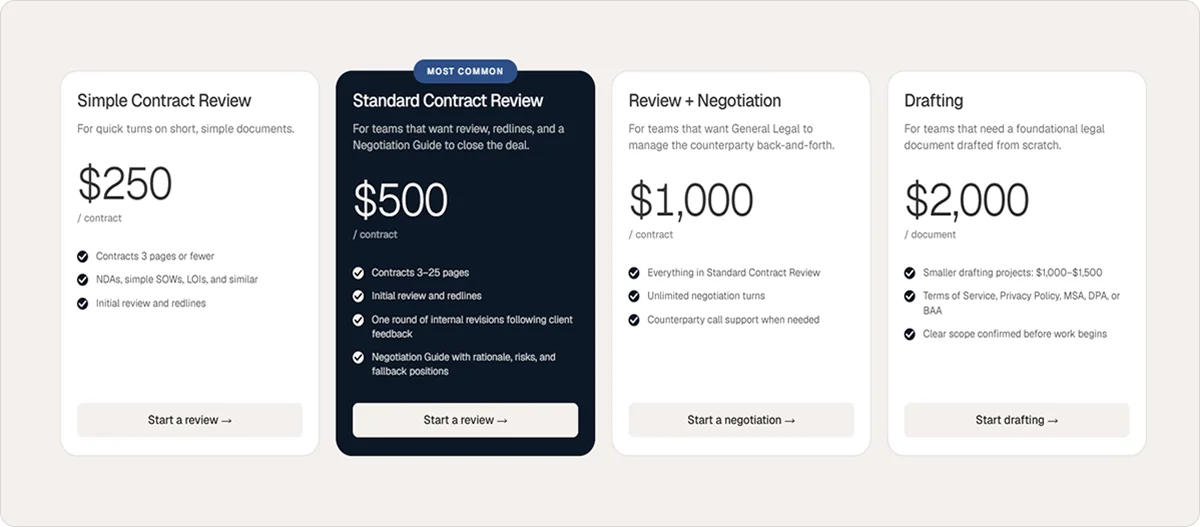
That approach to pricing gives startups more control over legal spend without forcing them into a one-size-fits-all retainer. They can pay for individual matters when needs are sporadic, or move to recurring support as legal volume increases.
2. Gunderson Dettmer: Best for VC-backed startups raising institutional capital

Gunderson Dettmer is a venture-focused BigLaw firm dedicated exclusively to the innovation economy, representing both emerging companies and the investors that fund them.
Its general corporate attorneys take on outside GC roles on a client-based approach, rather than a transaction-by-transaction basis, advising companies on governance, financings, M&A, public-company readiness, and other legal matters.
VC-backed startups raising institutional capital have a particularly strong case for Gunderson Dettmer because the firm lives inside the venture ecosystem. Its lawyers regularly work with both founders and investors, giving startup clients a practical understanding of how financing negotiations, board relationships, and investor expectations actually work.
Core strengths
Gunderson Dettmer’s core strengths include:
- Venture-market expertise: Draw on decades of experience working exclusively with startups, emerging companies, and venture investors to get advice grounded in how the market operates in practice.
- Founder-investor perspective: Use counsel experienced on both sides of the table to anticipate investor concerns and approach financing negotiations with a better read on the other side.
- Multidisciplinary legal bench: Tap attorneys across corporate, tax, employment, IP, regulatory, and other disciplines as new issues emerge, gaining access to specialized expertise without changing firms.
Pricing
Gunderson Dettmer primarily uses hourly billing, with rates based on attorney seniority. Its specific outside GC pricing isn’t publicly disclosed, so prospective clients need to discuss fee arrangements directly with the firm.
3. Outside GC: Best for startups needing in-house-style legal leadership
Outside GC is a dedicated outside GC firm built around providing experienced legal leadership without requiring a full-time hire. Its attorneys, many of whom have served as GC or senior in-house lawyers, work directly with clients on ongoing legal needs rather than operating through the traditional associate-driven law firm structure.
Its OGC services provide partner-level attorneys who act as an extension of the client’s team, covering day-to-day legal leadership alongside corporate, commercial, employment, IP, compliance, privacy, and regulatory matters. Flexible project-based engagements are also available when a company needs additional support for a specific transaction or initiative.
Startups will benefit from the model when they need senior legal judgment embedded in the business but aren’t ready to build a full-time legal function. The firm’s in-house experience means its attorneys can advise on business decisions and risk management, not just respond to individual legal requests.
Core strengths
Outside GC combines an in-house mindset with the flexibility of external counsel, with strengths including:
- Partner-level experience: Work directly with attorneys who bring over 15 years of experience and an in-house perspective to get senior legal judgment without adding full-time headcount.
- Business-first counsel: Apply legal advice to commercial objectives and risk tolerance to make faster, more practical business decisions.
- Broad functional coverage: Draw on expertise spanning multiple areas to address specialized issues as they arise.
Pricing
Outside GC primarily uses fixed fees or hourly rates below typical BigLaw pricing, while its OGC services are structured around predictable rates.
4. LWD Advisors: Best for hardware, cleantech, and manufacturing startups

LWD Advisors is a startup-focused outside GC provider that combines senior legal leadership with the functionality of an in-house legal team. Its OGC service covers day-to-day legal support while its team manages commercial contracting, including NDAs, customer and vendor agreements, and contract-management systems.
The firm is an especially strong fit for hardware, cleantech, and manufacturing startups because it works extensively with companies building physical products and at the intersection of hardware, software, and cloud services.
Its experience also spans supply chains, enterprise sales, and industry-specific commercial agreements, where legal needs tend to extend well beyond standard SaaS contracts.
Core strengths
LWD is built to function as the lean in-house legal team an early-stage company would eventually hire, with strengths including:
- Commercial contracting infrastructure: Put contract-request workflows and right-sized management systems in place to keep agreements moving without building a legal operations function from scratch.
- In-house integration: Embed with company leadership through meetings, Slack, email, and other internal tools to make legal support part of everyday operations.
- Physical-world expertise: Apply experience across clean energy, advanced manufacturing, medical devices, industrial products, and consumer devices to handle the legal issues specific to companies building in the physical world.
Pricing
LWD charges a flat monthly fee for its core OGC services, with certain additional services billed hourly.
5. CGL LLP: Best for AI startups preparing for rapid growth

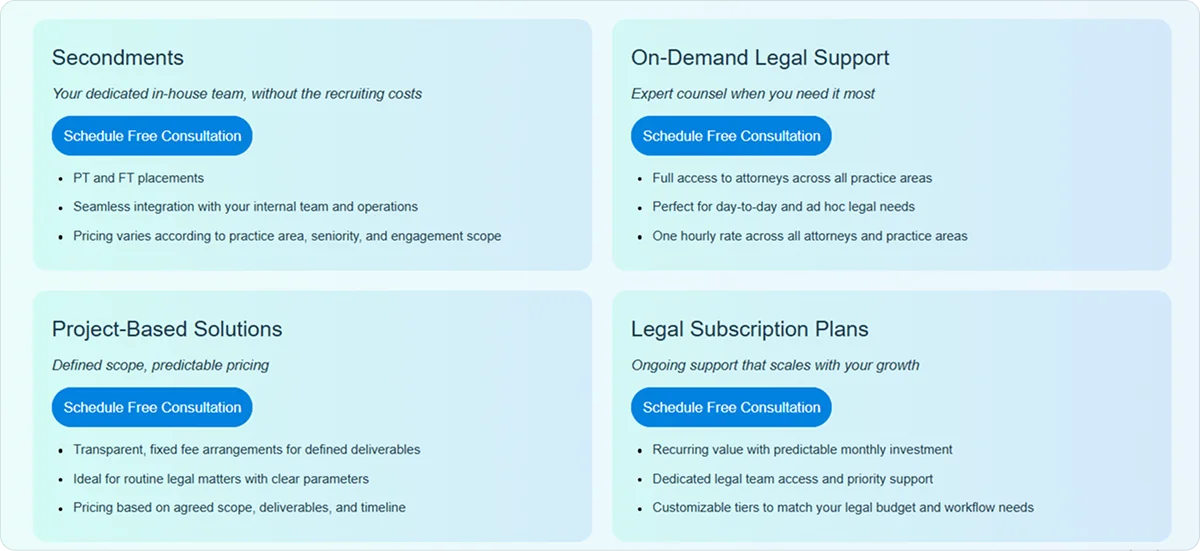
CGL LLP is a modern full-service corporate firm that merges traditional legal support with subscriptions, on-demand counsel, project-based work, and secondments.
Its outside-GC offering covers corporate governance, transactions, IP, privacy, commercial matters, employment, and regulatory work, giving companies access to a broad legal bench as their needs evolve.
AI startups preparing for rapid growth can benefit from CGL’s combination of AI-specific commercial experience and broad regulatory coverage. Its startup practice specifically cites AI product disclosures alongside SaaS contracts, financing, compliance, and M&A, giving companies a way to address the commercial and legal complexity that tends to increase as they scale.
Core strengths
CGL’s OGC model gives growing companies room to change how they use legal support without changing providers, with strengths like:
- Corporate governance: Manage entity restructuring, equity grants, board matters, corporate cleanup, and due diligence to keep the company’s legal foundation in order as it grows.
- Financing support: Handle equity and debt financings, Form D and Blue Sky filings, and related corporate work to keep fundraising moving.
- Specialist expertise: Bring in attorneys across IP, privacy, employment, healthcare, regulatory, and other areas when a startup’s legal questions move beyond day-to-day corporate work.
Pricing
CGL offers predictable pricing through several engagement models, including monthly subscription plans, fixed-fee project work, and on-demand support billed at a single hourly rate.
6. Flux: Best for pre-seed to Series A startups building legal infrastructure
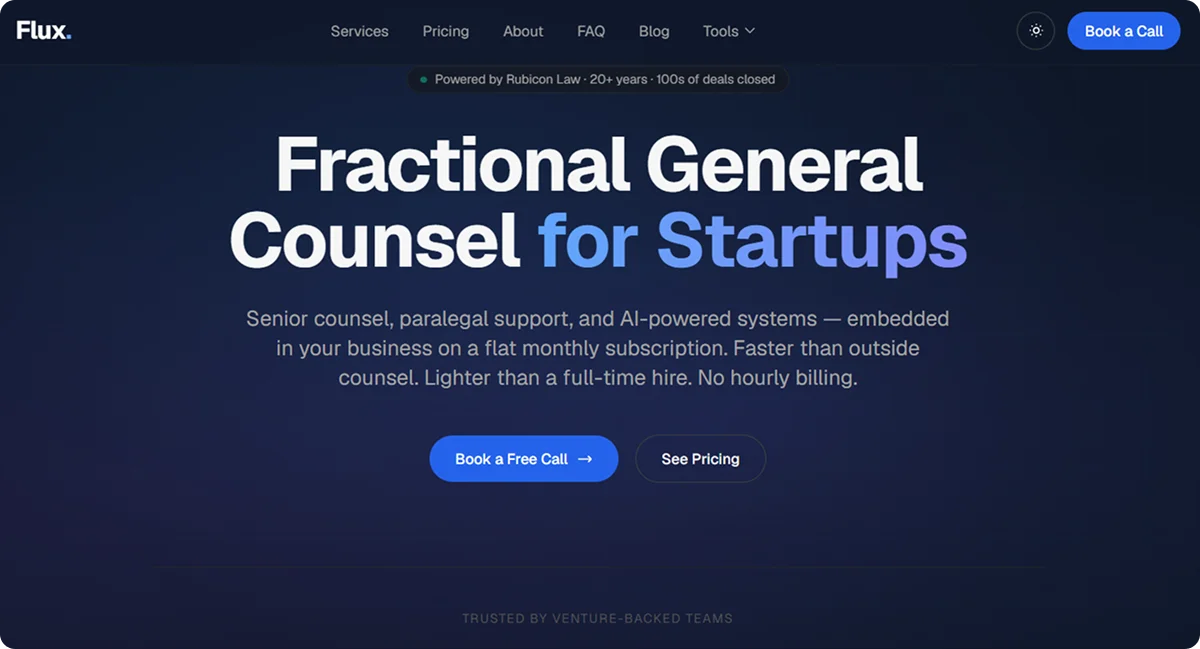
Flux is a subscription-based fractional legal department for venture-backed startups, combining senior counsel, paralegal support, and AI-powered systems. Its OGC service covers formation and governance, fundraising, commercial contracts, hiring and equity, compliance, and other recurring legal work, with additional attorneys brought in for specialized matters.
Pre-seed to Series A startups will benefit from Flux when legal work has become too substantial for ad hoc outside counsel but doesn’t yet justify an internal department. Its model is designed to put the basic legal infrastructure in place early, then expand coverage as fundraising, hiring, contracting, and compliance demands increase.
Core strengths
Flux gives early-stage companies a structured legal function without requiring them to build one internally, with strengths including:
- Proactive legal operations: Track filings, compliance deadlines, and emerging risks on a rolling calendar to prevent routine issues from becoming expensive problems.
- Senior-led support: Work directly with experienced startup attorneys rather than being handed off to junior associates, giving founders practical advice from lawyers who understand the pace of venture-backed companies.
- Legal workflow visibility: Manage requests through Slack, email, or a project board with regular status updates to keep founders informed without constant follow-ups.
Pricing
Flux uses a flat monthly subscription model for its OGC services, with tiered coverage that expands alongside a startup’s legal workload. M&A, exit transactions, and other larger projects are scoped separately.
What is the best outside General Counsel firm for your startup?
The best outside General Counsel firm for your startup depends on where your company is today, how its legal workload is changing, and what kind of expertise it needs most.
Let’s say a seed-stage SaaS startup has moved beyond formation and is now dealing with cap-table and governance work, SAFEs or convertible notes, early employee agreements, customer NDAs, vendor MSAs, and offer letters.
Gunderson Dettmer could be a strong fit here if institutional fundraising is becoming a central part of the business, particularly because its company-side practice stays involved beyond individual transactions.
Now, consider a Series A hardware startup whose legal workload has become more operational: customer and supplier contracts, employment documentation, board governance, investor requirements, and potentially industry-specific regulatory issues.
LWD Advisors makes more sense for this profile because its model is built around acting as an in-house-style legal function while supporting companies operating at the intersection of physical products, technology, and commercial operations.
At the same time, a fast-growing SaaS company with a lean legal function and a sales team sending a steady stream of customer agreements to legal every week needs lawyers who can handle the volume without turning every routine contract into a drawn-out exercise.
General Legal is a particularly strong fit for this kind of company because its attorney-led, technology-enabled model is designed around high-volume commercial work and fast turnaround.
Getting started with General Legal
If what you’ve read about General Legal sounds like the right fit for your startup, you can get started in whichever way suits your needs.
Need legal support now? Get set up digitally in minutes and start sending requests.
Prefer to talk first? Book a quick consultation to discuss your team’s needs and how General Legal can support you.
- Most VC-backed startups don't hire their first in-house General Counsel until around Series B or $5-10 million in revenue, leaving a gap that outside GC firms fill earlier.
- Outside counsel spend is inherently unpredictable: Gartner found only 20% of legal matters sent to outside counsel stay within their original budget, so cost alone shouldn't be the deciding factor.
- The guide compares six firms across five weighted criteria: dedicated OGC offering (30%), startup expertise (25%), breadth of support (20%), pricing flexibility (15%), and scalability/differentiation (10%).
- General Legal is named best for high-velocity SaaS and commercial-heavy startups; Gunderson Dettmer for VC-backed startups raising institutional capital; Outside GC for in-house-style leadership; LWD Advisors for hardware/cleantech/manufacturing; CGL LLP for AI startups; and Flux for pre-seed to Series A startups building legal infrastructure from scratch.
- 61.4% of global fractional-executive demand in 2025 came from SMEs, reflecting a broader trend of startups filling senior roles like CFO, CMO, COO, and now legal, without full-time hires.
- Pricing models across the six firms vary widely, from General Legal's custom flat-fee GC pricing to Gunderson Dettmer's hourly BigLaw rates to Flux's tiered monthly subscription.
| The gap this fills | Most VC-backed startups don't hire an in-house GC until around Series B or $5-10M in revenue, leaving a gap that outside GC firms are built to fill. |
|---|---|
| Why cost alone is a poor selection criterion | Only 20% of legal matters sent to outside counsel stay within their original budget, according to Gartner, so predictability matters as much as sticker price. |
| How the six firms were scored | Weighted on dedicated OGC offering (30%), startup expertise (25%), breadth of legal support (20%), pricing flexibility (15%), and scalability/differentiation (10%). |
| General Legal | Best for high-velocity SaaS and commercial-heavy startups, using an AI-native, attorney-led model with custom flat-fee GC pricing. |
| Gunderson Dettmer | A venture-focused BigLaw firm best for VC-backed startups raising institutional capital, billing primarily by the hour. |
| Outside GC, LWD Advisors, CGL LLP, Flux | Each targets a different niche: in-house-style leadership, hardware/cleantech/manufacturing, fast-scaling AI startups, and pre-seed to Series A startups building legal infrastructure from scratch, respectively. |
| Broader market context | SMEs accounted for 61.4% of global fractional-executive demand in 2025, part of a broader trend of filling senior roles like GC without a full-time hire. |
| How to choose | Fit depends on stage and workload type; a fundraising-heavy SaaS startup suits Gunderson Dettmer, a hardware startup suits LWD Advisors, and high-volume commercial-contract startups suit General Legal. |
When do startups typically bring on their first in-house General Counsel?
Usually around Series B or once revenue reaches roughly $5-10 million, according to the guide, which is why outside GC fills the gap before then.
Is outside GC actually cheaper or more predictable than an in-house hire?
Not automatically. Gartner found only 20% of legal matters sent to outside counsel stay within their original budget, so founders should evaluate pricing model and scope, not just headline cost.
Which firm is recommended for a high-volume SaaS startup sending lots of commercial contracts?
General Legal, cited for its AI-native, attorney-led model built around commercial contract velocity and flat-fee pricing.
Which firm is recommended for a startup raising institutional VC funding?
Gunderson Dettmer, a venture-focused BigLaw firm with deep experience representing both startups and the investors funding them.
Which firm fits a hardware or manufacturing startup best?
LWD Advisors, which specializes in physical-product companies and handles supply chain, enterprise sales, and industry-specific commercial agreements.
How were the six firms selected for this list?
They were screened from more than 40 firms against five weighted criteria: dedicated OGC offering, startup expertise, breadth of legal support, pricing flexibility, and scalability/differentiation.
What is the difference between inside and outside counsel?
The difference between inside and outside counsel is that inside counsel works as part of the company, while outside counsel provides legal support externally.
Are there legal services that specialize in helping startups with General Counsel guidance and sound employment policies?
Yes. These include traditional fractional and outside GC providers, as well as AI-native law firms like General Legal.
Are boutique technology law firms better for startups than big firms?
Not necessarily. Boutique technology law firms can be a better fit for startups that want specialized expertise, closer attorney relationships, and more flexible engagement models, while larger firms may be better suited to startups handling complex financings or needing broad specialist coverage.
How do boutique startup law firms typically price outsourced General Counsel services for mid-sized companies?
Boutique startup law firms typically price outsourced GC services for mid-sized companies through monthly retainers, fixed fees, or customized subscription models.
What is the best fractional General Counsel for startups?
The best fractional General Counsel for startups depends on the company’s stage, legal workload, and specific needs. For high-velocity, commercial-heavy startups, General Legal is a strong option.
- 6 Best Outside General Counsel Law Firms [Comparison]Explore the best outside general counsel law firms so you can compare legal support, expertise, pricing & fit for your business.
- Best Fractional General Counsel for Startups: 6 Top OptionsDiscover the best fractional general counsel for startups so you can find expert legal support and manage costs.
- Outside General Counsel for Startups: What to expect?Discover outside general counsel for startups so you can access ongoing legal guidance, reduce costs, and support your company.