
Many business owners associate commercial legal expenses with litigation only, and it’s easy to see why. Legal disputes can drain a company’s resources fast, as costs can even reach seven-figure territory.
Take intellectual property disputes, for example. According to the American Intellectual Property Law Association’s 2025 Report of the Economic Survey, as reported by IPWatchdog, the median cost of a patent case with $1 million to $10 million at risk is about $600,000 through discovery, motions, and claim construction, and $1 million through trial, post-trial proceedings, and appeal.
However, commercial legal spend extends far beyond the courtroom.
From drafting contracts and hiring employees to securing funding and staying compliant, commercial legal work touches nearly every stage of a business. The key is knowing what to budget for before the bill lands.
This guide breaks down what commercial legal expenses cover, what they cost, and how to make commercial legal spending more predictable.
What are commercial legal expenses?
Commercial legal expenses are the costs a business incurs to obtain legal advice, draft and review agreements, meet regulatory requirements, protect its interests, and resolve disputes. They broadly include attorney fees, court costs, government filing fees, and other expenses associated with legal work.
Depending on the matter, they may be one-off charges or recurring costs for ongoing legal support.
Either way, these expenses are part of doing business, not just a line item to worry about when something goes wrong. That’s because commercial legal work helps companies structure relationships with founders, employees, customers, and investors and make consequential business decisions with fewer legal unknowns.
Even so, commercial legal costs are harder to predict than most other operating costs. For example, rent and payroll tend to follow established schedules, while commercial legal spending can fluctuate with contract negotiations, fundraising rounds, regulatory changes, or disputes.
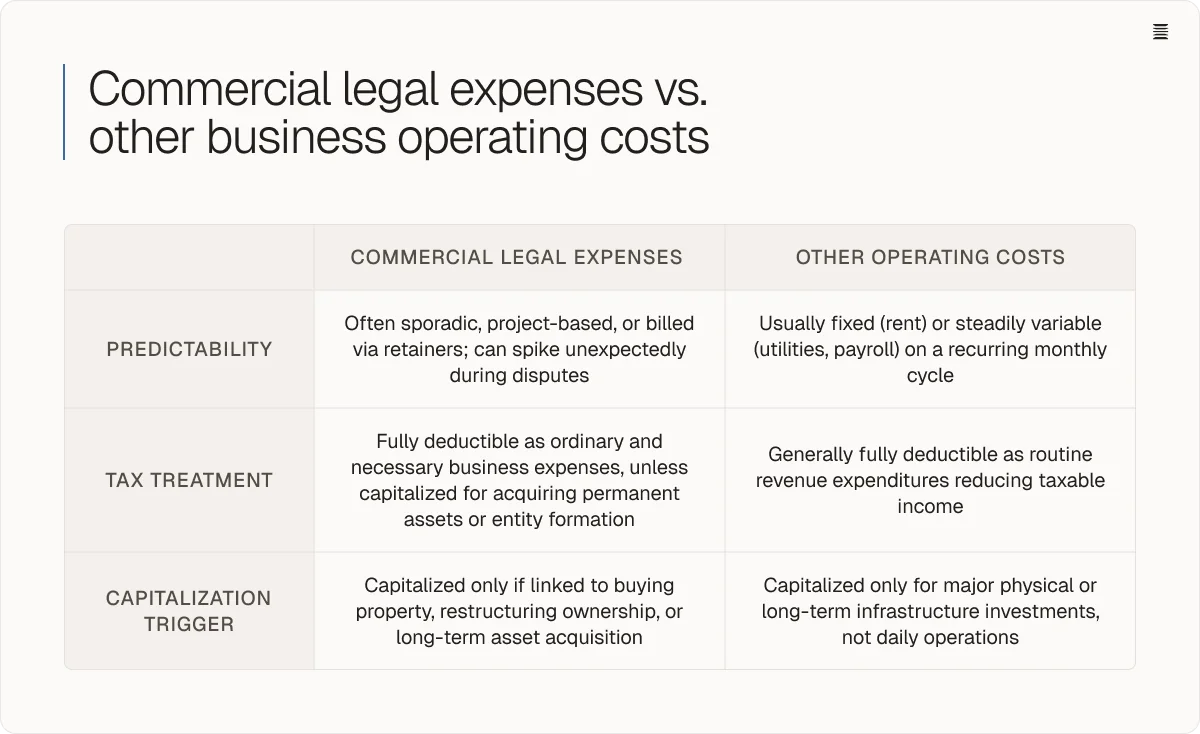
In addition, the predictability of commercial legal expenses depends on whether they’re proactive or reactive.
Proactive legal expenses arise from addressing legal needs before they become problems, such as establishing founder agreements during incorporation. This work helps identify risks early and makes legal costs easier to plan for.
Reactive legal expenses occur when a business has to respond to an existing problem, such as a lawsuit or a regulatory inquiry. These matters are often more difficult to forecast because their cost depends on the circumstances, urgency, and complexity involved.
Whether proactive or reactive, commercial costs can take many forms.
What do commercial legal expenses cover?
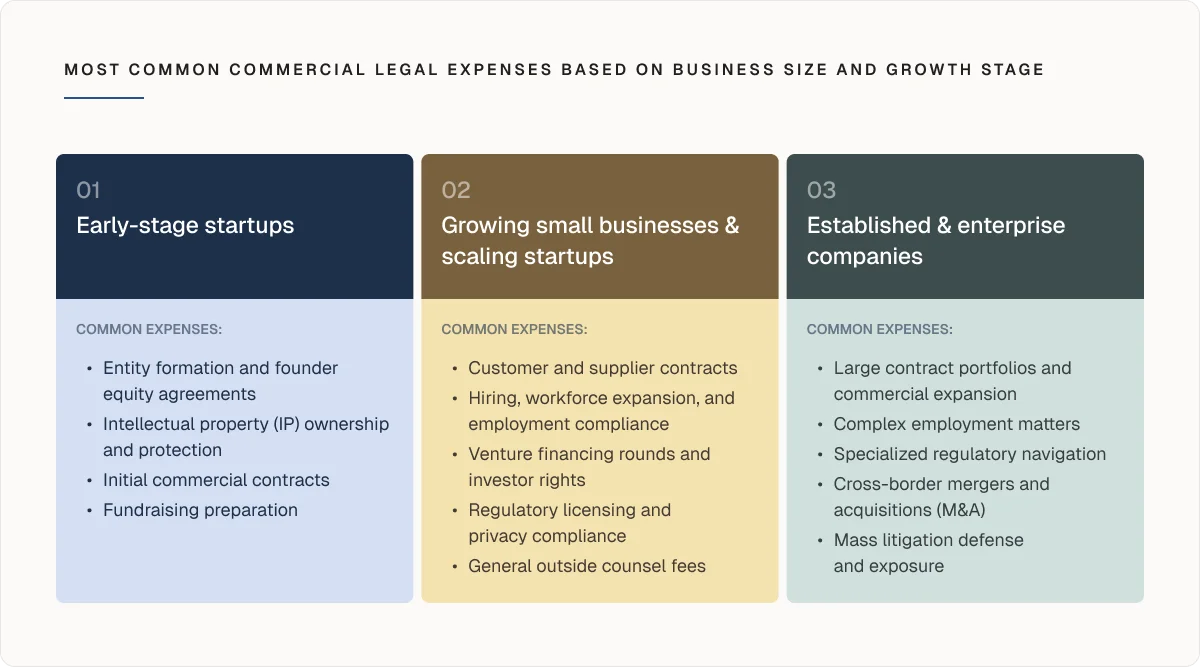
The most common commercial legal expenses fall into the following categories, though the exact mix depends on the company’s size, industry, growth stage, and legal obligations.
Business formation and entity structure
Starting a business involves choosing a legal structure, registering the entity, and preparing the documents that govern its operations.
Legal expenses here can include:
- LLC formation
- Incorporation
- Operating agreements
- Corporate bylaws
- Founder agreements
After formation, businesses may also pay for registered agent services, annual reports, franchise taxes, and other state-specific filings.
Commercial contracts and day-to-day business agreements
Commercial contracts govern how a company sells, buys, licenses, and delivers its products or services.
Legal fees in this category typically cover drafting, reviewing, and negotiating:
- Customer and vendor agreements
- master services agreements (MSAs)
- Statements of work (SOWs)
- SaaS agreements
- Software licenses
- NDAs (one-way and mutual)
- Partnership or supplier contracts
Businesses may also need legal help with terms of service and website policies.
Read more: The Most Common NDA Pitfall Isn't What You Think
Employment, HR, and workplace legal matters
Hiring and managing a team brings its own set of legal requirements, which vary by state and locality, as well as by industry and workforce size.
Common expenses include:
- Offer letters
- Employment and contractor agreements
- Confidentiality and IP assignment agreements
- Employee handbooks
- Workplace policies
Businesses may also need counsel on terminations, workplace complaints, and employment disputes.
Intellectual property protection and licensing
Businesses often need legal support to protect their brand, technology, creative work, and proprietary information. This can involve:
- Trademark and patent applications
- Copyright matters
- Trade secret protection
- IP ownership assignments
- Licensing agreements
The total cost may include attorney fees alongside separate government filing, registration, and maintenance fees.
Fundraising, financing, and mergers and acquisitions
Raising capital or buying and selling a business can generate substantial legal fees.
For startups, this may include:
- Preparing SAFEs and convertible notes
- Negotiating equity financing documents
- Reviewing investor rights
- Conducting due diligence
Established businesses may incur similar costs for loan agreements, acquisitions, mergers, or company sales.
Regulatory compliance, privacy, and risk management
Depending on the business and its location, commercial legal expenses may include:
- Licensing
- Regulatory filings
- Privacy policies
- Data protection advice
- Cybersecurity compliance
- Advertising reviews
- Accessibility compliance
Companies in regulated industries may also need specialized counsel to interpret and implement applicable rules, which can differ at federal, state, and local levels.
Commercial litigation, disputes, and debt recovery
When a business faces a legal dispute, expenses may include attorney fees for:
- Demand letters
- Settlement negotiations
- Arbitration
- Court proceedings
Common matters in this category involve breached contracts, unpaid invoices, employment claims, and IP disputes.
Additional costs can arise from discovery, expert witnesses, court filings, and other procedural requirements.
Other commercial legal expenses businesses may overlook
Legal spending can extend beyond attorney invoices. Depending on the matter, businesses may also pay:
- Process servers
- Local counsel
- Specialist consultants
- Document discovery costs
Contract management platforms and legal research or document automation tools can add further expenses. Where appropriate, track these items as separate lines in the legal budget, so it captures the full cost of managing commercial work.
So what do these expenses typically cost?
How much do commercial legal expenses cost?
Commercial legal expenses vary by the type of work, its complexity, and the lawyer or firm handling it.
A useful starting point is the hourly rate, since roughly 90% of legal spend still flows through billable-hour arrangements. A broad benchmark puts the average cost of hiring a US lawyer at around $350 per hour.
However, hourly rates tell only part of the story.
The total bill depends on how much work a matter requires, and two firms can charge very different amounts for the same service.
The table below shows what can push each cost up:
Actual quotes depend on the scope of work, jurisdiction, and provider, so ask for a written estimate before work begins.
Plus, these aren’t the only factors that can make your end bill higher.
What makes commercial legal expenses increase?
The following factors can additionally increase your commercial legal expenses:
- Scope creep: When a project expands beyond its original scope, additional requests and deliverables can generate extra fees, especially if the engagement terms don’t clearly define what’s included.
- Changing business priorities: A shift in strategy, a revised deal structure, or a change in commercial terms can require lawyers to revisit work already completed and draft new documents.
- Compressed deadlines: Asking lawyers to deliver work on short notice can require additional resources, increasing the total cost.
- Incomplete or late instructions: Providing key documents or decisions late in the process can force lawyers to revisit earlier work or compress subsequent stages to meet the deadline.
- Unplanned specialist input: A matter may reveal technical, financial, or regulatory questions that require input from additional specialists, creating costs that weren’t included in the original estimate.
- Poor coordination between stakeholders: Delayed approvals, conflicting feedback, or unclear decision-making authority can prolong a matter and create additional rounds of work.
With so many variables affecting the final bill, planning ahead matters.
How to budget for commercial legal expenses: 7 key steps
These seven steps can help you plan commercial legal spending with greater control and fewer surprises.
1. Audit your current and upcoming legal needs
Review your contracts, corporate records, employment documents, IP assets, compliance obligations, and any ongoing disputes. Then, map out legal work expected over the next 12 months, including hiring, fundraising, product launches, and contract renewals. Prioritize mandatory obligations and work tied to business goals, followed by preventive measures and projects that can wait.
This structured approach allows you to anticipate costs and avoid last-minute requests that disrupt your plans.
2. Separate predictable costs from unexpected ones
Organize your budget into one-time projects, recurring legal support, government filing fees, and a contingency category for unplanned matters. Annualize expenses you can reasonably forecast, but avoid treating litigation or complex transactions as fixed costs when their scope and outcome remain uncertain.
Separating these categories makes routine expenses easier to forecast while leaving room for costs that are difficult to predict.
3. Compare providers and billing models
Request written estimates from multiple law firms or legal service providers. Then, compare the proposed scope, deliverables, rates, flat-fee exclusions, third-party expenses, and process for handling changes or overruns.
Look at the expected total cost and what it covers, as a lower initial rate can still produce a larger bill if the work takes longer.
4. Consider ongoing legal support for recurring work
If your business regularly needs contract reviews, employment advice, vendor negotiations, or corporate guidance, compare an outside general counsel arrangement or subscription service with paying for each matter individually. Before committing, check monthly service limits, turnaround times, exclusions, and additional fees for litigation or major transactions.
A defined ongoing arrangement may make recurring legal costs more predictable and help your team get advice before small issues become larger problems.
5. Standardize routine legal workflows
Standardized workflows reduce duplicated effort, make key documents easier to find, and help prevent missed deadlines and contractual obligations.
To achieve this, try:
- Using approved contract templates
- Keeping signed agreements in a central location
- Tracking renewal dates
- Establishing a consistent process for submitting legal requests
During this process, document management and workflow tools can help teams avoid missed obligations. Technology-assisted review can also improve efficiency, but bespoke, ambiguous, or high-risk matters still need appropriate legal oversight.
6. Set aside a contingency reserve and review spending quarterly
Unexpected disputes, employment issues, regulatory inquiries, and urgent transactions can put pressure on cash flow.
That’s why it helps to hold reserve funds for unplanned matters. To size the reserve, look at open or threatened disputes, deals and hires planned for the next year, and how far past matters ran over their estimates.
Each quarter, compare actual spending with your budget, investigate overruns, and update forecasts to reflect upcoming business milestones. With these regular reviews, you can identify cost patterns before they undermine the budget.
7. Track legal spend and turnaround
Track these metrics:
- Legal spend by category
- Actual versus budgeted matter costs
- Contract turnaround times
- The percentage of work completed within agreed budgets
- Deal cycle time affected by legal review
Also, monitor whether key compliance deadlines are met.
These measures help you identify inefficiencies and improve planning over time. The goal is to allocate legal resources effectively while managing risk and supporting the business, not to minimize fees at the expense of sound decisions.
The good news is that you can keep legal costs under control without sacrificing the quality of legal advice your business needs. One way to do that is to work with an AI-native law firm like General Legal.
How General Legal makes commercial legal expenses more predictable
Traditional hourly billing can make commercial legal expenses difficult to forecast, because the final invoice depends on how long a matter takes, and the total can shift as the work evolves.
General Legal takes a different approach, using upfront flat fees so businesses know the price before work begins.
That predictability starts with a defined scope.
When you submit a contract or legal matter, General Legal gives you a flat-fee quote before work begins. Published prices cover many routine services, including standard commercial contract reviews, while longer or non-standard agreements may require a custom quote.

General Legal’s AI-native workflow also helps keep pricing practical.
AI handles the initial document analysis and surfaces potential issues, while experienced, US-barred attorneys review the work, apply legal judgment, and stand behind the advice. By reducing manual work in the process, the firm can deliver many contract reviews in hours rather than days or weeks.
For budgeting purposes, the benefit is straightforward: You can estimate the cost of defined legal work before committing, plan around known fees, and make more informed decisions about when to bring in counsel. While flat fees can’t make every legal matter predictable—complex, changing, or non-standard work may still need a tailored quote—they give businesses a clearer starting point for managing legal spend.
Ready to take control of your legal spend? Start a matter with General Legal to get an upfront flat-fee quote.
Have questions about your company’s legal needs first? Book a quick call to learn how General Legal can help.
- Commercial legal expenses extend far beyond litigation, covering contracts, employment, IP protection, compliance, and business formation that touch nearly every stage of a business.
- Legal costs are harder to predict than other operating expenses because they fluctuate with negotiations, fundraising, regulatory changes, and disputes, and depend on whether work is proactive or reactive.
- The average US lawyer charges around $350 per hour, but total costs vary widely based on matter complexity, scope creep, deadline urgency, and coordination quality between stakeholders.
- Budgeting effectively requires auditing legal needs, separating predictable from unexpected costs, comparing billing models, and maintaining a contingency reserve for unplanned matters.
- AI-native law firms like General Legal use upfront flat fees instead of hourly billing, making costs more predictable by defining scope and providing quotes before work begins.
- Tracking metrics like spend by category, actual versus budgeted costs, and contract turnaround times helps businesses identify inefficiencies and improve legal resource allocation over time.
| Scope of commercial legal expenses | Covers formation, contracts, employment, IP, fundraising, compliance, and disputes—not just litigation. |
|---|---|
| Cost predictability challenges | Legal spending fluctuates with business events and depends on whether work is proactive or reactive. |
| Primary cost drivers | Complexity, negotiation intensity, jurisdictional requirements, scope changes, and deadline urgency all increase bills. |
| Average hourly rates | US lawyers average $350/hour, but total costs vary significantly based on matter type and required work volume. |
| Budgeting best practices | Audit needs, separate fixed from variable costs, standardize workflows, set contingency reserves, and review spending quarterly. |
| Flat-fee alternative | AI-native firms provide upfront quotes for defined work, making routine legal expenses more predictable than hourly billing. |
| Tracking and optimization | Monitor spend by category, turnaround times, and budget variance to identify patterns and improve resource allocation. |
| When costs increase unexpectedly | Scope creep, priority changes, compressed deadlines, incomplete instructions, and poor coordination drive overruns. |
What are some examples of legal expenses?
Examples of legal expenses include attorney fees for drafting contracts, forming a business, handling employment matters, protecting intellectual property, ensuring compliance, and resolving disputes. Court costs and government filing fees may also qualify.
What are non-deductible legal expenses?
Legal fees for personal matters generally aren’t deductible as business expenses, and fines or penalties paid to a government for violating a law generally can’t be deducted under IRC §162(f). Some business legal fees aren’t deducted right away but capitalized, which means they’re recovered over time through amortization or as part of an asset’s cost. A qualified tax professional can confirm how this applies to you.
Are legal fees capitalized or expensed?
Routine legal fees for running a business are generally deductible under IRC §162, while fees tied to acquiring an asset are generally capitalized under IRC §263. Legal fees for forming a company are organizational expenditures, so a corporation or partnership can generally deduct up to $5,000 in the first year and amortize the rest. A qualified tax professional can confirm how this applies to you.
- How Much Does it Cost to Draft a Legal Contract? [2026 Guide]Explore what drives legal contract drafting costs, compare pricing models, and learn how to budget for reliable legal support without unexpected fees.
- Law Firm Startup Costs: What New Firms Need to Budget ForDiscover law firm startup costs so you can plan your budget, understand essential expenses, and choose where to invest.
- How Much Does it Cost to Incorporate a Startup? [Guide]Learn how much does it cost to incorporate a startup so you can compare formation options, legal fees, filing costs, and ongoing expenses.