
Whether you’re building a venture-backed startup or a bootstrapped business, you can’t run it for long on a handshake, a personal bank account, and a messy pile of documents.
Incorporation is what gives startups the legal structure to grow, allowing them to separate business liabilities from founders’ personal assets, establish clear ownership, protect intellectual property, and give investors a legal entity to fund. It also makes hiring easier, giving early-stage startups another way to compete for talent when cash is tight.
SBA data shows the pattern: 86.7% of businesses without employees operate as sole proprietorships, compared with 12.3% of businesses that have employees. Simply put, hiring often goes hand in hand with a more formal business structure.
To help you put that formal legal structure in place and lay the groundwork for growth from day one, we curated a list of eight startup incorporation services that cover both paths: venture-track C corps and bootstrapped LLCs.
Disclaimer: This article is published by General Legal, which is covered in a separate section. The providers are presented to help founders evaluate incorporation services based on publicly available information about their features, pricing, and legal support. The list isn’t intended as a ranking from best to worst, and the right choice depends on each founder’s needs. Pricing, services, and terms may change, so verify the latest details directly with each provider before making a decision. Prices last checked: November 4, 2026.
How we selected the 8 best startup incorporation services
Harvard Business School professor Noam Wasserman’s research attributes 65% of startup failures in the venture-backed companies he studied to people problems, primarily co-founder tensions.
That’s partly why choosing an incorporation service requires more than finding someone to file the paperwork.
The right service can help founders establish a suitable entity, document ownership, prepare for fundraising, and manage the compliance obligations that follow.
However, not all founders need the same setup. For example, a Delaware C corp issuing founder stock has different requirements from a bootstrapped LLC, and founders operating internationally face another set of considerations. For this reason, we prioritized services that address distinct founder needs, rather than filling the list with interchangeable providers.
To build this list, we reviewed dozens of providers and selected eight based on the following six criteria:
- Startup-specific legal readiness: We examined providers’ published service descriptions and document libraries for founder stock issuance, vesting, intellectual-property assignments, bylaws, board consents, and 83(b) election support.
- Pricing and total cost of ownership: We compared official pricing pages to assess formation fees, state filing charges, first-year inclusions, and optional add-ons, and noted renewal costs where providers publish them.
- Fundraising readiness and entity fit: We assessed support for Delaware C corps, founder equity, and fundraising workflows like SAFE financing, while accounting for providers better suited to bootstrapped LLCs and other business models.
- Post-formation support: We evaluated published offerings for registered agent services, annual report reminders, franchise-tax assistance, EIN (Employer Identification Number) applications, and access to bookkeeping, tax support, or ongoing legal documentation.
- Privacy and pricing transparency: We looked into disclosed privacy practices, public record considerations, package inclusions, renewal terms, and additional fees.
- Usability and support: We considered how each provider describes its formation process, document preparation, filing options, and customer support channels.
8 best startup incorporation services at a glance
Ratings are based on publicly available review platforms on November 4, 2026, and should be treated as a point-in-time snapshot rather than a definitive measure of product quality.
1. Stripe Atlas: Best for founders launching a tech business
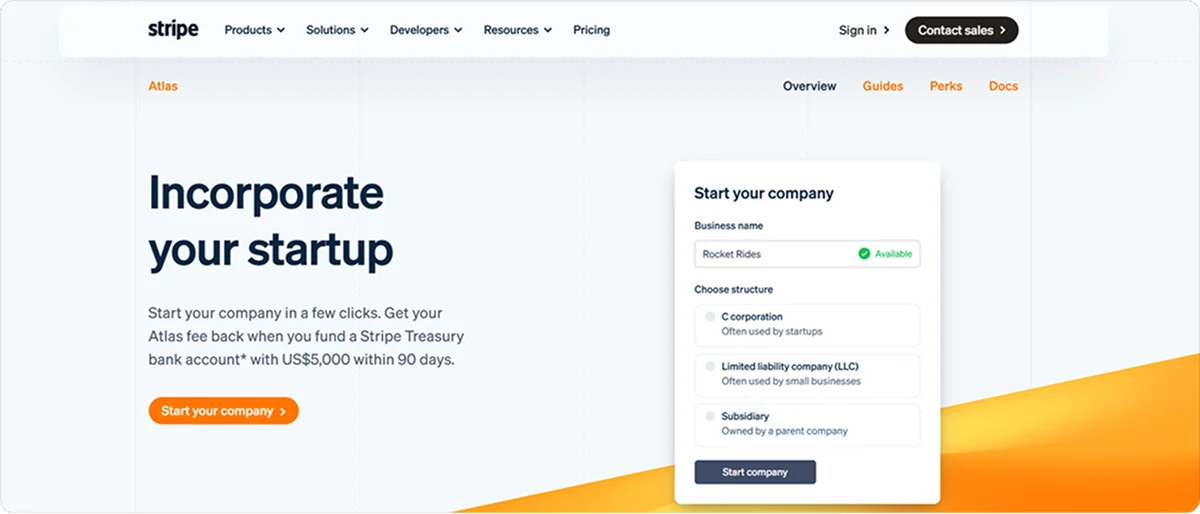
Stripe Atlas is a company formation platform that Stripe reports more than 100,000 founders have used to incorporate in Delaware. Its standardized setup is built around the needs of startups launching in the US, including founders based abroad.
It’s particularly well-suited for tech founders who want to get incorporated and start operating quickly, with payment infrastructure and startup perks available through the Stripe ecosystem. That combination can reduce the administrative work of moving from an idea to a funded, revenue-generating company.
Key features
Atlas streamlines the legal and administrative steps involved in launching a startup, including:
- Founder equity issuance: Issue founder shares and document stock purchases to establish ownership from the outset.
- 83(b) election filing: Submit the election for eligible restricted stock to help founders address the relevant tax deadline.
- Fundraising tools: Generate standard SAFE agreements and board consents to prepare for early-stage investment.
Pricing
Stripe Atlas charges a one-time formation fee of $500 that includes government filing fees and the first year of registered agent service.
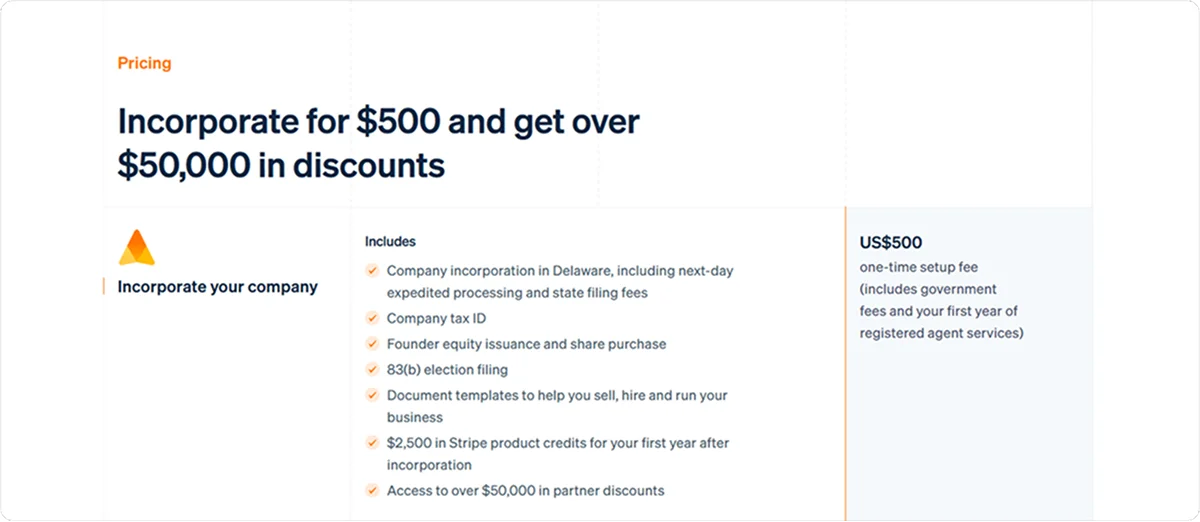
After the first year, registered agent service costs $100 a year, while eligible founders can also access $2,500 in Stripe product credits and over $50,000 in partner discounts.
Read more: How Many Shares Should a Startup Authorize at Incorporation?
Potential drawbacks
Stripe Atlas may be less suitable for founders who want ongoing, personalized legal advice during incorporation. Atlas provides standardized workflows rather than tailored legal counsel, and its Stripe credits matter less if you use another payment provider.
2. Clerky: Best for VC-backed startups preparing to raise
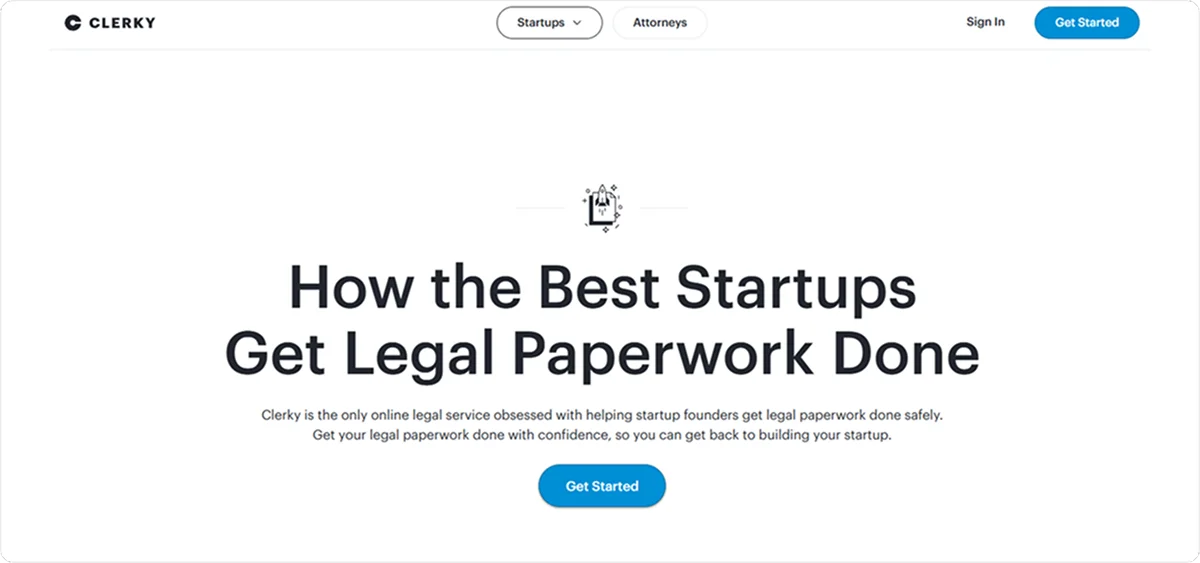
Clerky is a legal document automation platform built specifically for startups, and it reports that more than 20,000 startups have incorporated through its service. Its tools support Delaware C corporations through formation and the legal work that follows, making it particularly relevant to founders building companies with plans to raise outside capital.
Clerky stands out for teams that need consistent, investor-ready corporate records as they bring on co-founders, issue equity, and close early financing rounds.
Key features
Clerky focuses on the legal documentation needs of high-growth startups, with tools including:
- Founder equity and IP paperwork: Document stock ownership, vesting terms, and intellectual-property assignments to clarify founders’ rights and protect company assets.
- Fundraising documents: Prepare SAFEs or convertible notes, track investor signatures and funding, and secure the required board approvals for financing.
- Employee equity and hiring: Generate stock option paperwork, offer letters, and invention-assignment agreements as the team grows.
Pricing
Clerky’s pay-per-use option costs $427 for Delaware incorporation alone, with post-incorporation setup sold separately for $299. Its $819 Company Lifetime Package adds a broader range of ongoing legal paperwork, including fundraising and hiring documents.

Potential drawbacks
Clerky’s startup-focused legal tools can be excessive for small businesses that don’t plan to raise venture capital or issue equity. Also, Clerky only forms Delaware C corps, so it doesn’t suit founders who want an LLC.
3. Northwest Registered Agent: Best for privacy-conscious founders

Northwest Registered Agent provides business formation and registered agent services for entrepreneurs setting up LLCs and corporations. Its focus on practical formation support makes it a useful option for solo founders and early-stage teams that want to establish a formal business without investing in a broader startup software suite.
Privacy-conscious founders, in particular, will appreciate Northwest’s policy of using its own address on public formation documents where permitted, helping keep their home addresses off the public record.
Its in-house Corporate Guides also provide direct support with state-specific requirements and ongoing compliance questions as the business develops.
Key features
Northwest supports businesses through formation and routine corporate administration, with services including:
- Registered agent coverage: Receive state correspondence and service of process through a designated agent rather than handling these notices yourself.
- Mail scanning: Review scanned business mail remotely without needing to collect physical correspondence at the registered address.
- Multi-state expansion: Arrange foreign qualification in additional states as your company’s operations extend beyond its state of formation.
Pricing
Northwest charges $39 plus state filing fees for business formation, including the first year of registered agent service.

Potential drawbacks
Northwest prioritizes formation, privacy, and registered agent services, so founders seeking fundraising documents and specialized startup legal support will likely need additional providers.
4. Bizee: Best for founders on a tight budget
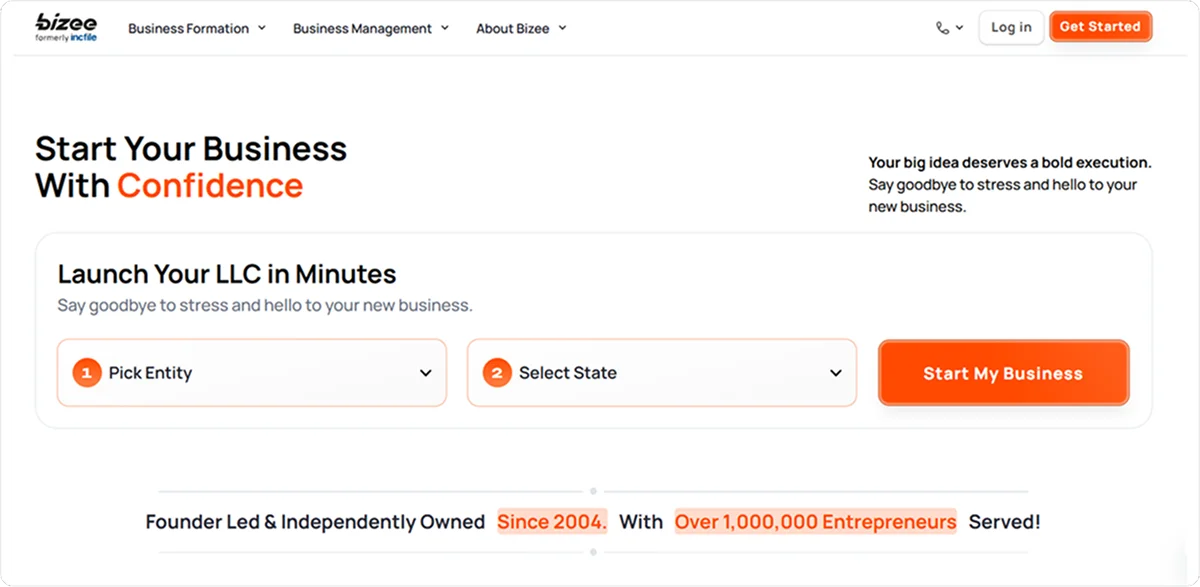
Bizee, formerly known as Incfile, offers online formation services for LLCs, corporations, and nonprofits. The company reports having served more than one million entrepreneurs, and its streamlined formation process makes it accessible to founders launching side projects, bootstrapped businesses, or early-stage ventures.
Bizee is especially appealing to founders validating a business idea who want to avoid paying for legal and administrative extras before they need them. Its entry-level package provides a starting point for getting a business formally established, while optional upgrades let founders add services as their needs evolve.
Key features
Bizee guides founders through the core steps of registering a business, with services including:
- Entity selection: Compare LLC and corporation structures to identify which best fits your ownership plans and business goals.
- Registered agent service: Arrange an official point of contact for service of process and state correspondence during the initial formation period.
- Ongoing compliance: Set reminders for annual reports and franchise tax deadlines to help keep your company in good standing.
Pricing
Bizee offers three formation packages:
- Basic: $0 + state filing fees
- Standard: $199 + state filing fees
- Premium: $299 + state filing fees

Optional services and state charges can increase the total cost, so check renewal terms and package inclusions before deciding.
Read more: How Much Does it Cost to Incorporate a Startup?
Potential drawbacks
Bizee’s basic formation service covers the essentials, but founders with complex ownership structures or specialized legal needs may require more tailored support.
5. ZenBusiness: Best for first-time founders who appreciate structured guidance
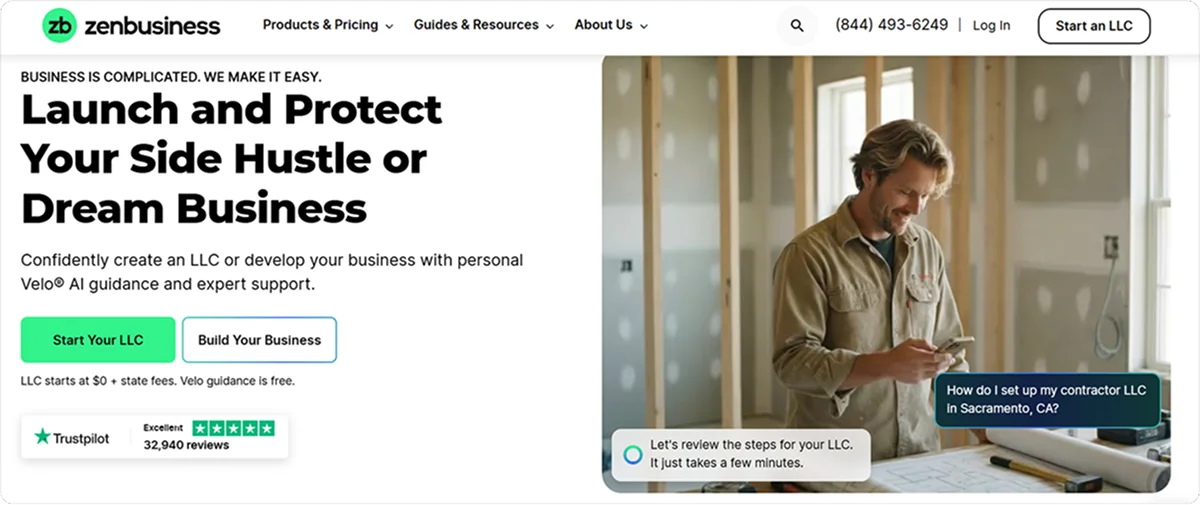
ZenBusiness is an online business formation and management platform that reports helping launch more than 950,000 new businesses. It serves entrepreneurs establishing LLCs or corporations, including first-time founders who need a guided route from business idea to formal registration.
ZenBusiness is particularly useful for founders who want help navigating unfamiliar administrative decisions without coordinating several separate providers. Its tiered services let businesses add support as their obligations grow, though founders planning a venture capital raise may need more specialized corporate legal tools.
Key features
ZenBusiness combines digital formation tools with services for managing a business after registration, including:
- AI formation guidance: Work through setup questions with Velo’s personalized guidance to understand the information required for your filing.
- EIN application support: Arrange an EIN to prepare for opening a business bank account, hiring employees, and handling federal tax obligations.
- Compliance reminders: Monitor state filing deadlines and ongoing requirements to help keep your company in good standing.
Pricing
ZenBusiness structures its pricing around three tiers:
- Starter: $0 + state filing fees
- Pro: $199 + state filing fees
- Premium: $299 + state filing fees
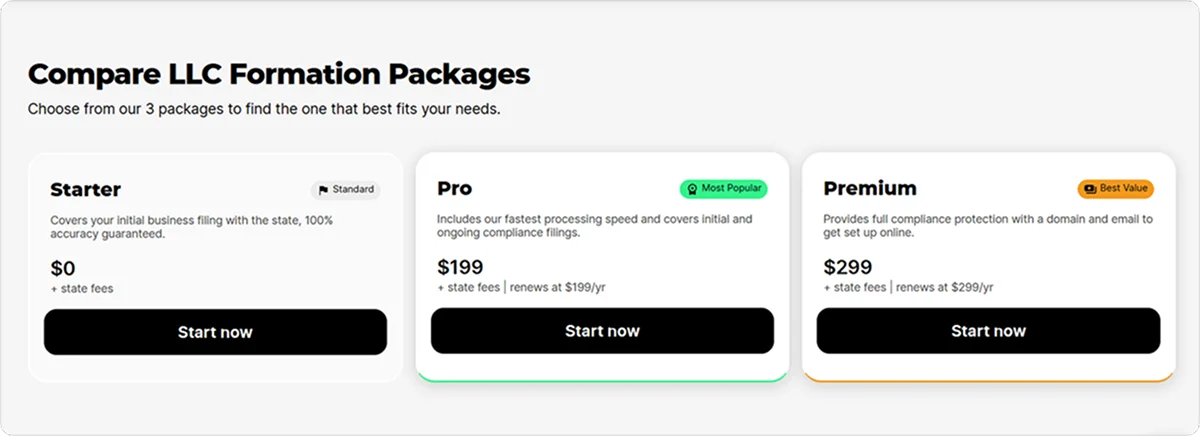
Review renewal terms and optional add-ons carefully, particularly where introductory offers automatically convert to paid subscriptions.
Potential drawbacks
ZenBusiness offers accessible formation and compliance tools, but startups preparing for venture-capital fundraising may need more specialized corporate legal documentation.
6. doola: Best for non-US founders
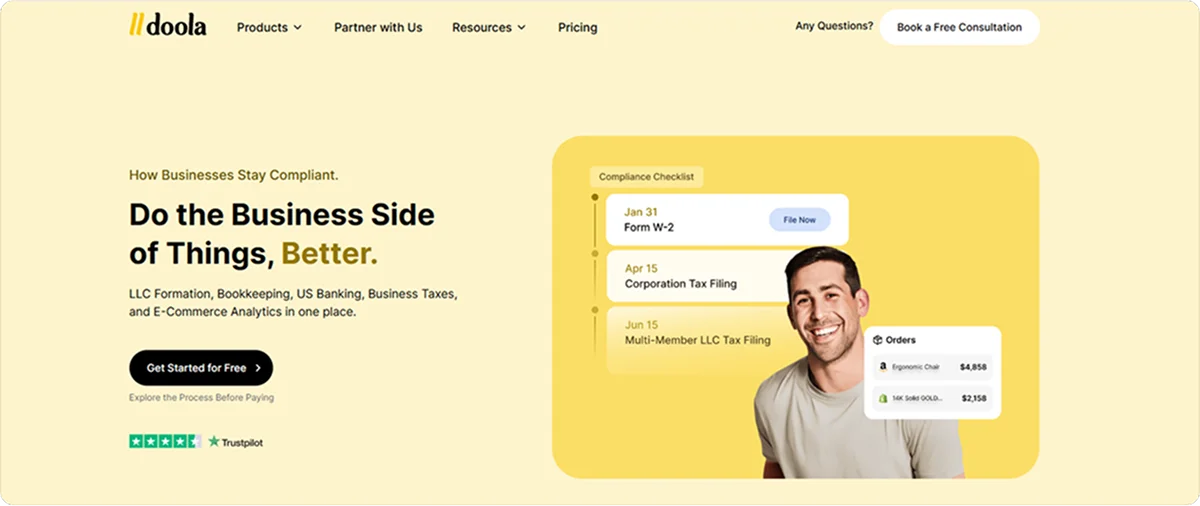
doola is a US business formation and management platform built to help entrepreneurs establish companies from abroad. The company reports serving founders in more than 175 countries, making it relevant to international startups seeking access to the US market without relocating.
doola is particularly valuable for founders unfamiliar with US administrative requirements who want help navigating the process from overseas. Its broader service options can reduce the burden of coordinating US-based providers, especially for entrepreneurs who need ongoing assistance beyond incorporation.
Key features
doola combines company formation with services for managing a US business remotely, including:
- EIN application support: Navigate the process of obtaining an EIN, which is generally needed for US business banking and federal tax administration.
- Operating agreement preparation: Establish written rules for LLC ownership, member responsibilities, and decision-making.
- Registered agent service: Designate a US-based agent to receive official legal and government correspondence for your company.
Pricing
doola organizes its services into three annual plans:
- Starter: $297 + state filing fees
- Tax and Compliance: $1,999 + state filing fees
- Business-in-a-Box: $2,999 + state filing fees
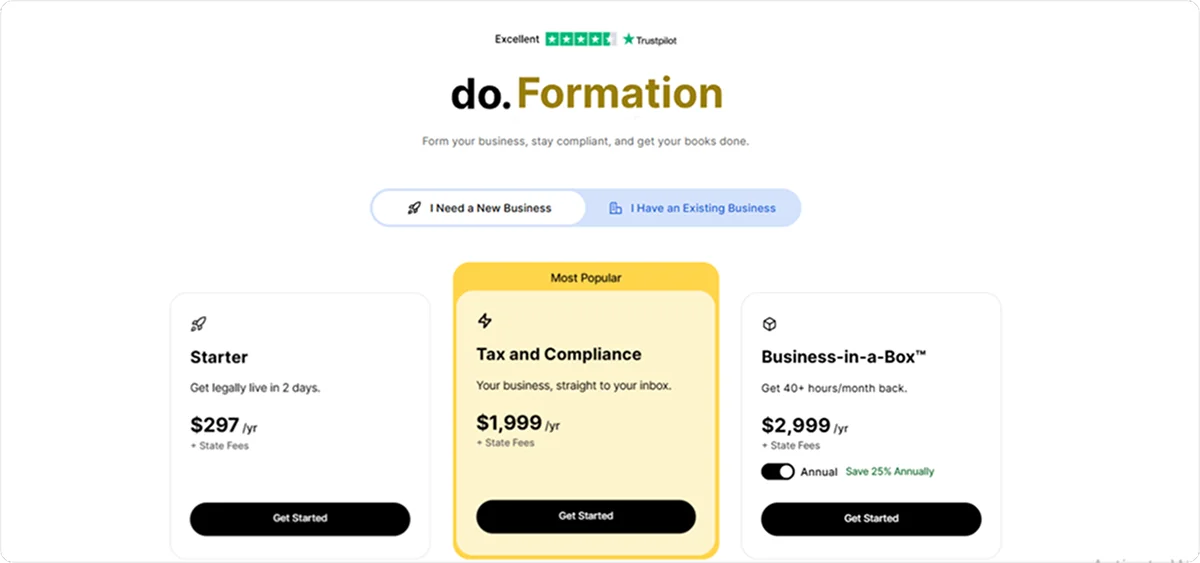
More comprehensive tiers add tax, bookkeeping, and compliance support. Compare the scope of each package and its renewal costs against the specific obligations of your business before committing.
Potential drawbacks
doola’s broader business management plans can be more than founders need if they’re only looking to incorporate and can handle ongoing administration themselves.
7. Firstbase: Best for internationally oriented startups and lean teams
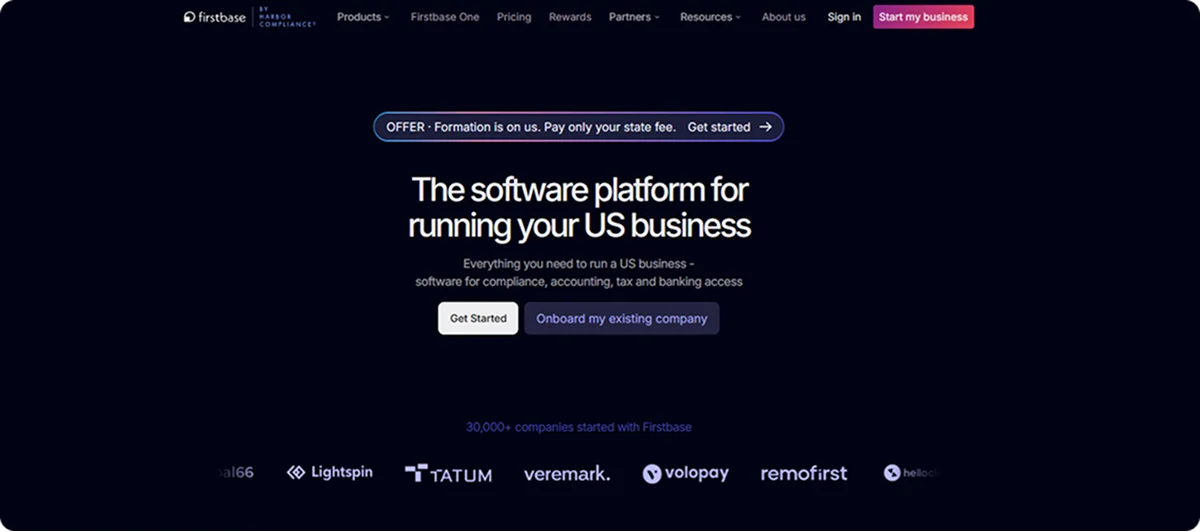
Firstbase is a US incorporation and business operations platform that reports helping launch more than 30,000 companies across over 190 countries. It caters to startups that need a US legal entity alongside the administrative infrastructure to run it remotely.
Firstbase is a strong option for lean teams that want to consolidate business administration instead of managing several separate vendors. Its broader service ecosystem can support founders as they move from formation into accounting, tax filing, and day-to-day operations, although smaller businesses may not need the full suite.
Key features
Firstbase connects company formation with the practical requirements of operating a US business through services like:
- EIN processing: Submit the required IRS information and track your EIN application, including if you’re a non-US founder without an SSN or ITIN.
- Banking applications: Apply through integrated banking partners to establish a dedicated account for company finances, subject to the partner’s approval.
- Corporate documentation: Prepare foundational records like bylaws, stock purchase agreements, operating agreements, and initial board resolutions to document ownership and governance.
Pricing
Firstbase charges a one-time formation fee of $399. Registered agent service, which every company needs, is a separate charge of $299 per state per year. Founders seeking an all-in-one package can choose Firstbase One for $199 per month, billed annually ($2,388 per year).

Potential drawbacks
Firstbase’s wider range of operational services adds value for internationally oriented teams, but can be unnecessary overhead for founders who only need incorporation.
8. LegalZoom: Best for founders who want optional attorney access
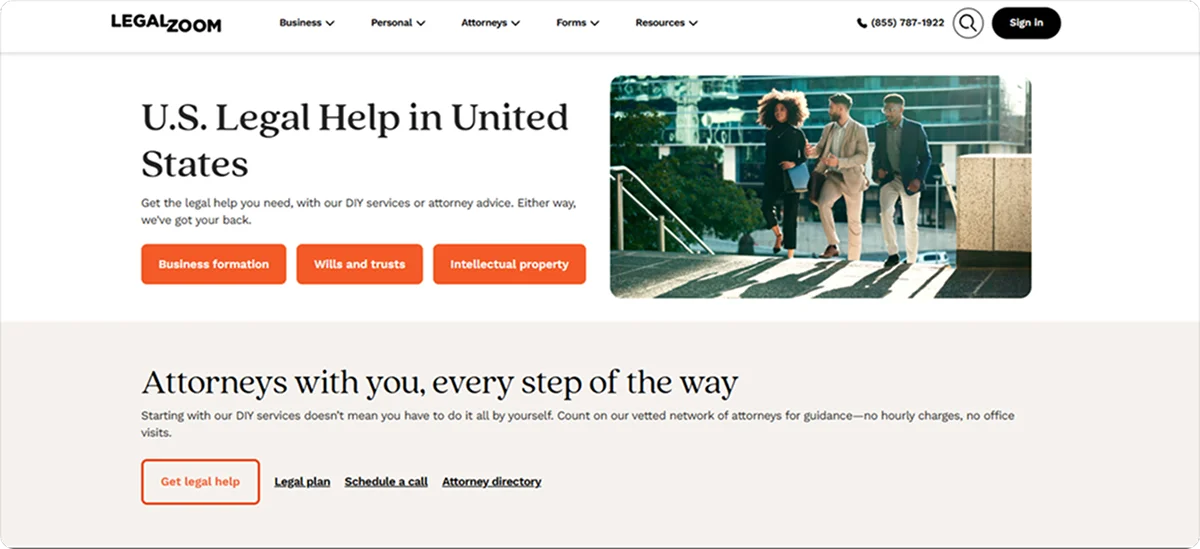
LegalZoom is an online legal services platform offering business formation, document preparation, and access to independent attorneys. The company reports having helped entrepreneurs establish businesses more than four million times, giving early-stage founders a broad range of legal and administrative services to consider as their companies develop.
LegalZoom is a sensible choice for founders who expect questions to arise beyond the initial filing and want the option to seek professional legal guidance.
This flexibility can be especially valuable for small businesses dealing with contracts, trademarks, or other legal matters.
Key features
LegalZoom combines self-service formation tools with options for additional legal support, including:
- Corporate filing preparation: Prepare and submit articles of incorporation to establish your company under the selected state’s requirements.
- Registered agent service: Designate an agent to receive lawsuits, subpoenas, and other official documents on behalf of your business.
- Attorney consultations: Connect with an independent attorney for guidance on business contracts, intellectual property, or other legal questions when you need individualized advice.
Pricing
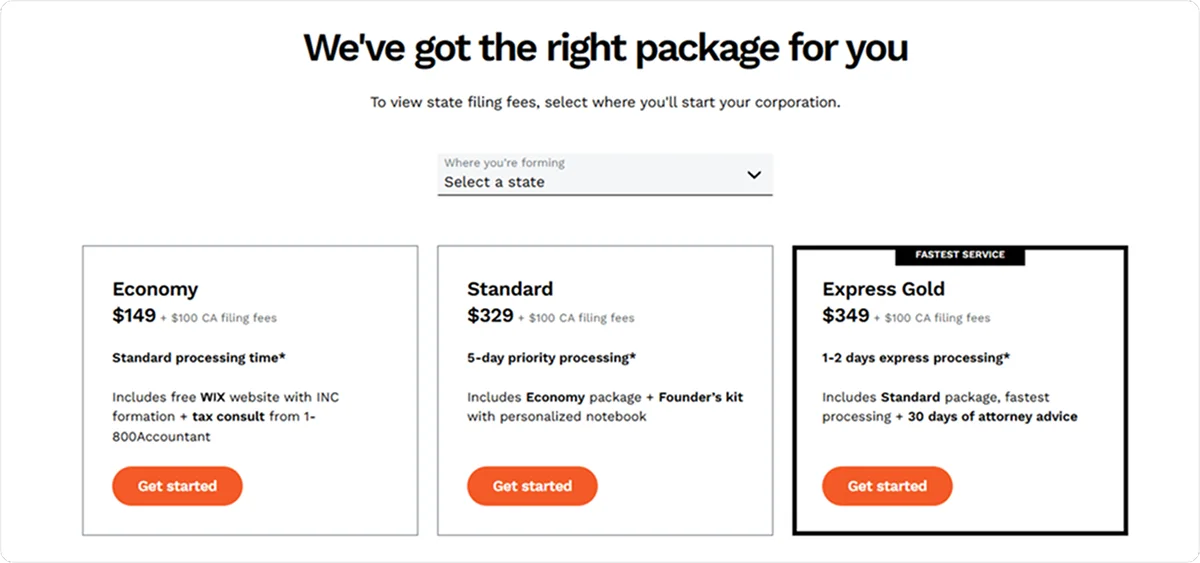
LegalZoom offers three formation packages with different processing speeds and levels of additional support:
- Economy: $149 + state filing fees
- Standard: $329 + state filing fees
- Express Gold: $349 + state filing fees
Potential drawbacks
Attorney access depends on the package and service you select, so founders seeking consistent, hands-on legal guidance should confirm exactly what’s included before committing. Express Gold also includes 30 days of LegalZoom’s Business Attorney Plan, which renews automatically at $49 a month unless you cancel.
Which startup incorporation service is right for you?
The right service depends on how you plan to fund and run the business:
- Raising venture capital as a Delaware C corp: Stripe Atlas or Clerky
- Bootstrapping an LLC on a budget: Bizee or ZenBusiness, or Northwest if you want your home address off public records
- Founding from outside the US: doola or Firstbase
- Wanting optional attorney access: LegalZoom
If you’d rather have legal guidance throughout the entire incorporation process, such as advice on choosing the right entity type, structuring co-founder ownership, and addressing intellectual property rights, a law firm is the better fit.
Traditional law firms can provide this level of support, though that can mean high hourly rates, unpredictable costs, and slow turnaround times for an early-stage startup.
Luckily, founders can still get hands-on legal guidance without taking on the cost and delays traditionally associated with hiring a law firm by working with an AI-native law firm like General Legal.
General Legal: Best for lawyer-led startup incorporation and fundraising

General Legal is a full-service business law firm where experienced, US-barred attorneys use AI-powered workflows to deliver legal work faster and with more predictable pricing. More than 500 startups, scaleups, and enterprises trust us for legal support that fits the pace of building and running a business.
Whether you’re forming a company, preparing to issue founder equity, or getting ready to raise capital, our Emerging Companies and Venture Capital practice can help you structure the business and document key decisions.
Matters are scoped and priced upfront, so you know what the work will cost before it begins. This level of transparency gives founders a clearer path to getting essential legal work done without committing to an open-ended hourly engagement.
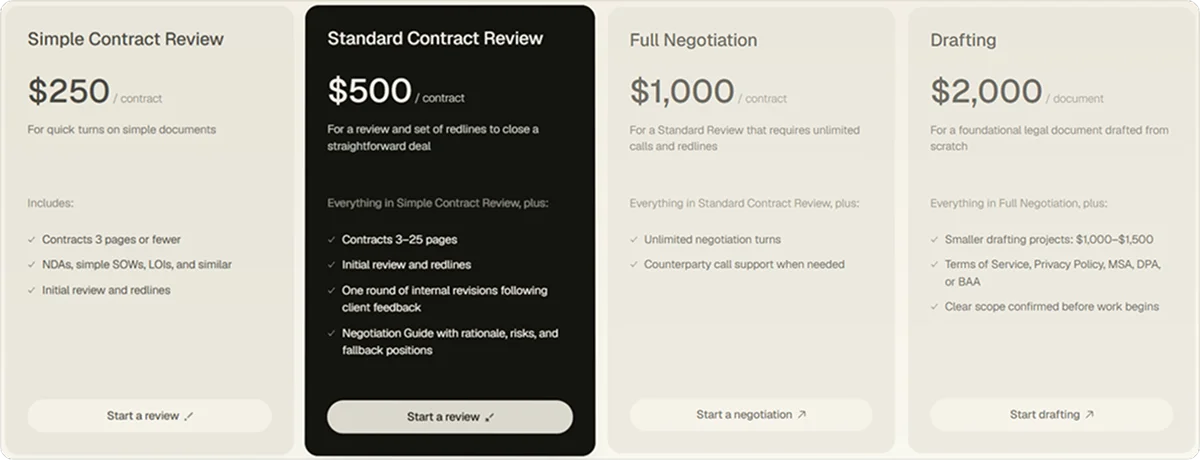
Beyond incorporation, General Legal can support startups across several areas, including:
- Fundraising and corporate governance: Prepare SAFEs, side letters, and other financing documents, while helping founders address governance and ownership matters as the company evolves.
- Employment: Draft offer letters, contractor agreements, confidentiality and invention assignment agreements, and other employment documents as you build your team.
- Intellectual property and technology transactions: Address IP ownership, licensing, and technology agreements so the rights behind your product and business are properly documented.
Our firm also handles commercial contracts, data privacy, and tax matters as the company grows.
If you’re looking for a straightforward filing service, General Legal’s attorney-led approach might offer more support than you need. However, if you want personalized legal guidance from the outset, open a matter to connect with experienced business attorneys and receive an upfront, flat-fee quote.
Want to learn more first? Book a call to discuss your startup’s legal needs with our team.
- Incorporation separates business liabilities from personal assets, establishes clear ownership, and creates a legal entity investors can fund—essential groundwork before hiring or fundraising.
- The right incorporation service depends on your funding path: venture-backed Delaware C corps need different tools than bootstrapped LLCs or internationally founded companies.
- Budget-friendly DIY services like Bizee start at $0 plus state fees, while specialized platforms like Stripe Atlas ($500) and Clerky ($427–$819) offer fundraising-ready documents and equity issuance.
- Non-US founders can use services like doola and Firstbase to navigate US incorporation remotely, including EIN applications and registered agent designation.
- Privacy-conscious founders benefit from Northwest Registered Agent's policy of using its own address on public records, while LegalZoom offers optional attorney consultations for individualized guidance.
- AI-native law firms like General Legal provide lawyer-led incorporation and fundraising support with flat-fee, upfront pricing—bridging the gap between DIY services and traditional hourly billing.
| Why incorporation matters | Formal legal structure protects personal assets, clarifies ownership, and enables hiring and fundraising—86.7% of businesses without employees stay as sole proprietorships. |
|---|---|
| Venture-backed startups | Stripe Atlas ($500) and Clerky ($427–$819) offer Delaware C corp formation, founder equity issuance, 83(b) elections, and SAFE agreements for fundraising. |
| Bootstrapped LLCs | Bizee ($0 base fee), ZenBusiness ($0–$299), and Northwest ($39) provide budget-friendly LLC formation with registered agent service and compliance reminders. |
| International founders | doola ($297–$2,999/year) and Firstbase ($399 + $299/state/year) help non-US founders incorporate remotely, apply for EINs, and open US bank accounts. |
| Privacy and attorney access | Northwest uses its own address on public filings to protect founder privacy; LegalZoom ($149–$349) includes optional attorney consultations. |
| Lawyer-led alternative | General Legal offers attorney-guided incorporation and fundraising with flat-fee pricing, using AI workflows to deliver faster turnaround than traditional hourly law firms. |
Should a startup be an LLC?
It depends on your fundraising plans. An LLC is ideal for bootstrapped businesses, small teams, and service enterprises because it offers pass-through taxation and simple maintenance, but if you intend to seek venture capital or issue equity, institutional investors almost universally prefer or require a C corporation.
Who is the best company to start an LLC with?
The right LLC formation company depends on your priorities. Bizee and ZenBusiness suit budget-conscious founders who want simple filing, Northwest suits those who want their home address off public records, and Stripe Atlas offers a Delaware LLC option inside Stripe’s ecosystem. Clerky only forms Delaware C corps, so it isn’t an option for an LLC.
What’s the cheapest LLC to start?
Montana offers the lowest initial state filing fee at $35, while Arizona, Missouri, and New Mexico charge about $50 to file and don’t require LLCs to file annual reports.
What are the best states to incorporate?
Delaware is the dominant choice for venture-backed startups due to its well-established business laws, while Wyoming is favored by privacy-focused online or small businesses for its low fees and strong legal protections. At the same time, your home state is usually best for a local brick-and-mortar business to keep compliance and tax filings simple.
- 6 Best Law Firms for Growing Startups To Choose in 2026 [Comparison]An overview of the top law firms for growing companies.
- How Many Shares Should a Startup Authorize at Incorporation?Learn how to choose the right number of authorized shares for your startup, plan for future fundraising, and avoid costly incorporation changes.
- 5 Best LegalZoom Alternatives for Startups: Top Picks 2026Explore how you can compare LegalZoom alternatives, assess startup formation costs and legal support, and choose the right fit for you.