
According to the American Bar Association's 2025 Profile of the Legal Profession, there are over 1.37 million active lawyers in the United States. With this many lawyers, hiring one should be straightforward: Find someone who handles your type of legal work, check their availability, and get started.
Except it isn't always that simple.
This guide breaks down how long it takes to hire a lawyer, explains what slows the process down, and tells you how to cut the wait when you need legal work done now.
What hiring a lawyer actually means
The question "how long does it take to hire a lawyer" can mean two very different things. One is about engaging outside counsel, the way a startup hires a firm to review a contract. The other is about hiring an attorney as an employee, whether an associate, in-house counsel, or a general counsel.
The timelines are wildly different, and knowing which process you're actually dealing with makes a big difference when you're trying to figure out how long hiring a lawyer will take.
While this guide covers both, it weighs toward the outside-counsel path, because that's the decision most founders are actually facing right now.
How long does it take to find and hire outside counsel?
Finding and hiring outside counsel typically takes anywhere from a few days to a few weeks, depending on how quickly you can find the right lawyer, compare your options, and get through the firm's intake process.
This range lines up with what people expect when they start the process.
A 2024 iLawyer Marketing study of 1,050 US adults asked people how long they'd expect the entire process of researching, consulting, and hiring to take, and the table below displays their answers:
What often prolongs the timeline is that most people don't call the first lawyer they find.
Martindale-Avvo's 2023 Understanding the Legal Consumer report found that only about 11% of clients hire the first attorney they contact, while 78.9% reach out to more than one firm before deciding.
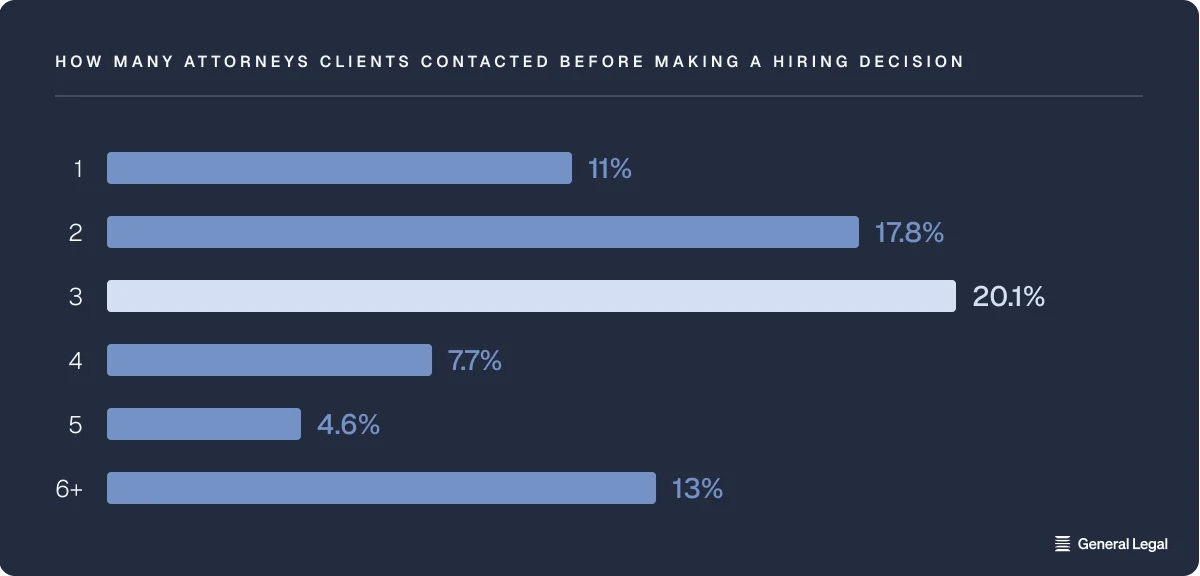
The 2024 iLawyer Marketing study points the same way: Nearly 98% of clients want to consult at least two firms, and roughly 80% want three or more before they commit. However, once you've made contact, the decision comes fast: Martindale-Avvo found that half of legal consumers make their hiring decision within a week of starting the search.
The next question is what happens once you've actually picked your lawyer.
What happens after you pick a lawyer
Picking a firm doesn't mean the work starts immediately. A traditional engagement follows a predictable sequence:
- An intake call
- A conflict check
- A scoping conversation
- A signed engagement letter
Only then does the legal work begin.
This is where traditional firm structure works against speed. Partners bill by the hour and juggle a dozen client relationships, so getting time on a partner's calendar for your intake call can take days.
Hourly billing doesn't reward turnaround the way flat-fee work does, because the meter runs either way. Plus, pricing is often opaque until after the engagement letter is signed, so you don't even know the cost until you're committed. These inefficiencies are so baked into the traditional law firm model that these firms struggle to move fast even when they're the ones hiring.
Legal recruiters at CM Legal Search put the average lateral associate search at 60 to 90 days, with partner-level searches often running six months or more. If the industry's own hiring pipeline runs on a three-month clock, it's no surprise that client-facing engagement, wrapped in the same institutional habits, drags, too.
This raises another question: Is bringing legal in-house any faster?
How long does it take to hire a lawyer in-house?
Hiring a lawyer in-house is slower than hiring outside counsel because you're running a full recruitment process, not simply engaging someone to handle a legal matter.
For an associate-level attorney, expect 60 to 90 days on average to fill the role, and often longer. A survey of legal professionals by Auray found the reality frequently runs past two months:
For a General Counsel (GC) or Chief Legal Officer (CLO), time-to-fill typically runs 75 to 120 days, since you're hiring for a senior leadership role that requires a broader search, more interviews, and more extensive vetting.
That longer timeline isn't unique to legal.
Executive hiring takes longer across industries, which is reflected in SHRM's 2026 recruiting benchmarks: Median time-to-fill for non-executive positions fell to 39 calendar days, while the time-to-fill for executive positions remained unchanged from the previous year (45 days).
But does your startup actually need to spend all this time looking for in-house counsel?
The answer is spend-based. Once you're spending well into six figures a year on legal work, an in-house hire starts to pencil out. Below that, you're paying six figures in first-year cost, plus 75-plus days of search time, to solve a problem the right outside counsel firm can handle for a fraction of the cost with zero hiring risk.
This makes hiring outside counsel the correct call for almost every pre-scale company.
How to hire a lawyer faster: A practical checklist
Here's how you can cut days out of the hiring process and get the right lawyer working on your matter faster:
- Know your matter before you start calling: Have the contract or the issue summarized in a paragraph. Firms move faster when they aren't spending the first call extracting basic facts.
- Apply the 48-hour rule: If a firm hasn't responded within two business days, move on. Responsiveness now is a preview of responsiveness later.
- Ask for a flat fee and a turnaround commitment upfront: "We'll let you know after we look at it" is not a commitment. Get a number and a timeframe before you sign anything.
- Confirm scope and jurisdiction early: Make sure the firm covers the states and matter type you need before you invest time in intake.
- Prioritize async-first firms: A firm that lets you start over Slack or a portal beats one that makes you wait for a scheduled call just to begin.
Follow all five, and you've optimized your side of the process. The remaining bottleneck is the firm's structure, and that's exactly why hiring an AI-native law firm like General Legal might be a more prudent choice.
The fast path: How General Legal compresses the timeline to hours
Every number above measures the same thing: time lost to a process, not to the work itself. An AI-native firm is built to change that process, so the part of the timeline you can't control shrinks from days or weeks to hours.
When working with General Legal, experienced US-barred attorneys do the legal work, while AI handles the routine and manual parts of the workflow, from the initial contract review and issue spotting to redlines and annotations. The attorney then reviews the full contract, applies their judgment, and stands behind the final work product.
Here's what onboarding looks like:
- Sign up online: Smaller companies sign up directly on the site, with no sales call, and the engagement letter goes out for e-signature the same day.
- Get a shared Slack channel: Onboarding sets up a dedicated channel connecting you to your legal team.
- Start sending contracts immediately: There's no waiting on a scoping call or a follow-up email; you send the document and the clock starts.
Larger companies still get a sales call and a DocuSign engagement letter, but the structure is the same: no multi-week intake funnel, no waiting on a partner's calendar.
The turnaround difference is the whole point.
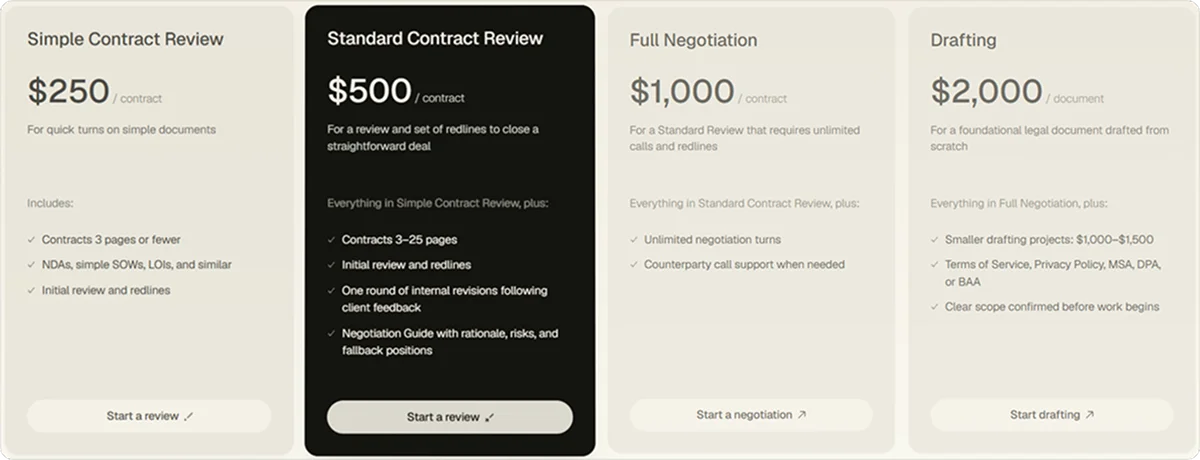
Traditional firms typically bill up to $20,000 per contract and return work in days or weeks. General Legal reviews most contracts in hours at flat, upfront fees of $250 or $500 depending on complexity, with negotiation guidance included and no surprise invoice.
Most importantly, this isn't a cheap alternative story.
It's Big Law-caliber attorneys operating at startup speed, at a price built for a company at your stage rather than an enterprise legal budget. The firm represents over 650 companies, more than 40 of them unicorns, and supports work across most US states for the majority of commercial agreements.
To experience the level of service firsthand, create a free account with no commitment or upfront fees and send your first matter over. Alternatively, book a 10-minute working session to talk through your workload first. Either way, the answer comes back in hours, not weeks.
- Hiring outside counsel typically takes a few days to a few weeks, though most clients decide within a week once they begin their search.
- Nearly 80% of clients consult with three or more firms before hiring, while only 11% hire the first attorney they contact.
- Hiring in-house counsel takes 60-90 days for associates and 75-120 days for general counsel positions, making it impractical for early-stage companies.
- Traditional law firms' intake processes—including conflict checks, scheduled calls, and partner availability—create delays even before legal work begins.
- AI-native firms like General Legal compress engagement timelines from weeks to hours by eliminating intake bottlenecks and offering flat-fee, async-first service.
- Most startups don't need in-house counsel until annual legal spend reaches six figures, making outside counsel the cost-effective choice below that threshold.
| Outside Counsel Timeline | Finding and hiring outside counsel typically takes a few days to a few weeks, with half of clients deciding within one week of starting their search. |
|---|---|
| Client Shopping Behavior | Nearly 80% of clients want to consult three or more firms before committing, and only 11% hire the first attorney they contact. |
| Traditional Firm Delays | Hourly billing, partner availability, conflict checks, and scoping calls add days or weeks before legal work actually begins. |
| In-House Hiring Timeline | Hiring associate-level attorneys takes 60-90 days on average, while general counsel searches run 75-120 days or longer. |
| When to Hire In-House | In-house counsel makes financial sense once annual legal spend reaches well into six figures; below that, outside counsel is more cost-effective. |
| AI-Native Firm Advantage | AI-native firms compress engagement from weeks to hours with flat fees, async workflows, and no intake bottlenecks while maintaining Big Law quality. |
| Speed Optimization Tips | Apply the 48-hour responsiveness rule, request flat fees upfront, prepare matter details in advance, and prioritize async-first firms. |
| General Legal Difference | General Legal offers contract reviews in hours at $250-$500 flat fees versus traditional firms' weeks-long turnaround at up to $20,000 per contract. |
How long does it take to hire a lawyer for a contract review?
With a traditional firm, hiring a lawyer for a contract review takes several days to a couple of weeks once you account for intake, scoping, and hourly-billed turnaround. With an AI-native firm like General Legal, most contract reviews come back in hours at a flat fee, once you've signed up and sent the document over.
How fast can I get a lawyer for an urgent deal?
Speed depends on the firm's structure, not just its skill. Firms that require a sales call, a conflict check, and a scoping meeting before starting will struggle to move fast no matter how good the attorneys are. Firms built for async, flat-fee work can start the same day.
How long does it take to hire in-house counsel versus outside counsel?
In-house hiring is a recruiting process: roughly 60 to 90 days for an associate and 75 to 120 for a general counsel. Engaging outside counsel is a service engagement, not a hiring search, and can be completed in days rather than months.
Why do traditional law firms take so long to engage?
Hourly billing doesn't reward speed, and partner calendars are the bottleneck for intake calls, conflict checks, and scoping. None of that reflects a lack of skill; it reflects a business model built around partner leverage rather than turnaround.
What should I have ready before contacting a lawyer?
The actual document or a clear one-paragraph summary of the issue, your deadline, and any jurisdiction-specific details. Firms move fastest when they aren't spending the first interaction gathering basic facts.
- 6 Best Fractional GC Attorneys at Law [Comparison]Discover the best fractional GC attorneys at law so you can compare legal expertise, support, pricing, and fit for your business.
- 6 Best Outside General Counsel Law Firms [Comparison]Explore the best outside general counsel law firms so you can compare legal support, expertise, pricing & fit for your business.
- How Much Does It Cost To Hire a Lawyer? [2026 Guide]Learn how much does it cost to hire a lawyer and discover what affects legal fees, compare pricing, and choose the right option.