
Signing a contract without reviewing it closely means taking a potentially serious risk. One buried clause can chain your company to a vendor for three more years on auto-renew, make you personally liable for a customer’s lawsuit, or sign away IP your engineers built on company time.
And these scenarios aren’t rare.
Contract disputes have historically topped court dockets, with state caseloads alone jumping 62.7% between 2020 and 2024. For comparison, tort claims grew just 4.1% over the same period.
Even if you avoid a courtroom, the math still doesn’t favor the careless. Businesses lose an average of 9% of annual revenue to issues like ambiguous scope, missed entitlements, overlooked obligations, and rigid terms nobody challenged before signing.
But what does a contract review cost in the first place? This guide breaks down typical pricing, the factors that drive costs up or down, and the most effective ways to reduce your spend without increasing the legal risk.
What is the average contract review cost?
According to ContractsCounsel’s marketplace data covering thousands of legal projects, the average contract review cost is approximately $600, which is consistent with estimates provided by attorneys across the legal industry.
That said, contract review pricing varies widely because no two agreements carry the same level of risk, complexity, or attorney involvement.
At the low end, you can expect to pay roughly $100–$300 for a basic review of a simple document with minimal revisions. At the higher end, complex contracts often cost $1,000–$3,000 or more when they require extensive analysis, redlining, and negotiation support.
And even these substantial figures are nowhere near the ceiling.
Large enterprise transactions, sophisticated commercial deals, and M&A matters can push contract review costs as high as $20,000, particularly when multiple attorneys and specialist legal teams are involved.
7 factors that determine the contract review cost
The spread between a $200 review and a $20,000 review may seem unusual, but the pricing isn’t arbitrary. Behind every quote is a set of variables that determine how much you’ll end up paying. Among those variables, these seven have the most significant influence.
1. The pricing model behind the review
Contract review isn’t a commodity. Some lawyers bill for their time, others bill for outcomes, while larger providers may package contract work into ongoing service plans. The pricing model they use can substantially change the economics of the engagement, even when the contract itself doesn’t change.
According to Thomson Reuters, around 90% of legal spend still flows through hourly billing arrangements. However, contract reviews are commonly offered through several different pricing structures, each with its own cost dynamics:
| Pricing model | Typical pricing | Cost predictability |
|---|---|---|
| Hourly billing | $100–$750+ per hour | Low |
| Flat fee | $250–$3,000+ per contract | High |
| Monthly retainer | From $1,000+ per month | Medium-high |
| Subscription / managed program | Custom pricing | High |
Hourly billing works best when the scope is difficult to predict upfront.
If you’re reviewing a heavily negotiated commercial contract or an agreement that may require multiple rounds of revisions, paying only for the time spent on the work can sometimes be cheaper than accepting a lawyer’s worst-case fixed-fee quote. However, the downside is that costs can escalate quickly once negotiations, redlines, and follow-up questions start piling up.
Flat-fee pricing is usually the most economical option for one-off contract reviews.
Because the scope is clearly defined, the lawyer can price the work in advance and absorb the risk of minor complications. This model is particularly cost-effective for standard vendor agreements, employment contracts, NDAs, and customer contracts where both parties have a reasonable idea of the work involved.
Monthly retainers start making financial sense when contract reviews become a recurring business function.
Instead of engaging a lawyer for each new agreement, you’re reserving a portion of their time every month. This model is cost-effective for growing companies that need regular legal support but don’t generate enough contract volume to justify a dedicated program.
Subscription and managed-service models operate at a different scale.
Rather than purchasing lawyer time, you’re effectively outsourcing part of your contract workflow to a provider. If your team is processing hundreds of agreements each month, these arrangements often produce the lowest cost per contract because the provider can spread resources across a large, predictable volume of work.
Pro tip:
If your goal is minimizing contract review cost, start by asking for a fixed-fee quote. Unless the contract is unusually complex or difficult to scope, predictable pricing often beats open-ended hourly billing.
Read more: The Death of the Billable Hour
2. The type of contract being reviewed
Contract types carry varying pricing expectations because they require different levels of legal specialization.
A lawyer reviewing a standard NDA or vendor agreement is usually working within a familiar framework. By contrast, contracts involving intellectual property, software licensing, employment law, real estate, or corporate transactions frequently require subject-matter expertise that commands higher rates.
The table below shows reported pricing differences across common business agreements:
| Typical review cost | Common contract types |
|---|---|
| $250–$500 | • NDAs • Vendor agreements • Independent contractor agreements • Standard service agreements |
| $500–$1,000 | • Employment agreements • SaaS agreements • Professional services agreements • Data processing agreements |
| $1,000–$3,000 | • Licensing agreements • Commercial leases • Distribution agreements • Franchise agreements |
| $3,000–$10,000+ | • Asset purchase agreements • Business acquisition agreements • Share purchase agreements • Other M&A-related contracts |
Read more: The Most Common NDA Pitfall Isn’t What You Think [Explained]
3. The length and complexity of the agreement
In general, longer agreements take more time to review because they contain more provisions and cross-references, as well as more opportunities for risk to hide in the fine print.
Complexity adds another layer.
Contracts containing unusual indemnification provisions, restrictive employment terms, intellectual property rights, regulatory obligations, or multiple parties typically require closer scrutiny than agreements built around standard market language.
As a result, lawyers often evaluate both page count and complexity when determining the scope of a review.
General Legal’s pricing provides a useful example of how length influences review costs in practice. Because its AI-native operating model automates much of the administrative and analysis work, pricing is offered upfront as a flat fee rather than being tied to billable hours.
Even so, the amount of material that needs review still matters:
| Agreement length | General Legal pricing | Example |
|---|---|---|
| Up to 3 pages | $250 | Short NDA, simple employment agreement |
| 3–25 pages | $500 | Typical vendor, customer, or SaaS agreement |
| 25+ pages | From $1,000 | Regulatory, highly negotiated, or specialized contracts |
While complexity ultimately drives the depth of the analysis, page count remains one of the clearest indicators of how much attorney time a review will require.
Read more: Contract Review & the AI-Native Model
4. The experience level of the reviewer
Years of specialized experience often translate directly into higher contract review fees. At large corporate firms, partner rates can exceed $1,000 per hour.
However, this doesn’t mean every contract requires the most senior lawyer available. For routine NDAs, vendor agreements, and employment contracts, a mid-level attorney is often the most cost-effective choice.
Senior lawyers and partners typically become involved when the agreement carries substantial financial, regulatory, or strategic risk. Cross-border transactions, intellectual property licensing deals, major commercial agreements, and M&A contracts frequently warrant that level of oversight.
5. The value and risk involved
The value of the transaction influences how much risk a business can afford to accept after contract review.
A questionable clause in a $2,000 vendor agreement may not justify extensive negotiation. The same clause in a contract worth hundreds of thousands—or even millions—of dollars can change the economics of the deal, requiring a far more detailed review.
Take Vodafone’s acquisition of Mannesmann as an example.
Worth more than $190 billion, this remains one of the largest acquisitions in history. Transactions of that scale involve armies of lawyers reviewing thousands of pages of agreements, disclosures, and supporting documents because even a small oversight can carry major financial consequences.
Of course, most businesses will never encounter a deal of that size. The principle, however, remains the same: As the value and risk increase, the cost of getting the contract wrong rises much faster than the cost of reviewing it properly.
6. The services included beyond review
At its most basic, contract review involves a lawyer reading an agreement, identifying risks, and explaining how the terms affect your business. However, in some cases, this is only the starting point.
The scope can expand considerably with services like:
- Written risk report: You receive a concise summary of the agreement’s key provisions, major risks, and recommended next steps.
- Contract redlines: Problematic clauses are marked up with suggested language designed to better protect your interests.
- Revision support: Client feedback can be incorporated before revised terms are shared with the counterparty.
- Negotiation guidance: Strategic recommendations help prioritize which issues are worth pushing on and where compromise may be appropriate.
- Direct negotiations: Responsibility for the back-and-forth moves to legal counsel, who communicates and negotiates directly with the other party.
Each additional layer requires more attorney involvement, which increases the cost.
Reviewing a contract and summarizing key risks may take only a few hours. Drafting revisions, preparing redlines, and participating in multiple negotiation rounds can easily multiply the amount of work required.
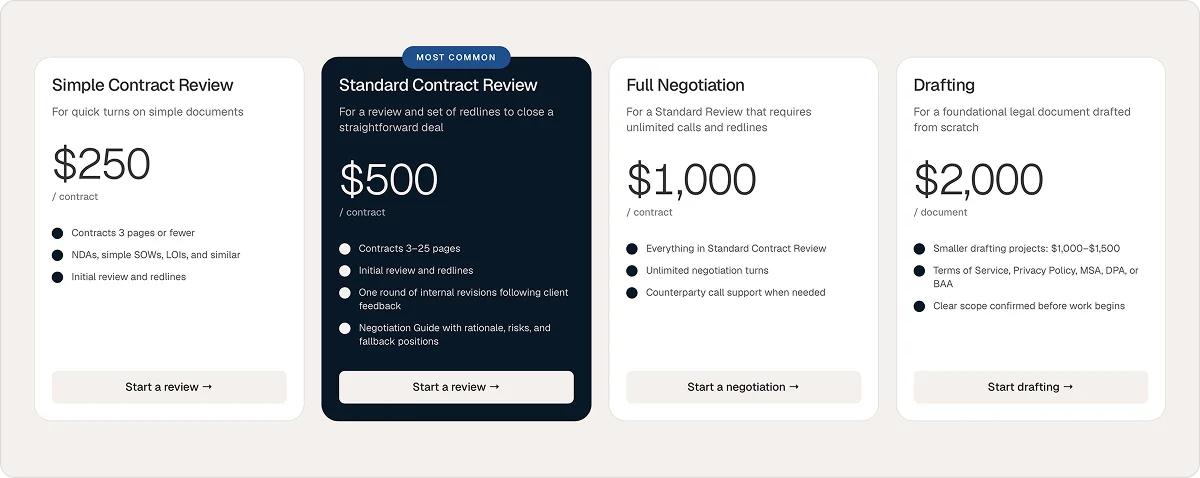
General Legal’s pricing illustrates this distinction.
Its standard process includes a legal review, redlines, one round of internal revisions, and initial negotiation guidance. Businesses that need ongoing communication with the counterparty can add full negotiation support for an additional fee.
Pro tip:
Avoid comparing only quotes when evaluating contract review providers. Two reviews may be priced similarly while including different levels of analysis, revisions, and negotiation support.
That’s why it's better to compare deliverables, as this provides a more accurate picture of the value you’re receiving.
7. The turnaround time required
Providers typically build their pricing around standard turnaround times that allow work to be scheduled alongside existing client matters. For most commercial contracts, the typical review window is 3–5 business days, while more complex matters may take one or more weeks.
In some cases, the review timeline becomes a service in its own right.
Meeting a same-day or next-day deadline may require lawyers to set aside other matters, extend working hours, or bring in additional support, all of which can increase the overall cost of the engagement.
Depending on the timeline and complexity involved, expedited reviews can increase fees by as much as 50%. The good news is that a few simple changes can reduce your legal spend without compromising review quality.
How to reduce your contract review cost: 3 most effective strategies
These three strategies can help reduce your overall contract review cost:
- Use a reputable template instead of starting from scratch: If you’re planning to make a legal contract without a lawyer, use an established template to build it. This way, the review lawyer can spend less time correcting structural issues and focus on the provisions that actually matter.
- Create a contract review playbook: A playbook documents your preferred positions on key terms, including what is acceptable, what should be negotiated, and what requires escalation. This reduces review time, improves consistency, and allows both internal teams and external counsel to work more efficiently.
- Use contract review automation for routine agreements: Not every contract requires bespoke legal analysis. Low-risk agreements can often be screened using AI contract review tools.
Even if you use leading contract automation tools, chances are you’ll still need legal review for your most important agreements.
However, this doesn’t mean you have to absorb the full cost of a traditional review process. Partnering with an AI-native law firm allows you to capture many of the efficiency gains of contract review automation while still benefiting from legal expertise when needed.
How AI-native law firms reduce contract review costs
AI-native law firms like General Legal reduce contract review costs by using AI to handle much of the repetitive work that traditionally consumes billable hours, allowing attorneys to focus on the issues that require legal judgment.
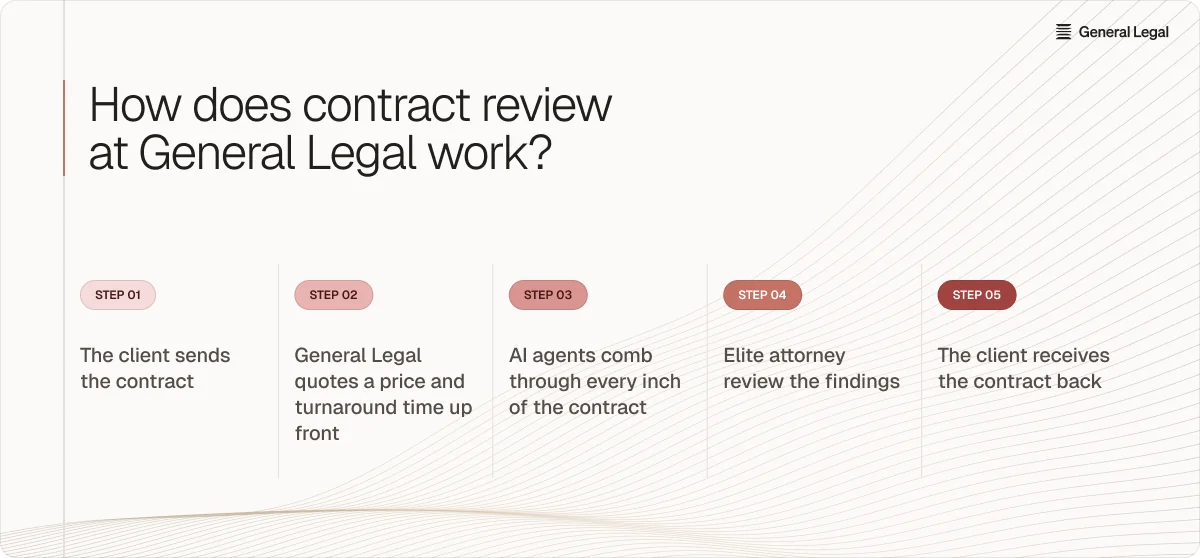
This approach creates several cost advantages:
- More efficient first-pass reviews: General Legal’s AI reviews contracts in seconds, surfacing issues, annotations, and proposed redlines before an attorney begins their review.
- Less manual review time: Attorneys receive a pre-analyzed contract instead of starting from a blank page, reducing the time required to complete a review.
- Fixed-fee pricing: Because reviews are completed more efficiently, most contracts can be offered at predictable flat fees rather than open-ended hourly rates.
- Faster turnaround times: Standard commercial contracts are typically turned in hours rather than days, eliminating the need for expensive rush requests.
General Legal’s US-barred attorneys can complete a post-AI contract review in 15–30 minutes, compressing several hours of traditional legal work into a fraction of the time. This efficiency is one of the reasons the firm can offer flat-fee contract reviews starting at more attractive price points.
Ready to reduce your contract review cost?
Get started online in minutes or book a 10-minute working session with our team first. Together, we’ll review your current legal workflow and determine whether General Legal can help you handle contracts and other legal work faster without adding headcount.
- The average contract review costs about $600, ranging from $100-$300 for simple documents up to $1,000-$3,000+ for complex agreements, and as high as $20,000 for large enterprise or M&A transactions.
- Seven factors drive the price: the pricing model used, contract type, length and complexity, reviewer experience, transaction value/risk, services included beyond a basic review, and turnaround time required.
- Flat-fee pricing is usually the most economical option for one-off reviews of standard agreements like NDAs, vendor contracts, and employment agreements, since scope is defined upfront.
- Contract disputes have surged, with state caseloads up 62.7% between 2020 and 2024 versus just 4.1% for tort claims, and businesses lose an average of 9% of annual revenue to issues like ambiguous scope or missed obligations.
- Three practical strategies reduce review cost: using an established template instead of drafting from scratch, building a contract review playbook, and using automation to screen routine, low-risk agreements.
- AI-native firms like General Legal cut costs by having AI complete the first-pass review in seconds so attorneys spend just 15-30 minutes finishing it, enabling flat fees starting at $250 for short contracts.
| Average cost | Contract review averages about $600, ranging from $100-$300 for simple documents to $20,000+ for large enterprise or M&A deals. |
|---|---|
| Pricing models | Hourly billing ($100-$750+/hr) offers low predictability; flat fees ($250-$3,000+/contract) offer the highest predictability for standard agreements. |
| Contract type matters | NDAs and vendor agreements typically run $250-$500, while M&A-related contracts can run $3,000-$10,000+. |
| Length and General Legal's tiers | General Legal prices flat fees by page count: $250 up to 3 pages, $500 for 3-25 pages, and from $1,000 for 25+ pages. |
| Why it matters | Contract disputes have surged 62.7% in state courts since 2020, and businesses lose an average of 9% of annual revenue to overlooked or ambiguous contract terms. |
| Cost-cutting strategies | Using an established template, building a review playbook, and automating screening of low-risk agreements are the three most effective ways to reduce spend. |
| How AI-native firms cut cost | AI handles first-pass review in seconds so attorneys spend only 15-30 minutes finishing it, letting firms like General Legal offer flat fees rather than open-ended hourly billing. |
Can I review a contract myself?
Yes, but you might miss technical risks. An AI tool or lawyer can help identify issues that may not be obvious on a first read.
What is the cost of a contract?
It varies depending on whether it's purchased, drafted, reviewed, or negotiated; contract review costs typically range from a few hundred to several thousand dollars.
How do I ask for a contract review?
Send the agreement to a lawyer and specify any deadlines, concerns, or commercial objectives so they can scope the work appropriately.
What is a contract review checklist?
A structured list of provisions to evaluate, such as payment terms, liability, termination rights, intellectual property, and dispute resolution clauses.
What are the benefits of using AI for contract review?
Faster reviews, lower costs, improved consistency, and the ability to identify potential risks at scale, though it still generally requires attorney oversight for important agreements.
Can ChatGPT review a contract?
Yes, ChatGPT can identify potential issues, but it doesn't provide legal advice and shouldn't be relied on as a substitute for lawyer review.
How to automate contract review workflows?
You can automate contract review workflows using AI-powered contract review tools, standardized templates, approval workflows, and contract playbooks.
What contract review tools do corporate legal departments prefer?
Corporate legal departments typically prefer contract review tools that combine AI-powered analysis, workflow automation, contract management, and collaboration features, such as Harvey and Legora.
- How Much Does It Cost To Hire a Lawyer? [2026 Guide]Learn how much does it cost to hire a lawyer and discover what affects legal fees, compare pricing, and choose the right option.
- 6 Best Fractional GC Attorneys at Law [Comparison]Discover the best fractional GC attorneys at law so you can compare legal expertise, support, pricing, and fit for your business.
- 9 Best Legal Tech Companies for Contract Solutions [Comparison]Discover the best legal tech companies for contract solutions so you can compare features, workflows, and services.