
If you’re going the traditional route for legal help, you’ll usually end up choosing between two options: a law firm or an independent lawyer.
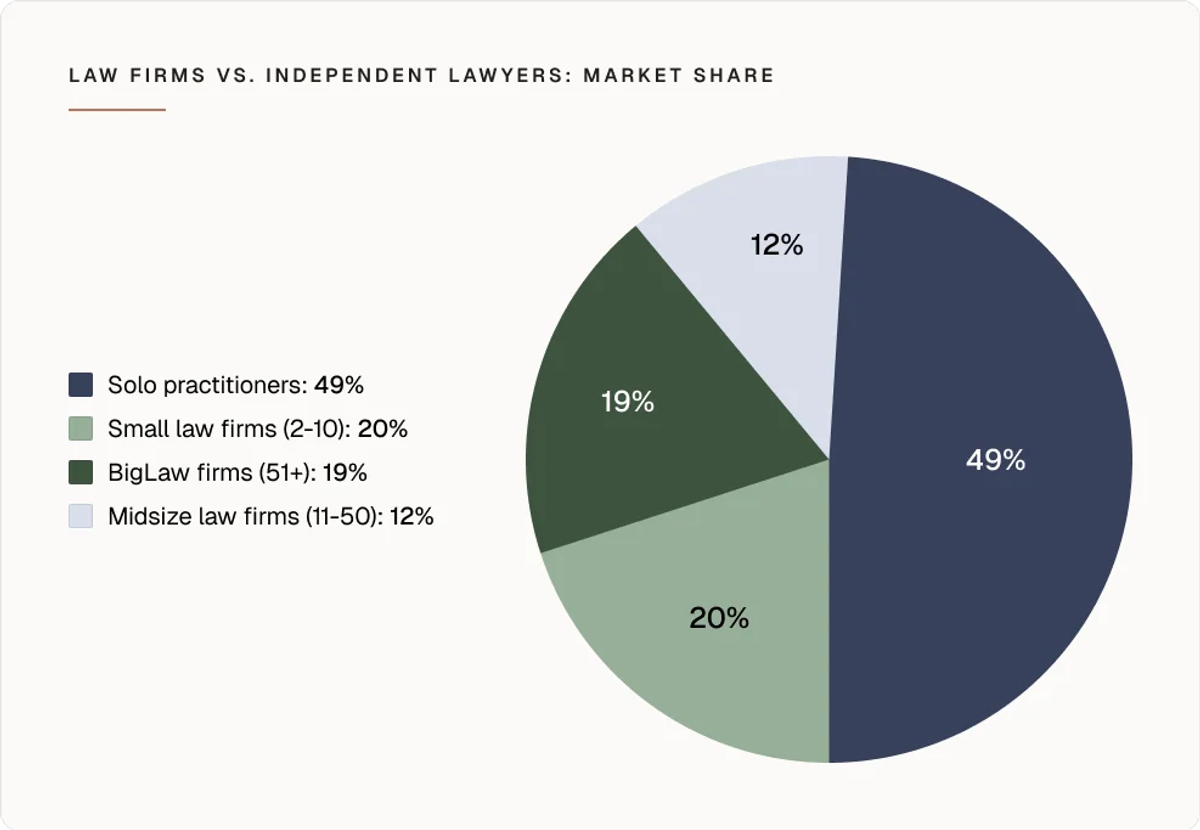
The market itself doesn’t make the call easy. It’s nearly an even split, as solo practitioners hold 49% of the field, while the other 51% is carved up between small, midsize, and BigLaw firms.
On paper, both of these categories solve the same legal problems. In practice, they often deliver very different experiences. To help you choose the right fit for your needs, this guide on hiring a law firm vs. independent lawyer compares those experiences across eight key areas.
Hiring a law firm vs. independent lawyer: 8 key differences
While you’re hiring lawyers in either scenario, these eight differences will dictate how your matter is staffed, coordinated, and executed.
1. What you’ll pay and how
As many as 46% of Americans who don’t seek legal help cite cost concerns as a primary reason for foregoing representation. That’s why one of the first questions people ask is how much it costs to hire a lawyer.
Generally speaking, solo practitioners are perceived as the more affordable option.
The logic is straightforward: There are fewer employees, less office space, and lower overhead. In addition, independent lawyers are often more flexible with fee arrangements. Since they can make pricing decisions on their own terms, these lawyers can offer flat fees, capped fees, unbundled services, or other arrangements that wouldn’t fit as easily within a firm’s pricing model.
Law firms, meanwhile, tend to charge more because you’re paying for more than one lawyer. There’s support staff, associates, partners, office infrastructure, knowledge management systems, and the administrative machinery required to run a larger operation.
The price difference between the two can become substantial at the top end of the market. While lawyers charged an average of $349 per hour in 2025, standard rates at Am Law 100 firms crossed the $1,000-per-hour mark. As for lawyers outside that elite tier, they averaged closer to $600 per hour.
However, there are exceptions.
An experienced solo practitioner with a strong reputation, niche expertise, or a highly specialized practice can charge rates that rival those of major firms.
The opposite is also true, as not all law firms are more expensive than independent lawyers.
The rise of AI-native law firms has introduced a different approach to billing. Firms like General Legal combine experienced attorneys with AI-powered workflows to eliminate much of the administrative and repetitive work that traditionally gets billed to clients.
Because these firms often operate with lower overhead than traditional firms and different cost structures than firms burdened by significant law firm startup costs, this approach can translate into lower and more predictable pricing.

2. What expertise you’ll have access to
Legal issues rarely stay confined to a single area of law. For example, a single acquisition can involve intellectual property, privacy, regulatory compliance, and corporate governance at the same time.
Law firms are typically better positioned for these complex cases because they bring together specialists from multiple practice areas under one roof. This arrangement creates an often-overlooked advantage: knowledge-sharing.
Because partners share in the firm’s overall success, they have a strong incentive to pull in the best internal specialist for a particular issue. This leads to a smoother transfer of information and less friction than starting over with a completely new legal provider.
Independent lawyers tend to operate differently.
Some are highly specialized and focus on a narrow area of law, while others act as generalists serving a broader range of client needs. Both approaches can work well, but when a legal issue extends beyond the lawyer’s core expertise, additional outside counsel may be needed.
While independent lawyers can—and do—maintain strong professional networks, these referrals typically happen across separate businesses rather than within a single organization. This makes collaboration and information-sharing less seamless when multiple areas of expertise are required.
3. How connected you’ll be to your legal team
Communication shapes every aspect of the client experience, from how quickly questions are answered to how effectively legal strategy is explained and executed.
When it comes to law firms, communication may pass through multiple people, depending on the size of the firm and nature of the engagement. This includes:
- Partners
- Associates
- Paralegals
- Client service staff
While this structured approach to communication can improve coordination on larger matters, it also creates more opportunities for delays, misunderstandings, and communication gaps. These challenges may help explain why 79% of law firm clients report feeling uncared for during their engagement.
Independent lawyers generally offer a more direct line of communication, with questions, updates, and strategic discussions happening with the same person handling the work. By minimizing intermediaries, they also reduce the risk of information being lost or miscommunicated along the way.
4. Who will actually do the work
When hiring a law firm, the lawyer you meet during the sales process isn’t always the lawyer managing the day-to-day work.
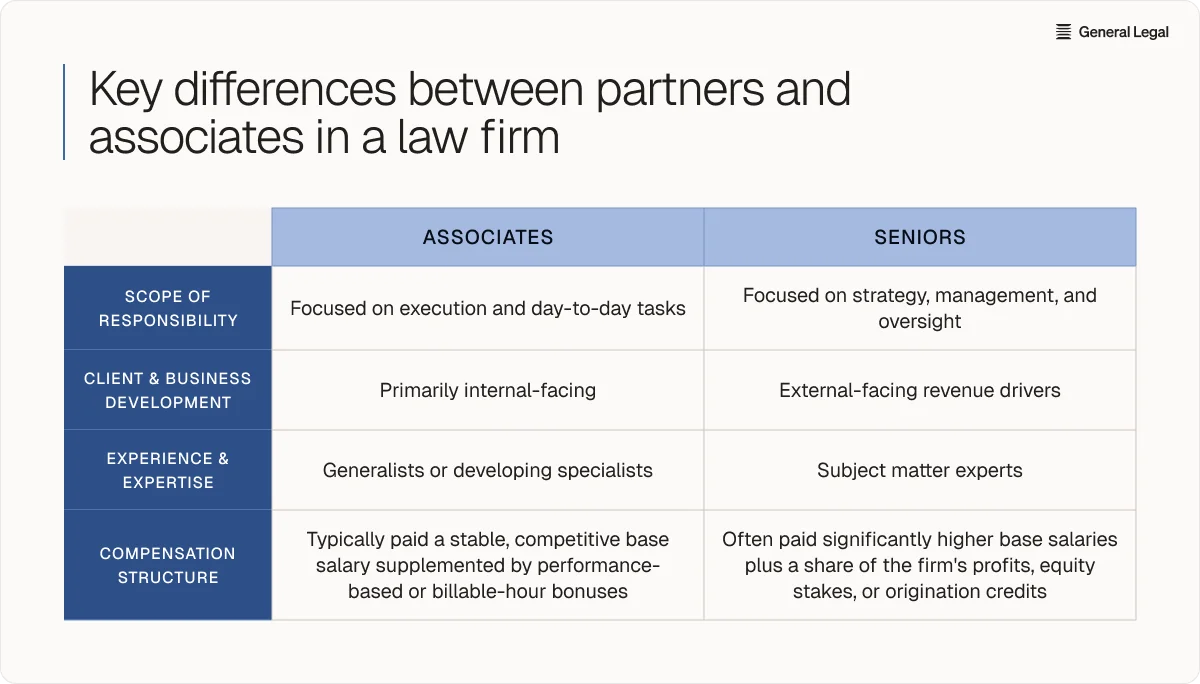
In many firms, senior partners focus on client relationships, legal strategy, and business development, while associates are in charge of legal research, document drafting, due diligence, discovery, and routine client communications. This staffing model can be efficient, but it can also mean that much of the work is performed by lawyers with less experience than clients initially anticipated.
That’s not the case with independent lawyers.
The person you hire is normally the person reviewing documents, answering questions, developing strategy, and carrying out the legal work. For clients who specifically want a senior lawyer managing the work throughout the engagement, this model can be a significant advantage.
That said, delegation isn’t inherently negative.
Many associates are highly capable lawyers, and leveraging a mix of senior and junior professionals can reduce costs by reserving partner time for higher-value work.
5. How much personal attention you’ll receive
Since solo practitioners typically manage smaller caseloads and handle matters personally from start to finish, they can devote more attention to each client. Over time, this continuity can lead to a stronger working relationship and a deeper understanding of the client’s goals.
As for law firms, personalization is often more dependent on how the matter is staffed.
If portions of your case are delegated to team members, the lawyer leading the engagement may pay less attention to your matter. As a result, recommendations may be informed by less context than they would be in a more hands-on arrangement.
6. How your legal strategy is shaped
Independent lawyers often have greater flexibility in how they approach a legal issue. Without firm-wide policies, approval chains, or standardized workflows, they can tailor their strategy more closely to a client’s specific objectives and risk tolerance.
Law firms tend to rely on more structured processes.
That consistency can be beneficial, particularly for recurring matters or complex engagements that require coordination across multiple people. However, it can also make legal strategies less adaptable to a client’s specific circumstances, particularly when a firm’s established processes take precedence over a more customized approach.
7. How much continuity you’ll have
Legal work rarely follows a predictable schedule. A court deadline can move up, an opposing party can send an urgent demand, or a deal that seemed dormant can suddenly require immediate review. In those moments, responsiveness and backup coverage become just as important as legal expertise.
Law firms are generally better equipped to maintain continuity in these situations.
If one attorney is unavailable, another lawyer or member of the support team can always take over. This is particularly valuable in time-sensitive matters where delays can carry legal or financial consequences, such as:
- Responding to a demand letter to avoid escalation or litigation
- Reviewing acquisition documents before a scheduled closing date
- Meeting court-imposed deadlines, where a missed filing can result in the loss of important legal rights
- Addressing a lender’s requests during a financing process to prevent funding delays
Independent lawyers typically have less built-in coverage.
Since these lawyers are usually the sole point of contact, there may be no one else with enough context to step in immediately. So, if they’re attending trial, taking a vacation, dealing with a personal emergency, or just operating at capacity, work may stop until they’re available again.
8. What resources you’ll have available
Many matters require far more than legal advice alone. Depending on the case, they may involve document review, legal research, drafting, filing, fact gathering, and coordination with outside parties.
Law firms typically support this work with a broader operational structure, which may include:
- Paralegals and legal assistants
- Administrative and operations staff
- Litigation support personnel
- Relationships with expert witnesses and outside consultants
- Internal research resources and document libraries
Independent lawyers, on the other hand, handle a larger share of these responsibilities personally. This can create a leaner operation, but it also means fewer resources are available when a legal issue requires significant support beyond the attorney’s own time.
However, this dynamic may change over time as more legal professionals learn how to use AI in law effectively. As of 2025, AI adoption reached 71% among solo practitioners and climbed to 87% at firms with over 50 employees.

Thanks to AI, tasks that once required teams of paralegals, researchers, and support staff can now be completed much faster, allowing lawyers to accomplish more with fewer people involved.
As these AI-powered workflows become standard across the profession, the resource gap between independent lawyers and law firms may narrow. With the lines between these two options blurring, how should you make your final decision?
Hiring a law firm vs. independent lawyer: Which way should you go?
The right choice between a law firm and an independent lawyer ultimately depends on the type of legal issue you’re facing.
If you’re handling a merger, acquisition, financing round, major regulatory matter, or another project that touches multiple areas of law, a law firm will usually be the stronger choice. These matters often require coordinated input from different specialists, and having those capabilities available within a single organization can make complex projects easier to manage.
Law firms are also a good fit for litigation involving large volumes of documents, multiple parties, or substantial financial exposure. In these situations, the additional personnel and support infrastructure can be just as important as the legal advice itself.
Independent lawyers tend to be a strong choice when the issue is more focused and self-contained. Examples include engagements where success depends primarily on the judgment and expertise of a single practitioner, such as:
- Estate planning
- Real estate transactions
- Criminal defense
- Family law matters
Solo practitioners can also be a great fit for clients who already know exactly what type of legal help they need and want to build a direct, long-term relationship with the lawyer providing it. In the business world, this relationship can evolve into an outside general counsel arrangement, with the same lawyer advising on day-to-day legal issues.
Of course, this doesn’t mean independent lawyers have a monopoly on long-term legal relationships for startups and high-growth companies. A new generation of outside general counsel law firms aims to combine the affordability and accessibility that attract clients to independent lawyers with the broader resources and expertise of a firm.
General Legal: An alternative to traditional law firms and independent lawyers
General Legal is an AI-native law firm that merges experienced attorneys with AI-powered workflows built specifically for legal work. AI handles much of the administrative and process-heavy work that has historically consumed attorney time, while lawyers focus on legal judgment, negotiation strategy, risk assessment, and client counseling. The result is a legal team that can handle matters more efficiently without compromising the quality of the advice clients receive.
This model is designed to address many of the tradeoffs that have traditionally existed between independent lawyers and larger firms:
| Category | Traditional law firm | Independent lawyer | General Legal |
|---|---|---|---|
| Cost | Hourly billing and often higher costs | Flexible pricing and often lower-cost | Flat-fee pricing with transparent costs upfront |
| Resources | Large support teams and operational infrastructure | Individual capacity and network | Dedicated attorneys supported by firm-wide systems and AI-powered workflows |
| Expertise | Broad specialist bench | Individual attorney expertise | Specialized attorneys across multiple practice areas with experience from leading law firms and in-house legal teams |
| Communication | Multiple points of contact | Direct attorney communication | Direct attorney access through Slack, email, and the client portal |
| Personal attention | Staffing-dependent | High-touch service | Dedicated attorney relationships backed by firm resources |
| Strategy | Firm-developed playbooks | Individualized advice | Customized legal guidance supported by institutional knowledge and continuously improving AI systems |
| Continuity | Team-based coverage | Single-attorney availability | Built-in coverage without sacrificing matter ownership |
| Access to senior lawyers | Partner oversight with delegated execution | Direct lawyer involvement | Experienced attorneys handling matters directly |
Our attorney bench spans technology transactions, venture capital, employment, data privacy, financial regulation, commercial contracting, blockchain matters, and it’s continuously expanding.
New matters are triaged based on subject matter, complexity, urgency, and attorney availability before being routed to the lawyer best equipped to handle them. The goal is simple: Get the right matter to the right lawyer at the right time.
Ready to get started?
Register online with General Legal today and start sending your legal requests. If you want to learn more about the firm, discuss your legal needs, and determine whether General Legal is the right partner for your business, reach out directly by email.
Read more:
Balancing Attorney and Machine at an AI-Native Law Firm
- Solo practitioners hold 49% of the legal market versus 51% for firms, and the right choice depends mainly on whether a matter needs a single specialist or multiple areas of expertise.
- Independent lawyers tend to be more affordable and flexible on pricing, while law firms charge more to cover support staff and infrastructure, with Am Law 100 rates crossing $1,000 per hour versus a $349 average overall in 2025.
- Law firms offer built-in backup coverage and broader resources like paralegals, support staff, and research libraries, while independent lawyers offer more direct communication but less coverage if they're unavailable.
- At a law firm, the senior lawyer you meet in sales may delegate day-to-day work to associates, whereas with an independent lawyer, the person you hire is typically the one doing the work throughout.
- Law firms tend to suit complex, multi-specialist matters like M&A or heavy litigation, while independent lawyers tend to suit focused, self-contained matters like estate planning or real estate transactions.
- AI-native firms like General Legal aim to combine an independent lawyer's direct access and flat-fee pricing with a firm's broader resources and specialist bench.
| Market split | Solo practitioners hold 49% of the market, and firms of various sizes hold the other 51%, so the choice is genuinely common. |
|---|---|
| Cost | Independent lawyers are usually cheaper and more flexible on fees; average hourly rates were $349 in 2025, but Am Law 100 firm rates crossed $1,000 per hour. |
| Expertise breadth | Firms bring multiple specialists under one roof for cross-disciplinary matters, while independent lawyers may need to refer out work beyond their core expertise. |
| Communication and who does the work | Independent lawyers offer direct, single-point communication and typically do the work themselves; at firms, work is often delegated to associates while partners manage the relationship. |
| Personal attention vs. continuity | Solo practitioners give more personalized attention over time, while firms offer built-in backup coverage if one attorney is unavailable during a time-sensitive matter. |
| Resources | Firms bring paralegals, support staff, and research infrastructure that solo practitioners generally handle alone, though AI adoption (71% among solo practitioners, 87% at larger firms) is narrowing this gap. |
| When to choose which | Firms suit complex, multi-specialist matters like M&A or large-scale litigation; independent lawyers suit focused matters like estate planning, real estate, or family law. |
| A third option | AI-native firms like General Legal aim to combine flat-fee pricing and direct attorney access with the specialist bench and resources of a traditional firm. |
Is it cheaper to hire an independent lawyer than a law firm?
Usually, since independent lawyers have less overhead and more flexible pricing, though highly specialized solo practitioners can charge rates that rival major firms, and not all firms cost more.
Who actually does the legal work when I hire a law firm?
Often associates handle day-to-day drafting, research, and communications while the senior partner you meet focuses on strategy and the client relationship, unlike an independent lawyer who typically does the work personally.
What happens if my independent lawyer is unavailable during an urgent matter?
There's typically no built-in backup, since independent lawyers are usually the sole point of contact, so work can pause until they're available again, unlike a firm that can shift matters to another attorney.
When should I choose a law firm over an independent lawyer?
For matters spanning multiple areas of law, like M&A, financing, or major regulatory issues, or for litigation involving large document volumes, multiple parties, or high financial exposure.
What does an AI-native law firm like General Legal offer compared to these two traditional options?
Flat-fee pricing and direct attorney access similar to an independent lawyer, combined with the specialist bench, institutional systems, and continuity of a traditional firm.
What is a general lawyer?
A general lawyer is a lawyer who handles a broad range of legal issues instead of focusing on a single specialty.
How do you choose a lawyer with confidence?
To choose a lawyer with confidence, look for one with relevant experience, clear communication systems, transparent pricing, and a track record of handling matters similar to yours.
What does a commercial law firm do?
A commercial law firm helps businesses with contracts, transactions, employment issues, regulatory compliance, and other legal matters that arise during day-to-day operations.
What are the best law firms for startups?
The best law firms for startups are those with experience advising high-growth companies, transparent pricing, responsive communication, and expertise in areas like venture capital, commercial contracts, employment, and data privacy. Many startups also consider AI-native law firms, which use technology to deliver legal services more efficiently while maintaining attorney oversight.
- Paralegal vs. Lawyer: Who Should You Hire? [5 Differences]Compare if you should hire paralegal vs lawyer so you can understand their roles, legal responsibilities, costs, and the right choice for your needs.
- How Much Does It Cost To Hire a Lawyer? [2026 Guide]Learn how much does it cost to hire a lawyer and discover what affects legal fees, compare pricing, and choose the right option.
- 6 Best Fractional GC Attorneys at Law [Comparison]Discover the best fractional GC attorneys at law so you can compare legal expertise, support, pricing, and fit for your business.