
There’s a new model challenging BigLaw: the AI-native law firm. Where a traditional shop provides you with a partner, three associates, and a six-week timeline, these law firms are using AI to deliver partner-level judgment in a fraction of the time—and often for a fraction of the bill.
However, this model is still in its early stages. As of late August 2026, there are only 60 AI-native law firms operating worldwide, according to the AI Firm Index.
And within that small pool, an even smaller subset has cleared a notable bar: backing from Y Combinator (YC), a world-renowned startup accelerator that has funded more than 5,000 companies, including giants like Airbnb, Stripe, Dropbox, Reddit, and DoorDash.
Given that these firms are too new to have the track record or traditional legal rankings that usually help buyers evaluate law firms, the YC stamp is a useful filter for operators trying to figure out which one to partner with.
With that in mind, this guide breaks down the top three YC AI-native law firms and explains what sets each apart.
How we chose the 3 best YC AI-native law firms
To date, YC has funded 56 legal startups, with only a select few being AI-native law firms.
To further narrow the field, we evaluated these law firms on:
- Founder and Legal Expertise: We assessed the depth of relevant legal, technical, and startup experience on the team.
- Legal Offering and Differentiation: We scored the firms on how broad their services are, how effectively technology is integrated into delivery, and what sets them apart from traditional firms and other AI-native players.
- YC Tier List Ranking: We consulted this independent ranking that places companies in S-to-D tiers based on founder credibility, product reality, market opportunity, and competitive positioning.
3 best YC AI-native law firms at a glance
1. General Legal: Best for growth-stage B2B startups without a large in-house legal team

General Legal is an AI-native law firm focused on commercial legal work for founders, with over 650 growth-stage companies represented and a 95% customer satisfaction score.
General Legal is designed around the needs of companies that have outgrown ad hoc legal help but don’t yet need a full-time GC, particularly startups signing customer and vendor agreements at a steady clip.
So, for a growth-stage B2B company, the appeal is straightforward: You get experienced US-barred attorneys, AI-native workflows, and a direct line to counsel without building a legal department or waiting days for routine contracts.
How General Legal delivers legal services
The process is designed to remove the usual back-and-forth between lawyers, associates, and email threads. Here’s what that looks like in practice:
- You send the work: Drop in a contract or legal request through Slack, email, or the client portal.
- You get a quote: An attorney confirms the scope, price, and turnaround before work begins.
- AI does the first pass: Sentinel reviews the document, flags issues, summarizes key terms, and prepares redlines and annotations.
- An attorney takes over: A US-barred attorney reviews the full contract and AI output, applies legal and commercial judgment, and delivers the final work product.
Which services General Legal offers
While commercial contracts remain the core offering, General Legal now covers much of the legal work a growing company encounters across its lifecycle, including:
- Technology transactions – Master Services Agreements (MSA), SaaS agreements, licensing, Statements of Work (SOWs), and AI/data terms
- Employment – Offer letters, contractor agreements, equity grants, policies, and employment counseling
- Data privacy – Global privacy policies and US privacy policies, global Data Processing Addenda (DPA) and US DPA, cookie notices, and AI-data governance
- Financial regulatory – Regulatory-aware contracts for payments, lending, and financial products
- Emerging companies and venture capital – Incorporations, SAFEs, priced rounds, governance, and cap tables
- Tax – Formation, QSBS planning, financings, equity compensation, and exits
Why YC backed General Legal
General Legal fits a thesis YC has been increasingly interested in: using AI to rebuild the service itself, rather than selling software to the incumbent.
The co-founding team also brings an unusually relevant pedigree.
Ryan Walker spent more than five years as CTO of Casetext, while Javed Qadrud-Din led AI there and JP Mohler worked on Casetext’s AI products at Thomson Reuters. The founders combine legal experience from firms including Cooley and Fenwick with deep experience building legal AI.
There was also early evidence that the model was working, as General Legal reported over 20 growth-stage companies moving their commercial contracting to the firm within weeks of joining YC.
And according to the YC Tier List, General Legal received an A-tier ranking, making it one of only two YC-backed AI-native law firms in this upper tier.
How General Legal’s pricing works
General Legal uses upfront, flat-fee pricing that varies depending on the type and complexity of the matter.
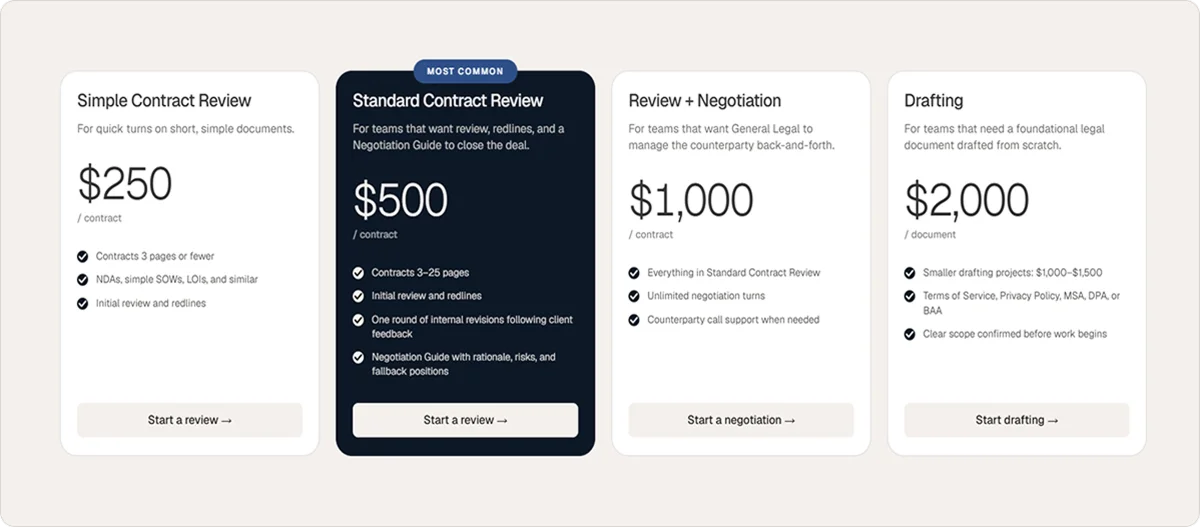
For recurring or higher-volume legal needs, the firm also offers custom pricing and ongoing support through its GC-as-a-service model.
2. LegalOS: Best for startups hiring international talent
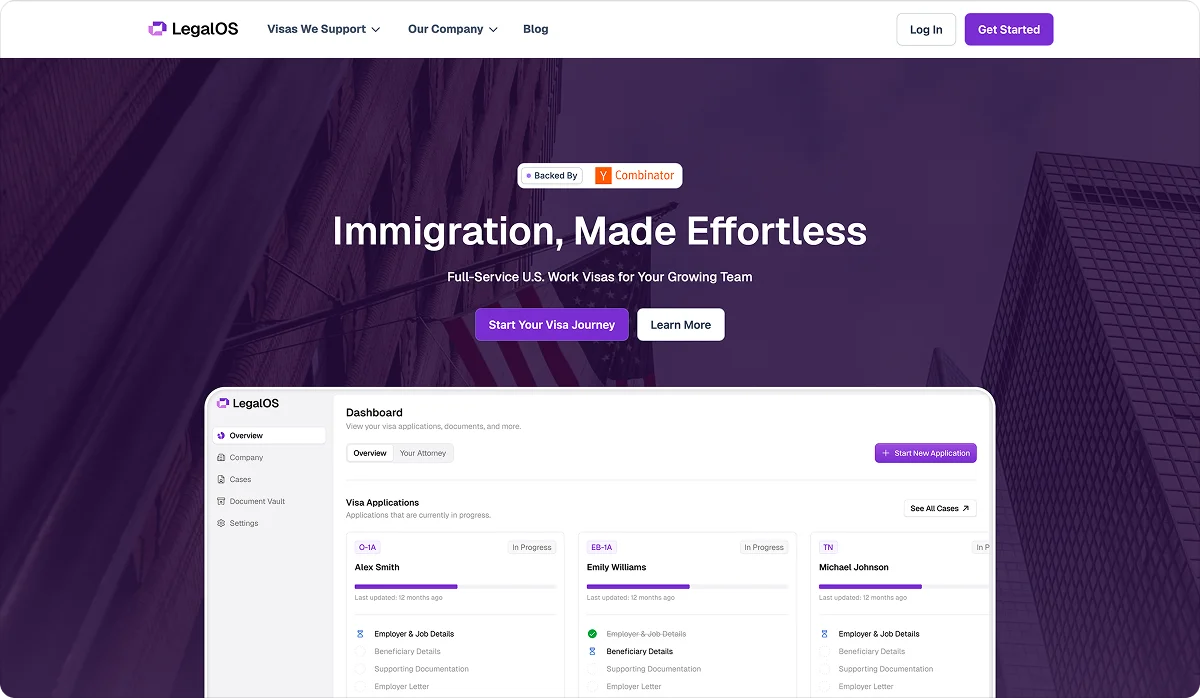
LegalOS is an AI-native law firm serving founders and companies navigating US immigration. It has studied thousands of successful petitions, giving it a substantial dataset to build and refine its immigration process.
This streamlined process is precisely what makes it a strong fit for startups hiring internationally, as it allows them to move visa applications forward much faster than traditional immigration firms can.
How LegalOS delivers legal services
LegalOS uses generative AI to handle most of the preparation work while licensed immigration attorneys remain responsible for the final application. Here’s a step-by-step overview of the process:
- You start with an evaluation: LegalOS assesses the candidate’s profile and identifies the strongest visa path.
- You provide your documents: The team collects and organizes the information needed for the petition.
- AI prepares the petition: Its specialized agents use patterns from successful petitions to build narratives and supporting evidence.
- An attorney reviews the case: A licensed immigration attorney reviews every filing before submission.
- LegalOS handles the filing: The team files the application and provides ongoing support through RFEs, updates, and questions.
Which services LegalOS offers
LegalOS focuses exclusively on US immigration, covering several of the visa categories most relevant to startups and international talent, such as:
- O-1A/O-1B (extraordinary ability)
- H-1B (specialty occupations)
- L-1A/L-1B (intracompany transfers)
- TN (eligible Canadian and Mexican professionals)
- EB-1A (extraordinary ability green cards)
Why YC backed LegalOS
LegalOS has unusually deep experience in its target market.
CEO Matthew Asir previously founded immigration-tech company Legal Bullet, while Matthew and COO Rachel Asir grew up around their family’s 40-year immigration law firm. CTO Claire Jutabha brings the technical side, with experience at TikTok, Notarize, and NASA JPL.
The product also has a defensible starting point: LegalOS built its AI workflows around 12,000 successful petitions, combining that data with decades of immigration-law expertise. The company says it has filed dozens of applications with a 100% approval rate so far.
How LegalOS’s pricing works
LegalOS uses transparent pricing without retainers or hidden fees, positioning itself as a lower-cost alternative to traditional immigration counsel.
Pricing varies by visa type and case complexity, and prospective clients start with an evaluation and consultation.
3. Vector Legal: Best for startups that want legal counsel and an integrated legal tech platform
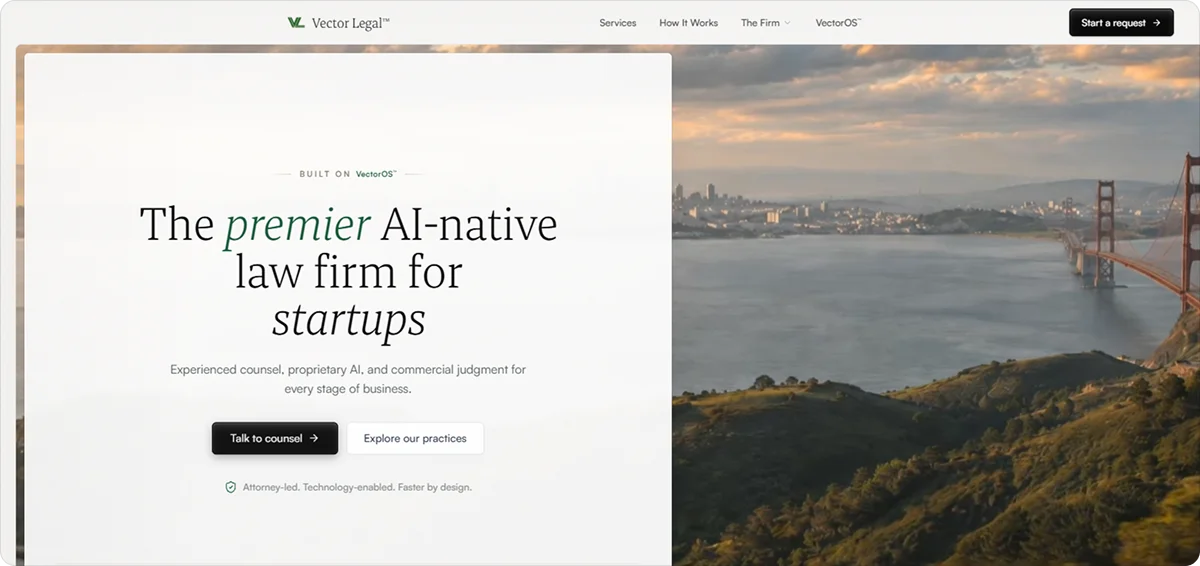
Vector Legal is an AI-native law firm and legal tech platform primarily serving startups from Seed through Series B, with over 1,000 companies and matters supported and more than 600 venture financings handled by its team.
For founders who want legal support and technology in the same place, Vector combines experienced startup lawyers with its proprietary VectorOS platform, which brings contract review, document drafting, equity management, data rooms, and other legal workflows into one system.
How Vector Legal delivers legal services
Here’s how Vector Legal delivers legal services step by step:
- You send the work: Share your legal request and relevant documents through Slack, Outlook, email, or VectorOS.
- You approve the scope: Review the proposed scope, timing, and price before work begins.
- VectorOS assists with the work: The platform can review contracts, draft documents, answer questions across your legal documents, and manage workflows such as equity and data rooms.
- An attorney takes over: Vector’s legal team prepares the work, provides practical advice, and handles the matters that require legal judgment.
- Vector closes the matter: The team manages documents and negotiations through completion.
Which services Vector Legal offers
Vector covers business law needs across the startup lifecycle, including:
- Startup formation – Entity formation, founder equity, vesting, IP protection, and international flips
- Financing – SAFEs, debt, equity, and priced rounds
- Employment – Hiring and related employment matters
- Governance and privacy – Corporate governance, privacy, and related matters
- Founder transitions – Co-founder separations and dissolutions
Why YC backed Vector Legal
Vector’s strongest signal is its tight founder-market fit.
Co-founder Mitch Duncombe previously spent about four years at Fenwick and three years at YC Legal, while co-founder and CTO Keenan Venuti was a Staff AI software engineer at Ironclad, where he worked on AI for contract workflows. Together, they bring experience from both startup law and legal technology.
The firm has also built a broader operating model around that technology, combining lawyers, paralegals, and engineers rather than treating AI as a standalone legal tool.
How Vector Legal’s pricing works
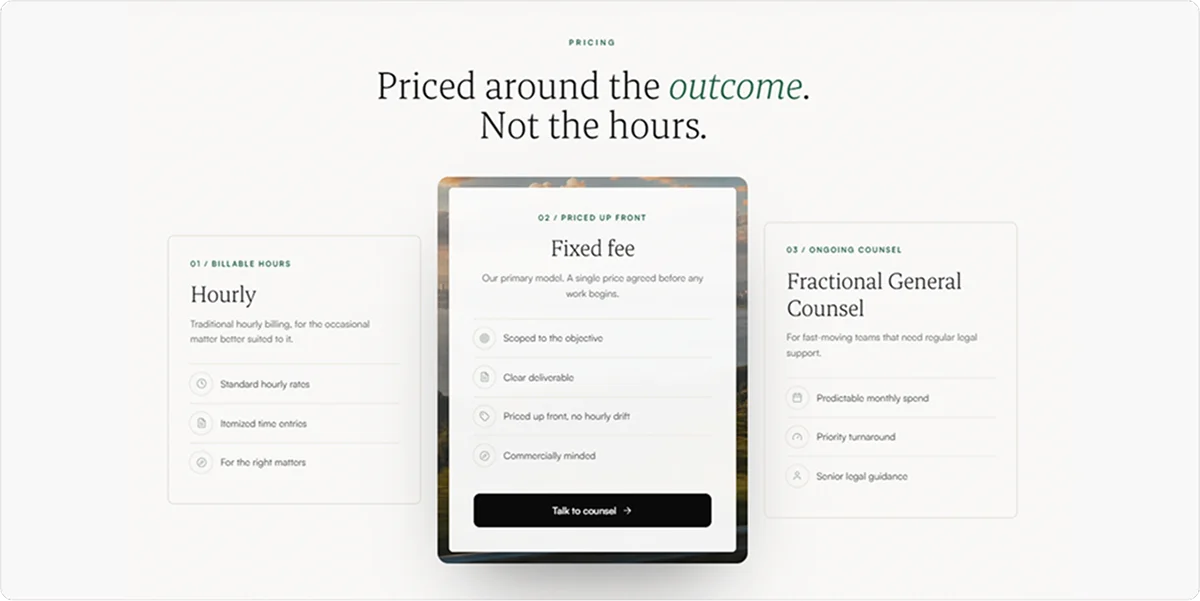
Vector uses a mix of fixed-fee, hourly, and ongoing counsel arrangements, depending on the matter.
What is the best YC AI-native law firm for your business?
Given the elite legal and technical teams across all three YC-backed AI-native law firms for startups, the best choice for your business ultimately depends on the type of legal support you need.
General Legal is the most comprehensive option of the three, and its scope is constantly expanding.
For example, the firm recently expanded into defense and government contracts, helping companies with matters like:
- Subcontracts
- Teaming agreements
- Other Transaction Agreements (OTAs)
- Small Business Innovation Research (SBIR) awards
- Data rights
- Cybersecurity Maturity Model Certification (CMMC) requirements
At the same time, it’s experimenting with additional areas, such as real estate.
For a growing company that wants one outside counsel partner rather than a different specialist for every new legal problem, that breadth makes General Legal the most versatile choice.
Getting started with General Legal
If General Legal feels like the right fit for your business, you can get started with our firm in two ways:
- Create an account: Sign up with your work email or Google and connect with our business attorneys. There are no upfront fees or commitments.
- Book a consultation: Schedule a 10-minute conversation to discuss your team’s legal needs and see where General Legal can help.
- Only 60 AI-native law firms exist globally as of August 2026, with just three having Y Combinator backing: General Legal, LegalOS, and Vector Legal.
- General Legal serves growth-stage B2B startups with commercial contracts and broad legal services, having raised $11.5 million and achieved a 95% customer satisfaction score across 650+ companies.
- LegalOS specializes exclusively in US immigration law for startups hiring international talent, built on a dataset of 12,000 successful petitions with a 100% approval rate to date.
- Vector Legal combines startup legal counsel with its proprietary VectorOS platform, offering integrated technology for contract review, equity management, and data rooms alongside traditional legal services.
- All three firms use AI to handle initial document preparation and analysis, while US-barred attorneys provide final legal judgment, review, and strategic advice.
- YC backing serves as a credibility filter for evaluating these new firms, which lack the traditional track records and legal rankings used to assess established law firms.
| AI-native law firm landscape | Only 60 AI-native firms exist worldwide, with three having Y Combinator backing as of August 2026 |
|---|---|
| General Legal's focus | Serves 650+ growth-stage B2B startups with commercial contracts, employment, privacy, tax, and corporate matters using flat-fee pricing |
| LegalOS's specialization | Handles US immigration exclusively (O-1, H-1B, L-1, EB-1A visas) for startups, trained on 12,000 successful petitions with 100% approval rate |
| Vector Legal's approach | Combines startup legal counsel with VectorOS platform for contract review, equity management, and document workflows in one system |
| Delivery model | AI handles first-pass document review and preparation, then US-barred attorneys apply legal judgment and finalize work |
| Founder credentials | Teams combine legal experience from Cooley, Fenwick, and YC Legal with AI expertise from Casetext, Ironclad, and TikTok |
| Pricing structure | General Legal uses flat fees; LegalOS offers transparent visa-specific pricing; Vector uses fixed-fee, hourly, or ongoing arrangements |
| Best fit scenarios | Choose General Legal for broad legal needs, LegalOS for immigration only, or Vector for integrated legal tech platform with counsel |
What is an AI-native law firm?
An AI-native law firm is a legal practice built around AI from the ground up. Instead of adding AI tools to traditional workflows, these firms design their staffing, processes, technology, and service delivery around AI, while attorneys remain responsible for legal judgment and advice.
What are some AI-native law firms?
Examples of AI-native law firms include General Legal, LegalOS, Covenant, Eudia, and Vector Legal.
Are there any law firms that specialize in AI-driven solutions for corporate law?
Yes, there are firms that use AI in corporate law. General Legal is one example, using AI-native workflows to deliver commercial contracts, employment, privacy, corporate, and other business legal services.
- 6 Best Outside General Counsel Law Firms [Comparison]Explore the best outside general counsel law firms so you can compare legal support, expertise, pricing & fit for your business.
- 6 Best Fractional GC Attorneys at Law [Comparison]Discover the best fractional GC attorneys at law so you can compare legal expertise, support, pricing, and fit for your business.
- 12 Types of Commercial Law You Should Know in 2026Explore the types of commercial law so you can understand your legal needs, manage business risks, and choose the right legal support.