
Your MSA, the purchase order your hardware supplier just sent over, and the NDA you signed last week are all contracts, but they don’t run on the same rules.
Most founders use commercial law and contract law interchangeably, and for most of what you sign, it’s unlikely to make a difference. The distinction starts to matter when you sell a device with a software subscription attached, or when a supplier's order form contradicts your MSA, because two rulebooks are then competing for the same deal.
Getting it wrong is expensive. World Commerce & Contracting's 2025 contract management research puts the value an average business loses to weak contracting at close to 9% of revenue, rising to 15% or more in complex industries.
The question worth answering isn't which field applies; both do. It's which set of contract rules governs the deal in front of you, and whether anyone has checked that before signing.
This guide covers the key differences between commercial law and contract law, the goods-versus-services line that decides which rules apply to your agreements, and the three mistakes that cost founders the most.
What is commercial law?
Commercial law is the umbrella term for the rules governing business transactions: buying and selling, financing, leasing, licensing, secured lending, and the paperwork behind it.
It's not a single statute or code but a collection of frameworks that includes contract law, the Uniform Commercial Code, agency law, secured transactions, and (depending on the deal) elements of corporate and regulatory law.
For a startup, it shows up in nearly everything you sign:
- Customer and vendor agreements
- NDAs and MSAs
- Equipment leases and purchase orders
- Financing and security documents
Think of commercial law as the terrain and contract law as the rules of the road that apply once you're on it. A commercial law firm works across the whole terrain, and the contract question is one part of what it handles.
What is contract law?
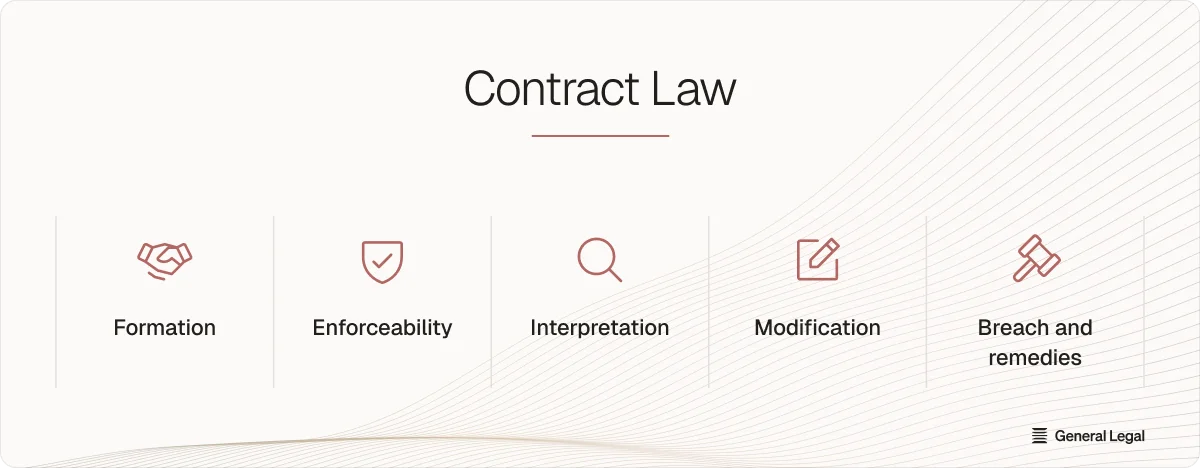
Contract law governs the lifecycle of an agreement:
Formation: An offer, an acceptance, and consideration generally need to be present before a contract exists.
Enforceability: Courts look at whether the parties had capacity and intent to be bound, and whether the terms are clear enough to enforce.
Interpretation: Where language is ambiguous, courts look at context, industry custom, and how the parties behaved.
Breach and remedies: What you can recover depends on the type of contract and the governing framework.
Modification: How easily a signed deal can be changed later depends heavily on which rules apply.
Both UCC Article 2 and common-law principles are contract law. They're different rule sets applied to different subject matter, which template-driven advice tends to skip.
Contract law vs. commercial law: 5 key differences
The distinction matters in five places, and only the first is definitional. The other four decide what your contract actually does.
1. What each field covers
Commercial law sets the outer boundary. Contract law operates inside it, governing the individual bargains.
2. Which rulebook applies to your deal
In the US, UCC Article 2 governs transactions in goods, meaning tangible, movable personal property. It doesn't reach services, real property, or most intangibles, which stay under common-law principles.
Every state except Louisiana has adopted a version of Article 2, so this is a near-universal feature of US commercial law rather than a local quirk.
For startups, the split shows up constantly:
However, the classification isn't fixed by the label on the document. A subscription structured around delivered equipment can pull the analysis toward Article 2 even where the contract calls itself a services agreement.
3. How the contract gets formed
Under common law, the mirror-image rule applies: an acceptance that changes the offer is a counteroffer, not a deal. Under UCC § 2-207, a definite expression of acceptance can form a contract even when it states additional or different terms, unless acceptance is made conditional on assent to them.
That difference does a lot of work in the background. When your order form and a customer's purchase order don't match, the battle-of-the-forms rules decide which terms survive, not whichever document was signed last.
4. Which warranties attach without being written
Common law has no standard statutory warranty scheme, which means that what you promised is what's in the document.
Article 2 works the other way. The implied warranty of merchantability applies by default where the seller deals in goods of that kind, alongside fitness for a particular purpose and any express warranties. Disclaiming merchantability takes specific language that mentions merchantability clearly and explicitly.
A goods contract silent on warranties still carries warranties, while a services contract silent on warranties generally doesn't.
5. What happens when the deal changes or breaks
Modifying a common-law contract usually requires fresh consideration. Under UCC § 2-209, an agreement modifying a contract for the sale of goods needs no consideration to be binding. An addendum that works for your hardware supply agreement may not apply to your consulting agreement.
Remedies split the same way. Common law offers damages, specific performance, and rescission shaped by precedent, while Article 2 carries its own provisions for buyers and sellers of goods.
These five differences are straightforward when a deal includes just goods or just services, but many startup contracts don’t.
What happens when a contract includes both goods and services?
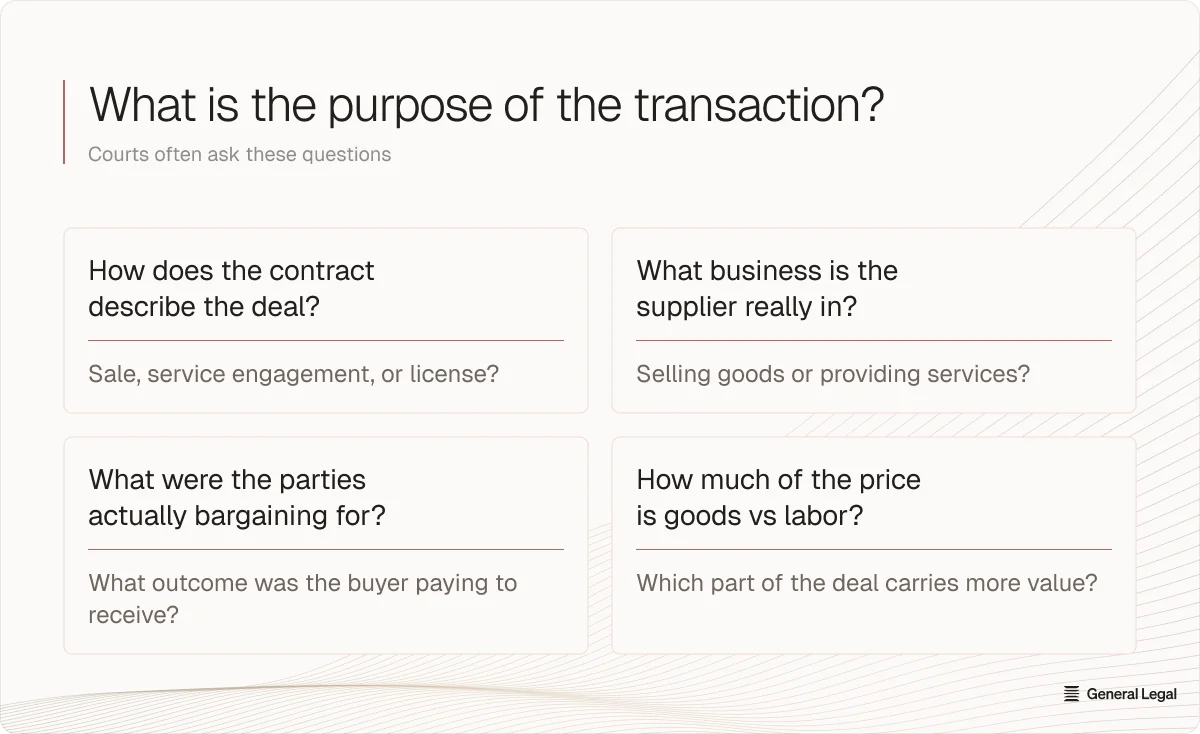
Courts generally apply the predominant-purpose test, first articulated in Bonebrake v. Cox (8th Cir. 1974). The main question is whether the purpose of the transaction is the rendition of services with goods incidentally involved, or a sale of goods with labor incidentally involved.
Courts weigh several things in making that call:
- The contract's own language: Whether it reads as a sale, a service engagement, or a license
- The nature of the supplier's business: What the seller does for a living
- What the parties bargained for: The outcome the buyer was paying to receive
- Relative value: How much of the price sits in the goods versus the labor
No single factor decides it, and reasonable courts reach different conclusions on similar facts. A hardware startup bundling a device with a subscription, or an AI company selling a platform license alongside implementation work, can't assume the answer is obvious from the cover page.
This is the kind of question a lawyer answers by reading the whole arrangement. Firms like General Legal treat classification as a triage step at the front of a contract review, so the warranty and remedy analysis that follows starts from the right rulebook.
Founders who skip the question tend to skip it the same three ways.
3 mistakes founders make with commercial contracts
These mistakes typically surface in diligence, at renewal, and in the first real dispute.
1. Treating every agreement as the same kind of contract
The NDA, the vendor MSA, and the hardware purchase agreement from a supplier aren't interchangeable just because they're all "contracts." Each may sit under a different framework, with different defaults for formation, warranties, and modification.
Template reuse is efficient right up to the point where the deal type changes, and nothing in the document announces when that happened.
2. Assuming the signed form controls
When your sales motion generates a purchase order, an order form, and an MSA that don't perfectly agree, the document signed last doesn't automatically win. On a goods deal, § 2-207 decides which terms survive, and it can produce a contract on terms neither side would have picked.
3. Reusing services warranty language on a goods deal
Warranty disclaimers and limitation-of-liability clauses written for a services agreement don't translate cleanly to a hardware sale or a mixed deal. Implied warranties under Article 2 can apply unless properly disclaimed, so a clause that was adequate in your SaaS terms may leave you exposed on a device sale.
That said, none of these is fatal on its own. What turns them expensive is finding them after signature, which is why it’s often a good idea to get a second set of eyes.
Read more: Outside General Counsel for Startups: What to expect?
When to get a commercial contract reviewed
Run through this checklist before you sign any contract:
- What is actually being sold? Break the deal into components rather than trusting the title.
- Goods, services, software, or a combination? Be honest about whether a tangible product is involved.
- Which state's law governs? The governing-law clause matters, given jurisdiction-specific variation in how Article 2 was adopted.
- Do the POs, order forms, and MSA agree? If your process generates several documents, check that they say the same thing.
- Are warranties or modification rights in play? These are where the frameworks diverge most sharply.
If you can't answer confidently, seek a second opinion before signature rather than after a dispute forces the question.
The usual objections are time and cost of hiring a lawyer. Waiting three days for a contract review while a deal is closing isn't realistic, which makes turnaround as much a constraint as quality.
That's why more startups now delegate this work to AI-native law firms, where an AI first pass handles the mechanical part of the review and an attorney makes the call that carries the risk.
General Legal’s approach to commercial contract review
Using AI and being AI-native aren't the same thing. Contract review automation performs well on high-volume, standardized paper: NDAs checked against a playbook, order forms checked against a clause library.
However, a tool that flags a missing liability cap won't tell you the disclaimer above it was drafted for a services deal, which is one of the known risks of using AI in legal work without a lawyer in the loop.
General Legal is an AI-native law firm that pairs elite, US-barred attorneys with AI-powered workflows built specifically for legal work, serving startups and growth-stage companies.
AI agents handle the operational layer: triaging documents, running first-pass review, surfacing risk, and producing first drafts. Attorneys handle legal judgment, negotiation strategy, risk assessment, and the final review before anything reaches the client. The result is a contract review that moves at software speed but arrives with a lawyer's judgment attached to the answer.
On a commercial contract, that means you get:
- A straight answer on which framework governs: Goods, services, or hybrid, and what follows from that classification
- Warranty and indemnity language matched to the transaction: Disclaimers drafted for the deal in front of you rather than carried over from the last SaaS agreement
- A read on conflicting paper: Which terms survive when a purchase order, an order form, and an MSA don't agree
- Redlines you can send: Issues marked with a recommended position, not a list of observations
- Answers between reviews: Clerk AI handles common legal questions and surfaces the next step on a matter, so small questions don't wait for a meeting
The same bench covers technology transactions, emerging companies and venture capital, and data privacy when a contract question turns out to be part of something larger.
We quote flat-fee pricing upfront and work matter by matter, so one review doesn't require a retainer or an existing counsel relationship, and no question gets more expensive to ask because of the billable hour. Work comes back through Slack, email, or the client portal.
You can register online for free and send us a contract today, or you can contact our team directly to see whether the AI-native law firm model fits the legal work your company needs.
- Commercial law is the umbrella governing business transactions, while contract law focuses specifically on agreement formation, interpretation, and enforcement within that broader framework.
- UCC Article 2 governs sales of goods and carries default implied warranties, while common-law principles apply to services and most intangibles without statutory warranty protections.
- Under UCC § 2-207, acceptance can form a contract even with different terms, whereas common law requires mirror-image acceptance—a critical difference in the battle of the forms.
- Mixed contracts involving both goods and services are analyzed using the predominant-purpose test, which examines language, business nature, value allocation, and what parties actually bargained for.
- World Commerce & Contracting research shows businesses lose close to 9% of revenue to weak contracting, rising to 15% or more in complex industries.
- Warranty disclaimers and limitation clauses drafted for services agreements don't translate to goods deals, leaving companies exposed if they reuse language without checking which framework applies.
| Scope distinction | Commercial law governs all business transactions; contract law operates within it to enforce specific agreements. |
|---|---|
| Governing frameworks | UCC Article 2 applies to goods transactions; common-law principles govern services, licenses, and most intangibles. |
| Contract formation rules | Common law requires mirror-image acceptance; UCC allows acceptance with different terms under § 2-207. |
| Default warranties | Article 2 carries implied warranties of merchantability and fitness unless properly disclaimed; common law does not. |
| Modification requirements | UCC § 2-209 allows no-consideration modifications for goods; common law generally requires fresh consideration. |
| Mixed transactions | Courts apply the predominant-purpose test to determine whether goods or services rules govern hybrid deals. |
| Common founder mistakes | Treating all contracts identically, assuming the last-signed form controls, and reusing services warranty language on goods deals. |
| AI-native review approach | General Legal combines AI-powered first-pass review with attorney judgment for contract analysis at software speed with legal accountability. |
Is contract law part of commercial law?
Yes. Contract law is one of the core frameworks inside commercial law, governing the agreements that document commercial transactions.
What is the main difference between commercial law and contract law?
The main difference is scope. Commercial law covers business transactions broadly, while contract law focuses on how individual agreements are formed, interpreted, performed, and enforced.
Does the UCC apply to every business contract?
No. UCC Article 2 primarily governs transactions in goods. Many services, software arrangements, and intangible transactions are governed by common-law contract principles instead.
Does the UCC apply to SaaS contracts?
Not automatically. SaaS is usually treated as a service or a license rather than a sale of goods, though the analysis can shift where software is bundled with hardware or other tangible products.
Why does UCC versus common law matter for a startup?
It matters because the framework sets the defaults. Formation, conflicting forms, modification, warranties, and remedies all work differently depending on which rules govern the deal.
- Commercial Law vs. Business Law: 5 Main DifferencesCompare commercial law vs business law so you can understand their differences, identify your legal needs & choose the right fit.
- Commercial Terms vs. Legal Terms: 5 Key DifferencesCompare commercial terms vs legal terms so you can understand key differences, spot risks, and protect your interests before signing a contract.
- Commercial Contract Litigation: When It Happens & How to AvoidExplore what you need to know about commercial contract litigation so you can understand common disputes, manage legal risks & protect your business.