
Somewhere between the term sheet and the signature, someone on your team asks whether the contract is even legally valid.
It's the wrong question, and answering it rarely protects you.
What decides whether a deal is good or bad for your company isn't whether a court would enforce it, since almost every commercial contract you sign will clear the enforceability bar. It's what the contract says once it's enforceable.
A perfectly valid agreement can still expose a vendor to uncapped liability, bury an auto-renewal, or leave your IP ownership ambiguous.
The evidence backs the emphasis. World Commerce & Contracting's Most Negotiated Terms 2024 report, drawn from 937 organizations, found the same handful of risk-allocating clauses consuming most negotiation effort year after year. Their contract management research found just 16% of practitioners believe negotiations focus on the right topics at all.
This guide covers what makes an agreement enforceable, what happens when legal contract requirements are missing, and which clauses decide whether the deal is any good.
6 legal contract requirements that make an agreement enforceable
Every enforceable contract rests on the same foundation. The Restatement (Second) of Contracts § 17 puts it as a bargain with a manifestation of mutual assent and a consideration, which is dense phrasing for a simple idea: Both sides have to actually agree, and both sides have to give something up.
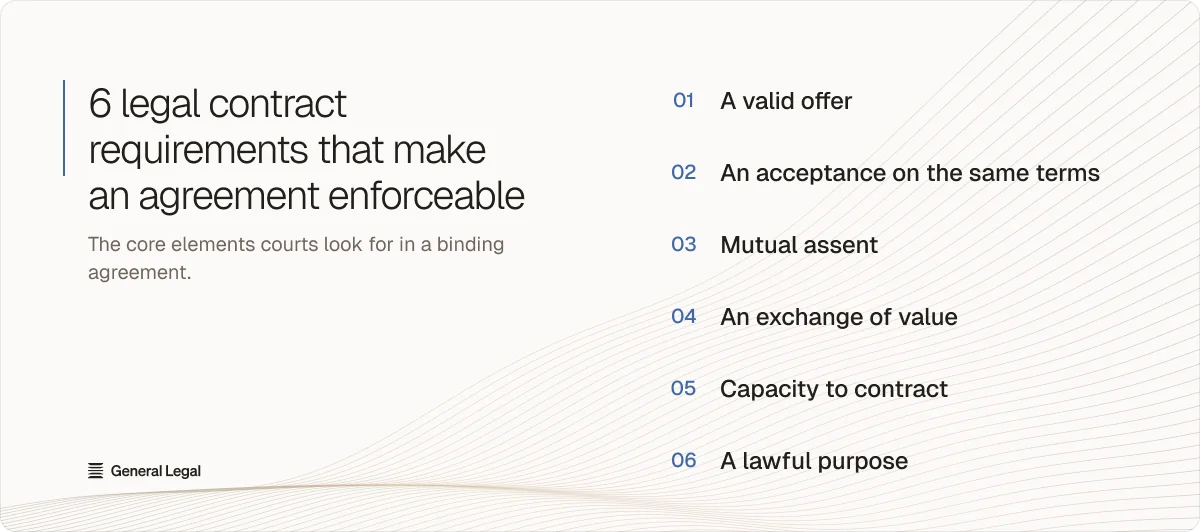
Courts and commentators break that into six elements:
1. A valid offer: One party proposes terms clear enough that a reasonable person would expect a binding deal upon acceptance. A vague or open-ended proposal isn't an offer, and a counteroffer kills the original.
2. An acceptance on the same terms: The other party agrees to those exact terms. Change anything, and you've made a counteroffer rather than an acceptance, which matters more than founders expect when order forms and vendor paper don't match.
3. Mutual assent: Offer plus acceptance produce what's often called a meeting of the minds. Courts judge this objectively, on what the parties said and did, not on what either privately intended.
4. An exchange of value: Each side has to give up something. A one-sided gratuitous promise isn't enforceable as a contract, though courts generally won't second-guess whether the exchange was fair, only whether an exchange happened at all.
5. Capacity to contract: Both parties must be legally able to contract: of age, of sound mind, and for companies, authorized to sign. A contract signed by someone lacking capacity can be void or voidable.
6. A lawful purpose: The subject matter has to be legal. Courts won't enforce an agreement against public policy, no matter how clearly both sides agreed to it.
Notice what's absent from that list: formality. Cornell's Wex dictionary defines a contract simply as an agreement creating obligations enforceable by law. If a napkin can bind two parties, so can your Slack thread with a vendor.
You'll also see this list sliced into four, five, or seven requirements. They're not competing theories:
Read more: How to make a legal contract without a lawyer? [Guide]
Does a contract have to be in writing?
For most deals, no. A writing isn't a legal requirement, but it helps you avoid having to prove later what you agreed to. The exception is the statute of frauds, which requires certain categories to be written and signed to be enforceable at all:
- Contracts for the sale of land or an interest in real property
- Contracts that can't be performed within one year
- Contracts to pay someone else's debt
- Sales of goods valued at $500 or more, under UCC § 2-201
Outside those categories, oral agreements are generally enforceable, with state statutes varying in the details. In practice, this means your team's habit of confirming deal terms quickly over email may already create a binding contract on terms nobody negotiated.
What happens if a requirement is missing?
If an agreement lacks a core element—no real offer, no consideration, or a party without capacity—a court won't enforce it as a contract. However, that doesn't mean the performing party gets nothing.
Promissory estoppel and unjust enrichment sometimes let a party recover value delivered in reliance on a defective agreement, but that's a weaker, costlier, less certain position than holding an enforceable contract.
Typically, remedies are limited to expectation damages, whether general, consequential, reliance-based, or specific performance. Punitive damages aren't available for a plain breach of contract claim. In other words, your recovery is capped by what the contract says, not by how badly the counterparty behaved.
8 clauses that actually decide outcomes
Commercial contracts share a standard architecture, but the clauses don't carry equal weight.
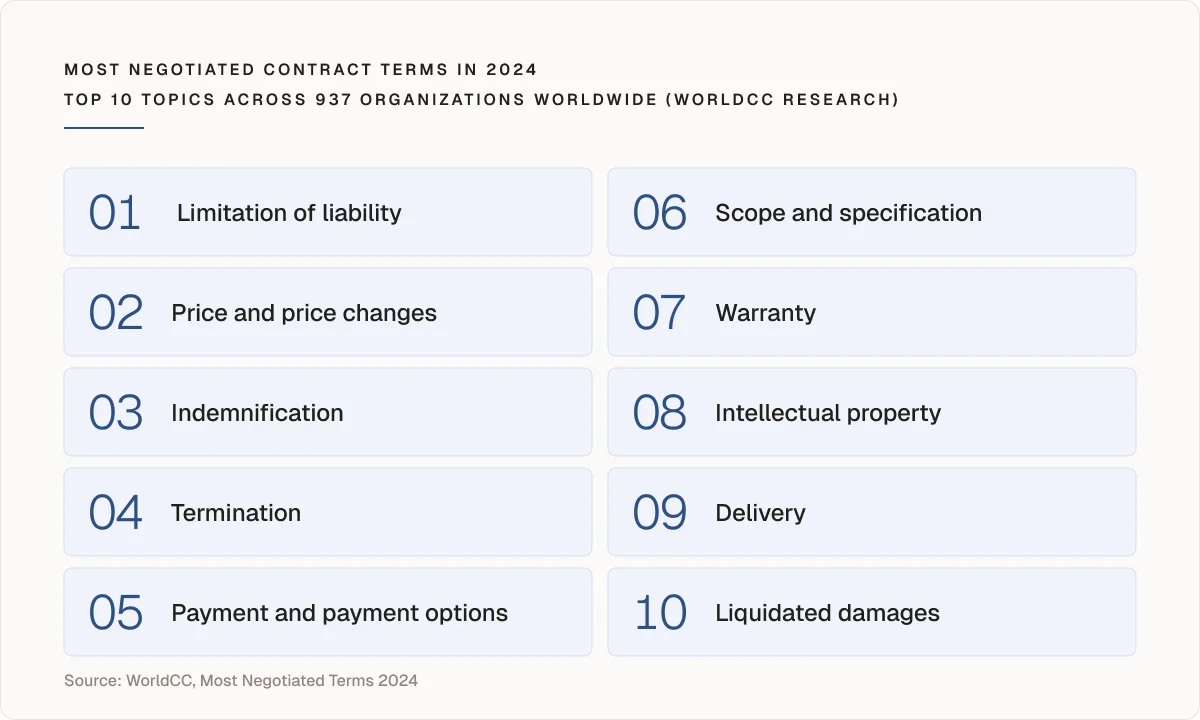
Smaller companies fight harder over who eats the risk and when they get paid than over abstract scope language, because that's where cash and exposure actually live. Here's what to check in the eight that matter most to a startup.
1. Limitation of liability
Limitation of liability should cap total exposure, commonly around one year's fees, with carve-outs for data breaches, IP infringement, and confidentiality violations. An uncapped liability clause on the other side's paper is the single most dangerous thing you can sign.
2. Indemnification
Indemnification should be mutual and limited to third-party claims, not first-party losses. One-sided indemnities making you responsible for the other party's negligence are the most common trap in vendor paper.
3. Payment terms
Net 30 against net 60 against net 90 isn't boilerplate; it's your cash flow. Late-payment penalties and invoicing triggers deserve real attention.
4. Termination
Look for symmetry. Termination for cause with a cure period should apply to both sides equally, and asymmetric exit rights are a negotiating failure rather than a legal requirement.
5. Scope and specification
Vague scope language is how change orders quietly turn a fixed-fee engagement into an open-ended one.
6. Warranty
Understand what's actually promised about the product or service, and for how long. Silence here means your remedy comes from somewhere else in the document, if it exists at all.
7. Intellectual property
Watch the gap between "will assign" and "hereby assigns," and confirm your background IP stays yours.
8. Delivery and acceptance
Delivery timelines and acceptance criteria determine when risk and payment obligations shift. Acceptance is the trigger that most contracts define badly.
Four of these go wrong in predictable, repeatable ways.
Where founders actually get burned
Formation risk almost never materializes between two operating businesses. Clause risk shows up constantly, and in the same places.
The "will assign" trap deserves its own note. A promise to assign in the future leaves ownership genuinely disputable if the assignment is never formally executed. A present-tense assignment transfers it on signature.
These are the errors that slip through a cursory read, and the issue producing them is structural rather than individual.
Read more: Outside General Counsel for Startups: What to expect?
Why AI-native review catches what a checklist doesn't
A clause checklist tells you the liability cap exists. It doesn't tell you whether one year's fees are defensible for this deal, whether the carve-outs are the ones you need, or whether the indemnity three pages later quietly swallows the cap. That's the judgment layer, and it's the reason contract review has stayed expensive under hourly billing: Someone qualified has to read all of it.
General Legal is an AI-native law firm rather than a legal-tech product, built by technology leaders from Casetext (Y Combinator S13) and attorneys with Big Law backgrounds. Its technology transactions practice covers the contracts in this article: MSAs, SaaS agreements, licensing deals, partnerships, and NDAs.
Quality control sits inside the workflow rather than after it, which is what separates this from the known risks of unsupervised AI in legal work, and the firm reports that attorneys working this way make fewer errors and produce more complete reviews than manual review alone.
For a contract on your desk, the process includes three steps:
1. Send it over through Slack, email, or the client portal.
2. Get a flat-fee quote upfront, with no hourly billing and no surprise invoice.
3. Get a marked-up draft back in hours, not days, with the issues explained.
That approach has accelerated commercial contract delivery by a factor of ten against traditional review timelines, and it’s priced for your stage rather than for a traditional firm's assumptions about your budget.
If you're looking at a vendor contract right now, wondering whether that indemnification clause is standard or a trap, you can create a free account and send it over, or book a 10-minute working session to show us the paper your deals actually run on.
- Most commercial contracts easily meet enforceability standards, but the real risk lies in what the enforceable contract actually says—uncapped liability, auto-renewals, and vague IP terms cause the damage.
- Six core elements make agreements enforceable: valid offer, acceptance on identical terms, mutual assent, exchange of value, capacity to contract, and lawful purpose—no writing required for most deals.
- Eight clauses decide commercial outcomes: limitation of liability, indemnification, payment terms, termination rights, scope, warranty, IP ownership, and delivery/acceptance criteria.
- Common traps include one-sided indemnities for the other party's negligence, silent auto-renewals with long notice windows, future-tense IP assignments that never execute, and asymmetric termination rights.
- World Commerce & Contracting found only 16% of practitioners believe negotiations focus on the right topics, with the same risk-allocating clauses consuming most effort year after year.
- AI-native review catches judgment-layer issues a checklist misses—whether a liability cap is defensible for this specific deal, not just whether one exists.
| Enforceability vs. quality | Nearly every commercial contract meets enforceability standards; the real question is whether the enforceable terms protect your business or expose it to uncapped risk. |
|---|---|
| Six formation elements | Valid offer, acceptance on same terms, mutual assent, consideration, capacity, and lawful purpose—no writing required except for land sales, year-plus contracts, debt guarantees, and goods over $500. |
| What missing elements mean | Without core elements, courts won't enforce the contract, though weaker doctrines like promissory estoppel may recover some value—a costlier, less certain position than holding an enforceable agreement. |
| Eight clauses that matter | Limitation of liability, indemnification, payment terms, termination, scope, warranty, IP ownership, and delivery/acceptance determine cash flow and risk exposure in practice. |
| Predictable traps | One-sided indemnities for counterparty negligence, buried auto-renewals, future-tense IP assignments ('will assign' instead of 'hereby assigns'), and asymmetric exit rights. |
| Why checklists fail | A checklist confirms a liability cap exists but doesn't assess whether it's defensible for this deal or whether another clause quietly undermines it—that judgment layer requires qualified review. |
| Punitive damages unavailable | Plain breach-of-contract claims limit recovery to expectation damages or specific performance, so negotiated liability caps matter more than contract law for determining exposure. |
| AI-native review advantage | General Legal combines Big Law attorneys with AI workflow to deliver contract reviews in hours at flat fees, catching judgment-layer issues manual review and unsupervised AI both miss. |
What are the 5 requirements for a valid contract?
The five-requirement framing lists offer, acceptance, consideration, capacity, and legality. It splits mutual assent into its two components while keeping the other three as separate elements.
What are the 7 requirements for a valid contract?
Seven-requirement lists add certainty of terms, meaning the terms must be definite enough for a court to enforce, and a writing requirement where the Statute of Frauds applies. Both are doctrines relevant to specific contract types folded into a longer checklist.
Does an email count as a legally binding contract?
An email exchange can form a binding contract if the six elements are present, and for most deal types, no signature or formal document is required. That's why confirming terms over email without a "subject to contract" qualifier is riskier than it feels.
Can I get punitive damages for breach of contract?
Punitive damages generally aren't available for a plain breach-of-contract claim. Remedies are limited to expectation damages or specific performance, which is why a negotiated liability cap matters more for determining your exposure than contract law does.
- AI Contract Review: How it Works and What it Actually CatchesExplore how AI contract review works so you can identify risks, understand its limits, protect sensitive data, and know when to seek legal advice.
- Commercial Contract Litigation: When It Happens & How to AvoidExplore what you need to know about commercial contract litigation so you can understand common disputes, manage legal risks & protect your business.
- Contract Law vs. Commercial Law: 5 Key DifferencesCompare contract vs commercial law so you can understand their differences, identify the right legal framework & protect your business in every deal.