
You need a contract reviewed. You called a firm, got quoted $450 an hour, and now you're looking at your inbox wondering whether a paralegal could just do it instead.
It's a fair question, but for almost every founder asking it, it's also the wrong one.
The paralegal vs. lawyer decision isn't really a staffing choice. It's an attempt to solve a pricing problem by swapping in a cheaper option, as NALA's 2024 National Utilization & Compensation Report puts the average paralegal billing rate at $134 an hour, while Clio's 2025 Legal Trends data puts the average US lawyer at $349.
However, the law won't let you make that swap for the part you actually need. What you want is attorney-quality work at a price your company can absorb.
This guide covers the differences that decide which one you need, details no lawyer is allowed to delegate, and the test to run before you hire anyone.
Paralegal vs. lawyer: 5 key differences
The five differences below are about authority rather than seniority, and the fourth one is where founders get hurt.
1. What each one is licensed to do
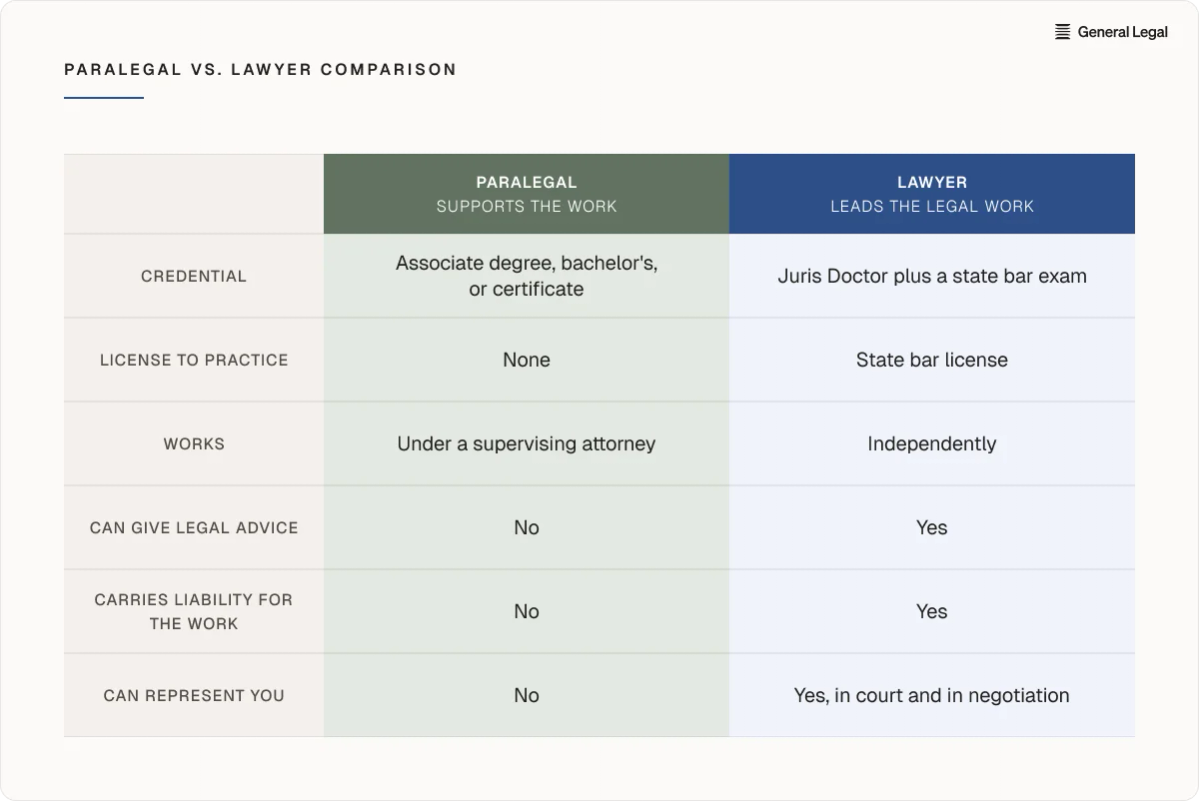
A lawyer holds a Juris Doctor and has passed a state bar exam, which is what creates the license to practice. A paralegal typically holds an associate degree, a bachelor's, or a certificate. No bar exam, no license.
Credentials like NALA's Certified Paralegal or NFPA's Registered Paralegal are real and respected, and they signal genuine skill. However, they're voluntary professional designations, not licenses.
2. Who supervises the work
Under the ABA's 2020 definition, a paralegal is someone qualified by education, training, or work experience who performs "specifically delegated substantive legal work for which a lawyer is responsible." A paralegal cannot operate independently of attorney oversight, and no license scheme in general practice changes that.
3. Whether they can advise you
A paralegal can research, draft, organize, file, and manage, all under a lawyer's direction. The Bureau of Labor Statistics lists exactly that: legal research, drafting documents, maintaining case files, preparing for hearings, and filing with courts.
That's substantive work, and good paralegals often know a practice area's procedural mechanics better than anyone in the building. What it isn't is advice. A paralegal drafting a services agreement is executing a template or instruction a supervising attorney reviews and owns.
4. Who carries the liability
One executes delegated tasks. The other owns the judgment call and the professional liability attached to it.
That distinction sounds procedural until a contract term gets misapplied and you go looking for who's accountable. A legal opinion is only worth something because someone with a license stands behind it.
5. What each can take on alone
A lawyer can advise you, interpret how the law applies to your facts, negotiate on your behalf, sign a legal opinion, and represent you if things go wrong. A paralegal can do none of those on their own account, and that asymmetry is fixed by bar rule rather than by experience level.
4 things only a licensed attorney can do
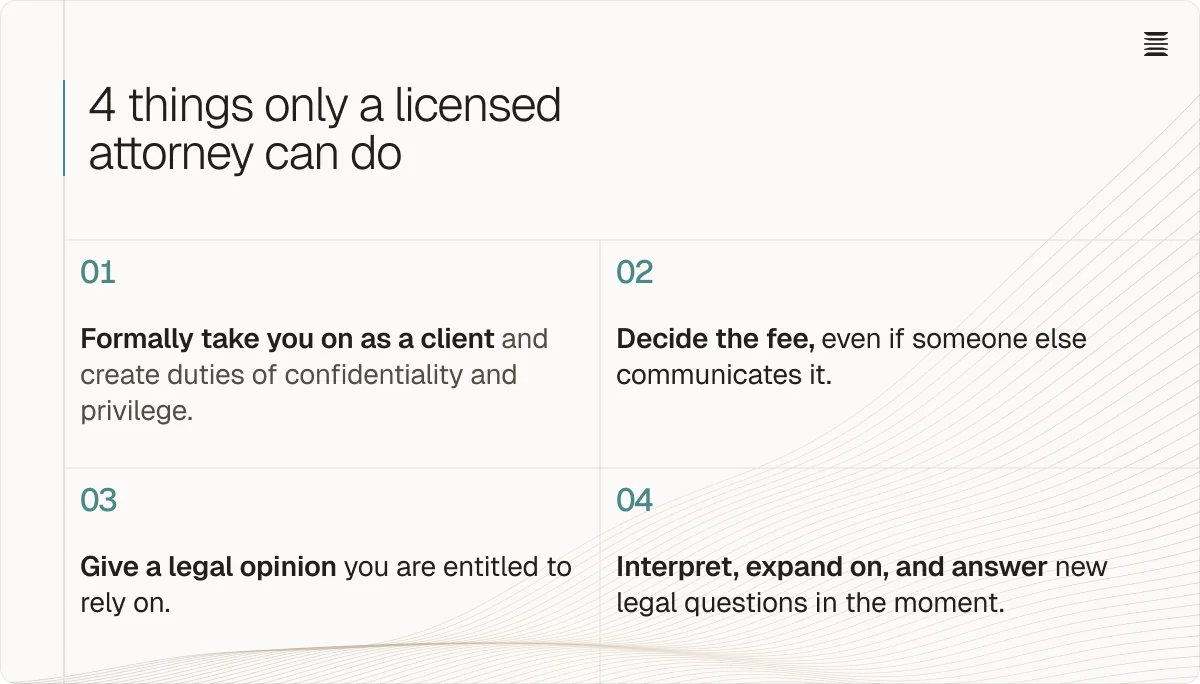
The ABA Model Guidelines for the Utilization of Paralegal Services name three things a lawyer can never delegate, no matter how experienced the paralegal. There's a fourth that catches people out:
1. Establish the attorney-client relationship: Only a lawyer can take you on as a client, and that relationship is what creates the duties you're actually buying, including confidentiality and privilege.
2. Set the fee: Fee-setting is a lawyer's call, not an administrative step. It can be communicated by someone else, but not decided by them.
3. Take responsibility for a legal opinion: If you're signing a contract, the question you need answered is "should I sign this, and what happens if I do?" That's a legal opinion, and only a lawyer can give you one you can rely on.
4. Answer the question the lawyer didn't anticipate: A paralegal can accurately relay advice a supervising lawyer has already given. They cannot interpret it, expand on it, or answer the new question you throw at them in the moment.
The ABA addressed this in Formal Opinion 506, issued in June 2023. Non-lawyer staff can gather information, run conflict checks, and explain a fee structure. Whether they can answer a specific question turns on whether answering it would constitute practicing law in that jurisdiction.
Why you can’t hire a paralegal instead of a lawyer
A paralegal cannot tell you whether to sign, how to read an indemnification clause, or whether your liability cap is defensible. Hiring one directly for that guidance is an unauthorized practice of law, and it exposes both of you.
There is one genuine exception. A handful of states have created limited-license paraprofessional programs that let non-lawyers give specific legal advice and even appear in court:
- Arizona licenses Legal Paraprofessionals who can prepare and sign documents, give legal advice, appear before courts, and negotiate, but only in family law, limited criminal, administrative, juvenile, and limited-jurisdiction civil matters.
- Utah licenses Paralegal Practitioners in three areas only: family law, forcible entry and detainer, and small-claims-scale debt collection. Utah's rules state directly that LPPs cannot represent corporations.
- Minnesota and Oregon run comparable narrow programs, and Washington sunset its pioneering LLLT program in 2020.
None of those scopes reach commercial contracts, vendor agreements, employment agreements, or anything else a startup handles weekly. If the matter involves your company rather than a family or a small debt, there is no state where a paraprofessional's license covers you.
Is a paralegal cheaper than an attorney?
On an hourly basis, yes. The comparison founders need to run, though, is cost per resolved question.
A paralegal's rate is a bargain only if the paralegal can finish the job. If your question requires legal advice, and for a founder deciding whether to sign something it nearly always does, a paralegal legally cannot close it out.
You pay the paralegal rate, then pay an attorney to answer the question the paralegal was never allowed to answer. Cheap labor that produces an unusable answer isn't cheap. It's a second invoice with extra steps.
Why law firms still hire paralegals
BLS projects 0% employment change for paralegals from 2025 to 2035, with roughly 40,800 annual openings expected mostly from replacement rather than growth. Lawyers are projected to grow 5% over the same period.
The reason sits in what AI now absorbs. The repetitive research, formatting, and first-draft work that used to justify a paralegal line item on your bill is exactly what AI tools do faster, without a supervision chain to manage. Paralegals aren't disappearing as a profession; the unbundled, hourly-billed version of their work is.
That shift matters more to you as a buyer than as an observer. The economics of hiring a cheaper human for the mechanical parts are being rewritten, and the firms rebuilding their delivery model around it are the ones that will keep getting hired.
The test: Judgment or execution?
Before you hire anyone, ask yourself: Does the task require judgment, or execution?
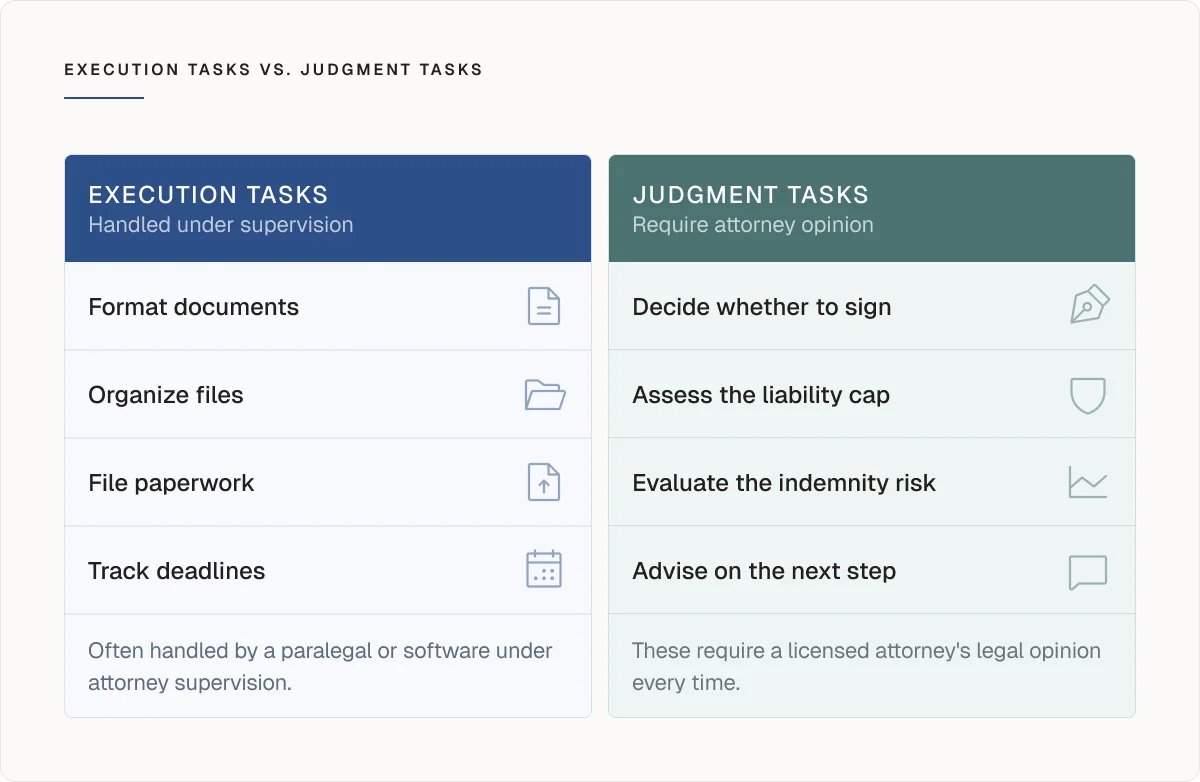
Almost everything a founder loses sleep over requires judgment: vendor contracts, customer MSAs, employment agreements, NDAs.
So the honest version of the question isn't which credential is cheaper but why attorney judgment costs what it does, and that has more to do with how firms bill than with what lawyers are worth.
Which leaves two imperfect options. Hire down on credentials and get an answer you can't rely on, or pay a traditional firm's hourly rate and wait a week for it.
General Legal: An alternative to trading down on credentials
Traditional firms bill every task, including the mechanical ones, at attorney or near-attorney rates. Strip the mechanical grind out of the invoice and the qualified person becomes affordable again. Nothing about that requires a less-qualified person to do the work.
General Legal is an AI-native law firm, not a legal-tech product and not a marketplace of freelance paralegals, pairing US-barred attorneys with AI-powered workflows built specifically for legal work:
- AI agents handle the operational layer: triaging documents, running first-pass review, surfacing risk, and producing first drafts.
- Attorneys handle legal judgment, negotiation strategy, risk assessment, and the final review before anything reaches a client.
A licensed attorney reviews every deliverable, and the result is an attorney's opinion at a price that no longer depends on how many hours the mechanical work took.
Our pricing is transparent, from $250 for a short review through $500 for a standard commercial contract review. Work comes back through Slack, email, or the client portal with direct attorney access, and we support companies operating in all US states for most agreements.
If you're sitting on the quote that sent you looking for alternatives, you can create a free account and send us the contract, or book a 10-minute working session to talk through what your legal spend actually needs to cover.
Read more: Balancing Attorney and Machine at an AI-Native Law Firm
- Paralegals cannot provide legal advice, sign opinions, or work independently—they operate only under attorney supervision as defined by ABA guidelines.
- The average paralegal bills at $134/hour versus $349/hour for attorneys, but paralegals legally cannot answer the judgment questions founders need resolved.
- Limited-license paraprofessional programs exist in four states but cover only family law and small civil matters, not commercial contracts or startup needs.
- Hiring a paralegal for work requiring legal judgment results in paying twice: once for unusable work, then again for the attorney who must provide the actual answer.
- AI-native firms are removing the mechanical work that justified paralegal rates, making attorney judgment available at prices previously reserved for non-attorney alternatives.
| Licensing authority | Lawyers hold bar licenses and can practice independently; paralegals have certifications but must work under attorney supervision with no independent practice rights. |
|---|---|
| Legal advice boundary | Only attorneys can interpret law, provide opinions, negotiate on your behalf, or answer unanticipated questions—paralegals execute delegated tasks only. |
| Professional liability | Attorneys carry malpractice liability for their judgments; paralegals cannot own legal opinions or be held accountable for advice they're prohibited from giving. |
| Limited-license exceptions | Arizona, Utah, Minnesota, and Oregon allow paraprofessionals to advise in narrow areas like family law, but none cover commercial contracts or corporate matters. |
| Cost-per-answer economics | Paralegal hourly rates appear cheaper, but paying for work they cannot legally complete means double billing when an attorney must still answer the judgment question. |
| AI impact on paralegal work | AI now handles the mechanical research and drafting that justified paralegal hiring, with BLS projecting 0% paralegal employment growth versus 5% for lawyers through 2035. |
| Judgment vs. execution test | Contracts, MSAs, and employment agreements require legal judgment, not just execution—founders need attorney opinions they can rely on when signing. |
| AI-native alternative | Firms using AI for mechanical tasks can deliver attorney-reviewed work at $250-$500 fixed prices, removing the cost penalty that drove credential-downgrade decisions. |
Can I hire a paralegal instead of a lawyer?
For your company's contracts and legal decisions, no. A paralegal cannot give legal advice, tell you whether to sign an agreement, or negotiate on your behalf, and doing so would be unauthorized practice of law. State-licensed paraprofessional programs in Arizona, Utah, Minnesota, and Oregon are the narrow exception, but they cover consumer matters like family law and small debt collection rather than commercial contracts, and Utah explicitly bars its licensees from representing corporations.
What can an attorney do that a paralegal cannot?
An attorney can establish an attorney-client relationship, set the fee, form and deliver a legal opinion you can rely on, represent you in court or in a negotiation, and interpret how the law applies to your specific facts. Under the ABA Model Guidelines, the first three can never be delegated to a paralegal.
Is a paralegal cheaper than an attorney?
On an hourly basis, yes. However, the comparison can be misleading when the paralegal can't finish the job, because anything requiring legal judgment still needs an attorney's sign-off.
Do law firms still hire paralegals?
Yes. BLS counts 404,900 paralegal and legal assistant jobs nationally, about 75% of them in legal services, and paralegals remain central to how firms staff research, drafting, and document management.
What is unauthorized practice of law?
Unauthorized practice of law is a non-lawyer performing work that a jurisdiction reserves for licensed attorneys, most commonly giving legal advice or drafting documents that determine legal rights. The specific boundary varies by state, which is why the same task can be permissible in one jurisdiction and a violation in another.
Should a startup hire an in-house paralegal?
Rarely, and never as a substitute for counsel. A paralegal needs a supervising attorney to work under, so a company with no in-house legal team has nobody to provide that supervision.
- Commercial Law vs. Business Law: 5 Main DifferencesCompare commercial law vs business law so you can understand their differences, identify your legal needs & choose the right fit.
- How Much Does It Cost To Hire a Lawyer? [2026 Guide]Learn how much does it cost to hire a lawyer and discover what affects legal fees, compare pricing, and choose the right option.
- Contract Law vs. Commercial Law: 5 Key DifferencesCompare contract vs commercial law so you can understand their differences, identify the right legal framework & protect your business in every deal.