
Artificial intelligence (AI) has quickly become a key priority across organizations because its operational upside is hard to ignore.
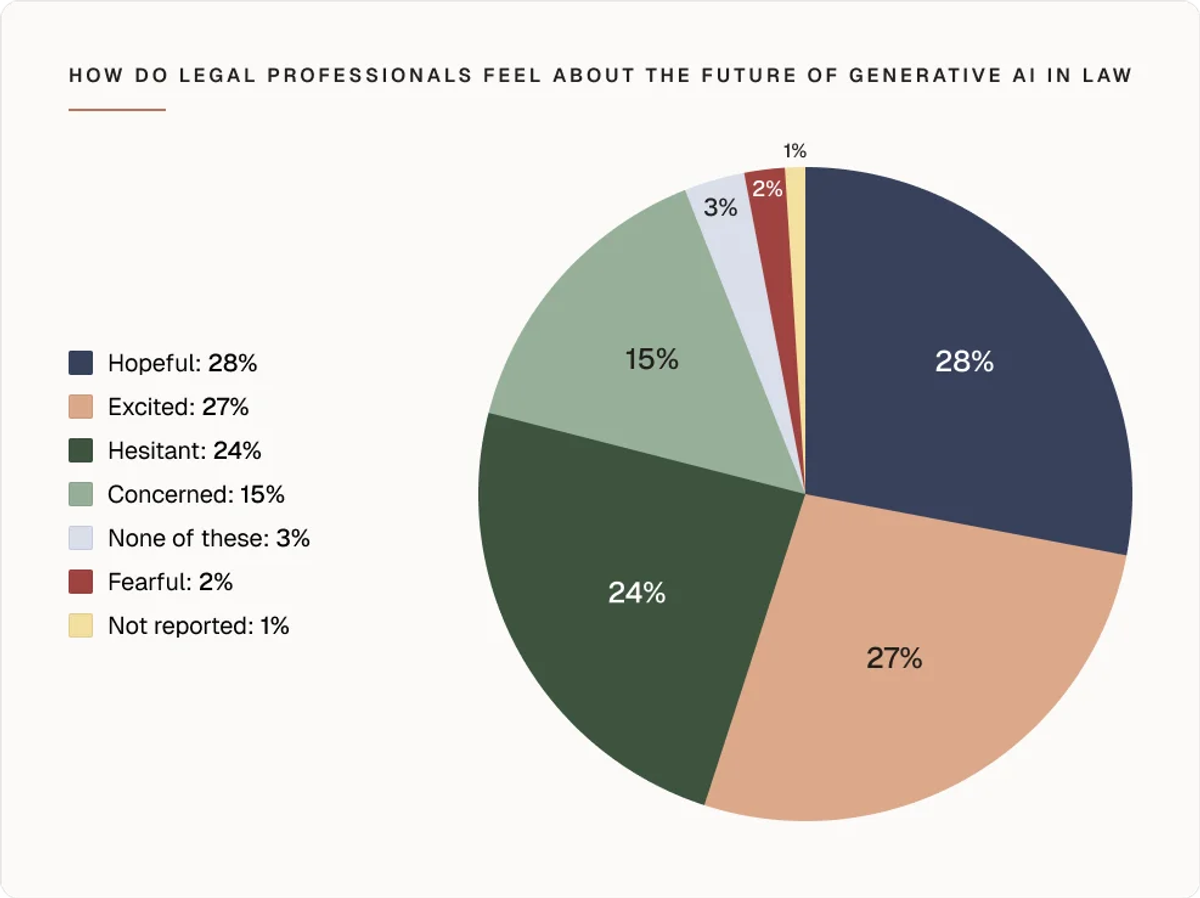
According to Bloomberg Law’s 2025 Buyer’s Guide to Legal AI Tools, this technology has helped 60% of legal professionals free up time for high-level strategic work, and 36% of them improve the quality of work produced. These results help explain why more than half of professionals describe their sentiment toward the future of generative AI in law as “excited” or “hopeful.”
But adoption is still far from universal.
If you’re among the 24% who remain hesitant about AI, this guide explains how to use AI in law through 10 practical use cases. Understanding the value this technology has already created for legal teams and learning about responsible implementation should help separate legitimate concerns from outdated assumptions.
How to use AI in law: 10 practical use cases for modern legal teams
Modern legal teams are using AI across nearly every layer of legal execution, from daily operational work to high-stakes strategic analysis.
The 10 examples below break down where this technology is already delivering practical value.
1. Legal research: Stop wasting time on irrelevant case law
If there’s one legal workflow that has embraced AI more readily than most, it’s research. While estimates vary depending on the report, between 40% and 73% of legal teams already use AI for this purpose.
Why? Because it takes AI 5–10 minutes to do what traditionally consumes up to an hour. But speed isn’t the only advantage of using AI for legal research.
This technology can also improve the quality of the research process by helping legal teams:
- Surface relevant authority more efficiently instead of relying solely on keyword searches
- Reduce the risk of missing important precedent, regulation, or guidance
- Cut down cognitive overload during review and synthesis
- Identify patterns and connections across large volumes of legal information
Real-life example:
McGuireWoods piloted generative AI for both trial and transactional attorneys. Legal research delivered immediate value because it was relevant across multiple practice areas and could be incorporated into existing workflows with minimal disruption. The value came from enabling the firm to respond to client needs more efficiently while maintaining accuracy.
2. Drafting communications: Stop rewriting the same email over and over
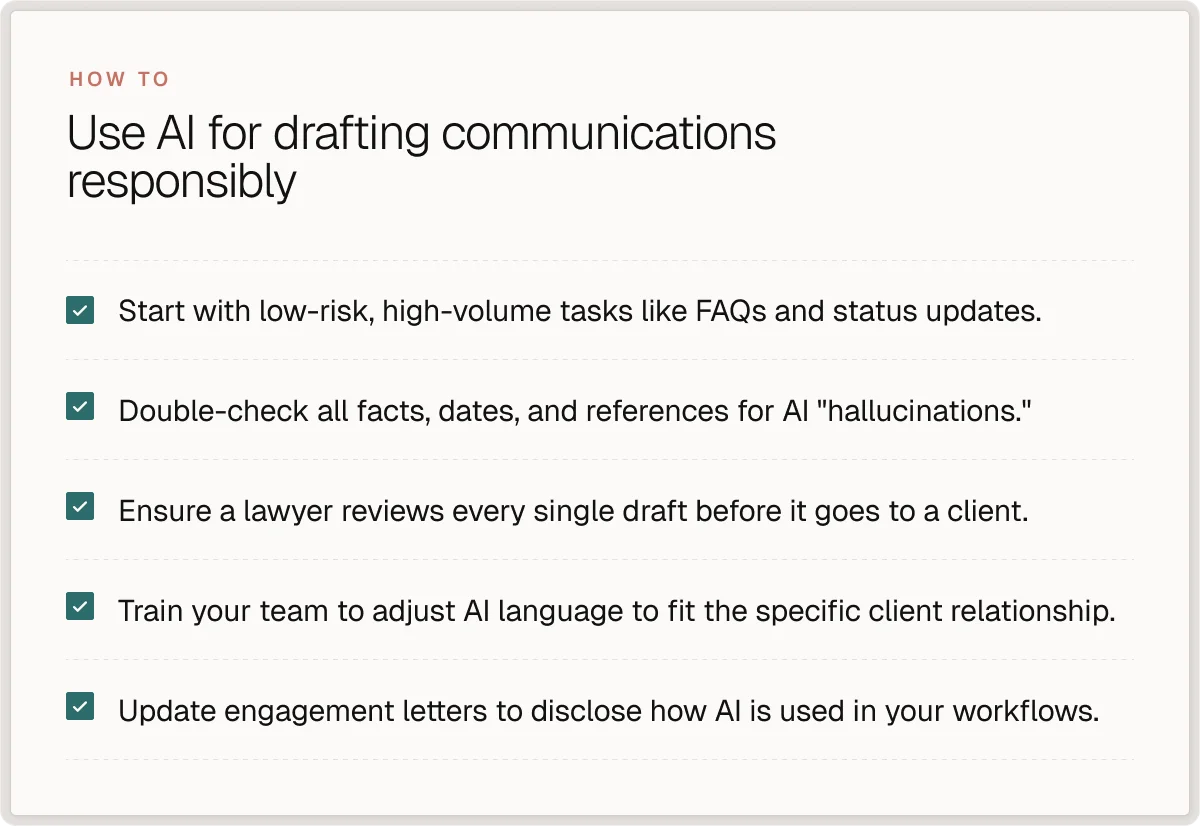
Legal teams spend a substantial amount of time drafting recurring explanations, client updates, status reports, and internal communications. This is exactly the type of workflow AI is well-suited to handle.
Already, 59% of professionals use AI for brief or memo drafting, while 50% use it for correspondence drafting. This technology helps legal teams:
- Draft first-pass emails and memos
- Summarize filings, contracts, and matter developments
- Translate dense legal language into plain English
- Generate tailored FAQ responses for recurring client questions
- Maintain consistent tone and formatting across teams
- Reduce turnaround times on routine communication
The value of AI for these use cases is largely operational. Instead of drafting every communication from scratch, lawyers can review, refine, and approve the initial draft created by AI. This allows legal teams to reserve senior attorney time for higher-value legal work.
3. Drafting contracts: Stop reinventing standard agreements
Contract drafting is one of the clearest examples of AI creating leverage in legal workflows, and more than half of professionals already use it for this task.
The reason is straightforward: Most contracts aren’t created from scratch.
Lawyers are usually modifying existing language, pulling clauses from prior agreements, checking for inconsistencies, and adapting templates to new scenarios.
AI excels at that kind of structured drafting work, particularly when it comes to:
- NDAs and confidentiality agreements
- Employment agreements and offer letters
- Vendor and procurement contracts
- MSAs and SaaS agreements
- Engagement letters and SOWs
- Internal policies and compliance documents
4. Contract review: Stop manually searching for red flags
Document review has become the most common AI use case in legal, with 74% of professionals using it in some capacity. That’s because it eliminates much of the manual effort involved in reviewing standardized contract language, which rarely requires novel legal analysis. AI takes over:
- Identifying risky or unusual clauses
- Flagging deviations from preferred templates
- Comparing language against market standards
- Detecting inconsistencies and missing provisions
With AI outperforming junior lawyers by 77 times in speed, reviews that once required hours of manual effort can now be narrowed down to a handful of provisions that actually require human judgment and negotiation strategy.
Real-life example:
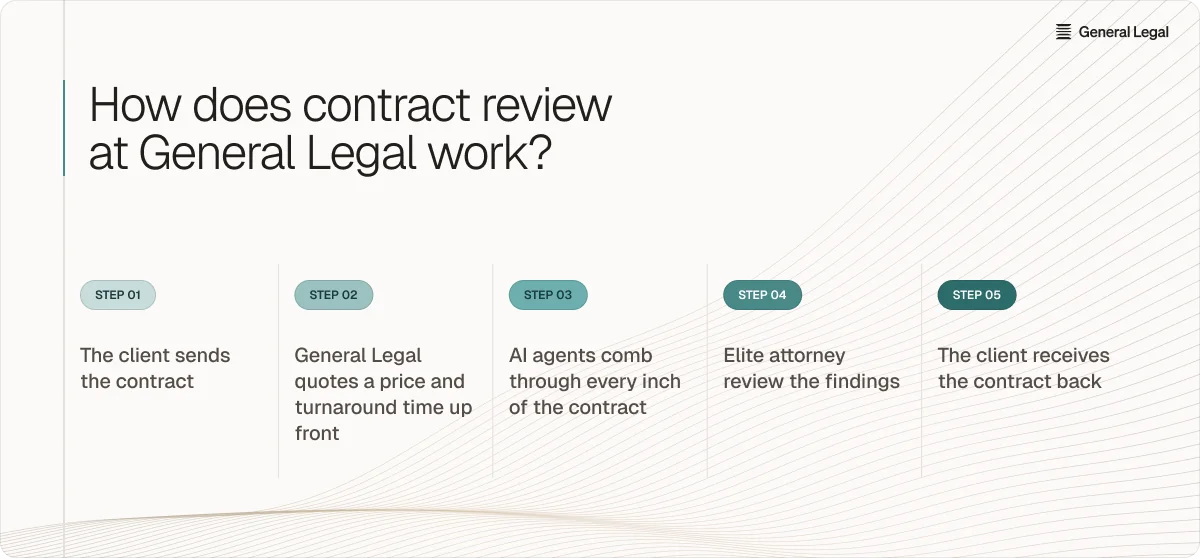
Over 250 growth-stage companies rely on General Legal to review commercial contracts more efficiently and consistently.
This outcome is made possible by the firm’s AI-native model, where AI handles the repetitive first-pass review tasks, such astriaging documents, surfacing risk, and summarizing key issues, while elite attorneys remain responsible for legal judgment, negotiation strategy, and final redlines.
5. eDiscovery: Stop paying lawyers to find needles in haystacks
eDiscovery has long been one of the most resource-intensive workflows in legal.
Teams often spend hundreds of hours reviewing large volumes of emails, messages, contracts, and transcripts just to identify the handful of documents that are actually relevant.
Much of this initial review work can now be streamlined with AI, which can:
- Surface important names, topics, and communication patterns
- Flag responsive or high-risk materials
- Group related documents automatically
- Remove duplicate or irrelevant files from review queues
- Prioritize documents for faster first-pass review
Real-life example:
Sidley and Relativity found that GPT-4 could successfully identify most responsive documents in an eDiscovery review exercise, suggesting that AI can help reduce the volume of material requiring manual review.
6. Litigation prep: Stop starting every case from zero
Litigation prep requires legal teams to synthesize discovery files, deposition transcripts, pleadings, emails, medical records, and thousands of disconnected facts into a coherent case strategy.
AI can help do just that by:
- Building case chronologies from discovery materials
- Generating timelines organized around legal problems or case phases
- Creating issue maps connecting facts to claims and defenses
- Surfacing inconsistencies, missing information, or evidentiary gaps
- Identifying patterns, trends, and strategic weak points
In some high-volume litigation matters, AI-assisted complaint response systems have reduced the work that previously took associates 16 hours down to just a few minutes.
7. Deposition prep: Stop looking for answers mid-deposition
Deposition prep requires attorneys to work through hundreds of pages of transcripts, scattered notes, contradictory statements, and other case materials to prepare for the testimony. More often than not, that process becomes a last-minute effort to locate key facts and inconsistencies across fragmented records.
AI is increasingly being used to bring structure to this process, helping teams avoid scrambling for information as the deposition date approaches.
Instead of manually stitching together testimony, exhibits, and discovery materials, legal teams can now rely on AI to organize the records, surface inconsistencies, and build sharper strategies before questioning begins.
The exact use cases of AI for deposition prep vary depending on the type of matter:
| Practice area | How AI helps with deposition prep |
|---|---|
| Criminal law | Flags inconsistencies within interviews, police reports, and testimony to help attorneys challenge witness credibility more effectively |
| Civil law | Connects testimony to discovery records, internal communications, and evidence tied to specific allegations or defenses |
| Commercial law | Cross-references contracts, amendments, emails, and meeting notes to uncover conflicting interpretations and weak points in testimony |
8. Document summarization: Stop manually distilling complex legal information
Legal teams are constantly managing massive document sets, lengthy transcripts, medical chronologies, hearing records, and internal communications that need to be understood quickly by both lawyers and business stakeholders.
That’s why document summarization has become one of the most widely adopted AI workflows in legal. As many as 72% of professionals now use AI to:
- Generate executive-ready summaries
- Extract key facts, dates, and issues
- Condense transcripts and chronologies
- Translate dense legal language into digestible takeaways
- Create client-facing or internal summaries faster
Real-life example:
Dentons uses its proprietary AI platform to summarize large legal documents into simpler, more digestible formats for lawyers and clients.
9. Business operations: Stop wasting legal talent on admin work
A significant portion of legal work has little to do with legal judgment. Intake forms, internal updates, billable-hour tracking, marketing copy, and data extraction are all necessary tasks, but they create operational overhead that consumes valuable time and attention.
AI is increasingly being used to automate this layer of work, so legal teams can focus on higher-leverage tasks instead of administrative maintenance. In practice, firms are using AI to:
- Automate client intake workflows
- Extract and organize data from forms and records
- Draft internal documents and onboarding materials
- Generate marketing copy, press releases, and social posts
- Track and summarize billable work
- Produce first-pass operational documentation
Real-life example:
Husch Blackwell used AI during its summer associate program to generate more than 100 internal associate biographies in a single afternoon—work that previously would’ve taken roughly 120 to 160 hours manually.
10. Knowledge management: Stop losing institutional knowledge in Slack threads
Most law firms already have the knowledge they need. The problem is that it’s scattered across shared drives, inboxes, random folders, Slack threads, and the institutional memory of individual attorneys. As a result, lawyers often spend time recreating work that already exists somewhere within the overall system.
AI allows lawyers to avoid unnecessary duplication of effort by turning siloed work product into searchable, reusable institutional knowledge. Specifically, the technology can:
- Surface relevant precedents and prior work product
- Apply tags and metadata automatically
- Organize clause banks and template libraries
- Retrieve documents by context, jurisdiction, or matter type
These and other use cases of AI in law illustrate how valuable this technology is proving to be. However, unlocking the full potential of AI requires more than just adopting new tools and processes.
How to use AI in law responsibly: Best practices for legal teams
Using AI in law responsibly starts with understanding both its capabilities and limitations. While this technology can create significant operational leverage, it also introduces risks related to accuracy, confidentiality, security, and overreliance on AI-generated outputs.
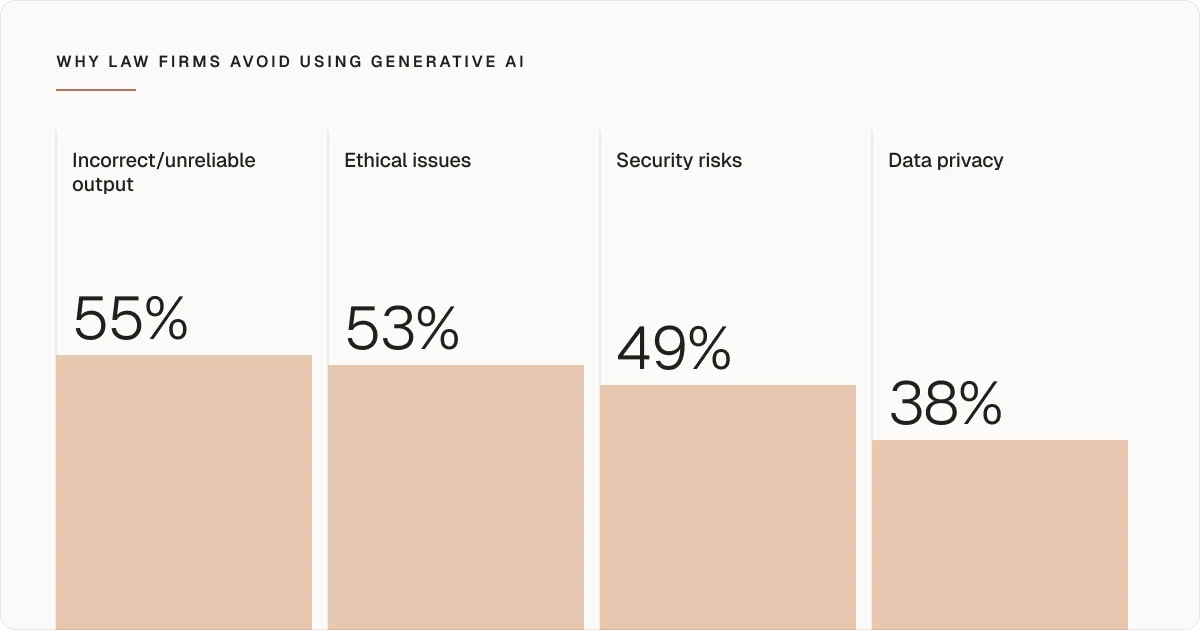
Most of these concerns become far more manageable when AI is implemented with the right safeguards and oversight.
Here’s what you can learn from the way leading legal teams approach AI adoption:
- Use secure legal-specific tools: General-purpose AI platforms weren’t built for legal work, confidentiality obligations, or jurisdiction-specific analysis. While 41% of professionals report using public tools like ChatGPT, legal-specific platforms offer stronger security controls, legal databases, and auditability.
- Never upload sensitive client data into public tools: Client confidentiality isn’t optional. Avoid entering privileged information, personally identifiable information (PII), or sensitive data into unsecured public models.
- Verify citations and jurisdictional accuracy: General AI models frequently blend jurisdictions, cite outdated authority, or invent sources entirely. Always cross-check citations, procedural rules, and legal standards manually.
- Keep lawyers in the decision loop: AI excels at synthesis, summarization, and first-pass drafting. The same can’t be said for judgment, negotiation dynamics, and strategic tradeoffs. Lawyers still need to own the legal reasoning.
- Build internal AI usage policies: Teams need clear rules around approved tools, confidentiality standards, review requirements, and acceptable use cases. AI governance should become part of legal operations.
- Train staff on limitations, not just features: AI is sometimes convincingly wrong. Teams need to understand where the technology performs well and where it shouldn’t be trusted without review.
- Maintain human sign-off on all legal work: The American Bar Association’s Formal Opinion 512 makes it clear that lawyers remain responsible for AI-assisted work products. Every output should go through human legal review before it reaches a client, court, or counterparty.
- Focus on augmentation, not replacement: The best legal teams aren’t replacing lawyers with AI. They’re using AI to eliminate low-leverage operational and administrative work so lawyers can spend more time on strategy, negotiation, and high-value judgment calls.
However, not every legal team has the resources to build, govern, and maintain AI-powered legal workflows internally. Working with the right legal partner can help bridge that gap.
General Legal: The middle ground between ChatGPT and BigLaw

For the most part, traditional law firms still rely on manual workflows that tend to slow down execution and inflate bills. As for the AI-only products, they remain limited in their ability to handle nuance, negotiation strategy, and risk judgment.
General Legal offers the best of both worlds by bringing together the judgment of elite attorneys and the speed of integrated AI workflows.
Here’s what that looks like in practice:
- Lightning-fast turnaround times: Contracts are reviewed in hours, not days or weeks.
- BigLaw-quality work without BigLaw overhead: AI automates repetitive operational work so attorneys can focus on legal judgment and negotiation strategy.
- Predictable flat-fee pricing: There are no open-ended billable-hour models and, thus, no surprises.
- AI-native workflows built from the ground up: Technology is embedded directly into legal execution rather than layered onto outdated processes.
- Lawyers who work where startups work: You can choose Slack, email, or the client portal to communicate with General Legal.
- Human accountability on every matter: Every output is reviewed and owned by a licensed attorney.
Ready to increase legal velocity without sacrificing legal quality?
Register now to get your first contract reviewed, or reach out directly if you have any questions about contract drafting, review, negotiation, legal research, or other services we offer.
- AI is already used across ten practical legal workflows: research, drafting communications, drafting contracts, contract review, eDiscovery, litigation prep, deposition prep, document summarization, business operations, and knowledge management.
- Legal research and contract review are among the most widely adopted use cases, with AI completing tasks in minutes that traditionally took an hour or more of attorney time.
- Real firms have already seen concrete results: McGuireWoods found AI research valuable across practice areas, Sidley found GPT-4 could identify most responsive documents in an eDiscovery exercise, and Husch Blackwell generated 100+ associate biographies in an afternoon instead of roughly 120-160 hours.
- Using AI responsibly requires specific safeguards: secure legal-specific tools instead of public chatbots, never uploading sensitive client data to unsecured tools, verifying citations manually, and maintaining human sign-off on every piece of AI-assisted work.
- The ABA's Formal Opinion 512 makes clear that lawyers remain responsible for AI-assisted work product, so oversight isn't optional even when AI drafts the first version.
- General Legal positions itself as a middle ground between consumer AI tools and traditional BigLaw, pairing AI-native workflows with licensed attorneys who remain accountable for every output.
| Legal research | AI can complete research in 5-10 minutes that traditionally took up to an hour, and firms like McGuireWoods have piloted it across both trial and transactional practice areas. |
|---|---|
| Drafting communications and contracts | AI is widely used to draft first-pass emails, memos, and contracts by adapting existing language and templates rather than starting from a blank page. |
| Contract review | The most common AI use case in legal, used by 74% of professionals surveyed, letting reviews that took hours narrow down to just the provisions that need real negotiation and judgment. |
| eDiscovery and litigation prep | AI can surface responsive documents and build case chronologies from discovery materials; one example cut complaint-response work from 16 attorney-hours to a few minutes. |
| Deposition prep and summarization | AI helps organize transcripts and case materials to surface inconsistencies, and 72% of professionals already use it to summarize complex documents into digestible takeaways. |
| Business operations and knowledge management | AI automates admin tasks like intake and internal documentation, and helps turn scattered institutional knowledge into searchable, reusable resources. |
| Responsible use requires oversight | Best practices include using secure legal-specific tools, never uploading sensitive data to public models, verifying citations manually, and keeping human sign-off on every AI-assisted work product. |
What's a concrete example of AI speeding up legal work?
Husch Blackwell used AI to generate over 100 internal associate biographies in a single afternoon, work that previously would have taken roughly 120 to 160 hours manually.
Is it safe to use general-purpose tools like ChatGPT for legal work?
The article advises against uploading sensitive client data to public tools and recommends legal-specific platforms instead, which offer stronger security controls, legal databases, and auditability.
Do I still need to check AI-generated legal research and citations?
Yes. General AI models can blend jurisdictions, cite outdated authority, or invent sources entirely, so citations and procedural rules should always be manually verified.
Who is responsible if AI makes a mistake in legal work?
The lawyer. The ABA's Formal Opinion 512 makes clear that lawyers remain responsible for AI-assisted work product, so every output needs human legal review before reaching a client, court, or counterparty.
What's the difference between using consumer AI tools and working with an AI-native firm like General Legal?
General Legal combines AI-native workflows with licensed attorneys who review and take accountability for every output, positioned as a middle ground between unsupervised AI tools and traditional, slower BigLaw processes.
How can we use AI in law?
You can use AI in law to accelerate workflows like legal research, contract drafting and review, litigation prep, eDiscovery, deposition prep, document summarization, and knowledge management.
Which AI to use for law?
The best AI to use for law is usually a legal-specific platform with strong security, reliable legal data sources, and built-in guardrails. General-purpose consumer AI tools can be useful, but they often lack the accuracy, confidentiality protections, and legal context required for professional legal work.
What is an example of AI being used in law?
One example of AI being used in law is contract review. AI can quickly identify risky clauses, summarize agreements, flag deviations from preferred language, and accelerate first-pass review before an attorney handles negotiation strategy and final judgment.
What are the benefits of using AI for contract review?
The benefits of using AI for contract review include faster review times, improved issue spotting, more consistent analysis, and reduced administrative workload.
Can ChatGPT act as a lawyer?
No. ChatGPT isn’t a lawyer and can’t provide legal representation or legal advice. It can help with tasks like research, summarization, and drafting, but legal judgment and final decisions still require a qualified attorney.
Is AI the future of law?
AI is almost certainly part of the future of law, but not as a replacement for lawyers. The firms gaining the most leverage are using AI to automate repetitive operational work while lawyers focus on strategy, negotiation, and legal judgment.
- Benefits of AI in Law vs. Its Limitations: A Complete GuideExplore the benefits of AI in law so you can improve legal workflows, reduce costs, enhance accuracy, and focus on srategic work.
- 5 Best AI-native Law Firms for Startups [Comparison]Discover the best AI native law firms and find the right legal partner to streamline legal work, reduce costs, and support your bu
- Legora vs. Harvey: Which AI Legal Platform is Better?Compare Legora vs Harvey so you can evaluate their features, workflows, user experience, and fit for your legal team.