
When it comes to the legal industry, artificial intelligence (AI) is here to stay.
According to 8am’s 2026 Legal Industry Report, as many as 69% of legal professionals now use general-purpose generative AI tools for work, which is more than double the 31% reported in 2025.
Zoom out to the firm level, and the pattern holds, with the 2026 AI in Professional Services Report by Thomson Reuters reporting that 41% of law firms and 47% of corporate legal departments now have teams using GenAI, up from 28% and 23% just a year earlier.
These figures make sense when you consider the many practical use cases and valuable benefits of AI in law. However, adoption at this speed doesn’t mean the technology is foolproof. Left unmanaged, AI can introduce risks that undermine its intended value.
To help you make informed decisions about where AI belongs in your legal operations, this guide breaks down both the advantages it delivers in legal work and the disadvantages that surface when it’s used without proper oversight.
Why legal teams are embracing AI: 7 benefits of AI in law
Legal teams are well aware that AI is reshaping the industry. According to Thomson Reuters’ 2026 Future of Professionals Report, 80% of them believe that this technology will have a high or transformational impact on their work within the next five years. That optimism is already translating into results, with 53% of organizations reporting a return on investment from their AI initiatives.
These figures help explain why legal teams are increasingly embracing AI, and here are seven main benefits:
1. It accelerates legal work without sacrificing quality
Legal work often involves time-intensive but highly repeatable tasks, which AI can handle in a fraction of the time. For example, one high-volume litigation team reduced the time required to prepare complaint responses from roughly 16 hours of associate work to just a few minutes using an AI-powered workflow.
As for the cumulative effect, Thomson Reuters estimates that generative AI could save the average legal professional 12 hours per week.
These gains are largely driven by AI’s ability to automate the following tasks:
| Legal task | How AI helps |
|---|---|
| Legal research | Identifies relevant cases, statutes, and precedents in minutes |
| Contract review | Extracts key information and flags important issues automatically |
| Contract analysis | Surfaces clauses, risks, inconsistencies, and obligations faster |
| Due diligence | Reviews large volumes of documents at scale |
| Document drafting | Produces first drafts and standard documents for lawyer review |
| Investigations and disputes | Identifies patterns, communications, and key facts across large datasets |
These efficiency gains don’t just benefit law firms; they translate into shorter turnaround times, quicker responses, and a more streamlined experience for clients.
2. It reduces legal costs and creates pricing predictability
Legal costs have long been one of the biggest frustrations for individuals and businesses seeking legal support. Long review cycles, manual research, and repetitive administrative work all increase the number of hours required to complete a matter, which ultimately raises the bill.
That’s why one of the most significant benefits of AI in law is its ability to reduce the cost of legal service delivery. It does so by:
- Reducing reliance on external vendors and outsourced legal services
- Allowing more work to be completed with existing resources
- Lowering the administrative overhead associated with routine legal operations
- Creating reusable workflows and knowledge systems that improve efficiency over time
- Increasing capacity without a proportional increase in operating costs
Beyond lowering costs, AI addresses another long-standing challenge in the legal industry: pricing transparency.
Traditional legal billing often relies on hourly rates, making it difficult for clients to predict the final cost of a matter. AI changes that equation by making legal workflows more consistent and predictable.
As a result, AI-enabled legal teams are often better positioned to offer flat-fee and alternative pricing arrangements. These allow clients to gain greater visibility into costs upfront, which helps with budgeting, forecasting, and financial planning.
Some AI-native law firms, including General Legal, take it a step further by publishing fixed-fee pricing for common legal services.

Thanks to this level of transparency, founders can evaluate legal costs, compare options, and make purchasing decisions without ever scheduling a sales call or requesting a quote.
3. It helps legal teams scale without adding headcount
As companies grow, legal demand increases alongside it. Hiring, procurement, compliance, customer contracts, and commercial negotiations all generate additional legal work, but headcount rarely grows at the same pace.
AI allows legal teams to absorb a larger volume of work without proportionally increasing staffing costs. By automating routine processes and standardizing common workflows, lawyers can handle more matters, respond faster, and reduce reliance on outside counsel.
4. It improves accuracy and consistency across legal workflows
Accuracy remains one of the biggest factors slowing AI adoption in the legal industry. According to the 2024 Future of Professionals Report, 43% of legal professionals who haven’t used AI cite concerns about the accuracy of its outputs as the number one reason for abstaining.
Yet when used with appropriate human oversight, AI can actually improve accuracy throughout legal workflows by:
- Identifying missing clauses
- Flagging inconsistencies
- Detecting deviations from approved language
- Surfacing potential issues that might be overlooked during manual review
Legal professionals increasingly recognize this potential, with 35% of them citing reduced human error as a key benefit of AI.
Thanks to these capabilities, AI can serve as an additional quality control layer, reducing the likelihood that important details slip through the cracks before work reaches the client.
5. It strengthens compliance and risk management
Regulatory requirements are constantly evolving, making compliance difficult to manage through manual processes alone.
AI strengthens compliance and risk management by continuously monitoring contracts, obligations, and regulatory requirements at scale. It can track renewal dates, flag clauses that fall outside approved policies, identify contractual obligations, and surface agreements that may be affected by regulatory changes.
This allows legal teams to identify potential issues earlier, maintain stronger compliance controls, and reduce the risk of costly violations, audits, and disputes.
6. It enables lawyers to focus on higher-value strategic work
Legal expertise creates the most value when it’s applied to judgment, strategy, negotiation, and business decision-making, not repetitive administrative work.
By reducing the time spent on routine tasks, AI gives lawyers more capacity to focus on complex matters where experience and commercial judgment have the greatest impact. Clients benefit from more strategic guidance, stronger risk assessment, and advice that is better aligned with business objectives.
AI-native law firms, in particular, tend to create more sustainable working environments for their lawyers. With fewer late-night drafting sessions and less administrative burden, attorneys can devote more attention to delivering thoughtful, high-quality counsel when it matters most.
7. It improves the overall legal service experience
Clients are increasingly embracing the use of AI in legal services. According to Thomson Reuters, 78% of corporate clients consider AI-enabled quality improvements very important or essential. Among these improvements, the most valued one is improved responsiveness, with 41% of legal professionals identifying it as a key benefit of AI in law.
The enhanced client experience enabled by AI also includes:
- Faster responses to legal questions and requests
- Shorter turnaround times on contracts and legal documents
- Greater visibility into matter status and progress
- More proactive communication throughout an engagement
- Increased access to strategic guidance and business-focused advice
AI can also improve accessibility outside of traditional lawyer-client interactions. Many firms now use AI-powered assistants to answer simple questions, guide clients through intake processes, provide status updates, and direct users to relevant resources at any time of day.
General Legal’s Clerk AI is one example. Rather than waiting for a meeting or email response, founders can quickly obtain answers to common legal questions and determine the next steps for their matter.
Together, these improvements create a client-centric legal experience—one that aligns more closely with how modern businesses expect professional services to operate.
However, despite meaningful advantages, this technology still has limitations that businesses and legal teams should understand when evaluating AI tools and AI-enabled legal services.
What legal teams need to watch for: Key limitations of AI in law
The following limitations influence the effectiveness of AI in legal settings:
- Hallucinations: AI can generate convincing but incorrect information, including fabricated legal citations, inaccurate summaries, or unsupported conclusions. Without human review, these errors can create legal, financial, and reputational risks.
- Limited judgment: AI can analyze information, but it can’t replicate human judgment, commercial context, negotiation strategy, or the ability to balance competing business priorities in complex situations.
- Data privacy and confidentiality: Many AI tools process large amounts of sensitive information. Businesses must understand how data is stored, used, and protected to avoid confidentiality breaches, regulatory violations, or security risks.
- Bias: AI systems learn from existing data, which can contain historical or systemic biases. If left unchecked, these biases can influence recommendations, analyses, and decision-making in ways that create legal and ethical concerns.
- Ethical and regulatory compliance: The rules governing AI continue to evolve. Organizations using AI must ensure that its use aligns with professional obligations, industry regulations, and emerging legal standards.
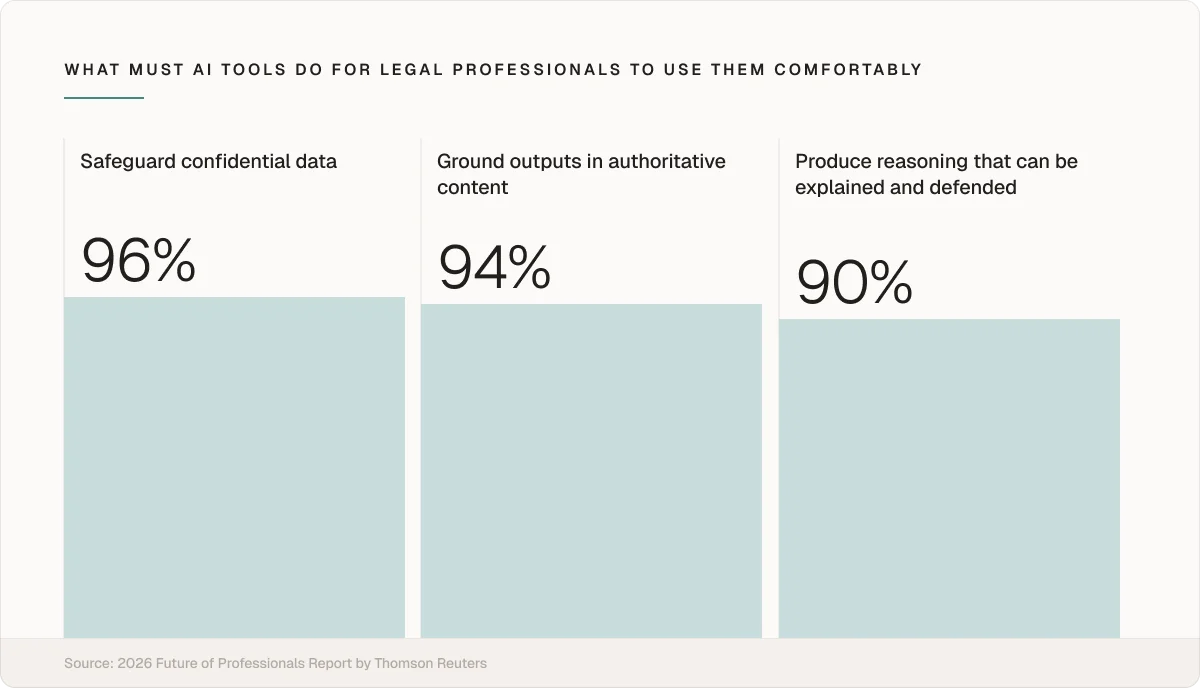
Importantly, these limitations aren’t deal-breakers on their own. The real differentiator is the quality of human oversight surrounding the technology.
If you plan to incorporate AI into your legal operations, one approach is to build that oversight internally. This usually means hiring in-house counsel to review outputs, validate recommendations, and apply legal and commercial judgment before decisions are made.
While effective, this model can be difficult for startups and high-growth companies to scale. A single lawyer can only review so much work, and no individual can maintain deep expertise across every legal discipline a growing business may encounter.
That’s why many of these companies turn to AI-native law firms. By combining AI-powered workflows with experienced attorneys across multiple practice areas, these firms embed legal oversight directly into the service model.
How AI-native law firms maximize the benefits of AI
Most effective legal organizations don’t treat AI as a replacement for lawyers; they use the technology to amplify what great attorneys can accomplish.
Unlike traditional firms that layer AI onto existing processes, AI-native law firms build their operations around AI from the ground up. Technology handles much of the administrative, analytical, and process-driven work, while attorneys focus on legal judgment, risk assessment, negotiation strategy, and client counsel.
The result is a model designed to maximize the benefits of AI in law while preserving the elements of legal practice that AI can’t replace, including ethical responsibility and legal accountability.
If this model sounds appealing to you, consider working with General Legal.

Whether you need contract reviews, technology transactions, employment support, privacy documentation, financing documents, or ongoing commercial legal guidance, our team combines AI-powered workflows with experienced attorneys to deliver high-quality legal services at a price that makes sense for growing companies.
Our attorneys support startups and growth-stage companies with everything from MSAs, SaaS agreements, DPAs, and privacy policies to offer letters, equity grants, SAFEs, governance matters, and venture financings—all delivered with turnaround times measured in hours rather than weeks.
You can register online for free to get started right away, or contact our team directly to discuss your legal needs and determine whether the AI-native law firm model is the right fit for your business.
- Legal AI adoption more than doubled year over year, with 69% of legal professionals now using general-purpose generative AI tools, up from 31% in 2025.
- AI's biggest measurable benefit is time savings on repetitive, document-heavy tasks; one litigation team cut complaint-response prep from about 16 hours to a few minutes, and Thomson Reuters estimates 12 hours saved per professional per week.
- AI is pushing the industry toward flat-fee and alternative pricing because it makes legal workflows more consistent and predictable than traditional hourly billing.
- Despite the benefits, AI carries real limitations: hallucinated citations, limited judgment, data privacy risks, embedded bias, and evolving regulatory compliance requirements.
- Accuracy concerns remain the top reason legal professionals hesitate to adopt AI, cited by 43% of non-users, even though 35% of users already credit AI with reducing human error.
- AI-native firms like General Legal build attorney oversight directly into the AI workflow from the start, rather than layering AI onto an existing process, which the article frames as the more sustainable way to capture AI's benefits without its risks.
| Adoption surge | 69% of legal professionals now use generative AI, more than double the 31% reported the year before, with firm-level adoption also roughly doubling. |
|---|---|
| Speed benefit | One litigation team cut complaint-response prep from about 16 hours of associate work to a few minutes using an AI workflow; Thomson Reuters estimates 12 hours saved per professional weekly overall. |
| Cost and pricing benefit | AI lowers delivery costs and makes workflows predictable enough to support flat-fee pricing instead of unpredictable hourly billing. |
| Scaling without headcount | AI lets legal teams absorb more work, like contracts and compliance demands, without growing staff proportionally. |
| Accuracy and consistency | With oversight, AI can flag missing clauses and inconsistencies, and 35% of legal professionals already credit it with reducing human error, even though accuracy concerns remain the top reason non-users hesitate at 43%. |
| Compliance and client experience | AI helps track regulatory obligations and renewal dates at scale, and 78% of corporate clients say AI-enabled quality improvements are very important or essential. |
| The real limitations | Hallucinations, limited judgment, data privacy risks, embedded bias, and evolving ethical or regulatory standards remain genuine constraints on AI in legal work. |
| How to capture the benefits safely | AI-native firms like General Legal build attorney oversight into the AI workflow from day one rather than layering AI onto an existing process after the fact. |
How much time can AI actually save legal teams?
Thomson Reuters estimates up to 12 hours saved per legal professional per week, and one litigation team cut complaint-response prep from about 16 hours to a few minutes using an AI workflow.
Is AI safe to use for legal work without a lawyer checking it?
Not really; the article says it's safe when combined with appropriate human oversight, since on its own AI can hallucinate citations and generate inaccurate information.
What are the main limitations of AI in law?
Hallucinated citations, limited judgment and inability to weigh business context, data privacy and confidentiality risks, embedded bias from training data, and evolving ethical and regulatory compliance requirements.
Can AI replace lawyers?
No, it can automate repetitive tasks like document review and research, but it can't replace legal judgment, negotiation strategy, client counseling, or professional accountability.
Why are legal professionals still hesitant to adopt AI?
Accuracy is the top concern, cited by 43% of professionals who haven't used it, even though 35% of those who have already credit AI with reducing human error.
What is General Legal's Clerk AI?
An AI-powered assistant the firm uses to answer common legal questions and guide clients through intake and status updates without waiting for a meeting or email response.
How can lawyers benefit from AI?
Lawyers can use AI to automate repetitive tasks like document review, legal research, drafting, and contract analysis. This allows them to spend more time on higher-value work, including client counseling, negotiation, strategy, and risk assessment.
What are the benefits of using AI for contract review?
AI can review contracts faster, identify potential risks, flag unusual clauses, detect inconsistencies, and surface key provisions that may require attention. This reduces review time, improves consistency, and allows lawyers to focus on negotiation strategy and legal judgment.
Is AI safe to use for legal work?
It can be—when combined with appropriate human oversight. On its own, AI can make mistakes and generate inaccurate information.
What are the limitations of AI in law?
AI can generate hallucinations, struggle with complex business contexts, raise privacy concerns, and create ethical or compliance challenges when used improperly.
- How to Use AI in Law: 10 Practical Examples for Legal TeamsLearn how to use AI in law so you can improve legal workflows, reduce repetitive work, support better research, and drafting.
- 5 Best AI-native Law Firms for Startups [Comparison]Discover the best AI native law firms and find the right legal partner to streamline legal work, reduce costs, and support your bu
- 6 Best Harvey Alternatives for Law Firms [2026 Comparison]Explore the best Harvey alternatives so you can compare legal AI tools by cost, features, workflows, and ease of adoption.