
Law firms can no longer afford to treat technology as a back-office expense, and judging by the findings of Thomson Reuters’s 2026 Report on the State of the US Legal Market, many of them don’t.
According to the report, the average law firm spending on technology jumped 9.7% in 2025, marking what may be the fastest real growth these expenses have ever seen.
If you’re looking to keep pace with firms investing in smarter workflows or expand your existing tech stack, this guide breaks down seven best legal tech companies across distinct categories, from practice management to contract solutions.
Disclaimer: This article is published by General Legal, which is included among the companies discussed. The companies are presented to help law firms evaluate legal technology providers and alternative legal service models based on their use cases, capabilities, and publicly available information. The list isn’t a ranking from best to worst, and the right choice depends on each firm’s needs. Features, pricing, and service terms may change, so verify the latest details directly with each provider before making a decision.
How we selected the 7 best legal tech companies for law firms
Lawyers have historically been cautious about adopting new technology, and firm-wide AI adoption shows that the hesitation still exists. According to 8am’s 2026 Legal Industry Report, just 34% of law firms have adopted legal-specific AI tools, despite the many well-documented benefits of using AI in law.
With new tools flooding the market, choosing the right tech company to work with takes more than following the hype. The first step should be determining what you need the tech to do.
According to Thomson Reuters’ 2025 Generative AI in Professional Services Report, 73% of legal teams use generative AI for legal research. If that’s your priority, look for companies creating tools built to support legal research and source verification.
That’s the approach we took when shortlisting seven companies from a pool of dozens of contenders. We prioritized distinct use cases to ensure each company serves a different need.
Here are the five criteria we used to evaluate our picks:
- Use case fit (30%): We assessed how directly each company addresses a specific need for US law firms, from legal research to client intake and litigation support.
- Functional differentiation (25%): We ensured each company serves a distinct primary purpose so the final list covers different needs rather than recommending competing tools in the same category.
- Market credibility (20%): We looked for verifiable evidence of each company’s legal-industry experience, established customer base, and product capabilities.
- Workflow integration and security (15%): We considered how well each solution connects with existing firm systems and protects confidential client information.
- Practical value (10%): We considered whether the product or service offers a tangible operational benefit, such as reducing repetitive work, improving efficiency, or expanding a firm’s capacity.
An overview of the 7 best legal tech companies for law firms
* Ratings are based on publicly available review platforms on October 26, 2026, and should be treated as a point-in-time snapshot rather than a definitive measure of product quality.
1. Clio: Best for practice management and client intake
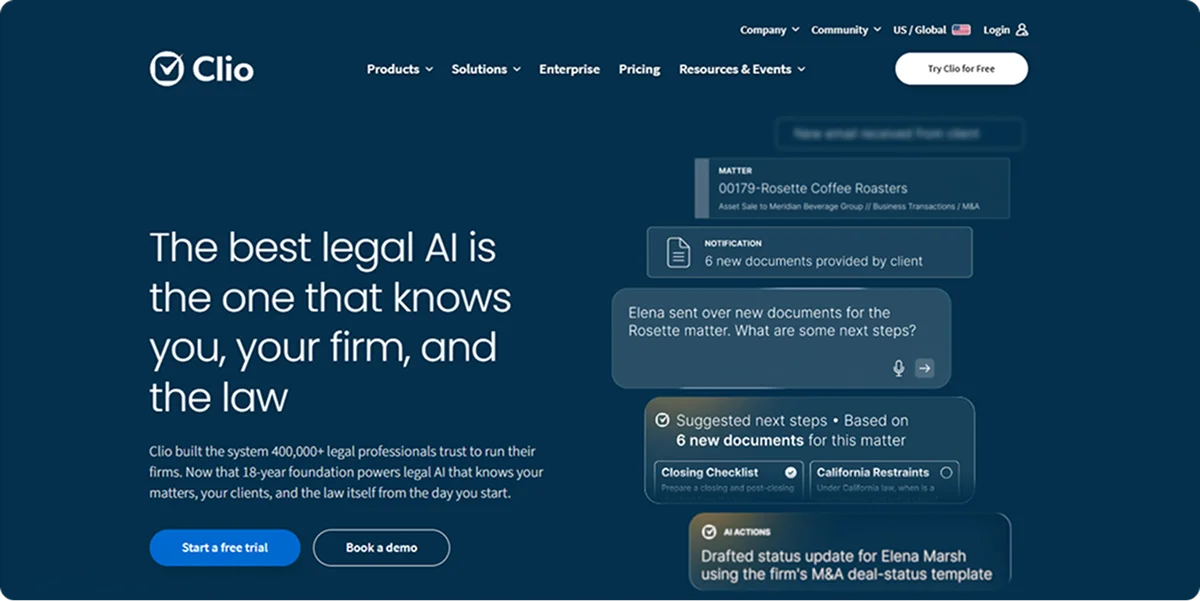
Clio is a cloud-based legal software company whose Clio Manage platform helps law firms run their practices, with more than 400,000 legal professionals relying on its system.
It’s particularly well-suited for solo practitioners and small to midsize firms that want to grow without adding administrative overhead, because it helps teams standardize routine processes and keep new client inquiries moving through intake.
Key features
Clio positions its platform as an all-in-one solution for running a law firm, with tools like:
- Automated calendaring: Convert dates in court documents into calendar events and tasks to reduce manual entry and missed deadlines.
- Time tracking and billing: Record billable hours and automate invoice preparation to spend less time on billing administration.
- Client communication portal: Share messages, documents, bills, and matter updates securely to keep clients informed without endless email threads.
- Conflict checking: Scan contacts, communications, case notes, and calendar events to identify potential conflicts before accepting or managing matters.
- Client intake automation: Capture leads through online forms, schedule consultations, and automate follow-ups to move prospective clients toward engagement.
Pricing
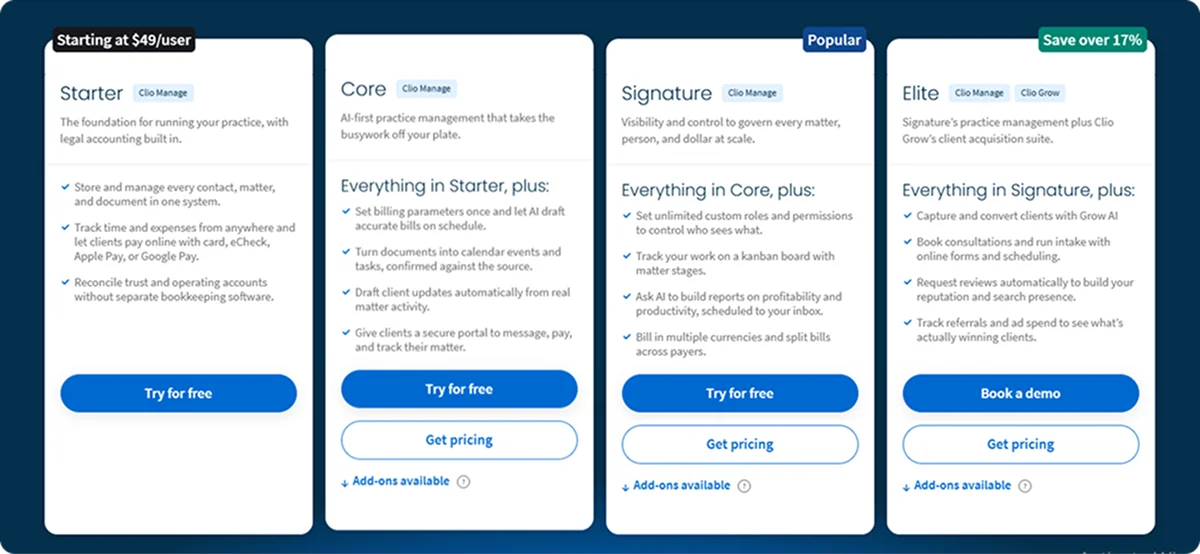
Clio offers publicly listed plans starting at $49 per user per month. For higher-tier plans and pricing tailored to specific needs, firms should contact Clio directly.
Potential drawbacks
Clio may be more than a small firm needs if it handles few matters and has limited requirements for practice management automation.
2. Thomson Reuters: Best for legal research and authority verification
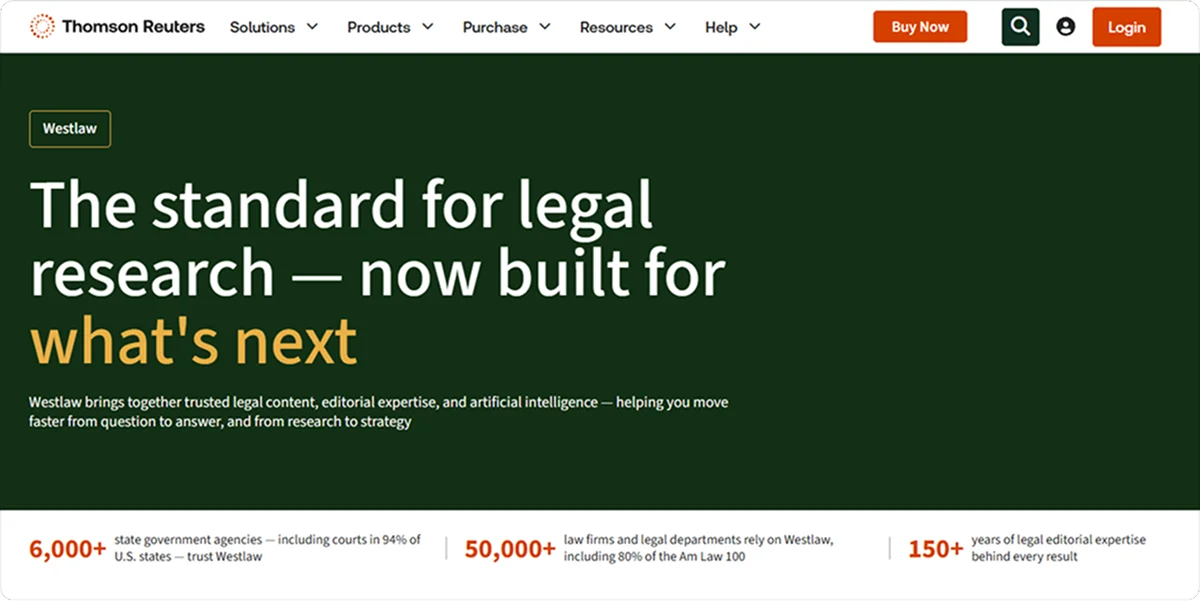
Thomson Reuters is a global information and technology company serving legal professionals, among other industries. Its Westlaw legal research platform combines authoritative legal content, editorial expertise, and AI-powered research capabilities. More than 50,000 law firms and legal departments rely on Westlaw, including 80% of the Am Law 100.
Litigation teams and attorneys handling complex, research-intensive matters will benefit from Westlaw because its legal analytics and citation-validation tools help them assess arguments and verify that the authorities they rely on remain sound.
Key features
Westlaw helps legal professionals move from initial questions to more informed legal analysis, with capabilities like:
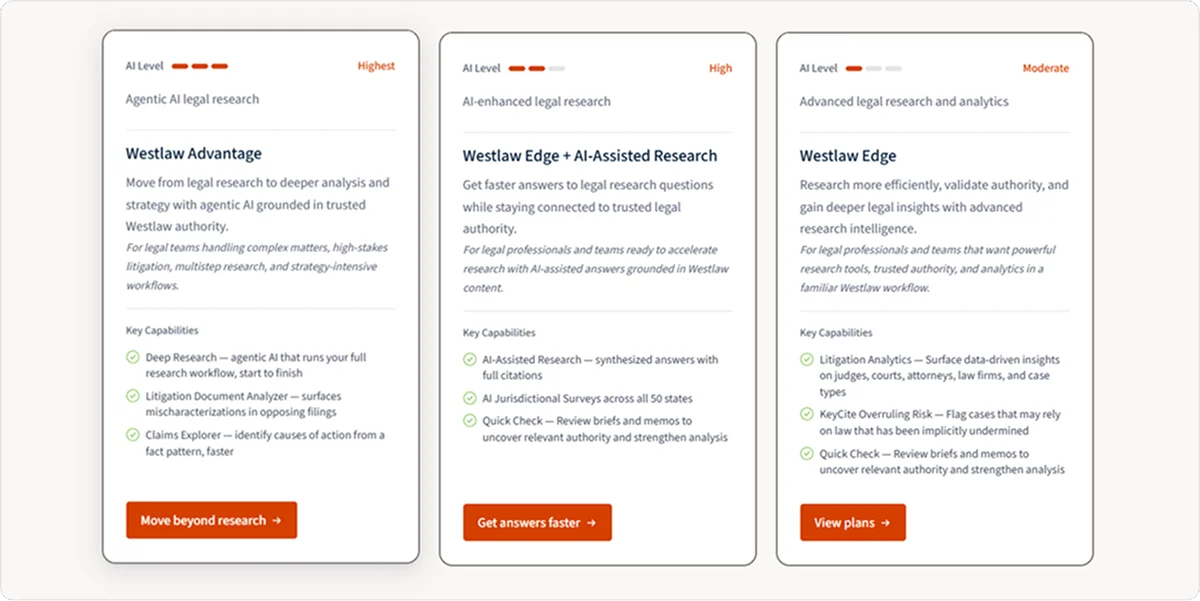
- AI-assisted research: Generate synthesized answers to legal questions with citations linked to authoritative sources, making it easier to verify the underlying law.
- KeyCite Overruling Risk: Identify cases potentially undermined by subsequent legal developments to avoid relying on weakened authority.
- Litigation analytics: Examine data on judges, courts, attorneys, law firms, and case types to inform litigation strategy.
- Quick Check: Analyze briefs and memoranda to uncover relevant authority and strengthen legal arguments.
- Claims Explorer: Identify potential causes of action from a fact pattern up to three times faster than traditional research methods.
Pricing
Westlaw offers subscription-based plans, with online pricing available for firms with up to 10 attorneys. Larger firms must contact Thomson Reuters for pricing.
Potential drawbacks
Smaller firms with straightforward research needs or tight budgets may find Westlaw’s extensive research capabilities and subscription costs difficult to justify.
3. Lawmatics: Best for lead capture and conversion
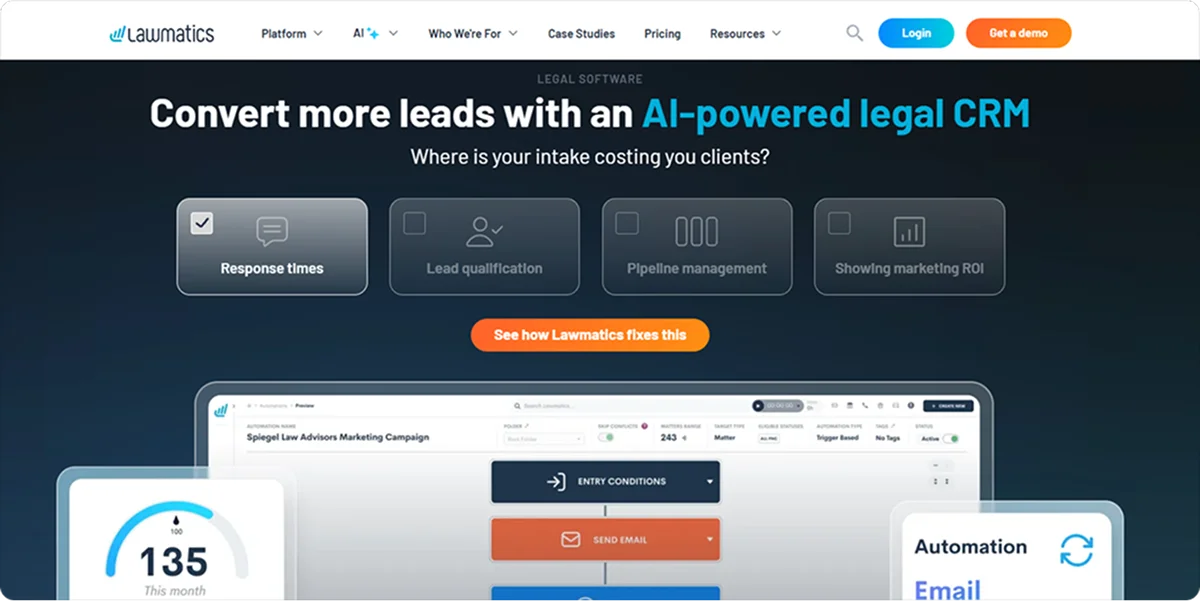
Lawmatics provides a legal CRM designed to manage client intake, marketing, and lead conversion. Its platform automates follow-ups, consultation scheduling, and client onboarding, while customer-reported results include 10 hours saved per week per employee.
Firms handling a steady stream of inquiries will find Lawmatics useful because its automated workflows help maintain consistent communication with prospects without requiring staff to manage every step manually.
Key features
Lawmatics focuses on streamlining the journey from first inquiry to signed client, with features like:
- Custom intake forms: Collect case-specific information upfront to reduce manual data entry and incomplete submissions.
- Automated lead follow-ups: Send personalized emails or text messages as soon as prospects submit inquiries to reduce response delays.
- Drip marketing campaigns: Schedule targeted messages to keep prospective clients engaged throughout their decision-making process.
- Appointment scheduling: Let prospects book consultations based on your team’s availability to cut down on scheduling back-and-forth.
- Pipeline analytics: Track lead progress and conversion performance to identify where potential clients drop off.
Pricing
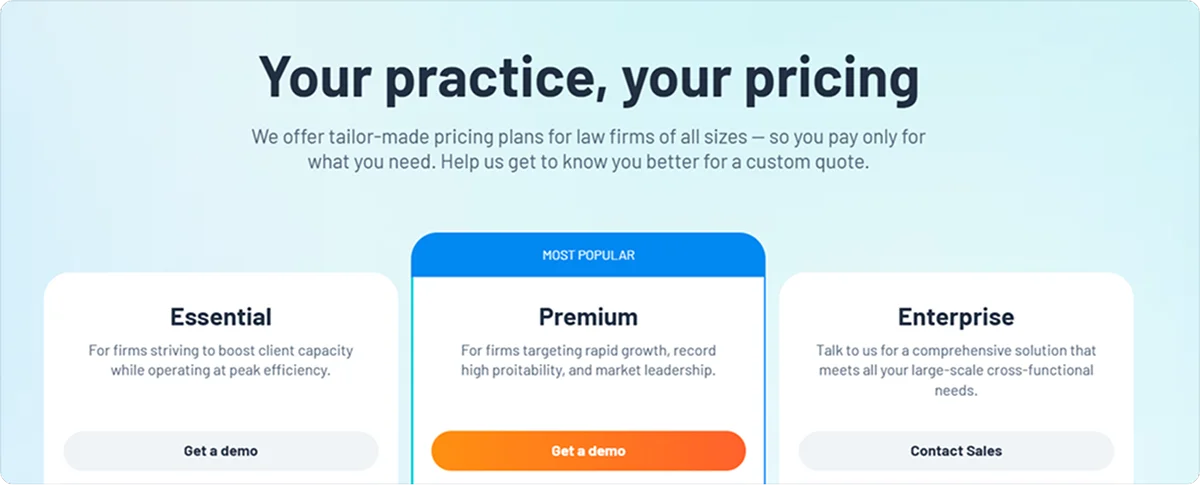
Lawmatics uses custom-quoted pricing based on the firm’s needs and selected plan.
Potential drawbacks
Firms that rely primarily on referrals and receive few inbound leads may not need Lawmatics’ extensive intake and marketing automation capabilities.
4. Everlaw: Best for litigation collaboration and evidence analysis
Everlaw develops cloud-native eDiscovery and litigation software that helps legal teams process, search, and analyze large volumes of case evidence. Its Deep Dive AI tool has been used on databases containing more than 20 million documents, helping teams surface relevant facts across complex evidence sets.
Litigation teams handling sprawling disputes or regulatory investigations can use Everlaw to coordinate case preparation across large groups of reviewers while keeping findings tied to the underlying evidence.
Key features
Everlaw brings evidence management and case preparation into a collaborative litigation environment, offering capabilities like:
- AI-powered evidence analysis: Ask natural-language questions across case documents to uncover relevant facts and supporting records.
- Predictive coding: Prioritize documents for review based on relevance to accelerate the discovery process.
- Storybuilder: Organize evidence into chronologies, deposition outlines, and trial arguments to build a more coherent case narrative.
- Granular access controls: Assign permissions and review responsibilities to protect sensitive material and keep teams organized.
- Broad file support: Process 194 file types, including emails, chat logs, and less common formats, to reduce gaps in evidence review.
Pricing
Everlaw bases pricing on the volume of data hosted rather than the number of users.
Firms can choose pay-as-you-go billing or annual commitments for lower per-gigabyte rates.
Potential drawbacks
Everlaw is likely unnecessary for firms that rarely handle document-heavy litigation or investigations requiring large-scale eDiscovery.
5. NetDocuments: Best for secure document and email management
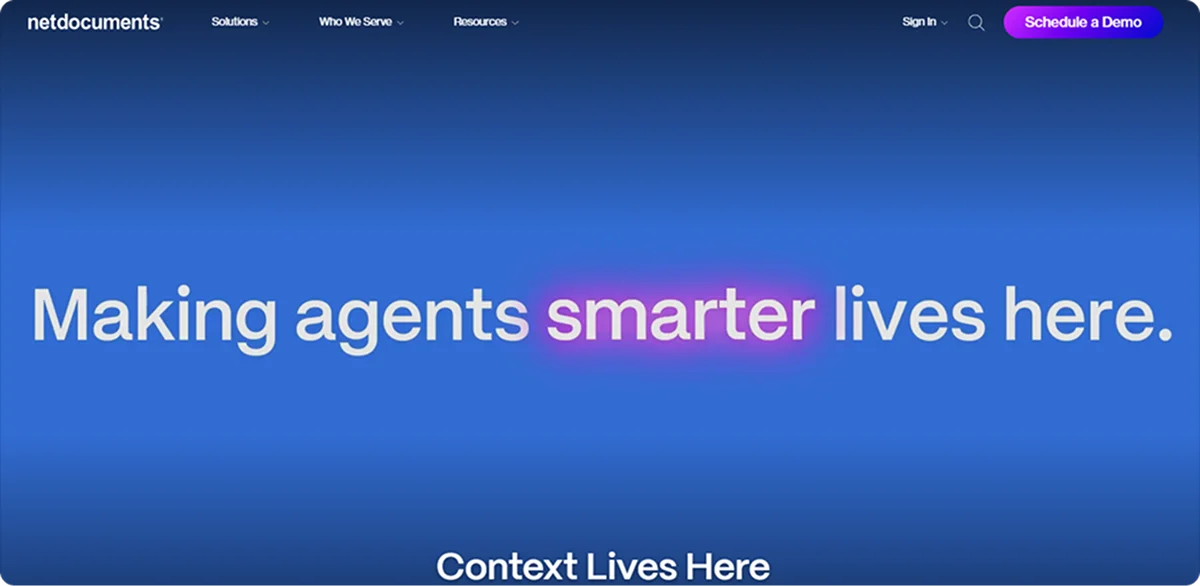
NetDocuments offers cloud-based document management software for legal teams, helping firms organize, retrieve, and protect matter files and correspondence. The company serves more than 7,000 customers worldwide and reports 99.9% service uptime, supporting reliable access to critical documents.
Firms with extensive document archives and strict confidentiality requirements can benefit from NetDocuments because it centralizes information across matters and helps preserve consistent filing practices as teams grow.
Key features
NetDocuments combines document management with productivity tools built around legal workflows, including:
- Predictive email filing: Automatically sort emails and attachments by sender, content, and other context to reduce manual filing.
- Version control: Track document revisions to prevent confusion over which draft is current.
- Advanced search: Filter documents, emails, and attachments to locate relevant information faster.
- Microsoft 365 and email integrations: Connect more than 150 technologies, including Outlook, Gmail, and Microsoft Teams, to keep matter information accessible across existing workflows.
- AI-powered document review: Generate summaries, draft content, and analyze documents to reduce repetitive work.
Pricing
NetDocuments offers custom-quote pricing, with costs depending on the firm’s specific requirements.
Potential drawbacks
Solo practitioners and small firms with modest document volumes may find a dedicated document management system excessive if simpler tools already meet their security and organization needs.
6. Ironclad: Best for contract lifecycle management
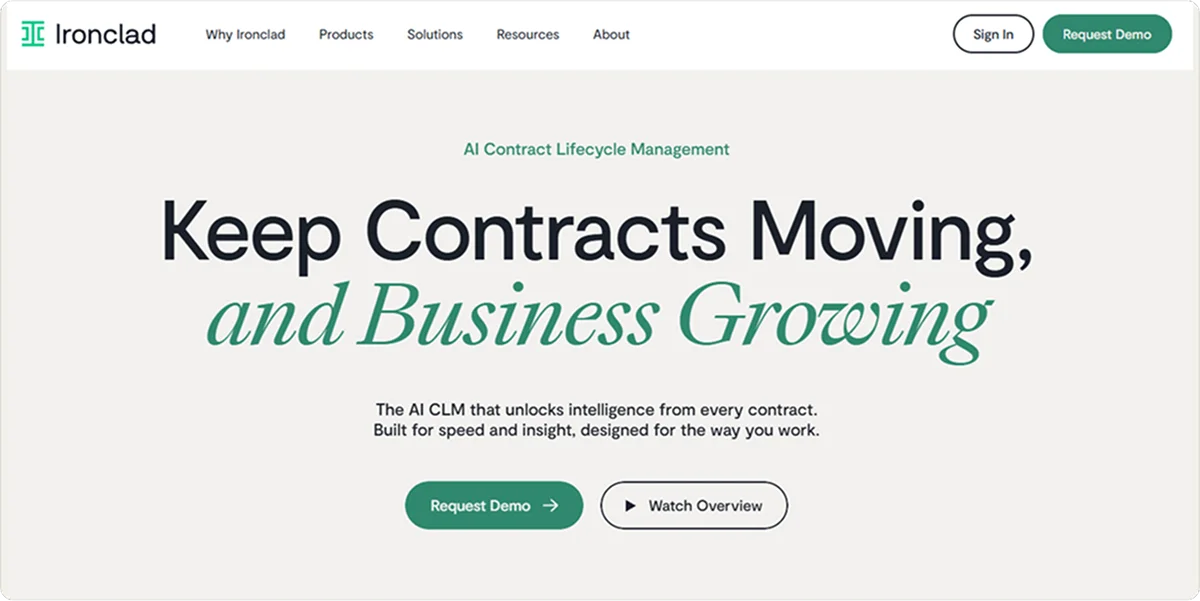
Ironclad is a CLM company whose platform supports agreements from drafting and approval through signing and ongoing management. The company reports that its customers have managed more than 2 billion contracts on the platform, demonstrating its reach across enterprise contracting.
Legal and operations teams managing high volumes of agreements will appreciate Ironclad’s workflow automation because it helps standardize approvals, reduce bottlenecks, and keep contracts moving without relying on manual handoffs.
Key features
Ironclad presents its platform as an AI-powered system for managing contracts across the business, providing tools like:
- No-code workflow designer: Build and modify contract workflows without programming to adapt processes as requirements change.
- Automated approvals: Route agreements to the right stakeholders based on predefined rules to reduce delays and maintain oversight.
- AI contract insights: Analyze agreements alongside deal history and workflow data to support better-informed decisions.
- Electronic signing: Send agreements for digital execution to shorten the path from approval to a signed contract.
- Business system integrations: Connect contracting workflows with platforms like Salesforce, Slack, and SAP to limit application switching.
Pricing
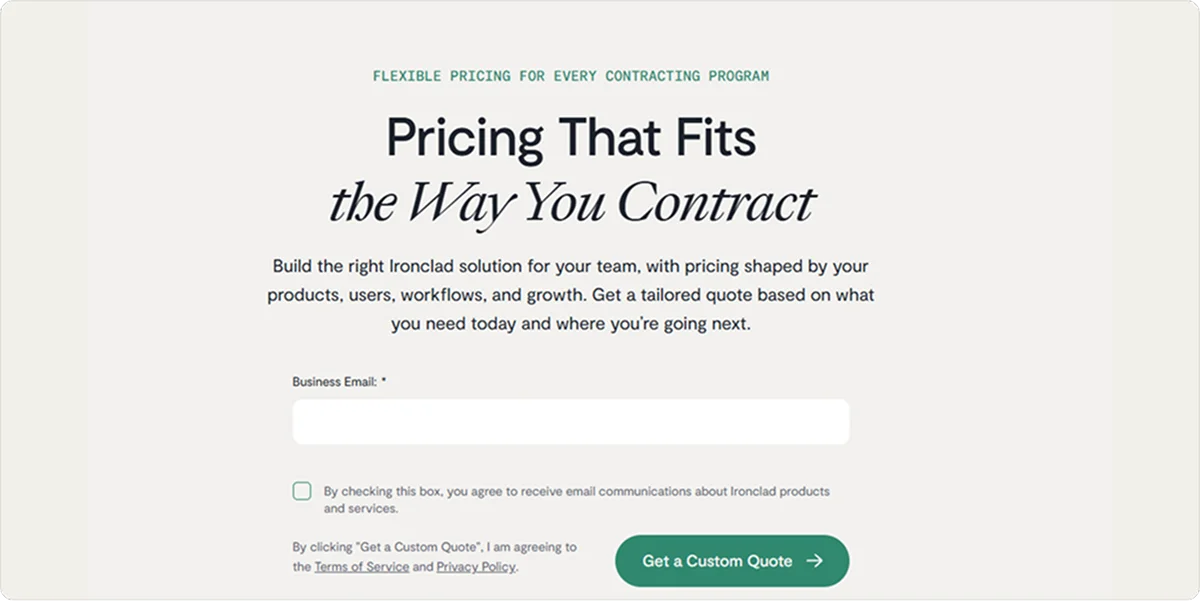
Ironclad offers custom pricing based on the products, users, workflows, and scale of each contracting program.
Potential drawbacks
Firms that handle relatively few contracts or rely on bespoke negotiations may get limited value from a dedicated CLM platform.
7. Harvey: Best for firm-wide generative AI use
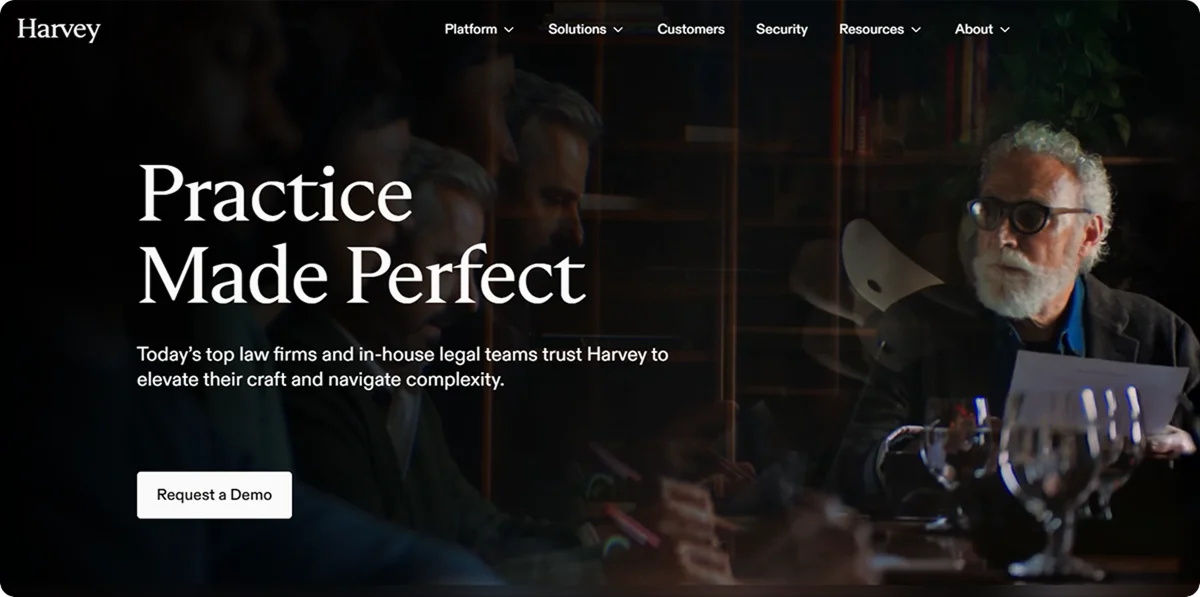
Harvey develops an enterprise AI platform built specifically for legal work, spanning research, drafting, document review, and matter analysis. The company serves more than 3,500 legal organizations and is trusted by over 80% of Am Law 100 firms, reflecting its adoption among large legal practices.
Firms looking to deploy AI across multiple practice groups may find Harvey particularly useful because it can incorporate firm-specific templates, playbooks, and workflows, helping lawyers apply established standards rather than rely on generic outputs.
Key features
Harvey positions its platform as a connected AI environment for legal work, with features like:
- AI agents: Delegate multistep legal tasks to agents that produce review-ready work with citations, freeing lawyers to focus on judgment and client service.
- Legal research: Search more than 1,000 global legal data sources to surface relevant authorities and accelerate complex research.
- Document vaults: Store, organize, and analyze large collections of legal documents in one secure workspace to support matter-level review.
- Firm knowledge integration: Apply internal playbooks, templates, and preferred drafting styles to keep AI-generated work aligned with firm standards.
- Enterprise security controls: Use SSO, audit logs, IP allow-listing, and data lifecycle management to strengthen oversight of sensitive information.
Pricing
Harvey uses custom enterprise pricing, with costs provided through its sales team rather than a publicly listed price schedule.
Potential drawbacks
Firms with limited AI adoption, straightforward workflows, or insufficient resources to implement and govern enterprise AI may find Harvey’s broad capabilities unnecessary for their current needs.
General Legal: A strong alternative to legal tech companies for law firms

Legal tech can help law firms research cases, manage matters, review documents, and automate routine workflows. However, software alone can’t take responsibility for legal advice. Someone still needs to interpret the facts, apply legal judgment, and stand behind the final work product.
That’s why, instead of the best legal tech companies listed in this article, you might consider working with General Legal, an AI-native law firm that combines US-barred attorneys with AI-powered workflows to deliver commercial legal services faster and at more predictable prices.
Instead of selling software for your team to operate, General Legal handles defined legal work directly, with upfront flat-fee quotes and turnaround times that can be measured in hours rather than days or weeks for many standard commercial contracts.
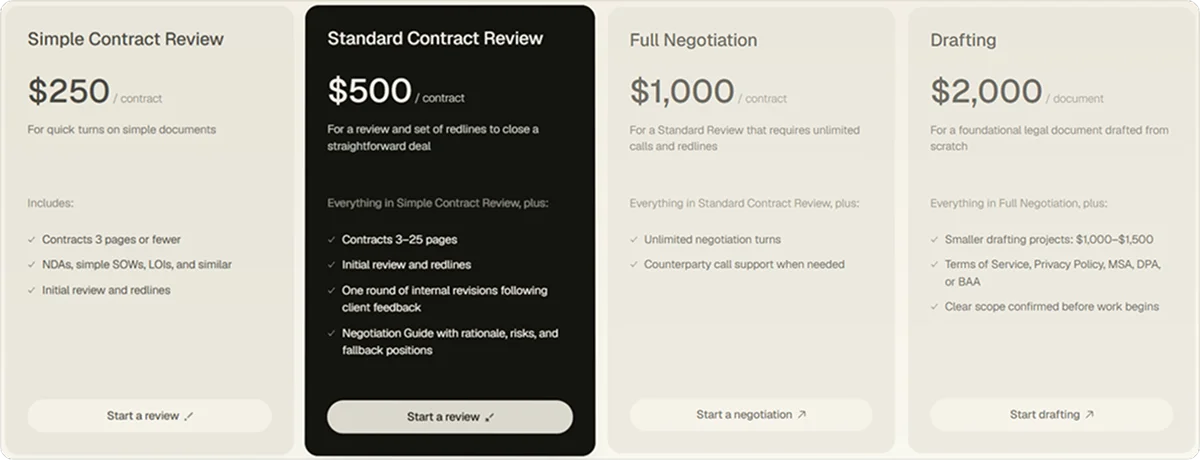
Law firms should consider working with General Legal when looking to:
- Add capacity without adding headcount: When workloads spike, firms can outsource suitable commercial contract reviews and other defined tasks instead of hiring permanent staff to handle temporary demand. That helps teams meet deadlines without overextending their existing attorneys.
- Give clients more predictable costs and turnaround times: General Legal quotes the fee and expected delivery time before work begins. For firms managing client budgets or handling repeatable matters, this approach makes delivery costs easier to forecast than an open-ended hourly engagement.
- Extend your capabilities beyond your core practice: A litigation-focused firm may not have the bandwidth or in-house expertise to handle every tax, employment, or privacy matter. An external legal provider can fill those gaps while the firm retains its client relationship and focuses on its core work.
To learn more about how General Legal can support your law firm as an external legal partner, book a call with our team.
Alternatively, create your General Legal account to connect with experienced business attorneys and start delegating right away.
- Average law firm technology spending jumped 9.7% in 2025, marking the fastest real growth this expense category has seen.
- Only 34% of law firms have adopted legal-specific AI tools despite well-documented benefits, indicating ongoing hesitation about new technology.
- The seven companies featured serve distinct purposes ranging from practice management and legal research to contract lifecycle management and litigation support.
- Selection criteria weighted use case fit at 30% and functional differentiation at 25% to ensure each recommendation addresses different firm needs.
- Firms can either invest in legal tech software they operate themselves or work with alternative providers like General Legal that deliver legal services directly using AI-powered workflows.
| Practice Management | Clio offers cloud-based tools for time tracking, billing, client intake automation, and conflict checking used by over 400,000 legal professionals. |
|---|---|
| Legal Research | Thomson Reuters Westlaw provides AI-assisted research, citation validation through KeyCite Overruling Risk, and litigation analytics trusted by 80% of Am Law 100 firms. |
| Lead Conversion | Lawmatics automates lead follow-ups, consultation scheduling, and client onboarding, reportedly saving 10 hours per week per employee. |
| Litigation Evidence | Everlaw's cloud-native eDiscovery platform uses AI to analyze databases of 20+ million documents and supports 194 file types with predictive coding. |
| Document Management | NetDocuments centralizes matter files with predictive email filing, version control, and integrations across 150+ technologies including Microsoft 365. |
| Contract Lifecycle | Ironclad provides no-code workflow automation for contract approvals and management, with over 2 billion contracts processed on its platform. |
| Enterprise AI | Harvey delivers firm-wide generative AI for research, drafting, and document review using firm-specific templates, serving over 80% of Am Law 100 firms. |
| Alternative Service Model | General Legal combines US-barred attorneys with AI workflows to deliver commercial legal services with flat-fee quotes and faster turnaround times than traditional hourly billing. |
Which law firm is best for legal tech?
The best law firm for legal tech depends on your needs. For law firms seeking an AI-native legal services partner, General Legal combines AI-powered workflows with attorney-led commercial legal work.
What is the best legal AI company?
The best legal AI company depends on whether you need software or legal services. Thomson Reuters and Harvey offer AI-powered tools for legal work, while General Legal embeds AI into attorney-led services, delivering finished legal work backed by professional judgment and accountability.
Is there a ChatGPT for lawyers?
Yes. Several AI tools are built specifically for legal work, including Harvey, CoCounsel, Spellbook, and LawChatGPT. The right choice depends on your practice area, existing tools, and workflow needs.
What are some popular legal tech platforms?
Popular legal tech platforms include Clio for practice management, LexisNexis for legal research, and Ironclad for contract lifecycle management.
Which law firms are using AI?
Law firms using AI include BigLaw firms, specialized practices, solo attorneys, and small firms. Some firms adopt third-party platforms, others build proprietary systems, while AI-native law firms like General Legal integrate AI into their legal services from the ground up.
- AI in Corporate Law in 2026: Use Cases & Key BenefitsExplore how AI in corporate law helps you streamline contracts, manage legal risks, improve compliance, and make better business decisions.
- 9 Best Legal Tech Companies for Contract Solutions [Comparison]Discover the best legal tech companies for contract solutions so you can compare features, workflows, and services.
- Contract Review Automation: Top Benefits & Use CasesA deep dive into how General Legal automates contract review