
“Garfield AI’s mission is access to justice.”
That’s what the law firm states on its website.
According to the AI law firm’s own account, UK SMEs fail to collect more than £5.3 billion in unpaid invoices each year, and many write off smaller debts because pursuing them through the courts takes too much time and money.
That’s precisely why Garfield AI was established: to make recovering those debts faster, cheaper, and more accessible, giving businesses that can’t justify the use of traditional legal services a fighting chance to recover what they’re owed.
But how well do these promises hold up in practice?
This review takes a closer look at the Garfield AI law firm’s services, pricing, and results to understand how its AI-driven approach performs in real-world cases.
Disclaimer: This review is published by General Legal and examines Garfield AI, including a note on General Legal for US companies with broader legal needs. The comparison is based on publicly available information about each firm’s services, pricing, approach to legal work, and client experience. Services, pricing, and capabilities may change over time, so readers should confirm current details directly with each firm before making a decision.
Garfield AI law firm: The basics
If you’re unfamiliar with the Garfield AI law firm, here’s the context you need to understand what it does and why it’s attracting attention.
What is Garfield AI?
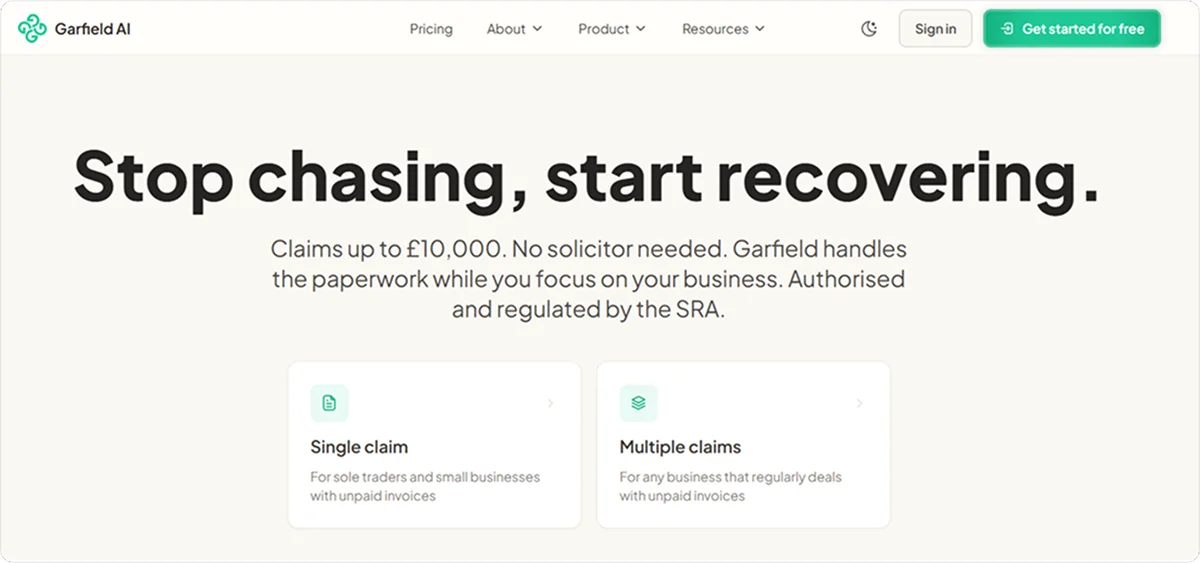
Garfield AI is an AI-powered legal service that helps businesses and individuals pursue small debt claims through the courts of England and Wales.
What makes Garfield stand out is its regulatory status.
In May 2025, the Solicitors Regulation Authority (SRA) authorized Garfield.Law Ltd to deliver regulated legal services in England and Wales, making it the first firm approved by the regulator to operate on a purely AI-driven model.
That makes Garfield an early example of an AI-native law firm operating under a regulator’s oversight: Named regulated solicitors remain accountable for its outputs, and users approve each stage before it proceeds.
The authorization followed the SRA’s assessment of how the firm could meet its regulatory obligations while using AI. Its decision came down to safeguards around common risks of AI use in law, as the regulator made sure that Garfield had processes to:
- Quality-check its work
- Protect client confidentiality
- Prevent conflicts of interest
- Manage the possibility of inaccurate AI-generated information
The SRA also restricted Garfield AI from proposing relevant case law, which the regulatory body identified as a high-risk area for AI hallucinations.
How does Garfield AI work?
Garfield AI uses a web-based legal platform to guide businesses through the small-claims debt recovery process in England and Wales, automating much of the paperwork and procedural work involved in pursuing an unpaid invoice.
The process breaks down into four main steps:
- Uploading the claim information: The claimant or their representative uploads relevant documents, such as invoices and contracts, or connects their accounting software. Garfield extracts the key details and shows the user what it has understood, allowing them to correct errors before proceeding.
- Generating and sending legal correspondence: Garfield prepares the appropriate documents, starting with pre-action letters to the debtor, which follow the Pre-Action Protocol for Debt Claims when the debtor is an individual or sole trader. If the debt remains unpaid, Garfield can help prepare the claim form and particulars of claim to initiate court proceedings.
- Navigating the court process: Once proceedings begin, Garfield helps manage the next steps based on the debtor’s response. This can include applying for a default judgment if the debtor doesn’t respond, handling settlement correspondence, and preparing documents if the claim is disputed.
- Preparing for trial or enforcement: If the dispute proceeds to trial, Garfield helps prepare witness statements, organize evidence, and assemble court documents. Courtroom advocacy remains a human role where needed. If the claimant already has a judgment but the debtor still hasn’t paid, Garfield can also help move the matter toward enforcement.
Who does Garfield AI serve?
Garfield AI primarily serves UK businesses, freelancers, and other organizations seeking to recover unpaid invoices without the cost of traditional legal services.
Its platform is designed for debt claims of up to £10,000 in England and Wales, making it most relevant to SMEs and independent professionals pursuing smaller commercial debts. It can also support representatives handling claims on a business’s behalf.
However, to assess Garfield AI beyond its stated features and services, it helps to look at how the platform has been used in real scenarios.
Garfield AI law firm: Real-world examples of cost, speed, and performance
The examples below offer a more concrete basis for understanding Garfield AI’s performance in practice.
Recovering £7,000 for a UK transport consultancy
In September 2025, UK transport consultancy Mayer Brown Limited used Garfield AI to pursue approximately £7,000 in unpaid invoices.
According to Garfield’s account, the company completed the process of signing up and sending a formal letter before action in less than five minutes, paying £7.50 plus VAT. The company’s Finance Director, David Bone, said the debt was successfully recovered with only a few minutes of work.
Comparing AI with a trainee lawyer
In an October 2025 episode of Channel 4’s “Dispatches” titled “Will AI Take My Job?” Garfield AI was tested against trainee lawyer Charlotte Jaques on a £4,500 dispute involving a builder and a client who refused to pay. Both were asked to analyze the dispute and prepare a court claim, with their work assessed blind by Jaques’ supervisor, Zainab Zaeem.
Garfield produced its documents in around 10 minutes for £100 plus VAT, compared with three to four hours and £1,080 for the trainee’s work.
Zaeem judged both documents impressive and Garfield’s output acceptable for court, but preferred Jaques’ version for its stronger legal detail, including relevant case precedent.
In this one test, Garfield produced a court-acceptable draft at a fraction of the time and cost, though the trainee’s version was stronger on legal detail.
Read more: Will AI Take Over Law in the Future?
Winning a £7,000 debt claim at trial
In May 2026, freelance HR consultant Tamires Camal Taquidir used Garfield AI to pursue £7,000 in unpaid fees from a hospitality business after attempts to resolve the dispute failed.
When the defendant brought a counterclaim, Garfield helped her prepare for trial, including drafting four witness statements and assembling the court documents. Taquidir paid around £400 in Garfield fees.
After a three-hour hearing at Wandsworth County Court, the court awarded Taquidir the £7,000 she was owed and dismissed the counterclaim.
The case attracted widespread media attention as a potential first: A claimant had won at trial with the support of a regulated AI law firm. It demonstrated that Garfield could support a case beyond routine debt-chasing. The outcome was also a notable example of AI-assisted legal work reaching trial, with a barrister instructed by Garfield handling the courtroom advocacy.
These examples provide a useful starting point for evaluating Garfield AI’s broader strengths.
The pros: What makes Garfield AI stand out
The following points examine the main advantages of using the Garfield AI law firm for debt recovery, explaining why they may matter to businesses deciding whether it’s the right fit.
Low upfront fees
One of Garfield AI’s clearest advantages is how little it costs to get started.
According to Garfield’s published pricing, a polite payment-chaser letter costs £2, while a formal letter before action costs £7.50, excluding VAT. For businesses chasing smaller debts, this pricing makes it possible to take a formal step toward recovery without committing hundreds of pounds to legal fees upfront.
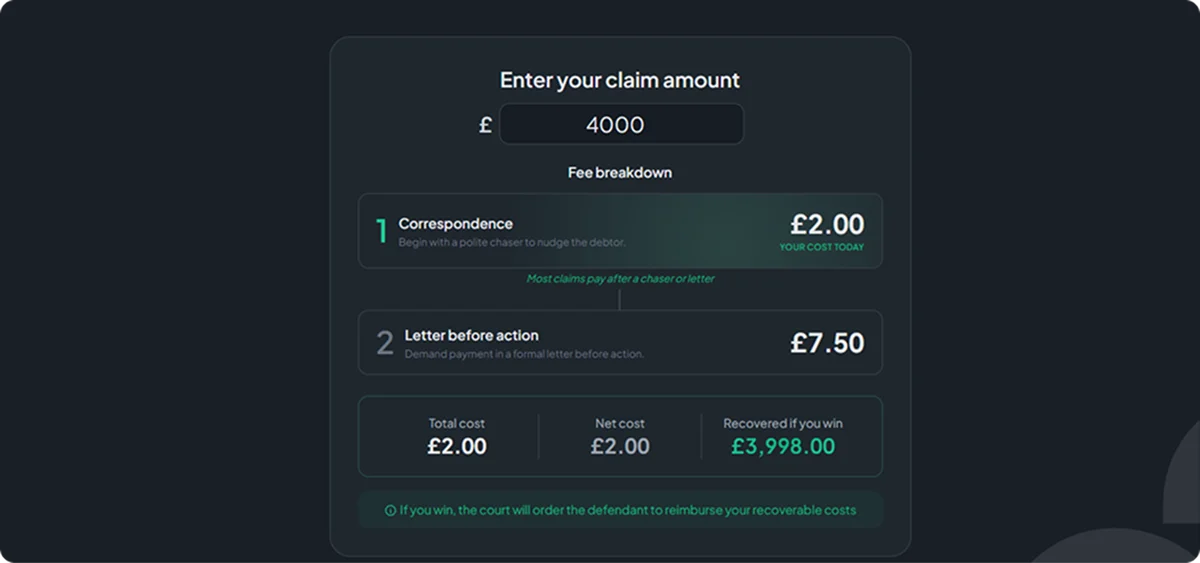
However, if the debtor still doesn’t pay and a court claim becomes necessary, Garfield’s fee for preparing the claim form and particulars increases, ranging from £50 for claims up to £500 to £100 for claims between £5,000 and £10,000.
A more accessible experience
Garfield’s guided, self-service model walks users through each stage of debt recovery, which can make the process easier for businesses that have never pursued a debt through the courts. That can lower some of the practical barriers that stop businesses from chasing unpaid invoices in the first place.
Faster document preparation
Garfield AI can prepare debt recovery documents in minutes, reducing the time businesses spend assembling paperwork and moving through procedural steps.
The firm claims its approach is 20 times faster than traditional legal processes.
That speed advantage comes from automating document-heavy tasks, although actual time savings will depend on how complex the claim is and how far the dispute progresses.
Support for high-volume claims
Garfield AI can handle both individual debt claims and larger volumes of unpaid invoices.
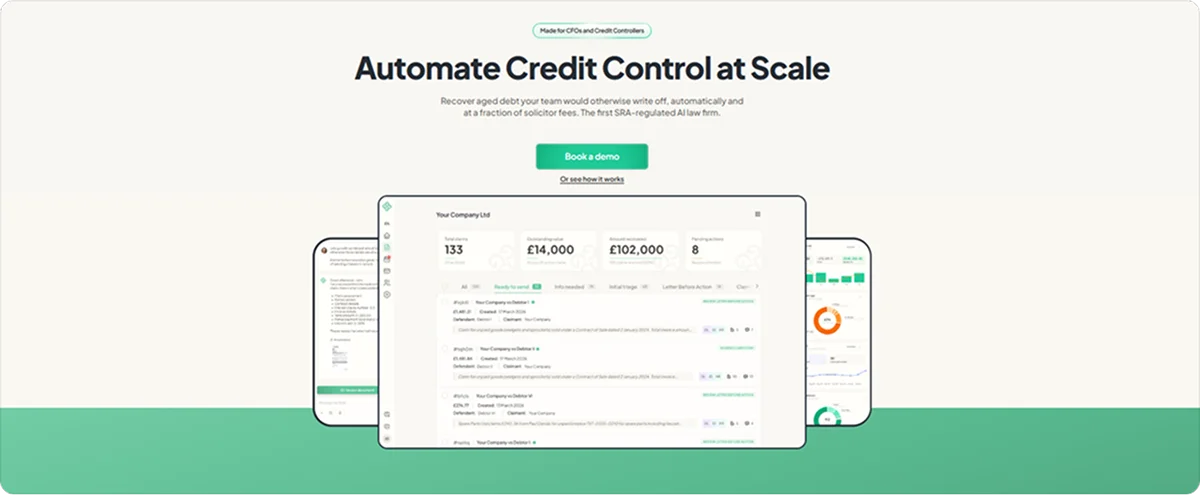
Businesses can connect accounting software like Xero, Sage, QuickBooks, and FreeAgent to import outstanding invoices, while bulk-processing features help automate document preparation across multiple claims.
For businesses managing recurring late payments, this functionality can turn debt recovery from a series of separate administrative tasks into a more systematic process.
Human oversight
At Garfield, the AI handles much of the routine debt-recovery work, while co-founder Philip Young, an experienced commercial litigator, provides oversight and handles escalations and exceptional cases.
Under its SRA approval, Garfield isn’t autonomous: Users approve each step, and named regulated solicitors remain responsible for the system’s outputs.
However, Garfield’s published material doesn’t say every document is individually reviewed by a lawyer, so it’s worth asking how documents are checked before they’re sent.
The cons: What businesses need to keep in mind
Garfield AI’s approach has clear advantages, but it also has limitations that businesses should weigh before using its services.
Additional costs beyond platform fees
Garfield AI’s platform fees are relatively low, but they don’t represent the full cost of pursuing a debt.
Businesses may also need to pay court fees, which vary according to the claim amount and the type of application. For claims between £5,000 and £10,000, for example, the court issue fee alone is £455.
Further costs can arise as the case progresses.
Applications for judgment, responding to a defense, and enforcement all carry separate fees, and some steps may require additional legal support, such as a lawyer if the case goes to trial. Plus, not all costs are recoverable from the debtor, even if the claim succeeds.
That’s why businesses should assess the likely cost of the entire recovery process, not just the price of generating an initial letter or preparing a claim.
A narrow focus on debt recovery
Garfield AI is built for one legal task: recovering unpaid debts.
This focus allows it to automate a defined set of legal workflows, but it also limits its usefulness for businesses dealing with broader business legal needs.
Limited relevance outside England and Wales
Garfield AI’s services are designed around the legal procedures of England and Wales. Its documents, workflows, and court guidance reflect the rules and requirements of that jurisdiction, which means its services aren’t suitable for businesses pursuing debts elsewhere.
These limitations don’t necessarily outweigh the benefits, but they do make it important to consider whether Garfield AI’s model is the right fit for your business.
Verdict: Is the Garfield AI law firm right for your business?
Garfield AI may be the right fit for UK businesses, freelancers, and professional services firms pursuing unpaid invoices of up to £10,000 through the courts of England and Wales. It’s particularly relevant to small businesses for which hiring a traditional law firm would be disproportionate to the amount owed, as well as larger organizations handling a high volume of debt claims.
However, Garfield AI may be less suitable if:
- You need help with legal matters beyond debt recovery: Contract drafting, employment issues, business formation, and other legal needs fall outside its core offering.
- Your dispute requires substantial legal judgment or a different strategy: A complex disagreement involving difficult legal questions may call for individualized advice from an attorney who can assess the merits and recommend a course of action.
- You want a lawyer personally involved throughout the case: Garfield’s model prioritizes automated workflows and self-service, with human oversight rather than continuous, direct attorney involvement.
- Your claim falls outside England and Wales: Garfield’s workflows are designed for this jurisdiction’s legal procedures, making the platform unsuitable for pursuing debts through courts in other jurisdictions.
Since Garfield isn’t built for US companies, US founders can consider a different path: working with General Legal.
While General Legal doesn’t handle debt collection or litigation, meaning it isn’t a direct substitute for Garfield’s core service, this YC-backed AI-native law firm is a great choice for founders looking beyond debt recovery services.
General Legal: A firm for US companies whose legal needs go beyond debt recovery

Like Garfield AI, General Legal uses automation to reduce repetitive work, accelerate document preparation, and make legal services more accessible without removing human legal expertise from the process. In this regard, both firms challenge the traditional model of expensive, time-consuming legal work.
However, the two firms use AI in different ways.
Garfield is a regulated, AI-led platform built for one process: Users move through each step themselves, with named solicitors accountable for the outputs. General Legal is an attorney-led firm: US-barred attorneys do the legal work and sign off on it, with AI handling the first pass.
The table below offers a closer look at how the two firms differ across key considerations:
Instead of relying on a separate provider for each new legal challenge, US founders can turn to one firm for support across multiple areas of business law, making it easier to address legal issues as they arise and keep pace with the demands of running a company.
If this sounds like the kind of legal support your business needs, start a matter with General Legal to get a flat-fee quote with no upfront fees or commitment.
Have questions before getting started? Book a 10-minute call with our team to discuss your needs first and explore how General Legal can help.
- Garfield AI is the first SRA-authorized AI-native law firm in England and Wales, focused exclusively on recovering unpaid business debts up to £10,000.
- The platform automates debt recovery paperwork with low initial costs—£2 for a payment-chaser letter and £7.50 for a formal letter before action—though total costs include court fees and potential additional legal support.
- Real-world cases show Garfield can produce court-acceptable documents in minutes for a fraction of traditional legal costs, though one comparative test found a trainee lawyer's work stronger on legal detail.
- Garfield's narrow focus on debt recovery in England and Wales makes it unsuitable for businesses needing broader legal services, operating in other jurisdictions, or requiring continuous attorney involvement.
- US companies seeking comprehensive business legal support beyond debt collection should consider AI-native firms like General Legal that cover commercial contracts, employment, privacy, and startup financing across all US states.
- Both Garfield AI and General Legal use automation to reduce costs and speed, but Garfield is AI-led with solicitor oversight while General Legal is attorney-led with AI assistance.
| What Garfield AI does | First SRA-authorized AI law firm automating debt recovery for unpaid invoices up to £10,000 in England and Wales |
|---|---|
| Pricing structure | Low platform fees (£2-£100) but total costs include court fees, enforcement, and potential trial representation |
| Real-world performance | Produced court-acceptable documents in 10 minutes for £100 versus 3-4 hours and £1,080 for trainee lawyer; supported successful £7,000 trial win |
| Key advantages | Low upfront costs, faster document preparation, guided self-service process, and bulk-processing for high-volume claims |
| Main limitations | Only handles debt recovery, limited to England and Wales, requires additional costs beyond platform fees, minimal direct attorney involvement |
| Best fit for | UK SMEs and freelancers pursuing smaller commercial debts where traditional legal fees would be disproportionate |
| US alternative | General Legal serves US companies with broader business legal needs through attorney-led work supported by AI automation |
| Key difference in approach | Garfield is AI-led with solicitor accountability; General Legal is attorney-led with US-barred lawyers doing and signing off on all work |
Which law firm is considered the world’s first AI-driven law firm?
Garfield AI is widely described as the world’s first AI-driven law firm to receive regulatory authorization, approved by the SRA in England and Wales in May 2025.
What is Garfield AI law firm?
Garfield AI is an AI-driven law firm that helps businesses recover unpaid debts of up to £10,000 through the courts of England and Wales, automating tasks such as legal correspondence, claim preparation, and trial preparation.
Who are the top AI lawyers in the US?
The top AI lawyers in the US depend on the type of legal support needed. For businesses seeking AI-native legal services, General Legal combines AI-enabled workflows with experienced, US-barred attorneys to support commercial legal needs.
What is the best legal AI tool?
There’s no single best legal AI tool for every task. Harvey is designed for law firms and enterprise legal teams, CoCounsel and Lexis+ with Protégé support legal research, while Spellbook specializes in agreement drafting and review in Microsoft Word. The best choice depends on your legal needs, workflow, and confidentiality requirements.
Can a US business use Garfield to recover a debt from a UK company?
Garfield works within the courts of England and Wales, so the claim has to be pursued there. Check with Garfield directly whether it accepts clients based outside the UK.
- 6 Best Fractional GC Attorneys at Law [Comparison]Discover the best fractional GC attorneys at law so you can compare legal expertise, support, pricing, and fit for your business.
- Commercial Law Firms Explained: Services, Fees & Hiring TipsAn overview of the business commercial law firms engage in
- Contract Review Cost: Pricing, Cost Drivers & SavingsDiscover the contract review cost so you can understand pricing, compare options, and reduce legal spend.